Recent Articles

Competing magnetic phases in Li-Fe-Ge kagome systems

Zhen Zhang, Kirill D. Belashchenko, Xiaoyi Su, Atreyee Das, Sergey L. Bud'ko, Paul C. Canfield, and Vladimir Antropov

Phys. Rev. B 112, 224412 (2025) - Published 8 December, 2025

Electronic and magnetic properties of light rare-earth cubic Laves compounds derived from x-ray magnetic circular dichroism

Vilde G. S. Lunde, Benedicte S. Ofstad, Øystein S. Fjellvåg, Philippe Ohresser, Anja O. Sjåstad, Bjørn C. Hauback, and Christoph Frommen

Phys. Rev. B 112, 224413 (2025) - Published 8 December, 2025

Ligand tunability of emergent noncollinear magnetism in Cu-based layered hybrid perovskites

P. Biswal, Sagar Sarkar, S. N. Sarangi, Arvind Kumar Yogi, Subhendra D. Mahanti, G. Tripathy, Ashis K. Nandy, Diptikanta Swain, and D. Samal

Phys. Rev. B 112, 224414 (2025) - Published 8 December, 2025

Triangular lattice models of the Kalmeyer-Laughlin spin liquid from coupled wires

Tingyu Gao (高廷宇), Niklas Tausendpfund, Erik L. Weerda, Jan Naumann, Matteo Rizzi, and David F. Mross

Phys. Rev. B 112, 224415 (2025) - Published 8 December, 2025

Spin-resolved Josephson diode effect through strongly spin-polarized conical magnets

Danilo Nikolić, Niklas L. Schulz, Alexander I. Buzdin, and Matthias Eschrig

Phys. Rev. B 112, 224507 (2025) - Published 8 December, 2025

Crystalline electric field and large anomalous Hall effect in the candidate topological material CeGaSi

Rajesh Swami, Daloo Ram, Anusree C V, V. Kanchana, and Z. Hossain

Phys. Rev. B 112, 235119 (2025) - Published 8 December, 2025

Accelerating ground-state auxiliary-field quantum Monte Carlo simulations by delayed update and block force-bias update

Hao Du and Yuan-Yao He

Phys. Rev. B 112, 235120 (2025) - Published 8 December, 2025

Ground-state auxiliary-field quantum Monte Carlo is a powerful tool for interacting fermions but is often limited by the bottleneck of costly local update. Here, the authors develop two acceleration schemes: the delayed update, which replaces multiple vector outer products by one matrix-matrix multiplication, and the block force-bias update, which retains high efficiency while tuning acceptance via block size. Applied to 2D Hubbard models, they yield up to ~ 8 times speedup in 1600-site systems. These update schemes can have broad applicability to general correlated fermion systems.

Van der Waals density functional for molecular crystals

Trevor Jenkins, Kristian Berland, and Timo Thonhauser

Phys. Rev. B 112, 235121 (2025) - Published 8 December, 2025

Size-dependent skin effect transitions in weakly coupled nonreciprocal chains

Yixuan Li, Linhu Li, and Zhihao Xu

Phys. Rev. B 112, 235122 (2025) - Published 8 December, 2025

V51 NMR evidence for interlayer-modulated charge order and a first-order low-temperature transition in CsV3Sb5

Xiaoling Wang, Arneil P. Reyes, Hrishit Banerjee, Andrea N. Capa Salinas, Stephen Wilson, and Brenden R. Ortiz

Phys. Rev. B 112, 235123 (2025) - Published 8 December, 2025

Atomistic mechanism of the Mott transition in PbCrO3

Jian Chen, Yusheng Zhao, and Shanmin Wang

Phys. Rev. B 112, 235124 (2025) - Published 8 December, 2025

Interplay between dressed and strong-axial-field states in nitrogen vacancy centers for quantum sensing and computation

G. Zanelli, E. Moreva, E. Bernardi, E. Losero, S. Ditalia Tchernij, J. Forneris, Ž. Pastuović, P. Traina, I. P. Degiovanni, and M. Genovese

Phys. Rev. B 112, 235201 (2025) - Published 8 December, 2025

Central cell corrections to shallow acceptor states in silicon including noncubic terms

Jianhua Zhu, Ji Chen, and Andrew J. Fisher

Phys. Rev. B 112, 235202 (2025) - Published 8 December, 2025

Electron-phonon coupling mediated by Fröhlich interaction in perovskite Rb2SnBr6

C. C. S. Soares, J. S. Rodríguez-Hernández, Bruno P. Silva, Mayra A. P. Gómez, V. S. Neto, A. P. Ayala, and C. W. A. Paschoal

Phys. Rev. B 112, 235203 (2025) - Published 8 December, 2025

High-speed x-ray reflectometry for characterization of thin film growth at high deposition rates

David Schumi-Mareček, Andrew Nelson, Erwin Pfeiler, Maximilian Eder, Florian Bertram, and Stefan Kowarik

Phys. Rev. B 112, 235304 (2025) - Published 8 December, 2025

Resonant and antiresonant exciton-phonon coupling in quantum dot molecules

Michelle Lienhart, Krzysztof Gawarecki, Markus Stöcker, Frederik Bopp, Charlotte Cullip, Nadeem Akhlaq, Christopher Thalacker, Johannes Schall, Sven Rodt, Arne Ludwig, Dirk Reuter, Stephan Reitzenstein, Kai Müller, Paweł Machnikowski, and Jonathan J. Finley

Phys. Rev. B 112, 235305 (2025) - Published 8 December, 2025

Surface Landau level signatures of a topological transition in antiferromagnetic topological insulators

Yichen Liu, Tongshuai Zhu, and Haijun Zhang

Phys. Rev. B 112, 245117 (2025) - Published 8 December, 2025

Exactly solvable spin liquids in Kitaev bilayers and moiré superlattices

Ivan Dutta, Anamitra Mukherjee, Onur Erten, and Kush Saha

Phys. Rev. B 112, 245118 (2025) - Published 8 December, 2025

Third-order strong-coupling impurity solver for real-frequency dynamical mean field theory: Accurate spectral functions for antiferromagnetic and photodoped states

Lei Geng, Aaram J. Kim, and Philipp Werner

Phys. Rev. B 112, 245119 (2025) - Published 8 December, 2025

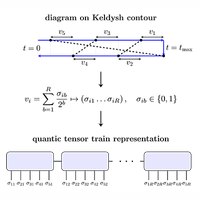
Strong-coupling expansions for impurity models up to third order are implemented here on the real-time axis using a quantics tensor cross interpolation framework. This approach provides an accurate impurity solver that can describe both equilibrium systems and nonequilibrium steady states in the intermediate to strong-interaction regime.

Kinetic magnetism in the crossover between the square and triangular lattice Fermi-Hubbard models

Darren Pereira and Erich J. Mueller

Phys. Rev. B 112, 245120 (2025) - Published 8 December, 2025
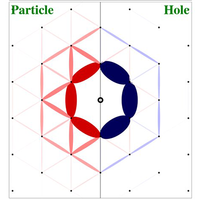
The ground state of the hard-core Fermi-Hubbard model with a single hole (and otherwise half-filled) is a ferromagnet on the square lattice, but an antiferromagnet on the triangular lattice, as those spin patterns minimize the kinetic energy of the hole. What is the magnetic behavior as one interpolates between these two geometries? Using a sophisticated quantum Monte Carlo algorithm, the authors determine here the magnetic correlations as the lattice is varied. Their calculations are performed in the thermodynamic limit and at temperatures comparable to current cold-atom experiments. They find a magnetic crossover between the two geometries, and calculate signatures of it that are observable in these experiments.

Sign In to Your Journals Account

Filter

Recent Issues

Vol. 114, Iss. 24
15 October 2026
Vol. 114, Iss. 23
15 October 2026
Vol. 114, Iss. 22
15 October 2026
Vol. 114, Iss. 21
1 October 2026
Category
Article Type
Section

Filter

Article Lookup

Enter a citation