



Optimal symbolic construction of matrix product operators and tree tensor network operators
Hazar Çakır, Richard M. Milbradt, and Christian B. Mendl
Phys. Rev. B 112, 035101 (2025) - Published 1 July, 2025
Topological properties of the [110] SnTe nanowires
Alicja Kawala and Wojciech Brzezicki
Phys. Rev. B 112, 035102 (2025) - Published 1 July, 2025
Steady-state dynamical mean field theory based on influence functional matrix product states
Mithilesh Nayak, Julian Thoenniss, Michael Sonner, Dmitry A. Abanin, and Philipp Werner
Phys. Rev. B 112, 035103 (2025) - Published 1 July, 2025
Left-left-right-right magnetic order in spin- Kitaev-Heisenberg chain
Wang Yang, Chao Xu, Shicheng Ma, Alberto Nocera, and Ian Affleck
Phys. Rev. B 112, 035104 (2025) - Published 1 July, 2025
gauging and self-dualities of the model and its cousins
Lei Su
Phys. Rev. B 112, 035105 (2025) - Published 1 July, 2025
Effects of chemical disorder and spin-orbit coupling on the electronic-structure and Fermi-surface topology of YbSb-based monopnictides
Maxwell Eibert, Christopher Burgio, Tyler Del Rose, Prince Sharma, Yaroslav Mudryk, and Prashant Singh
Phys. Rev. B 112, 035106 (2025) - Published 2 July, 2025
Altermagnetism and beyond in the Fermi-Hubbard model
Saisai He, Jize Zhao, Hong-Gang Luo, and Shijie Hu
Phys. Rev. B 112, 035108 (2025) - Published 7 July, 2025
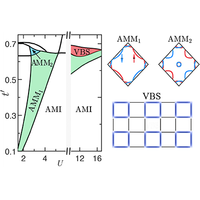
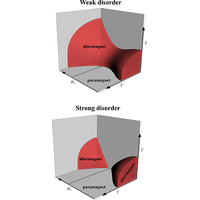
Here, the authors explore altermagnetism in the --δ Fermi-Hubbard model using mean-field analysis and density-matrix renormalization group (DMRG) simulations, presenting a detailed ground-state phase diagram at half filling that highlights a diverse array of competing magnetic orders. Key findings include two altermagnetic metallic phases, each with distinctive Fermi surface splitting for the two spin species. Plus, a valence-bond solid phase is identified within a narrow intermediate- region, and its stability is rigorously confirmed by DMRG calculations on cylindrical geometries.
Chiral symmetry and magnetism in a three-dimensional kagome lattice: prototype crystals ( and Nd)
C. E. Ardila-Gutiérrez, D. Torres-Amaris, Rafael González-Hernández, Aldo. H. Romero, and A. C. Garcia-Castro
Phys. Rev. B 112, 035109 (2025) - Published 7 July, 2025
Cusplike feature in the Hall resistivity of a uniaxial ferromagnet in nonorthogonal Hall geometry
Banik Rai and Nitesh Kumar
Phys. Rev. B 112, 035110 (2025) - Published 7 July, 2025
Charge transport limited by nonlocal electron-phonon interaction. I. Hierarchical equations of motion approach
Veljko Janković
Phys. Rev. B 112, 035111 (2025) - Published 7 July, 2025
Charge transport limited by nonlocal electron-phonon interaction. II. Numerically exact quantum dynamics in the slow-phonon regime
Veljko Janković
Phys. Rev. B 112, 035112 (2025) - Published 7 July, 2025
Coadjoint-orbit bosonization of a Fermi surface in a weak magnetic field
Mengxing Ye and Yuxuan Wang
Phys. Rev. B 112, 035113 (2025) - Published 7 July, 2025
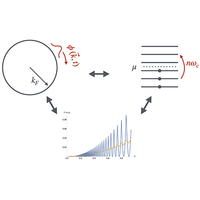
The authors develop here a bosonized theory for thermal and magnetic responses of two-dimensional Fermi surfaces, which has not been adequately addressed in bosonization. The theory describes chiral bosons propagating along the Fermi surface and identifies a topological θ-term crucial for capturing the de Haas–van Alphen effect. In addition, the existence of the magnetic field resolves the issue of UV/IR mixing that plagued earlier efforts to calculate the specific heat. This theory offers a powerful new approach to studying the magnetic response of correlated fermions.
Non-Hermitian glide-time symmetry: Topology and dynamics
Li-Wei Wang and Jian-Hua Jiang
Phys. Rev. B 112, 035114 (2025) - Published 7 July, 2025
Discrete scale invariance in topological semimetals
Haiwen Liu, Hua Jiang, Ziqiang Wang, Robert Joynt, and X. C. Xie
Phys. Rev. B 112, 035115 (2025) - Published 7 July, 2025
Symmetry-adapted closest Wannier modeling based on complete multipole basis set
Rikuto Oiwa, Akane Inda, Satoru Hayami, Takuya Nomoto, Ryotaro Arita, and Hiroaki Kusunose
Phys. Rev. B 112, 035116 (2025) - Published 7 July, 2025
Condensate ground states of hardcore bosons induced by an array of impurities
J. Y. Liu-Sun, E. S. Ma, and Z. Song
Phys. Rev. B 112, 035117 (2025) - Published 7 July, 2025
Interplay of superconducting, metallic, and crystalline states of composite fermions at in wide quantum wells
Ajit C. Balram, Anirban Sharma, and J. K. Jain
Phys. Rev. B 112, 035118 (2025) - Published 8 July, 2025
Detection of two-dimensional symmetry protected topological order with partial symmetries
Alex Turzillo, Naren Manjunath, and José Garre-Rubio
Phys. Rev. B 112, 035119 (2025) - Published 8 July, 2025
Universal entanglement correction induced by relevant deformations at the quantum critical point
Rui-Zhen Huang and Chen Peng
Phys. Rev. B 112, 035120 (2025) - Published 8 July, 2025
Hall angle of a spatially random vector model
Yi-Li Wang, Young-Kwon Han, Xian-Hui Ge, and Sang-Jin Sin
Phys. Rev. B 112, 035121 (2025) - Published 8 July, 2025
Direct observation of Dirac fermion and surface states in
Yuzhe Wang, Tongrui Li, Rui Xu, Jianghao Yao, Sen Liao, Zhengtai Liu, Dawei Shen, Yongjun Zhang, Qiuyun Chen, Yilin Wang, Juan Jiang, and Donglai Feng
Phys. Rev. B 112, 035122 (2025) - Published 8 July, 2025
A quantum cellular automaton for every symmetry protected topological phase
Lukasz Fidkowski, Jeongwan Haah, and Matthew B. Hastings
Phys. Rev. B 112, 035123 (2025) - Published 8 July, 2025
Quantum cellular automata (QCA) are unitary operations within a many-body Hilbert space that preserve the notion of locality by mapping local observables to nearby local observables. Every local quantum circuit is a QCA, but the reverse is not true, and it is an interesting open problem to classify the “nontrivial” QCA that do not have local circuit representatives. Here, the authors construct a large class of such QCA from disentanglers of ground states of lattice Hamiltonians, representing interacting bosonic analogs of topological superconductors. The topological properties encoded in their ground states translate into the nontrivial nature of the corresponding QCA. This work proposes a general conjecture that relates the quantum information theoretic problem of classifying QCA to the cobordism classification of invertible many-body quantum phases.
Dynamic critical exponents as an emergent property at interacting topological quantum critical points
Fan Yang, Zheng-Cheng Gu, and Fei Zhou
Phys. Rev. B 112, 035124 (2025) - Published 9 July, 2025
Quench dynamics of stripes and phase separation in the two-dimensional model
Luke Staszewski and Alexander Wietek
Phys. Rev. B 112, 035125 (2025) - Published 9 July, 2025
Pressure-induced orbital reordering in
Craig I. Hiley, Catriona A. Crawford, Craig L. Bull, Nicholas P. Funnell, Urmimala Dey, Nicholas C. Bristowe, Richard I. Walton, and Mark S. Senn
Phys. Rev. B 112, 035126 (2025) - Published 10 July, 2025
Correlations, spectra, and entanglement transitions in ensembles of matrix product states
Hugo Lóio, Guillaume Cecile, Sarang Gopalakrishnan, Guglielmo Lami, and Jacopo De Nardis
Phys. Rev. B 112, 035127 (2025) - Published 10 July, 2025
Disorder-induced spin excitation continuum and spin-glass ground state in the inverse spinel
Zhentao Huang, Zhijun Xu, Shuaiwei Li, Qingchen Duan, Junbo Liao, Song Bao, Yanyan Shangguan, Bo Zhang, Hao Xu, Shufan Cheng, Zihang Song, Shuai Dong, Maofeng Wu, M. B. Stone, Yiming Qiu, Ruidan Zhong, Guangyong Xu, Zhen Ma, G. D. Gu, J. M. Tranquada, and Jinsheng Wen
Phys. Rev. B 112, 035128 (2025) - Published 10 July, 2025
Textured exciton insulators
Yves H. Kwan, Ziwei Wang, Glenn Wagner, Steven H. Simon, S. A. Parameswaran, and Nick Bultinck
Phys. Rev. B 112, 035129 (2025) - Published 11 July, 2025
In electronic systems with a spin or valley flavor index, interactions can drive the condensation of flavor excitons, resulting in an excitonic insulator. The authors introduce here textured exciton insulators (TEIs), where the underlying electronic topology forces a momentum-space texture into the excitonic order parameter. This leads to consequences such as a delicate obstruction to atomic localization, and a lower bound on the quantum geometry. The authors demonstrate that one class of TEIs has already been experimentally realized in magic-angle moiré graphene.
Chern-textured exciton insulators with valley spiral order in moiré materials
Ziwei Wang, Yves H. Kwan, Glenn Wagner, Steven H. Simon, Nick Bultinck, and S. A. Parameswaran
Phys. Rev. B 112, 035130 (2025) - Published 11 July, 2025
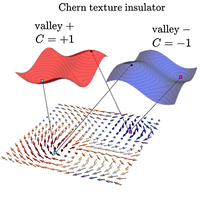
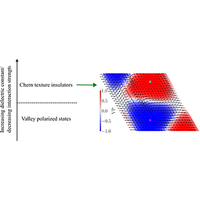
The authors explore here the phase diagrams of moiré materials in search of a new class of insulating states: the Chern texture insulators. These states spontaneously break the symmetry of independent charge conservation in each “valley” (low-energy regions in momentum space). The valley order parameter has a nontrivial texture in momentum space enforced by the underlying electronic band topology. Using detailed Hartree-Fock studies, the authors establish that such states emerge as competitive ground states in several moiré systems.
Optical absorption and luminescence of from the Bethe-Salpeter equation
Claudio Garcia and Walter R. L. Lambrecht
Phys. Rev. B 112, 035132 (2025) - Published 11 July, 2025
Probing the superconducting gap of the kagome-lattice superconductor
Vuong Thi Anh Hong, Honghong Wang, Seung-Yeop Paek, Jaegu Song, Seokmin Choi, Hanoh Lee, Harim Jang, Samreen Rashid, Soon-Gil Jung, and Tuson Park
Phys. Rev. B 112, 035133 (2025) - Published 11 July, 2025
Asymmetric real topology of conduction and valence bands
J. X. Dai, Chen Zhang, and Y. X. Zhao
Phys. Rev. B 112, 035134 (2025) - Published 11 July, 2025
Refining the two-band model for highly compensated semimetals using thermoelectric coefficients
Ian A. Leahy, Andrew C. Treglia, Gang Cao, Brian Skinner, and Minhyea Lee
Phys. Rev. B 112, 035135 (2025) - Published 11 July, 2025
Dispersion of neutral collective modes in partonic fractional quantum Hall states and its applications to paired states of composite fermions
Koyena Bose and Ajit C. Balram
Phys. Rev. B 112, 035136 (2025) - Published 14 July, 2025
Surface effects in x-ray absorption spectra of lanthanides: Focus on strongly correlated cerium materials
D. Yu. Usachov, K. A. Bokai, G. Poelchen, V. S. Stolyarov, A. V. Fedorov, K. Kliemt, S. Khim, N. Caroca-Canales, C. Krellner, and D. V. Vyalikh
Phys. Rev. B 112, 035137 (2025) - Published 14 July, 2025
Composition-dependent ultrafast luminescence in Cu-Ni alloys: Combined experimental and study
Tohru Suemoto, Haruki Morino, Shota Ono, Tsuyoshi Okuno, Takeshi Suzuki, Kozo Okazaki, Shuntaro Tani, and Yohei Kobayashi
Phys. Rev. B 112, 035138 (2025) - Published 14 July, 2025
Large ferromagnetic-like band splitting in ultrathin films
Hao Zheng, Yifu Xu, Guowei Yang, Ze Pan, Yi Wu, Yuan Zheng, Tulai Sun, Jiefeng Cao, Yi-feng Yang, Ming Shi, Chao Cao, and Yang Liu
Phys. Rev. B 112, 035139 (2025) - Published 14 July, 2025
Resonant photoemission from lanthanides at the edge: Analysis for individual states
D. Yu. Usachov, K. Kliemt, C. Krellner, V. S. Stolyarov, G. Poelchen, and D. V. Vyalikh
Phys. Rev. B 112, 035140 (2025) - Published 15 July, 2025
Time-dependent density functional theory simulation for analyzing the neutralization process of hydrogen ions injected onto tungsten surfaces
Yuto Toda, Arimichi Takayama, and Atsushi M. Ito
Phys. Rev. B 112, 035141 (2025) - Published 15 July, 2025
Effects of Ru doping on the magnetism of : A candidate Kitaev quantum spin liquid
Sanjay Bachhar, M. Baenitz, John Wilkinson, and A. V. Mahajan
Phys. Rev. B 112, 035142 (2025) - Published 15 July, 2025
Nonlinear Hall effect in bilayer induced by strong laser fields
M. Umar Farooq, Arqum Hashmi, Mizuki Tani, Kazuhiro Yabana, Kenichi L. Ishikawa, Li Huang, and Tomohito Otobe
Phys. Rev. B 112, 035143 (2025) - Published 15 July, 2025
Charge creation via quantum tunneling in one-dimensional Mott insulators: A numerical study of the extended Hubbard model
Thomas Hansen, Lars Bojer Madsen, and Yuta Murakami
Phys. Rev. B 112, 035144 (2025) - Published 16 July, 2025
Fractionally quantized electric polarization and discrete shift of crystalline fractional Chern insulators
Yuxuan Zhang and Maissam Barkeshli
Phys. Rev. B 112, 035145 (2025) - Published 17 July, 2025
Magnetic-field-tuned randomness in inhomogeneous altermagnets
Anzumaan R. Chakraborty, Jörg Schmalian, and Rafael M. Fernandes
Phys. Rev. B 112, 035146 (2025) - Published 16 July, 2025
The authors show here that, although altermagnets do not have a finite magnetization, an external magnetic field can be used to tune their phase diagram due to an effect called piezomagnetism, by which applying strain generates a magnetic field and vice versa. They show that two sources of inhomogeneous strain—elastic fluctuations and crystalline disorder—have opposing effects when a magnetic field is applied: the former favors order and the latter favors disorder. This leads to a rich phase diagram and experimental signatures in the shear modulus and in the elastocaloric effect.
Crystalline invariants of fractional Chern insulators
Ryohei Kobayashi, Yuxuan Zhang, Naren Manjunath, and Maissam Barkeshli
Phys. Rev. B 112, 035147 (2025) - Published 16 July, 2025
Bosonized one-dimensional quantum systems through enhanced event-chain Monte Carlo
Oscar Bouverot-Dupuis, Alberto Rosso, and Manon Michel
Phys. Rev. B 112, 035148 (2025) - Published 17 July, 2025
X-ray linear dichroism in MXenes
Thierry Ouisse, Hanna Pazniak, Fabrice Wilhelm, Aditya Sharma, Serge Quessada, Jesus Gonzalez-Julian, and Andrei Rogalev
Phys. Rev. B 112, 035149 (2025) - Published 17 July, 2025
Signatures of orbital order and disorder in fluoroperovskites with electronic degeneracies
C. A. Crawford, C. I. Hiley, J. Gainza, C. Ritter, R. I. Walton, and M. S. Senn
Phys. Rev. B 112, 035150 (2025) - Published 21 July, 2025
Tuning incommensurate charge order in and
Prathum Saraf, Eleanor M. Clements, Danila Sokratov, Shanta Saha, Peter Zavalij, Thomas W. Heitmann, Jeffrey W. Lynn, Camille Bernal-Choban, Dipanjan Chaudhuri, Caitlin S. Kengle, Yue Su, Simon Bettler, Nathan Manning, Peter Abbamonte, Sananda Biswas, Roser Valentí, and Johnpierre Paglione
Phys. Rev. B 112, 035151 (2025) - Published 21 July, 2025
Pure spin and orbital bulk photovoltaic effect in topological screw dislocations
Mengtong Yang, Chunmei Zhang, and Jian Zhou
Phys. Rev. B 112, 035152 (2025) - Published 21 July, 2025
Shubnikov–de Haas oscillations reaching the quantum limit in two-dimensional electron systems at (111) interfaces
Ziqiao Wang, Autumn Heltman, Shalini Kumari, Lunhui Hu, Zhu Lin, Rojin Taheri, Leixin Miao, Nasim Alem, Lin Jiao, Shalinee Chikara, Alexey Suslov, John Singleton, Fedor Balakirev, Chaoxing Liu, and Qi Li
Phys. Rev. B 112, 035153 (2025) - Published 21 July, 2025
Higher Berry curvature from matrix product states
Ken Shiozaki, Niclas Heinsdorf, and Shuhei Ohyama
Phys. Rev. B 112, 035154 (2025) - Published 21 July, 2025
Classification of mass terms in kagome semimetals
Simone Ciceri, Matteo Massaro, and Lars Fritz
Phys. Rev. B 112, 035155 (2025) - Published 21 July, 2025
Satellites, core hole excitations, and spin-resolved electronic structure in the spectroscopy of half-metallic
J. C. Woicik, C. Weiland, C. Jaye, E. L. Shirley, I. Jarrige, J. Pelliciari, V. Bisogni, A. K. Rumaiz, J. M. Ablett, Lijuan Qian, Gang Xiao, G. Ohad, A. V. Cohen, and L. Kronik
Phys. Rev. B 112, 035156 (2025) - Published 21 July, 2025
Nematic correlations and nematic Berezinskii-Kosterlitz-Thouless transition in spin-1 kagome lattice antiferromagnets
Chun-Jiong Huang, Xu-Ping Yao, and Gang v. Chen
Phys. Rev. B 112, 035157 (2025) - Published 22 July, 2025
Geometric bound on the structure factor and a harmonic condition on band geometry
Yugo Onishi, Alexander Avdoshkin, and Liang Fu
Phys. Rev. B 112, 035158 (2025) - Published 22 July, 2025
Dirac and chiral spin liquids on spin-1/2 square-lattice Heisenberg antiferromagnet
Hui-Ke Jin, Hong-Hao Tu, and Ya-Hui Zhang
Phys. Rev. B 112, 035159 (2025) - Published 23 July, 2025
Surface preparation method for investigating the three-dimensional electronic structure of perovskite nickelates
Yong Zhong, Kyuho Lee, Regan Bhatta, Yu Zhang, Yonghun Lee, Martin Gonzalez, Jiarui Li, Ruohan Wang, Makoto Hashimoto, Donghui Lu, Sung-Kwan Mo, Chunjing Jia, Harold Y. Hwang, and Zhi-Xun Shen
Phys. Rev. B 112, 035160 (2025) - Published 23 July, 2025
Optical spectroscopy evidence of a second-order Mott phase transition
Ariano De Giovanni Rodrigues, Andrea Perucchi, Luca Tomarchio, Marine Verseils, Paraskevas Parisiades, Benoît Baptiste, Keevin Béneut, Edmondo Gilioli, Stefano Lupi, and Andrea Gauzzi
Phys. Rev. B 112, 035161 (2025) - Published 23 July, 2025
Bicircular light-induced multistate geometric current
Zhichao Guo, Zhuocheng Lu, Hua Wang, and Kai Chang
Phys. Rev. B 112, 035162 (2025) - Published 23 July, 2025
Topological nodal line electride with inherently small spin-orbit coupling gaps
Yinuo Huo, Yihang Lin, Yong-An Zhong, Lei Jin, Ying Liu, Xuefang Dai, Xiaoming Zhang, and Guodong Liu
Phys. Rev. B 112, 035163 (2025) - Published 24 July, 2025
Site-selective correlations in interacting flat-band quasicrystals
Yuxi Zhang, Richard T. Scalettar, and Rafael M. Fernandes
Phys. Rev. B 112, 035164 (2025) - Published 24 July, 2025
Language-inspired machine learning approach for solving strongly correlated problems with dynamical mean-field theory
Hovan Lee, Zelong Zhao, George H. Booth, Weifeng Ge, and Cedric Weber
Phys. Rev. B 112, 035165 (2025) - Published 24 July, 2025
Berry curvature induced intrinsic spin Hall effect in the light-element-based CrN system for magnetization switching
Gaurav K. Shukla, Prabhat Kumar, and Shinji Isogami
Phys. Rev. B 112, 035166 (2025) - Published 25 July, 2025
Disordered topological crystalline phases
Adam Yanis Chaou, Mateo Moreno-Gonzalez, Alexander Altland, and Piet W. Brouwer
Phys. Rev. B 112, 035167 (2025) - Published 28 July, 2025
Observing two-electron interactions with correlation-ARPES
A. F. Kemper, Francesco Goto, Heba A. Labib, Nicolas Gauthier, E. H. da Silva Neto, and F. Boschini
Phys. Rev. B 112, 035168 (2025) - Published 28 July, 2025
Topological phase transition in the two-leg Hubbard model: Emergence of the Haldane phase via diagonal hopping and strong interactions
João Pedro Gama D'Elia and Thereza Paiva
Phys. Rev. B 112, 035169 (2025) - Published 28 July, 2025
Collapse of Landau levels in tilted Weyl semimetals and its detection via the planar Hall effect
Fu-Yang Chen, Zhuo-Hua Chen, Hou-Jian Duan, Mou Yang, Rui-Qiang Wang, and Ming-Xun Deng
Phys. Rev. B 112, 035170 (2025) - Published 28 July, 2025
Order parameter fluctuation effects on current-induced magnetization
Genta Furuya and Kazumasa Hattori
Phys. Rev. B 112, 035171 (2025) - Published 28 July, 2025
Computation kernel for Feynman diagrams
Daria Gazizova, Rayan Farid, B. D. E. McNiven, I. Assi, Ethan G. Armstrong, and J. P. F. LeBlanc
Phys. Rev. B 112, 035172 (2025) - Published 30 July, 2025
Duality via sequential quantum circuit in the topological holography formalism
Robijn Vanhove, Vibhu Ravindran, David T. Stephen, Xiao-Gang Wen, and Xie Chen
Phys. Rev. B 112, 035173 (2025) - Published 31 July, 2025
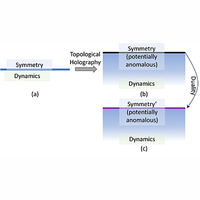
Dualities describe two quantum theories that secretly describe the same low-energy physics. The authors describe here how dualities emerge in the Topological Holography formalism – sometimes aptly called “sandwich – by changing the gapped boundary condition on top of the topological field theory. The authors show how this can be done on the lattice through the application of sequential quantum circuits and give systematic examples both in two and three dimensions.