Highlights

Local imaging of diamagnetism in proximity-coupled niobium nanoisland arrays on gold thin films

Logan Bishop-Van Horn, Irene P. Zhang, Emily N. Waite, Ian Mondragon-Shem, Scott Jensen, Junseok Oh, Tom Lippman, Malcolm Durkin, Taylor L. Hughes, Nadya Mason, Kathryn A. Moler, and Ilya Sochnikov

Phys. Rev. B 106, 054521 (2022) - Published 30 August, 2022

Using scanning SQUID susceptometry, the authors measure the local magnetic response of arrays of proximity-coupled superconducting nanoislands with engineered spatial disorder. The measurements, along with detailed numerical simulations, reveal a magnetic susceptibility that is nonlinear, spatially inhomogeneous, and strongly dependent on disorder. This work demonstrates the design, control, and measurement of a model superconducting system to simulate the spatial evolution of superfluid density and phase coherence in 2D superconductors with micron-scale disorder.

Observation of a multitude of correlated states at the surface of bulk 1T−TaSe2 crystals

Yi Chen, Wei Ruan, Jeffrey D. Cain, Ryan L. Lee, Salman Kahn, Caihong Jia, Alex Zettl, and Michael F. Crommie

Phys. Rev. B 106, 075153 (2022) - Published 30 August, 2022

Is it possible to have a single crystal that hosts a variety of correlated surface states? Layered transition metal dichalcogenides such as bulk 1T-TaSe2 offer a unique platform for accomplishing this since the electrons in each charge density wave (CDW) unit cell are susceptible to both Coulomb repulsion and interlayer coupling. By using scanning tunneling microscopy and spectroscopy, the authors identify here a multitude of correlated surface states that exist on bulk 1T-TaSe2 with properties ranging all the way from Mott insulating to strongly metallic Kondo behavior. 1T-TaSe2 thus simulates the full range of the periodic Anderson model within a single crystal by combining electron correlations with variable interlayer coupling.

Proximity-induced superconductivity generated by thin films: Effects of Fermi surface mismatch and disorder in the superconductor

Tudor D. Stanescu and Sankar Das Sarma

Phys. Rev. B 106, 085429 (2022) - Published 30 August, 2022

Detailed understanding of proximity-induced superconductivity generated by thin films has become critical in the context of recent efforts to realize topological quantum states in superconductor-based hybrid structures. Using a 3D microscopic model, the authors demonstrate here that disorder in the film is both essential for inducing robust superconductivity and potentially detrimental, as it generates “induced disorder”. Films with surface roughness are shown to induce uniform-enough topological superconductivity in a semiconductor, provided the coupling of the two subsystems is sufficiently weak.

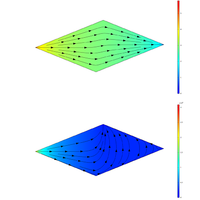
Transition from metal to higher-order topological insulator driven by random flux

Chang-An Li, Song-Bo Zhang, Jan Carl Budich, and Björn Trauzettel

Phys. Rev. B 106, L081410 (2022) - Published 29 August, 2022

Random flux can drive a phase transition from a metal to a higher-order topological insulator in the two-dimensional Su-Schrieffer-Heeger model. This transition happens in the vicinity of zero energy which is surprising when compared to the influence of random flux on a simple square-lattice model. The authors analytically discover the importance of sublattice degrees of freedom for the transition to happen.

Excitonic transverse and amplitude fluctuations in noncollinear and charge-ordered RbFe2+Fe3+F6

H. Lane, M. Songvilay, R. A. Ewings, and C. Stock

Phys. Rev. B 106, 054431 (2022) - Published 25 August, 2022

Conventional spin-wave theory of magnetic insulators deals with the investigation of transverse excitations of magnetic moments of fixed length. However, when single-ion energetics such as spin-orbit coupling are relevant, such symmetries are not necessarily present, allowing fluctuations of the magnitude of the magnetic moment. These excitations are termed amplitude modes. Here, the authors develop and investigate a theory for such excitations applied to neutron spectroscopy. They focus their attention on magnetic excitations in the low-temperature phase of RbFe2+Fe3+F6 which is based on a noncollinear arrangement of Fe3+ (S=5/2, l≈0) and orbitally active Fe2+(S = 2, l =1) magnetic moments. Conditions for the existence and the observation of amplitude modes are discussed, establishing a convention for predicting and analyzing neutron spectra when spin-orbit coupling is a pertinent energy scale.

Breakdown of the Migdal-Eliashberg theory and a theory of lattice-fermionic superfluidity

Emil A. Yuzbashyan and Boris L. Altshuler

Phys. Rev. B 106, 054518 (2022) - Published 24 August, 2022

Superconductors become unstable at strong renormalized electron-phonon coupling which breaks the crystalline symmetry and gives rise to a new phase. Smoking-gun evidence for this instability is negative specific heat. The authors also predict an upper bound on the superconducting critical temperature and explain why and how a spurious lattice instability as a function of the bare electron-phonon coupling has been frequently mistaken for a genuine breakdown of the Migdal-Eliashberg theory.

Magic angle conditions for twisted three-dimensional topological insulators

Aaron Dunbrack and Jennifer Cano

Phys. Rev. B 106, 075142 (2022) - Published 24 August, 2022

When two layers of graphene are stacked at a specific “magic” twist angle, the Dirac cones hybridize, forming perfectly flat bands. Can Dirac cones at the interface between two stacked and twisted 3D topological insulators exhibit similar band flattening? Ultimately, the generalization from Dirac cones in sublattice space to spin space is not so simple. The authors derive here the necessary conditions to flatten the anomalous Dirac cones, which has implications for realizing tunable interacting topological phases.

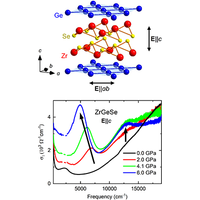
In-plane and out-of-plane optical response of the nodal-line semimetals ZrGeS and ZrGeSe

J. Ebad-Allah, S. Rojewski, Y. L. Zhu, Z. Q. Mao, and C. A. Kuntscher

Phys. Rev. B 106, 075143 (2022) - Published 24 August, 2022

The ZrSiS-type family of square-net materials ZrXY with X=Si,Ge,Sn and Y=O,S,Se,Te provide an ideal platform for exploring the exotic physics of the nodal-line semimetal phase. Here, the authors show by polarization-dependent reflectivity measurements that the optical response of the materials ZrGeSe and ZrGeS is highly anisotropic with a reduced metallic character perpendicular to the square-net layers, like in ZrSiS. Under external pressure, two new excitations appear in the out-of-plane optical response of ZrGeSe, confirming the recent findings in ZrSiS.

Low-energy interband transition in the infrared response of the correlated metal SrVO3 in the ultraclean limit

Gihyeon Ahn, M. Zingl, S. J. Noh, M. Brahlek, Joseph D. Roth, Roman Engel-Herbert, A. J. Millis, and S. J. Moon

Phys. Rev. B 106, 085133 (2022) - Published 24 August, 2022

Non-Fermi-liquid behavior of correlated metals is one of the central problems in condensed matter physics. To advance the understanding of the non-Fermi-liquid phase, it is crucial to know the intrinsic electronic response of correlated metals. The authors study the optical response of an archetypal correlated metal SrVO3 in the ultraclean limit. The results reveal that interband transitions can give rise to a significant contribution to the low-energy electronic response, mimicking the non-Fermi-liquid behavior of the charge dynamics.

Gaps in topological magnon spectra: Intrinsic versus extrinsic effects

Seung-Hwan Do, Joseph A. M. Paddison, Gabriele Sala, Travis J. Williams, Koji Kaneko, Keitaro Kuwahara, Andrew F. May, Jiaqiang Yan, Michael A. McGuire, Matthew B. Stone, Mark D. Lumsden, and Andrew D. Christianson

Phys. Rev. B 106, L060408 (2022) - Published 24 August, 2022

Using inelastic neutron scattering measurements of a high-quality single crystal of the prototype honeycomb-lattice ferromagnet CrCl3, the authors highlight critical issues in determining the sizes of topological gaps in magnon spectra. In particular, when the spin excitation spectrum contains a singularity such as a Dirac magnon crossing point, the measured spin-wave dispersion is extremely sensitive to experimental conditions such as sample mosaic, resolution, and data integration range. This work resolves an apparent dichotomy between measured and predicted gaps at Dirac crossing points, and provides guidelines for accurate measurement of magnon gap sizes in candidate materials for magnon spintronics applications.

Noncollinear ferrimagnetism and anomalous Hall effects in Mn4N thin films

Yangkun He, Simon Lenne, Zsolt Gercsi, Gwenael Atcheson, Jack O'Brien, Daniel Fruchart, Karsten Rode, and J. M. D. Coey

Phys. Rev. B 106, L060409 (2022) - Published 24 August, 2022

The magnetic structure of thin films of ferrimagnetic metallic Mn4N differs from the triangular ferrimagnetism of the bulk. Based on distance-dependence of Mn-Mn exchange and magnetic structures of other Mn3XN perovskites, a topological noncollinear spin structure is proposed for [001] Mn4N films with perpendicular anisotropy, which is confirmed by temperature-independent anomalous Hall conductivity coexisting with a normal temperature-dependent contribution. The study shows how a small symmetry change in the spin structure can influence magnetotransport properties of frustrated ferrimagnetic films.

c-axis transport in UTe2: Evidence of three-dimensional conductivity component

Yun Suk Eo, Shouzheng Liu, Shanta R. Saha, Hyunsoo Kim, Sheng Ran, Jarryd A. Horn, Halyna Hodovanets, John Collini, Tristin Metz, Wesley T. Fuhrman, Andriy H. Nevidomskyy, Jonathan D. Denlinger, Nicholas P. Butch, Michael S. Fuhrer, L. Andrew Wray, and Johnpierre Paglione

Phys. Rev. B 106, L060505 (2022) - Published 24 August, 2022

The recently discvoered topological spin-triplet superconductor UTe2 is thought to have anisotropic electronic band structure, yet measurements of normal-state electrical transport anisotropy have remained elusive. In this study, the authors develop and employ a generalized Montgomery resistance measurement technique to fully characterize the absolute transport anisotropy of UTe2, finding that the c-axis resistivity is surprisingly not quantitatively anisotropic, but rather qualitatively different from a−b plane resistivities.

Triple nodal points characterized by their nodal-line structure in all magnetic space groups

Patrick M. Lenggenhager, Xiaoxiong Liu, Titus Neupert, and Tomáš Bzdušek

Phys. Rev. B 106, 085128 (2022) - Published 18 August, 2022

Triple nodal points are threefold degeneracies of energy bands in momentum space and therefore constitute intermediates between Dirac and Weyl points. Here, the authors study these band nodes in spinless band structures arising in any space group, possibly magnetic and nonsymmorphic, and derive a complete symmetry classification according to the nodal-line structure in the vicinity of the triple nodal point. This provides criteria for the stability of such band nodes and predicts the intricate nodal structures observed in data obtained by first-principles calculations for real materials.

Magnetic excitations and interactions in the Kitaev hyperhoneycomb iridate β−Li2IrO3

Thomas Halloran, Yishu Wang, Mengqun Li, Ioannis Rousochatzakis, Prashant Chauhan, M. B. Stone, Tomohiro Takayama, Hidenori Takagi, N. P. Armitage, Natalia B. Perkins, and Collin Broholm

Phys. Rev. B 106, 064423 (2022) - Published 17 August, 2022

Materials with Kitaev interactions are increasingly studied for their potential to realize spin-liquid physics and Majorana quasiparticle excitations, but Kitaev materials with precisely refined spin exchange remain few. Here, the authors present a comprehensive experimental study, using powder inelastic neutron scattering, terahertz spectroscopy, and heat capacity measurements, that refines the spin exchange Hamiltonian of β-Li2IrO3. The results provide strong evidence for a dominant ferromagnetic Kitaev interaction and place β-Li2IrO3 in close proximity to the Kitaev spin-liquid phase.

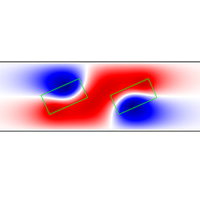
Desktop laboratory of bound states in the continuum in metallic waveguide with dielectric cavities

Evgeny Bulgakov, Artem Pilipchuk, and Almas Sadreev

Phys. Rev. B 106, 075304 (2022) - Published 16 August, 2022

A metallic waveguide with an integrated dielectric rod is equivalent to a periodic array of rods and readily allows to achieve bound states in the continuum, dependent on the position and orientation of the rod relative to the waveguide. This significantly facilitates experimental studies in comparison to the infinite arrays of cavities. However, the main advantage is related to material losses and structural fluctuations in long arrays of rods which quickly saturate the growth of the Q-factor with the number of rods in the periodic array in the GHz range, at least.

Weak ferromagnetism in Tb(Fe0.2Mn0.2Co0.2Cr0.2Ni0.2)O3 high-entropy oxide perovskite thin films

Alan Farhan, Federico Stramaglia, Maria Cocconcelli, Nikolai Kuznetsov, Lide Yao, Armin Kleibert, Cinthia Piamonteze, and Sebastiaan van Dijken

Phys. Rev. B 106, L060404 (2022) - Published 16 August, 2022

High-entropy oxide thin films have recently been introduced as an attractive strategy to design and enhance ferroic properties. Here, the authors perform element-sensitive x-ray absorption spectroscopy and magnetometry on high-entropy oxide perovskite thin films, shedding light on how different transition metal elements contribute to the overall magnetic response. The results demonstrate not only how disorder can lead to enhancement of magnetic properties but also provide a route towards further improvements of other desired properties in corresponding oxide thin films.

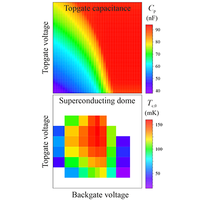
Capacitive probing of electronic phase separation in an oxide two-dimensional electron system

Sander Smink, Hans Boschker, Alexander Brinkman, Jochen Mannhart, and Hans Hilgenkamp

Phys. Rev. B 106, 054205 (2022) - Published 15 August, 2022

Electronic phase separation strongly affects the rich phenomenology of two-dimensional electron systems in complex oxides, but its origins and magnitude are not fully understood. Here, the authors use capacitance measurements to quantify the lateral variation of the carrier density associated with EPS at the LaAlO3/SrTiO3 interface. The very high value of several 1013 cm−2 and the pattern of capacitance variation imply that charged defects are the main factor causing phase separation. Measurements of the full superconducting dome show that phase separation suppresses global Tc, especially at low nominal carrier density.

Surface critical properties of the three-dimensional clock model

Xuan Zou, Shuo Liu, and Wenan Guo

Phys. Rev. B 106, 064420 (2022) - Published 15 August, 2022

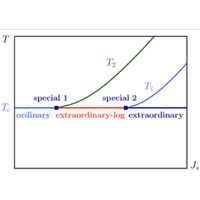
Surface effects are significant at the bulk critical point due to divergence of the correlation length. Recently, a novel extraordinary-log surface critical behavior was proposed in a 3D O(N) model. Here, the authors study the surface properties of the 3D q-state clock model, where the Zq anisotropy is a prototype of dangerously irrelevant perturbation. They identify the existence of an extraordinary-log phase between ordinary and extraordinary phases at the bulk critical point as the consequence of the emergent O(2) symmetry.

Adiabatic paths of Hamiltonians, symmetries of topological order, and automorphism codes

David Aasen, Zhenghan Wang, and Matthew B. Hastings

Phys. Rev. B 106, 085122 (2022) - Published 15 August, 2022

The recently developed “honeycomb code,” an example of a Floquet code, is a new type of fault-tolerant quantum memory distinguished by its dynamically generated logical qubits. In this work, the authors present a general framework to understand the honeycomb code by employing adiabatic paths of gapped Hamiltonians. The topology of the space of gapped Hamiltonians in two dimensions is examined, and the first few homotopy groups are conjectured, supported by several examples. Finally, the authors use this framework to design a new Floquet code, “the em-automorphism code.”

Surface Luttinger arcs in Weyl semimetals

Osakpolor Eki Obakpolor and Pavan Hosur

Phys. Rev. B 106, L081112 (2022) - Published 15 August, 2022

Weyl semimetals famously host a surface topological metal containing open Fermi arcs instead of closed Fermi surfaces. Here, the authors predict another surface feature, Luttinger arcs, that form closed loops with the Fermi arcs in undoped Weyl semimetals. Luttinger arcs are common, albeit experimentally inaccessible, for strongly interacting electrons. Here, they occur even without interactions and switch places with Fermi arcs for different surface terminations – a property the authors exploit to pinpoint Luttinger arcs for Co and Sn terminations in Co3Sn2S2.

Sign In to Your Journals Account

Filter

Section

Filter

Article Lookup

Enter a citation