Highlights

Correlation-enhanced electron-phonon coupling in FeSe/SrTiO3 at a magic angle

Qiang Zou, Antik Sihi, Basu Dev Oli, Huimin Zhang, Mercè Roig, Daniel Agterberg, Michael Weinert, Lian Li, and Subhasish Mandal

Phys. Rev. B 114, 225123 (2026) - Published 14 October, 2026

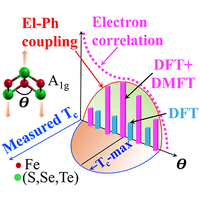
Here, the authors combine first-principles dynamical mean-field theory (DMFT), epitaxial materials design, angle-resolved photoemission spectroscopy, and scanning tunneling microscopy/spectroscopy to show that superconductivity in monolayer FeSe/SrTiO3 is maximized at a magic FeSe4 tetrahedral angle. They demonstrate that strong electronic correlations, captured by DMFT, substantially enhance electron-phonon coupling within the FeSe layer and produce a superconducting dome. These findings reveal the microscopic origin of enhanced superconductivity and suggest a route for engineering higher-temperature superconductors.

Time-dependent terahertz dielectric function of ZnTe under two-photon optical excitation at 800 nm wavelength

Farell Keiser, Wentao Zhang, Dominik Johannesmann, Nicolas S. Beermann, Yuhao Meng, Hassan A. Hafez, Savio Fabretti, and Dmitry Turchinovich

Phys. Rev. B 114, 235205 (2026) - Published 14 October, 2026

Zinc telluride (ZnTe) is widely used to generate and detect terahertz radiation with 800-nm laser pulses, yet its dielectric response at typical THz generation intensities remains unclear. Here, the authors show that two-photon absorption creates a transient free-carrier plasma strongly coupled to the lattice, modifying the THz dielectric function and markedly enhancing the 1.55-THz phonon resonance. These findings refine the physical description of THz generation in ZnTe and identify excitation-induced constraints on efficiency and bandwidth.

Discriminating superconducting fluctuations from the pseudogap in Bi2Sr2Can−1CunO2n+4+δ (n = 2, 3): A magnetotransport study

Shunpei Yamaguchi, Nae Sasaki, Shintaro Adachi, Keiichi Harada, Yuki Teramoto, Shintaro Matsuda, Tomohiro Usui, Takenori Fujii, Takashi Noji, Itsuhiro Kakeya, Haruka Taniguchi, Michiaki Matsukawa, Atsushi Miyake, Hajime Ishikawa, Koichi Kindo, and Takao Watanabe

Phys. Rev. B 114, L200501 (2026) - Published 14 October, 2026

Elucidating the origin of the pseudogap remains a central challenge in copper oxide high‑Tc superconductors. By investigating the magnetotransport properties of Bi‑2212 and Bi‑2223 single crystals, the authors demonstrate here that the pseudogap and superconducting fluctuations are distinct phenomena. Their results strongly suggest that the pseudogap arises from preformed Cooper pairing in the BCS–BEC crossover regime, imposing stringent constraints on theoretical descriptions of high‑Tc cuprates beyond the conventional BCS paradigm.

Highly uniaxial stress-tunable orbital-driven magnetism in CrAs

Kousuke Ishida, Hsiao-Yi Chen, Shumpei Seto, Hisashi Kotegawa, Ryoga Takahara, Yoichi Nii, Eiichi Matsuoka, Yusuke Wakabayashi, Clifford W. Hicks, Yusuke Nomura, and Yoshinori Onose

Phys. Rev. B 114, L231105 (2026) - Published 14 October, 2026

CrAs undergoes a first-order helimagnetic transition accompanied by a huge lattice distortion whose microscopic mechanism remains unresolved. Here, the authors demonstrate through stress-strain measurements that the helimagnetic transition in CrAs is substantially more sensitive to uniaxial stress than to hydrostatic pressure. First-principles calculations reveal that this strong response originates from an entanglement between anisotropic strain and orbital-dependent correlations, showing that local correlations can drive nonlinear elastic responses in strongly correlated systems.

Current-induced magnetization control in dipolar-coupled nanomagnet pairs and artificial spin ice

A. Pac, G. M. Macauley, J. A. Brock, A. Hrabec, A. Kurenkov, V. Raposo, E. Martinez, and L. J. Heyderman

Phys. Rev. B 114, 194411 (2026) - Published 13 October, 2026

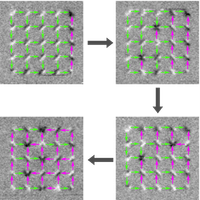
Here, the authors demonstrate how, in single nanomagnets and pairs of dipolar-coupled nanomagnets, the orientation of the applied electric current affects the threshold current density for field-free, all-electrical magnetization switching. Extending this approach to artificial spin ices, it is demonstrated how dipolar interactions influence the nanomagnet switching and enable selective control of their magnetization. These results provide a pathway toward programmable manipulation of dipolar-coupled nanomagnetic devices.

Gyrotropy from extrinsic geometry in twisted materials

Spenser Talkington and Eugene J. Mele

Phys. Rev. B 114, 235408 (2026) - Published 13 October, 2026

Two-dimensional moiré materials feature widely tunable electronic structures. When these materials are illuminated by light, they exhibit optical gyrotropy in the form of circular dichroism and birefringence. Here, the authors show that this gyrotropy naturally decomposes into an intrinsic contribution due to interlayer electronic coupling and an extrinsic contribution due to the twisted embedding of the material in physical space. The authors conduct a general symmetry analysis applicable to moiré materials and identify regimes in which the intrinsic, and in which the extrinsic contributions dominate the gyrotropy. Finally, they apply the analysis to twisted bilayer graphene and twisted MoTe2.

Lattice location of ion-implanted He6 in diamond

U. Wahl, J. G. Correia, A. Costa, B. Biesmans, G. Magchiels, S. M. Tunhuma, A. Lamelas, A. Vantomme, and L. M. C. Pereira

Phys. Rev. B 114, 194105 (2026) - Published 9 October, 2026

Understanding the properties of helium in diamond is crucial for geological dating and possible quantum applications. Here, the authors determine the lattice location of ion-implanted short-lived 6He in single-crystal diamond at temperatures from 30°C to 800°C using the β− emission channeling technique. 6He preferentially occupies tetrahedral interstitial sites. From the temperature dependence of the interstitial fraction, the migration energy of He is estimated at 1.63–2.89 eV, implying unbound interstitial helium is unstable in diamond over geological timescales, an important insight to be considered in He-based dating methods.

Microwave response of superconductors with paramagnetic impurities

Mehdi Zarea and J. A. Sauls

Phys. Rev. B 114, 214505 (2026) - Published 8 October, 2026

Dilute concentrations of paramagnetic impurities embedded in superconductors break Cooper pairs, create low-energy subgap quasiparticles that can impact the performance of superconducting microwave resonators and devices. The authors develop here the microscopic theory for the microwave response of superconductors with low-energy subgap quasiparticles and predict the low temperature Joule dissipation, anomalies in the London penetration depth, and frequency shifts of high-Q resonators. The authors show that microwave excitation of low-energy subgap quasiparticles gives rise to residual resistance of high-Q superconducting RF cavities.

Exact electromagnetic multipole expansion using elementary current multipoles

Radoslaw Kolkowski, Sagar Sehrawat, and Andriy Shevchenko

Phys. Rev. B 114, 225407 (2026) - Published 8 October, 2026

The authors introduce here a general electromagnetic multipole expansion, in which the scattering current density is expanded instead of the scattered field. The multipole moments obtained represent simple current configurations and can easily be calculated for an arbitrary multipole order and for scatterers of arbitrary sizes and shapes. They are connected to the conventional field-based moments by simple linear relations, providing a rigorous basis for intuitive design and analysis of complex scattering systems, such as electromagnetic anapoles and chiral structures.

Lieb-Schultz-Mattis constraints for hyperbolic lattices

G. Shankar and Joseph Maciejko

Phys. Rev. B 114, 245110 (2026) - Published 8 October, 2026

The Lieb-Schultz-Mattis (LSM) theorem powerfully constrains the low-energy behavior of quantum many-body systems. In spin systems with spin rotation and conventional (Euclidean) lattice translation symmetries, it forbids a unique, gapped, symmetric ground state at half-odd-integer spin per unit cell. Here, the authors generalize this theorem to hyperbolic lattices — synthetic structures that emulate negatively curved space. Unlike Euclidean lattice translations, hyperbolic translations are noncommutative. By adapting a flux-threading argument, the authors derive LSM constraints on gapped phases of hyperbolic quantum matter.

Importance of nonlinear long-range electron-phonon interaction for the carrier mobility of anharmonic halide perovskites

Matthew Houtput, Ingvar Zappacosta, William Wenborn, Serghei Klimin, Samuel Poncé, Jacques Tempere, and Cesare Franchini

Phys. Rev. B 114, L200301 (2026) - Published 8 October, 2026

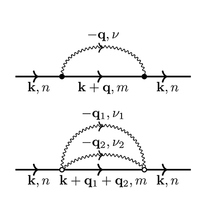
The carrier mobility in many materials is dominated by scattering of the carriers with phonons. It is often calculated using only linear, one-electron–one-phonon interaction. Here, the authors present a first-principles calculation of the mobility including the nonlinear, long-range electron-phonon interaction, for the representative halide perovskite CsPbI3. It is shown that the temperature dependence of the carrier mobility decreases by about 10% due to the one-electron–two-phonon interaction, which is attributed to the strong anharmonicity and low phonon frequencies present in halide perovskites.

Many-body Euler topology

Axel Fünfhaus, Titus Neupert, Thilo Kopp, and Roser Valentí

Phys. Rev. B 114, L231104 (2026) - Published 8 October, 2026

The authors introduce here many-body Euler numbers as a counterpart to many-body Chern numbers to diagnose the spontaneous breaking of time reversal symmetry in (fractional) Chern insulators. In addition, a classification scheme to realize different topological phases in interacting systems using symmetry indicators is laid out.

Discerning Hall and non-Hall transverse currents in linear and nonlinear regimes

Yu-Fei Liu, Jinchen Liu, Tiema Qian, Hou Chen Li, Tianye Huang, Jian-Xiang Qiu, Xiaoyu Zeng, Peng Guo, Jian Tang, Thao Dinh, Qiong Ma, Xufan Li, Ni Ni, Anyuan Gao, and Su-Yang Xu

Phys. Rev. B 114, 235407 (2026) - Published 7 October, 2026

Rapid advances in nonlinear Hall transport provide new probes of quantum geometry, but transverse signals generally mix Hall and non-Hall contributions that are difficult to disentangle. Here, the authors introduce a unified experimental protocol that exchanges current and voltage directions to identify antisymmetric Hall and symmetric non-Hall responses. Measurements across representative quantum materials validate the method in both linear and nonlinear regimes.

Unbiased large-N approach to competing vestigial orders of density-wave and superconducting instabilities

Grgur Palle and Rafael M. Fernandes

Phys. Rev. B 114, 245108 (2026) - Published 7 October, 2026

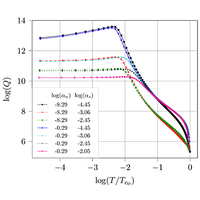
Vestigial orders are partially melted versions of ordered states stabilized by fluctuations of the order parameter. Observed in several quantum materials, their theoretical description has often relied on a large-N approximation that suffers from ambiguities due to multiple interfering channels. Here, the authors uncover the structural reasons for the ambiguities and from them derive a large-N prescription that removes the ambiguities, yielding unequivocal physical results. This prescription is then applied to multicomponent density wave and superconducting instabilities, where they find exotic vestigial phases describing spin-quadrupolar, charge-4e superconducting, and altermagnetic orders.

Structural disorder and critical voltage scaling in Al/AlOx/Al Josephson junction arrays

Amanuel M. Berhane, Susan N. Coppersmith, Emma E. Mitchell, and Timothy L. Duty

Phys. Rev. B 114, 204503 (2026) - Published 5 October, 2026

Disorder strongly modifies the collective electronic state of one-dimensional Josephson junction arrays. However, identifying types of disorder and understanding their link to collective behavior remain challenging. Here, the authors find three classes of fabrication-induced structural disorder and investigate their effects on critical-voltage scaling of arrays in the insulating state. While the scaling remains remarkably robust against some fabrication-induced variations, arrays containing nanoscale gaps exhibit significantly different behavior, demonstrating that the nature of disorder influences the collective state of the system.

Spin-density wave of ferrimagnetic building blocks masking the ferromagnetic quantum critical point in NbFe2

T. Poulis, G. Mani, J. Sturt, W. J. Duncan, H. Thoma, V. Hutanu, B. Ouladdiaf, I. Kibalin, M. H. Lemee, P. Manuel, A. Neubauer, C. Pfleiderer, F. M. Grosche, and P. G. Niklowitz

Phys. Rev. B 114, 225106 (2026) - Published 5 October, 2026

Ferromagnetic quantum critical points can be masked by emerging modulated magnetic order. Here, the authors use neutron diffraction to show that the example of NbFe2 provides the first case, where the masking modulated order is a longitudinal spin-density wave. The latter has a large-wavelength incommensurate modulation of its low average moment and is formed from ferrimagnetic building blocks with antiparallel ferromagnetic sheets. The findings can serve as a test case for magnetic quantum order-by-disorder models.

Nonlinear electron-phonon interactions from first principles

Zhenbang Dai and Feliciano Giustino

Phys. Rev. B 114, 245106 (2026) - Published 5 October, 2026

The interacting electron-phonon problem has long been studied within the linear coupling approximation, which can break down in the strong-coupling limit. Here, the authors develop an ab initio theory that enables the calculation of the full nonlinear electron-phonon coupling matrix. With this development, the authors demonstrate the critical role of nonlinear couplings in electron-phonon physics by analyzing its impact on the small hole polaron in lithium fluoride.

Effect of composition and pressure on diamond formation timescales from hydrocarbon demixing at icy planetary interior conditions

Mungo Frost et al.

Phys. Rev. B 114, 204101 (2026) - Published 1 October, 2026

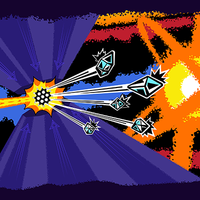
Under extreme conditions hydrocarbons are known to demix, forming diamond and a hydrogen-rich phase. Here, the authors probe the timescale of this process as a function of pressure and composition. Various hydrocarbon samples were compressed to between 20 and 80 GPa in diamond anvil cells prior to serial x-ray free electron laser heating and time-resolved diffraction. They find that carbon-rich precursors form diamond in 10s of microseconds over the whole pressure range, while hydrogen rich ones take longer. [Image credit: Greg Stewart/SLAC National Accelerator Laboratory]

Dissipative quantum mechanics of Andreev bound states

Mikhail S. Kalenkov and Andrei D. Zaikin

Phys. Rev. B 114, 214502 (2026) - Published 1 October, 2026

Microscopic description of ac Josephson effect in superconducting junctions beyond the tunneling limit should account for subtle nonequilibrium effects. Here, the authors demonstrate that this problem can be fully resolved by analyzing dissipative quantum dynamics of Andreev bound states inside the junction. Within this analysis, the authors identify Landau-Zener tunneling between subgap Andreev levels and quantum escape of quasiparticles from such levels into continuum of states above the gap as the dominant processes for the problem under consideration.

Millisecond-long electron spin lifetime in CsPbI3 perovskite nanocrystals revealed by optically detected magnetic resonance

Vasilii V. Belykh, Mikhail M. Glazov, Sergey R. Meliakov, Dmitri R. Yakovlev, Evgeniya V. Kulebyakina, Mikhail L. Skorikov, Mikhail V. Kochiev, Maria S. Kuznetsova, Elena V. Kolobkova, and Manfred Bayer

Phys. Rev. B 114, 225301 (2026) - Published 1 October, 2026

Here, the authors reveal millisecond-long electron spin relaxation in CsPbI3 perovskite nanocrystals at low temperatures using the resonant spin inertia technique based on optically detected magnetic resonance. The authors uncover the role of slowly fluctuating nuclear spins in the spin relaxation at low magnetic fields and show that a two-LO-phonon Raman process governs the temperature dependence of the spin relaxation.

Sign In to Your Journals Account

Filter

Section

Filter

Article Lookup

Enter a citation