Highlights

Thermally assisted transport of biexcitons in monolayer WSe2

Dorian Béret, Louka Hemmen, Vishwas Jindal, Sreyan Raha, Thierry Amand, Delphine Lagarde, Andrea Balocchi, Cédric Robert, Hélène Carrere, Xavier Marie, Pierre Renucci, and Laurent Lombez

Phys. Rev. B 114, 185422 (2026) - Published 21 September, 2026

Studies of excitonic transport in transition metal dichalcogenide monolayers have attracted increasing interest in recent years for the development of nano-optoelectronic devices based on 2D materials. Here, the authors investigate biexciton transport using spatially and temporally resolved photoluminescence spectroscopy under high excitation flux in a high-quality WSe2 monolayer. The results show that a Seebeck current driven by hot biexcitons contributes to their transport. These findings further highlight the importance of high-energy populations in excitonic transport in TMDs, even for complex and massive excitonic species.

Crystal fields and the properties of the Kitaev candidate Na3Co2SbO6 probed with x-ray absorption spectroscopy

M. M. Ferreira-Carvalho, S. H. Chen, Y. C. Ku, S. Rößler, Robert Kluge, Ryan C. Morrow, Javier Herrero-Martín, P. Gargiani, C. Y. Kuo, C. F. Chang, Alexander C. Komarek, Z. Hu, M. W. Haverkort, and L. H. Tjeng

Phys. Rev. B 114, 175123 (2026) - Published 17 September, 2026

Here, the authors utilize high-precision inverse-partial-fluorescence-yield x-ray absorption and magnetic circular dichroism, together with full-multiplet cluster calculations, to probe the local electronic structure of the Kitaev candidate Na3Co2SbO6. The measurements reveal a dominant trigonal crystal field together with subtle deviations from trigonal symmetry. Accounting for this lower local symmetry enables a consistent description of both the spectroscopic data and the observed in-plane magnetization anisotropy, highlighting the importance of local distortions for Kitaev physics.

Disentangling bulk and surface electronic structure using targeted cleave planes in RuO2

Maria H. Visscher, Sebastian Buchberger, Bruno Saika, Shu Mo, Lea Richter, Mats Leandersson, Craig Polley, Andrew P. Mackenzie, and Phil D. C. King

Phys. Rev. B 114, 175125 (2026) - Published 17 September, 2026

Using focused ion beam designed cleaving planes, the authors prepare different surface orientations of RuO2 for study by angle-resolved photoemission spectroscopy. The high-resolution measurements this enables from two distinct surfaces, combined with electronic structure calculations, make it possible to better distinguish bulk versus surface states. In fact, they reveal that the ARPES spectra are largely dominated by surface, rather than bulk, states, and reveal how these are strongly impacted by spin-orbit coupling, surface stoichiometry, and structure.

Extreme-ultraviolet optical response of atomically thin molybdenum disulfide

Giacomo Fiorentini, Nicola Di Palo, Giacomo Inzani, Gian Luca Dolso, Simone Bonetti, Qiuyang Li, Fang Liu, Xiaoyang Zhu, Angelo Giglia, Nicola Mahne, Luca Pasquali, Marco D'Alessandro, Mikhail Malakhov, María Camarasa-Gómez, Juan José Esteve-Paredes, Juan José Palacios, Rocío Borrego-Varillas, Mauro Nisoli, Antonio Picón, Davide Sangalli, and Matteo Lucchini

Phys. Rev. B 114, 185419 (2026) - Published 16 September, 2026

Here, the authors determine the extreme-ultraviolet optical constants of monolayer and bilayer MoS2 through a combined experimental and first-principles study. They establish a consistent connection between two-dimensional conductivity and an effective three-dimensional refractive index, demonstrating that the optical response scales linearly with thickness. Unlike in the visible spectral range, they find that the XUV response is dominated by local-field effects, largely suppressing distinct excitonic signatures and providing benchmark data for future XUV and attosecond spectroscopies.

Hidden ferromagnetism of centrosymmetric antiferromagnets

I. V. Solovyev

Phys. Rev. B 114, 154413 (2026) - Published 15 September, 2026

Here, the author develops a symmetry-based framework that explains why certain centrosymmetric antiferromagnets exhibit a finite anomalous Hall effect (AHE). In antipolarly distorted lattices, the inversional invariance of the spin-orbit interaction allows the antiferromagnetic state to be represented as an effective ferromagnet in a suitable local frame. This mapping naturally accounts for the emergence of conventionally ferromagnetic responses, including the AHE and a net orbital magnetization, even though the spin magnetization vanishes globally.

Topological spin multipolization and linear magnetoelectric coupling in two-dimensional antiferromagnets

Jörn W. F. Venderbos, Paola Gentile, and Carmine Ortix

Phys. Rev. B 114, 154414 (2026) - Published 15 September, 2026

Three-dimensional topological insulators exhibit a quantized magnetoelectric effect described by a topological response theory. This hallmark result raises the question whether magnetoelectric effects rooted in topology also exist in lower dimensions. Here, the authors demonstrate a (quasi)topological magnetoelectric response in a class of two-dimensional antiferromagnets, which is similarly described by a topological response theory, yet in two dimensions and derived from topological semimetals. As such, the effect ultimately originates from a crystalline topological index in one dimension.

Quadrupolar and dipolar phases of excitons in transition-metal dichalcogenide trilayer heterostructures

Michal Zimmerman, Daniel Podolsky, Ronen Rapaport, and Snir Gazit

Phys. Rev. B 114, 185116 (2026) - Published 15 September, 2026

In trilayer transition metal dichalcogenides, strong quantum fluctuations stabilize quadrupolar excitons. This study reveals how this state breaks down due to strong correlations at high exciton densities. Attractive interactions drive antiparallel dipolar correlations, explaining the redshift to blueshift transition observed in recent experiments. Furthermore, the authors predict novel correlation driven quantum phases, specifically an exciton droplet and a staggered dipolar crystal, and detail their distinct experimental signatures to guide future experimental explorations.

In search of diabolical critical points

Naren Manjunath and Dominic V. Else

Phys. Rev. B 114, 185119 (2026) - Published 15 September, 2026

We usually understand a critical point as occurring at a phase transition separating two distinct phases. Certain quantum many-body systems host unusual critical points that are entirely contained in a single phase of matter but are nonetheless protected for topological reasons. Here, the authors give general conditions when such “diabolical” critical points should exist and explore new types of classical phase transitions in which they might occur.

Odd-parity magnetism from the generalized Bloch theorem

Mikkel Christian Larsen and Thomas Olsen

Phys. Rev. B 114, 144414 (2026) - Published 14 September, 2026

Helimagnets naturally host odd-parity spin splitting — spin locked antisymmetrically to momentum — but their theoretical description is hindered by large, sometimes incommensurate magnetic supercells. Here, the authors show that the generalized Bloch theorem removes this barrier: bands, spin polarization, and wavefunctions of any single-q helimagnet can be obtained in the primitive cell and downfolded in reciprocal space. From first principles for MnI2, NiI2, and MnTe2, the authors find splitting maximized for p-orbital bands, and band spin texture that directly encodes the magnetic ordering vector.

Ferroelectric switchable intrinsic nonlinear pure spin Hall current

Xingyu Yue, Xiaoliang Xiao, Jinyang Ni, Pei-Hao Fu, Wenqian Li, Jin-Zhu Zhao, Min-Quan He, Zhijun Jiang, Xin Wang, Rui-Qiang Wang, and Yuanjun Jin

Phys. Rev. B 114, L171108 (2026) - Published 14 September, 2026

Here, the authors propose a new concept of nonlinear pure spin current rooted in quantum geometry. A pure spin current carries electron spin sideways without a net charge current in the same direction, making it attractive for low-power devices. They predict a unique property that flipping the built-in electric polarization of a nonmagnetic material can reverse the pure spin current. This flipping behavior is absent in the conventional spin Hall effect, which has impeded potential applications of the spin Hall effect in spintronics for a long time. The systematic survey here identifies five crystal symmetry classes that allow this behavior, and quantum mechanical calculations predict it in five atomically thin ferroelectrics, paving the way for experimental detection and device application. The authors also propose an optical second-harmonic Kerr microscopy test with an estimated measurable signal, providing a practical route to verify electrically programmable, low-dissipation spin transport without magnetic order.

Winding feature and thermal evolution of the gapped Dirac magnons in CrI3

Weiliang Yao, Matthew B. Stone, Colin L. Sarkis, Yi Li, Ruixian Liu, Xingye Lu, and Pengcheng Dai

Phys. Rev. B 114, 134413 (2026) - Published 10 September, 2026

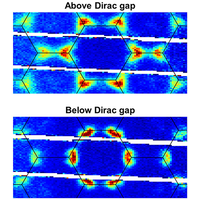
Here, the authors use inelastic neutron scattering to investigate gapped Dirac magnons in the van der Waals ferromagnet CrI3. With high-quality single crystals, they directly resolve the characteristic winding of magnon spectral weight around the K point of the hexagonal Brillouin zone, which provides a key signature of Dirac magnons. The authors further show that the magnon energies exhibit an approximately T2 thermal renormalization, consistent with magnon-magnon interactions.

Vestigial nematic order at zero temperature in two-dimensional frustrated quantum antiferromagnets

Matthew C. O'Brien and Eduardo Fradkin

Phys. Rev. B 114, 134414 (2026) - Published 10 September, 2026

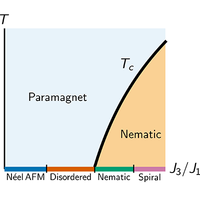
Recent numerical advances have renewed interest in the two-dimensional quantum J1-J3 Heisenberg antiferromagnet, but a detailed analytical theory has remained lacking. Here, the authors apply a semiclassical effective field theory and large-N analysis. They show that previously overlooked interactions stabilize a quantum vestigial nematic phase at zero temperature, where discrete rotational symmetry is spontaneously broken despite the loss of long-range antiferromagnetic spiral order. This phase continues the known finite-temperature nematic phase, reflecting enhanced quantum fluctuations near the classical Lifshitz point.

Three-dimensional zigzag correlations in the van der Waals Kitaev magnet RuBr3

H. Gretarsson, R. Iwazaki, F. Sato, H. Gotou, S. Francoual, J. Nasu, Y. Imai, K. Ohgushi, J. Chaloupka, B. Keimer, and H. Suzuki

Phys. Rev. B 114, L140404 (2026) - Published 10 September, 2026

Van der Waals materials can be exfoliated into ultrathin sheets, suggesting that their magnetism should also be two-dimensional. Using resonant x-ray scattering, the authors reveal here a different picture in the Kitaev magnet RuBr3: zigzag magnetic correlations exhibit spectral weight redistribution along the interlayer direction. Bromine’s spatially extended 4p orbitals strengthen interlayer magnetic interactions. The results demonstrate that an exfoliable crystal can host three-dimensional magnetism, challenging a common assumption about layered quantum materials and showing how ligand chemistry controls magnetic dimensionality.

Restoration of topological protection by adiabatic-geometry-induced suppression of intervalley mixing

Keita Funayama, Jotaro J. Nakane, and Ai Yamakage

Phys. Rev. B 114, 144103 (2026) - Published 9 September, 2026

Topological protection is weakened at armchair interfaces in quantum valley Hall systems because the two valleys mix and open a gap in the interface states. Here, the authors demonstrate that an adiabatic mass domain wall suppresses intervalley mixing, restoring robust propagation of topological interface modes throughout the bulk band gap. Experiments on silicon MEMS waveguides confirm efficient transmission through 90°, 120°, and 150° bends, establishing adiabatic geometry as a general strategy for designing versatile topological waveguides.

Kerr effect induced by exchange interaction of electrons separated by a tunnel barrier in a double quantum well

V. K. Kalevich, K. V. Kavokin, M. M. Afanasiev, B. F. Gribakin, M. I. Kuzmenko, G. Karczewski, and Yu. G. Kusrayev

Phys. Rev. B 114, 185412 (2026) - Published 9 September, 2026

Spin-spin interactions of itinerant charge carriers in semiconductors are weak and rarely accessible for quantitative measurement. Here, the authors detect electron spin precession in a wide quantum well in an in-plane magnetic field through the spin Kerr effect at the exciton resonance of a narrow tunnel-coupled quantum well. Through theoretical modeling, they show that this effect is due to interwell electron-electron exchange. The narrow well exciton exchange splitting of only tens of microelectronvolts is measured from the Kerr signal.

Phase-resolved imaging of coherent phonon-magnon coupling

Yannik Kunz, Florian Kraft, David Breitbach, Kevin Künstle, Torben Pfeifer, Matthias Küß, Stephan Glamsch, Manfred Albrecht, and Mathias Weiler

Phys. Rev. B 114, L140403 (2026) - Published 9 September, 2026

The interaction between surface acoustic waves and spin waves may open new routes for compact and efficient passive microwave devices. The design of such devices requires understanding of the magnetoacoustic phenomena. Here, the authors use phase-resolved micro-optical imaging to detect and discriminate both types of waves in their micropatterned device. By tuning the magnetic field, the authors directly image the resonant magnetoacoustic coupling and provide experimental evidence for the coherent excitation of spin waves by the traveling acoustic wave.

Magnetoelastic effects in the metallic frustrated antiferromagnet CrB2

Tadataka Watanabe, Mai Watanabe, Sakurako Suganuma, Andreas Bauer, and Christian Pfleiderer

Phys. Rev. B 114, 144409 (2026) - Published 8 September, 2026

Here, the authors reveal contrasting magnetoelastic effects in the metallic frustrated magnet CrB2: softening associated with Fermi surface nesting in compressive modes and spin-Jahn-Teller fluctuations in the shear mode. These results highlight the distinct roles of longitudinal and transverse magnetoelastic couplings in frustrated metallic magnetism.

Coexisting magnetic, charge, and superconducting orders in the two-dimensional Hubbard model

Robin Scholle, Pietro M. Bonetti, Walter Metzner, and Demetrio Vilardi

Phys. Rev. B 114, 185107 (2026) - Published 8 September, 2026

The authors analyze here the competition and coexistence of magnetic, charge, and d-wave superconducting orders in the two-dimensional Hubbard model using renormalization-group-improved Hartree–Fock calculations. The resulting phase diagram reveals superconductivity coexisting with Néel order on the electron-doped side and with spiral or stripe order on the hole-doped side. In the stripe phase, the superconducting gap is spatially modulated together with the charge order.

Bridging the gap between numerics and experiment in freestanding graphene

Maksim Ulybyshev, Savvas Zafeiropoulos, Christopher Winterowd, and Fakher Assaad

Phys. Rev. B 114, 185110 (2026) - Published 8 September, 2026

Here, the authors revisit the question of the logarithmic renormalization of the Fermi velocity in graphene. Using large-scale Quantum Monte Carlo simulations of lattices with up to 2×10⁴ interacting electrons, they directly connect experimental data with unbiased, nonperturbative calculations starting from a microscopic Hamiltonian. Their results reveal that even random-phase approximation corrections are quantitatively insufficient at realistic interaction strengths for suspended graphene, while continuum perturbation theory misses important lattice-scale effects. Remarkably, the optical conductivity still remains constant pointing to exact cancellation of different corrections.

High-order perturbation expansion of hydrodynamic phonon theory

Jordi Tur-Prats, Albert Beardo, Lluc Sendra, Almudena Diaz-Serrano, Brendan McBennett, Joshua L. Knobloch, Juan Camacho, and F. Xavier Alvarez

Phys. Rev. B 114, L171301 (2026) - Published 8 September, 2026

Far from equilibrium, heat flux profiles can exhibit complex and rapidly evolving shapes, hindering the formulation of macroscopic heat transport equations for energy currents in nanostructured semiconductors. Here, the authors address this challenge by decomposing the phonon distribution into a smooth component that captures its slowly evolving features and an arbitrarily complex component that accounts for higher-order corrections. Combined with the Boltzmann transport equation, this decomposition enables the prediction of heat transport under extreme confinement by modeling the slowly evolving component deterministically using the finite element method, while capturing the rapidly evolving component stochastically through a Monte Carlo scheme.

Sign In to Your Journals Account

Filter

Section

Filter

Article Lookup

Enter a citation