Highlights

Probing laser-induced spin-current generation in synthetic ferrimagnets using spin waves

Tom Lichtenberg, Youri L. W. van Hees, Maarten Beens, Caspar J. Levels, Reinoud Lavrijsen, Rembert A. Duine, and Bert Koopmans

Phys. Rev. B 106, 094436 (2022) - Published 30 September, 2022

The role of nonlocal spin transport in technologically highly relevant all-optical magnetization switching (AOS) of rare-earth transition metal ferrimagnets is scarcely understood. The authors investigate spin-current generation in layered systems containing Gd and Tb by studying spin-waves that these spin currents excite in an adjacent ferromagnetic layer. They observe a large discrepancy in spin-current generation between Gd and Tb, which provides a possible explanation for the relative difficulty of achieving AOS in systems containing only Tb as the rare-earth material.

Zero-point renormalization of the band gap of semiconductors and insulators using the projector augmented wave method

Manuel Engel, Henrique Miranda, Laurent Chaput, Atsushi Togo, Carla Verdi, Martijn Marsman, and Georg Kresse

Phys. Rev. B 106, 094316 (2022) - Published 29 September, 2022

Electron-phonon physics has become an integral part of today’s materials science world. In this work, the authors present ab initio results for the zero-point renormalization of the band gap of various semiconductors and insulators. They use a new implementation of the VASP code that utilizes the sophisticated projector augmented wave method to calculate the electron-phonon perturbation. Two complementary ways of treating the all-electron information are discussed in this context.

Antipolar transitions in GaNb4Se8 and GaTa4Se8

M. Winkler, L. Prodan, V. Tsurkan, P. Lunkenheimer, and I. Kézsmárki

Phys. Rev. B 106, 115146 (2022) - Published 28 September, 2022

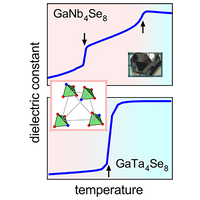
Applying dielectric spectroscopy and other techniques, the authors find antipolar ordering at the structural and magnetic transitions of the lacunar spinels GaNb4Se8 and GaTa4Se8, materials with substantial spin-orbit coupling. It arises from polar distortions of the moleculelike Nb4Se4 and Ta4Se4 clusters, typical for the crystalline lattice of lacunar spinels. Moreover, aside from dipolar relaxations and weak ferroelectric ordering, charge transport governed by in-gap impurity states is found at low temperatures, as previously suggested to explain the resistive switching in these compounds.

Order fractionalization in a Kitaev-Kondo model

Alexei M. Tsvelik and Piers Coleman

Phys. Rev. B 106, 125144 (2022) - Published 28 September, 2022

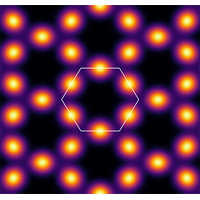
“Order fractionalization” results when a Yao-Lee spin liquid on a honeycomb lattice is exchange coupled to a conduction sea to form a Kondo lattice. Binding between the electrons and the Majorana excitations of the spin liquid gives rise to a condensate of charge-e S=½ spinor bosons. The tunneling of electrons through the spin liquid takes place over arbitrarily large distances, giving rise to a gapless cone of neutral Majorana excitations.

Ultrafast carrier and lattice dynamics in the Dirac semimetal NiTe2

L. Cheng, F. C. Fei, H. Hu, Y. M. Dai, F. Q. Song, and J. Qi

Phys. Rev. B 106, 104308 (2022) - Published 26 September, 2022

The nonequilibrium fermionic quasiparticle responding to bosonic modes is critical to understand the electromagnetic response of different materials. Using ultrafast optical spectroscopy, this work reveals that sudden variation in the Fermi surface topology induces exotic carrier and phonon dynamics via electron-phonon interaction in the type-II Dirac semimetal NiTe2. This provides the feasibility to manipulate the nonequilibrium carrier and lattice responses in a variety of materials with similar electronic structure, and benefits the development of future ultrafast optoelectronic devices.

Spin orbit torque driven magnetization reversal in CoFeTaB/Pt probed by resonant x-ray reflectivity

D. M. Burn, R. Fan, O. Inyang, M. Tokaç, L. Bouchenoire, A. T. Hindmarch, and P. Steadman

Phys. Rev. B 106, 094429 (2022) - Published 23 September, 2022

When electrical current flows through a heavy metal layer adjacent to a ferromagnetic layer, a spin-orbit torque is exerted on the magnetic spins within the ferromagnetic layer. This link between electronics and magnetic materials is significant for the development of novel technological memory and processing devices in a field known as spintronics. Here, the authors show how advanced synchrotron radiation techniques provide a new, nondestructive, and in situ view of the current-driven layer-dependent magnetization reversal in a spintronic bilayer system.

Phonon softening in Lu(Pt1−xPdx)2In close to a zero-temperature structural instability

T. Gruner, S. Lucas, C. Geibel, K. Kaneko, S. Tsutsui, K. Schmalzl, and O. Stockert

Phys. Rev. B 106, 115142 (2022) - Published 23 September, 2022

The structural transition in Lu(Pt1−xPdx)2In attracts special interest since it can be tuned to zero temperature with the appearance of a superconducting dome around structural quantum criticality. The authors combined inelastic neutron and x-ray scattering measurements to study this structural transition. They determined the low-energy phonon dispersions and detected the relevant phonon branch becoming soft. While theoretical calculations broadly agree with the measured dispersion, a clear non-mean-field behavior is demonstrated at this phase transition, which might be connected with quantum criticality and the superconducting dome.

Entanglement features of random neural network quantum states

Xiao-Qi Sun, Tamra Nebabu, Xizhi Han, Michael O. Flynn, and Xiao-Liang Qi

Phys. Rev. B 106, 115138 (2022) - Published 22 September, 2022

Neural networks offer a novel approach to represent wave functions for solving quantum many-body problems. But what kinds of quantum states are efficiently represented by neural networks? To approach this problem, the authors study here entanglement properties of an ensemble of neural network states represented by random restricted Boltzmann machines. Phases with distinct entanglement features are identified and characterized. In particular, the authors show that these neural network states can look typical in their entanglement profile while still being distinguishable from a typical state by their fractal dimensions.

Uniaxial ferromagnetism in the kagome metal TbV6Sn6

Elliott Rosenberg, Jonathan M. DeStefano, Yucheng Guo, Ji Seop Oh, Makoto Hashimoto, Donghui Lu, Robert J. Birgeneau, Yongbin Lee, Liqin Ke, Ming Yi, and Jiun-Haw Chu

Phys. Rev. B 106, 115139 (2022) - Published 22 September, 2022

The RT6X6 family (R=rare earth, T=transition metal) offers an interplay of magnetism with potentially nontrivial topological kagome band structures. Here, the authors present a new member TbV6Sn6, which contains a pure vanadium kagome lattice. Thermodynamic, magnetometric, and transport measurements reveal an Ising ferromagnetism of local Tb 4f moments accompanied by an anomalous Hall effect below 4.1 K. The Tb magnetism displays a strikingly large uniaxial anisotropy, which the authors argue originates from 4f crystalline electric field effects in a hexagonal symmetry environment.

Thermodynamic insights into the intricate magnetic phase diagram of EuAl4

William R. Meier, James R. Torres, Raphael P. Hermann, Jiyong Zhao, Barbara Lavina, Brian C. Sales, and Andrew F. May

Phys. Rev. B 106, 094421 (2022) - Published 19 September, 2022

Topological spin textures like skyrmions and merons have been proposed to explain a topological Hall signal observed in magnetically ordered phases of EuAl4. Here, the authors investigate these phases via many complementary thermodynamic measurements of EuAl4 single crystals and discuss the symmetry implications of the results. The study provides a detailed magnetic phase diagram to guide future investigations, which includes three phase boundaries that were not previously identified.

Quantum spin liquid with emergent chiral order in the triangular-lattice Hubbard model

Bin-Bin Chen, Ziyu Chen, Shou-Shu Gong, D. N. Sheng, Wei Li, and Andreas Weichselbaum

Phys. Rev. B 106, 094420 (2022) - Published 16 September, 2022

Despite a plethora of numerical studies, the nature of the quantum spin liquid near the Mott transition in the triangular-lattice Hubbard model remains controversial. Using a careful DMRG analysis on long cylinders up to width 6, the authors identify here a gapped spin liquid with robust chiral long-range correlations. The analysis unveils the need for surprisingly long systems for the spontaneous time-reversal symmetry breaking to occur due to strong open boundary effects. This reconciles previous contradictory results about this quantum spin liquid.

Investigating field-induced magnetic order in Han purple by neutron scattering up to 25.9 T

S. Allenspach, A. Madsen, A. Biffin, M. Bartkowiak, O. Prokhnenko, A. Gazizulina, X. Liu, R. Wahle, S. Gerischer, S. Kempfer, P. Heller, P. Smeibidl, A. Mira, N. Laflorencie, F. Mila, B. Normand, and Ch. Rüegg

Phys. Rev. B 106, 104418 (2022) - Published 16 September, 2022

The material BaCuSi2O6 has a fascinating dual status as an ancient pigment (the original Terracotta Army was colored with Han purple) and as a quasi-two-dimensional quantum magnet at the modern frontier of research into unconventional quantum many-body phenomena. The HFM/EXED facility at the Helmholtz-Zentrum Berlin neutron source allowed the authors to investigate the field-driven quantum phase transition to magnetic order above 23 T by neutron diffraction and spectroscopy. They report their search for fingerprints of the exotic critical behavior predicted to appear in the two-dimensional regime.

Magic angles in twisted bilayer graphene near commensuration: Towards a hypermagic regime

Michael G. Scheer, Kaiyuan Gu, and Biao Lian

Phys. Rev. B 106, 115418 (2022) - Published 15 September, 2022

The authors show here that twisted bilayer graphene near an arbitrary commensurate configuration is described by a generalization of the Bistritzer-MacDonald continuum model. They furthermore find magic angles near commensurate configurations that yield flat moiré bands. Additionally, they reveal a hypermagic parameter regime of this model in which numerous moiré bands become flat simultaneously. Some bands in this regime resemble those of kagome lattice or honeycomb lattice px, py tight-binding models, paving the way for future moiré realizations of such systems.

Polarons free from many-body self-interaction in density functional theory

Stefano Falletta and Alfredo Pasquarello

Phys. Rev. B 106, 125119 (2022) - Published 14 September, 2022

Semilocal density functional theory generally fails in stabilizing polarons, because of its spurious inclusion of the electron self-interaction. This work addresses the concepts of many-body and one-body self-interaction, which are found to be connected through the dielectric constant within a unified theoretical formulation. The superiority of the many-body self-interaction is demonstrated, resulting in robust polaron formation energies. In this context, an efficient semilocal scheme for polaron localization is developed.

Nonequilibrium spintronic transport through Kondo impurities

Anand Manaparambil, Andreas Weichselbaum, Jan von Delft, and Ireneusz Weymann

Phys. Rev. B 106, 125413 (2022) - Published 14 September, 2022

The accurate quantitative description of the nonequilibrium transport in interacting nanoscale junctions presents a formidable challenge. Tensor network methods have entered the arena as a highly competitive, versatile, and well-controlled approach. Here, in particular, the authors use a recently developed hybrid renormalization group thermofield quench approach. With this, they obtain reliable predictions for spintronic transport through a Kondo-correlated quantum dot coupled to magnetic leads in far-from-equilibrium conditions. The work focuses on the effects of the induced exchange field. As a key result, they demonstrate that an additional external magnetic field can be utilized to achieve a full Kondo revival in an out-of-equilibrium setting.

Pairing symmetry of twisted bilayer graphene: A phenomenological synthesis

Ethan Lake, Adarsh S. Patri, and T. Senthil

Phys. Rev. B 106, 104506 (2022) - Published 9 September, 2022

The nature of the superconductor in twisted bilayer graphene has remained a mystery ever since its discovery. Microscopic theoretical approaches are difficult to control, and there has been no single decisive experiment able to completely fix the pairing symmetry. In spite of this, this work shows that by carefully drawing on information from a diverse array of existing experiments – and using some minimal and general input from theory – the nature of the pairing can be almost uniquely determined.

Rare-earth monopnictides: Family of antiferromagnets hosting magnetic Fermi arcs

Yevhen Kushnirenko, Benjamin Schrunk, Brinda Kuthanazhi, Lin-Lin Wang, Junyeong Ahn, Evan O'Leary, Andrew Eaton, S. L. Bud'ko, Robert-Jan Slager, P. C. Canfield, and Adam Kaminski

Phys. Rev. B 106, 115112 (2022) - Published 8 September, 2022

The recent discovery of Fermi arcs and new magnetic bands splitting in antiferromagnet NdBi has opened up new avenues for exploration. This study shows that these uncharted effects are not restricted to NdBi, but also emerge in other rare-earth monopnictides. Also, it shows that the relative intensity of the new bands and splitting of these bands scale with the magnetic moments of the rare-earth elements.

Higher-order modulations in the skyrmion lattice phase of Cu2OSeO3

Johannes D. Reim, Shinnosuke Matsuzaka, Koya Makino, Seno Aji, Ryo Murasaki, Daiki Higashi, Daisuke Okuyama, Yusuke Nambu, Elliot P. Gilbert, Norman Booth, Shinichiro Seki, Yoshinori Tokura, and Taku J Sato

Phys. Rev. B 106, 104406 (2022) - Published 7 September, 2022

Since their first observation, topologically protected swirling spin structures, called skyrmions, have been witnessed in various materials. Here, the authors return to the classic example of Cu2OSeO3 to tackle a remaining issue: external magnetic field dependence of higher-order modulations. Performing long-exposure small-angle-neutron scattering, a clear difference was observed for the field dependence of the (1 1 0) and (2 0 0) modulations. Comparison to numerical Monte Carlo simulations suggest the appearance of weak swirling spin structures depending on the strength of the external magnetic field.

Competition between spin ordering and superconductivity near the pseudogap boundary in La2−xSrxCuO4: Insights from NMR

I. Vinograd, R. Zhou, H. Mayaffre, S. Krämer, S. K. Ramakrishna, A. P. Reyes, T. Kurosawa, N. Momono, M. Oda, S. Komiya, S. Ono, M. Horio, J. Chang, and M.-H. Julien

Phys. Rev. B 106, 054522 (2022) - Published 31 August, 2022

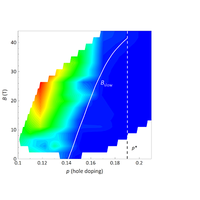
Spin-stripe order is a property of the high-Tc cuprate La2−xSrxCuO4 that is observed for x ≤ 0.13 but not at larger doping because it is nullified by superconducting order. However, it can be restored by applying intense magnetic fields that erase superconductivity. The present analysis of NMR data sheds light on how glasslike freezing of spin stripes emerges from the field-induced vortex cores and how such field-induced magnetism matters for the interpretation of any experiment below the pseudogap boundary at x = 0.19.

Tailoring optical excitation to control magnetic skyrmion nucleation

L.-M. Kern, B. Pfau, M. Schneider, K. Gerlinger, V. Deinhart, S. Wittrock, T. Sidiropoulos, D. Engel, I. Will, C. M. Günther, K. Litzius, S. Wintz, M. Weigand, F. Büttner, and S. Eisebitt

Phys. Rev. B 106, 054435 (2022) - Published 30 August, 2022

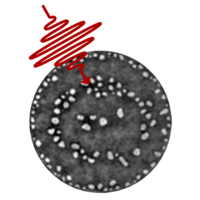
A single laser pulse can create nanometer-scale magnetic skyrmions in a thin film ferromagnet. However, the skyrmions appear randomly distributed within the excited film area hampering application of the process. Here, the authors present a reliable approach to gain nanometer spatial control over the skyrmions’ positions: reflective masks fabricated on the material’s backside locally affect the optical excitation amplitudes reached. The backside masks precisely define preferred and inhibited regions for skyrmion nucleation while maintaining frontside access to the magnetic film.

Sign In to Your Journals Account

Filter

Section

Filter

Article Lookup

Enter a citation