Highlights

Insulating phase in two-dimensional Josephson junction arrays investigated by nonlinear transport

Hiroki Ikegami and Yasunobu Nakamura

Phys. Rev. B 106, 184511 (2022) - Published 21 November, 2022

Understanding the properties of the insulating phase is key to uncovering the nature of the superconductor-insulator quantum phase transition. Here, the authors study two-dimensional Josephson junction arrays, a canonical model system of the superconductor-insulator transition, to clarify how the insulating phase develops. By systematic studies of nonlinear transport properties, they show that the formation of the insulating phase upon decreasing temperature is understood as the localization of Cooper pairs caused by the Berezinskii-Kosterlitz-Thouless mechanism under the influence of a finite-range screening of the interaction between Cooper pairs.

Combination of ultrafast time-resolved spectroscopy techniques for the analysis of electron dynamics of heliumlike impurity centers in silicon

N. Dessmann, S. G. Pavlov, A. Pohl, V. B. Shuman, L. M. Portsel, A. N. Lodygin, Yu. A. Astrov, N. V. Abrosimov, B. Redlich, and H.-W. Hübers

Phys. Rev. B 106, 195205 (2022) - Published 21 November, 2022

Helium-like interstitial donors in silicon have larger binding energies compared to their hydrogen-like counterparts. Long lifetimes of the excited states are expected since one-phonon transitions are not available. Here, the authors study their relaxation dynamics at two different free electron laser facilities using photon echo, transient grating, and pump-probe spectroscopy. In contrast to the theoretical predictions and previous experimental studies, it is found that the relaxation rates are extremely high. These results shed new light on the electron-lattice interaction and open the possibility for further studies of similar materials.

Disorder-free localization with Stark gauge protection

Haifeng Lang, Philipp Hauke, Johannes Knolle, Fabian Grusdt, and Jad C. Halimeh

Phys. Rev. B 106, 174305 (2022) - Published 18 November, 2022

A paradigm of strong ergodicity breaking – disorder-free localization (DFL) – offers a fundamental probe of out-of-equilibrium quantum many-body physics and also promises potential applications in quantum information technology. As such, stabilizing DFL against errors on modern quantum simulators becomes of paramount importance. Here, the authors introduce the concept of Stark gauge protection, which comprises an experimentally friendly sum of local symmetry generators each weighted by its spatial location. This stabilizes DFL up to all investigated evolution times.

Magnetic dynamics of NiPS3

A. R. Wildes, J. R. Stewart, M. D. Le, R. A. Ewings, K. C. Rule, G. Deng, and K. Anand

Phys. Rev. B 106, 174422 (2022) - Published 18 November, 2022

NiPS3 is a layered van der Waals compound. Like graphite, it can be delaminated down to a monolayer. Unlike graphite, it is magnetic. Neutron inelastic scattering has been performed on bulk single-crystal samples of NiPS3 to measure the magnetic dynamics, key to understanding the magnetic properties. Clear spin waves are observed, quantifying the magnetic exchange within and between the layers and the predominantly planar anisotropy. The findings have important ramifications for NiPS3 in graphene-based research.

Accurate localization of Kosterlitz-Thouless-type quantum phase transitions for one-dimensional spinless fermions

Florian Gebhard, Kevin Bauerbach, and Örs Legeza

Phys. Rev. B 106, 205133 (2022) - Published 18 November, 2022

Spinless fermions in one dimension with nearest-neighbor transfer amplitude −t and interaction V display a Kosterlitz-Thouless-type quantum phase transition from a Luttinger liquid metal to a charge density wave insulator at finite interaction strength Vc=2t. The authors use the density matrix renormalization group (DMRG) method on rings with L≤512 sites for an accurate localization of the transition. The maximum of the quasiparticle density in the upper Hartree-Fock band, nβmax(L,V)=maxknk,β(L,V), develops a peak close to the critical interaction whose position extrapolates to the exact result in the thermodynamic limit, limL→∞Vβmax(L,V)=Vc, with an accuracy of better than one percent. Monitoring the Luttinger parameter permits to locate the transition with an accuracy of three percent.

Multiple Rabi rotations of trions in InGaAs quantum dots observed by photon echo spectroscopy with spatially shaped laser pulses

S. Grisard, H. Rose, A. V. Trifonov, R. Reichhardt, D. E. Reiter, M. Reichelt, C. Schneider, M. Kamp, S. Höfling, M. Bayer, T. Meier, and I. A. Akimov

Phys. Rev. B 106, 205408 (2022) - Published 10 November, 2022

The authors investigate Rabi rotations, arising in photon echoes from an ensemble of InGaAs quantum dots. To overcome the dephasing of the Rabi rotations imposed by the inhomogeneity of laser intensities, a spatially flat intensity profile is introduced. This allows to observe robust Rabi rotations and to identify efficient coupling to acoustic phonons as the dominating channel of decoherence. The insights gained are crucial for the realization of optical quantum memories based on photon echoes from semiconductor quantum dots.

Time-resolved measurement of spin excitations in Cu2OSeO3

D. M. Burn, S. L. Zhang, G. van der Laan, and T. Hesjedal

Phys. Rev. B 106, 174409 (2022) - Published 9 November, 2022

Studying the dynamic behavior of topological spin textures can unlock future low-energy and high-speed spintronics devices. Recently, the synchrotron-based technique of diffractive ferromagnetic resonance (DFMR) was developed, allowing for element-selective dynamic studies of selected, ordered magnetic modes. In this work, the authors reveal by using DFMR how time-dependent magnetization dynamics couple to the complex spin texture in the well-known chiral magnetic system Cu2OSeO3, uncovering dynamical phase compressing that remained previously hidden using other experimental techniques.

Evolution of the cyclotron mass with doping in La2−xSrxCuO4

A. Legros, K. W. Post, Prashant Chauhan, D. G. Rickel, Xi He, Xiaotao Xu, Xiaoyan Shi, Ivan Božović, S. A. Crooker, and N. P. Armitage

Phys. Rev. B 106, 195110 (2022) - Published 4 November, 2022

The recent observation of cyclotron resonance in optimally doped La2−xSrxCuO4 using terahertz spectroscopy in a high magnetic field has opened new possibilities for the study of cuprate superconductors. Here, the authors measured cyclotron resonance from slightly underdoped to highly overdoped samples. The cyclotron mass is monotonically increasing and positive for all dopings and with a magnitude systematically below the heat capacity mass for under and optimally doped samples, while exceeding it for overdoped samples. These results are surprising as photoemission reveals a Lifshitz transition in the middle of the doping range. The sign of the cyclotron mass determined from a finite frequency resonance is, in conventional theories, a topological quantity only sensitive to whether or not the Fermi surface is closed around holes or electrons. These results should provide motivation to investigate the cyclotron resonance in non-Fermi liquids and systems with strong anisotropic scattering.

Elastic properties of moiré lattices in epitaxial two-dimensional materials

Alexandre Artaud, Nicolas Rougemaille, Sergio Vlaic, Vincent T. Renard, Nicolae Atodiresei, and Johann Coraux

Phys. Rev. B 106, L201402 (2022) - Published 4 November, 2022

Two-dimensional (2D) superlattices in conventional semiconductors are rigid. In 2D materials, where they are called moiré patterns, they are flexible so the physical properties depend not only on the super-periodicity but also on the 2D membrane’s topography. A mixed continuous+atomistic theory, treating 2D materials as crystalline elastic membranes, reveals the role of out-of-plane deformations on the ground-state topography. The model’s predictions agree with experimental structural characterizations on model systems (epitaxial graphene and MoS2 on metals) and explain moiré wavelength selection and wrinkling phenomena.

Many-body theory of phonon-induced spin relaxation and decoherence

Jinsoo Park, Yao Luo, Jin-Jian Zhou, and Marco Bernardi

Phys. Rev. B 106, 174404 (2022) - Published 3 November, 2022

Electron spin decoherence from atomic vibrations (phonons) limits the performance of spin-based devices but is difficult to model quantitatively. Here, the authors present a new theory for addressing this challenge. Their approach unifies the theoretical treatment of two mechanisms – spin scattering off phonons and spin precession altered by phonons – and provides unprecedented microscopic insight into spin motion in materials. This work enables precise predictions for spin relaxation and decoherence in materials, advancing the quest for spin-based quantum technologies.

Why mercury is a superconductor

Cesare Tresca, Gianni Profeta, Giovanni Marini, Giovanni B. Bachelet, Antonio Sanna, Matteo Calandra, and Lilia Boeri

Phys. Rev. B 106, L180501 (2022) - Published 3 November, 2022

In 1911, Kamerlingh Onnes discovered superconductivity, measuring the low-temperature resistivity in mercury. Nowadays, more than 100 years later, many new superconductors have been discovered with higher and higher critical temperatures. Ironically, the exact origin of the superconducting phase in mercury has remained hidden so far. The authors decided to revisit the description of this fascinating material with ab initio techniques, revealing all its intricate physical properties. Despite its apparent simplicity, mercury hides effects that are anything but trivial. Their proper description is a challenging problem and requires advanced computational and theoretical techniques, which have become available only recently.

Enhanced amplitude for superconductivity due to spectrum-wide wave function criticality in quasiperiodic and power-law random hopping models

Xinghai Zhang and Matthew S. Foster

Phys. Rev. B 106, L180503 (2022) - Published 3 November, 2022

The shape of electron wave functions determines key properties of quantum materials. Very recently, it was found that disorder can turn all wave functions into fractals (“spectrum-wide quantum criticality,” SWQC) in models of topological and strongly correlated superconductors. The implications of SWQC for superconductivity itself remain largely unexplored. Here, the authors show that superconductivity can be strongly enhanced near the SWQC Anderson transition in two one-dimensional models. The study highlights a new potential mechanism for achieving higher transition temperatures via random or structured inhomogeneity.

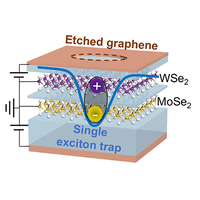
Single-exciton trapping in an electrostatically defined two-dimensional semiconductor quantum dot

Daniel N. Shanks, Fateme Mahdikhanysarvejahany, Michael R. Koehler, David G. Mandrus, Takashi Taniguchi, Kenji Watanabe, Brian J. LeRoy, and John R. Schaibley

Phys. Rev. B 106, L201401 (2022) - Published 3 November, 2022

The ability to deterministically trap and control single interlayer excitons in 2D transition metal dichalcogenide heterostructures opens new opportunities to utilize their spin and valley degrees of freedom for quantum information applications. In this work, the authors fabricate a lithographically defined electrostatic exciton trap using a nanopatterned graphene gate. Photoluminescence measurements show discrete excitation power-dependent emission energies, corresponding to different number states of excitons occupying the trap, with the lowest-energy state corresponding a single-exciton population.

Many-body correction to the intrinsic anomalous and spin Hall conductivities

Moslem Mir and Saeed H. Abedinpour

Phys. Rev. B 106, L201102 (2022) - Published 2 November, 2022

Spin-orbit coupling breaks the Galilean invariance in materials, leading to observable many-body corrections to different transport coefficients. Here, the authors study the intrinsic contribution to anomalous Hall and spin Hall conductivities of a magnetic two-dimensional electron liquid with Rashba spin-orbit coupling. They show that both of these responses are strongly affected by electron-electron interaction. The anomalous Hall conductivity is enhanced at low carrier concentrations, while in the same regime, the sign of spin Hall conductivity is reversed.

Magnetic structure and spin fluctuations in the colossal magnetoresistance ferrimagnet Mn3Si2Te6

Feng Ye, Masaaki Matsuda, Zachary Morgan, Todd Sherline, Yifei Ni, Hengdi Zhao, and G. Cao

Phys. Rev. B 106, L180402 (2022) - Published 1 November, 2022

Characterizing the magnetic structure is crucial to understand the extraordinary colossal magnetoresistance of ferrimagnetic Mn3Si2Te6. This material exhibits orders of magnitude reduction in resistivity when a magnetic polarization is avoided. Using single-crystal neutron diffraction, the authors reveal here the field evolution of the spin configuration. Prominent magnetic diffuse scattering is present and decays slowly well above the transition. The spin correlation lengths agree well with the electrical resistivity, underscoring the role of magnetic fluctuations contributing to the magnetoresistivity near the transition.

Integer quantum Hall effect and enhanced g factor in quantum-confined Cd3As2 films

Run Xiao, Junyi Zhang, Juan Chamorro, Jinwoong Kim, Tyrel M. McQueen, David Vanderbilt, Morteza Kayyalha, Yi Li, and Nitin Samarth

Phys. Rev. B 106, L201101 (2022) - Published 1 November, 2022

A concerted experimental and theoretical investigation of Shubnikov–de Haas oscillations and the integer quantum Hall effect in thin films of Cd3As2 leads to a new understanding of the Landau level spectrum in this archetypal Dirac semimetal under strong quantum confinement conditions. Experiments reveal an emerging ν=3 quantum Hall state as the film thickness is reduced, indicating an enhanced spin splitting. This is consistent with tight-binding calculations that show nonmonotonic enhancement of the g factor with increasing quantum confinement.

Expressive power of complex-valued restricted Boltzmann machines for solving nonstoquastic Hamiltonians

Chae-Yeun Park and Michael J. Kastoryano

Phys. Rev. B 106, 134437 (2022) - Published 31 October, 2022

Variational Monte Carlo with neural quantum states is one of the most powerful tools for solving the ground state of quantum many-body Hamiltonians. However, the performance of the method on frustrated Hamiltonians remains significantly worse than that of sign-free Hamiltonians, even though the method itself is free from sum-over alternating signs. Here, the authors systematically study numerical subtleties in restricted Boltzmann machine based variational Monte Carlo for solving Hamiltonians with the sign problem and unveil how quantum phases are related to the numerics.

Full configuration interaction quantum Monte Carlo for coupled electron-boson systems and infinite spaces

Robert J. Anderson, Charles J. C. Scott, and George H. Booth

Phys. Rev. B 106, 155158 (2022) - Published 31 October, 2022

When electrons interact not only with themselves, but also with bosons (phonons or other bosonic quasiparticles), what was previously a “curse of dimensionality” for its computational solution now becomes one of infinite size. To deal with this, the authors adapt here a recent method for its stochastic solution, without requiring truncation of the bosonic occupations, and which allows systematic improvability to exact solutions. They apply this to the paradigmatic Hubbard-Holstein model of local phonons, finding a state-of-the-art solution in the thermodynamic limit, as well as to a novel approach in which long-range collective electronic fluctuations are mapped to bosonic quasiparticles to tackle even long-range interacting problems of purely electronic form.

Large extrinsic phonon thermal Hall effect from resonant scattering

Xiao-Qi Sun, Jing-Yuan Chen, and Steven A. Kivelson

Phys. Rev. B 106, 144111 (2022) - Published 28 October, 2022

From a symmetry perspective, a magnetic field makes a material chiral and thus leads to a nonzero thermal Hall effect. However, recent experiments on a variety of interesting insulators – including a number of cuprates – have uncovered an unexpectedly large field-induced thermal Hall effect, despite the fact that there are no low-energy charge-carrying excitations, i.e., itinerant electrons. The authors propose here a mechanism of coupling a magnetic field to phonons and producing a thermal Hall response of the requisite magnitude through resonant skew scattering of phonons from a certain class of three-level systems.

Planckian properties of two-dimensional semiconductor systems

Seongjin Ahn and Sankar Das Sarma

Phys. Rev. B 106, 155427 (2022) - Published 27 October, 2022

The low-temperature resistivity and the temperature-dependent inelastic scattering rate of several different doped 2D semiconductor systems are described and discussed from the perspective of the Planckian hypothesis of the scattering rate having an intrinsic fundamental bound of kBT. The Planckian holds for all the systems with the scattering rate never exceeding kBT by more than an order of magnitude either in the experiment or in the theory. In addition, the authors calculate the temperature-dependent electron-electron inelastic scattering rate by obtaining the temperature-dependent self-energy arising from the Coulomb interaction, also finding it to obey the Planckian bound within an order of magnitude at all densities and temperatures. A theory is provided for why such a generalized Planckian bound applies generically.

Sign In to Your Journals Account

Filter

Section

Filter

Article Lookup

Enter a citation