Highlights

Interplay of ferromagnetism and spin-orbit coupling in Sr4Ru3O10

Izidor Benedičič, Masahiro Naritsuka, Luke C. Rhodes, Christopher Trainer, Yoshiko Nanao, Aaron B. Naden, Rosalba Fittipaldi, Veronica Granata, Mariateresa Lettieri, Antonio Vecchione, and Peter Wahl

Phys. Rev. B 106, L241107 (2022) - Published 19 December, 2022

Metamagnetic materials enable control of the ground state through applied magnetic fields. Understanding the microscopic origin of metamagnetism promises tuneability for new technological functionalities. Here, the authors use quasiparticle interference, magnetization measurements, and dilatometry in vector magnetic fields to establish the interplay between magnetism, spin-orbit coupling, microscopic electronic structure, and crystal structure of the trilayer ruthenate Sr4Ru3O10. These results reveal a surprising anisotropy in the properties of the material, highlighting the role of spin-orbit coupling.

Coexistence of trihexagonal and star-of-David pattern in the charge density wave of the kagome superconductor AV3Sb5

Yong Hu (胡勇), Xianxin Wu (吴贤新), Brenden R. Ortiz, Xinloong Han (韩欣龙), Nicholas C. Plumb, Stephen D. Wilson, Andreas P. Schnyder, and Ming Shi (史明)

Phys. Rev. B 106, L241106 (2022) - Published 16 December, 2022

Understanding the nature of the exotic CDW order is of crucial importance for uncovering its origin in the kagome superconductors AV3Sb5. Here, using angle-resolved photoemission spectroscopy, the authors reveal characteristic double-band splittings and band reconstructions as well as band-folding gaps in the CDW phase. By combining the findings with density functional theory calculations, they demonstrate that two representative distortions in the kagome lattice - the star of David and the trihexagonal ones - intrinsically coexist in the CDW of CsV3Sb5.

Chirality-induced intrinsic charge rectification in a tellurium-based field-effect transistor

Daichi Hirobe, Yoji Nabei, and Hiroshi M. Yamamoto

Phys. Rev. B 106, L220403 (2022) - Published 14 December, 2022

Chiral conductors exhibit spin-related charge rectification but its controllability is largely unexplored. Here, the authors combine chiral charge rectification with a field-effect transistor of tellurium. They demonstrate a gate-variable hundredfold enhancement of the rectification efficiency and enable quantitative comparison with theoretical calculations which considered chiral spin-momentum locking alongside the Zeeman effect. With this comparison across a wide range of temperature, an unexpected deviation from the conventional theory is revealed, which hints at the relevance of chirality-induced spin selectivity at higher temperatures.

Nonlocal conductance spectroscopy of Andreev bound states in gate-defined InAs/Al nanowires

Andreas Pöschl, Alisa Danilenko, Deividas Sabonis, Kaur Kristjuhan, Tyler Lindemann, Candice Thomas, Michael J. Manfra, and Charles M. Marcus

Phys. Rev. B 106, L241301 (2022) - Published 12 December, 2022

Andreev bound states emerge as excitations in semiconducting InAs, proximitized by superconducting Al. These states can be a mixture of electron and hole and their structure is determined by material parameters, external magnetic field, and gate voltages. Nonlocal conductance is a differential measurement of the current carried by Andreev bound states through a quasi-one-dimensional nanowire, and it can reveal the charge character of the states given by the BCS charge.

Entanglement phases in large-N hybrid Brownian circuits with long-range couplings

Subhayan Sahu, Shao-Kai Jian, Gregory Bentsen, and Brian Swingle

Phys. Rev. B 106, 224305 (2022) - Published 9 December, 2022

The interplay of unitary gates and quantum measurements leads to quantum many-body states with unique patterns of entanglement, and can even drive phase transitions between distinct entanglement phases. Here, the authors construct analytically solvable models to study the effects of long-range coupling on such measurement-induced phases, and also provide a minimal theoretical understanding of the phases and the phase transition in both spin and fermionic models. They show that power law couplings and measurements result in a rich entanglement phase diagram, including robust dynamical quantum phases with good error correcting properties, namely a power-law code distance.

Robust Fe divalent state in one-unit-cell FeSe/SrTiO3 thin films

Jingdong Shen, Wenxiang Jiang, Fengfeng Zhu, Guan-yong Wang, Huayao Li, Gan Zhao, Qian Li, Wensheng Yan, Wanli Yang, Yi-De Chuang, Jin-feng Jia, Dong Qian, L. Andrew Wray, and Lin Miao

Phys. Rev. B 106, 245112 (2022) - Published 9 December, 2022

The one-unit-cell FeSe thin film on SrTiO3 with superconductive Tc above 60K with unique electronic structures and magnetic excitations is reported here. The authors studied FeSe/STO thin films with x-ray absorption spectroscopy (XAS), resonant inelastic x-ray scattering (RIXS), and atomic multiplet simulation. The work clarifies that FeSe thin films (1UC to 10UC) are shown with pure low-spin 3d6 electronic occupancy. Besides, the 3d6 state in 1UC FeSe/STO is more robust under oxidization. This study calls for a high-resolution RIXS exploration of the pristine 1UC FeSe/STO thin film to reveal the many-body excitations.

Effects of relaxation on the photovoltaic effect and possibility for photocurrent within the transparent region

Yugo Onishi, Hikaru Watanabe, Takahiro Morimoto, and Naoto Nagaosa

Phys. Rev. B 106, 235110 (2022) - Published 7 December, 2022

In this work, the authors explore the possibility of photocurrents in metals that break both inversion and time-reversal symmetries within the transparent region, i.e., where neither Drude absorption nor interband transitions can occur. The authors show that the photocurrent is O(ωJ/γ) with the frequency of the induced current ωJ and the scattering rate γ when ωJ ≪ γ. While dc photocurrent vanishes for finite γ, the theory here also indicates that nonvanishing photocurrent can appear even in the transparent region if ω ≫ γ.

Nutational switching in ferromagnets and antiferromagnets

Lucas Winter, Sebastian Großenbach, Ulrich Nowak, and Levente Rózsa

Phys. Rev. B 106, 214403 (2022) - Published 5 December, 2022

At very short time scales, inertial effects separate the magnetic moment from the angular momentum, resulting in nutation. Here, it is demonstrated that a resonant excitation of nutation can switch the orientation of the magnetic moments within picoseconds. 90° and 180° switching can be realized in both ferromagnets and antiferromagnets, surpassing the switching speed achievable by any procedure based on spin precession.

Fully self-consistent finite-temperature GW in Gaussian Bloch orbitals for solids

Chia-Nan Yeh, Sergei Iskakov, Dominika Zgid, and Emanuel Gull

Phys. Rev. B 106, 235104 (2022) - Published 5 December, 2022

Fully self-consistent GW is a many-body perturbation theory based on an approximation to the Luttinger-Ward functional. The method satisfies certain conservation laws and thermodynamic consistency, and the self-consistent framework allows us to systematically include strong correlations. Fully self-consistent GW calculations of real materials have so far been hampered by their high computational cost. This paper presents algorithmic improvements and implementation details for the fully self-consistent GW method that make such calculations routinely possible and documents the performance of the method via examples from several materials.

Semiconductor Bloch equation analysis of optical Stark and Bloch-Siegert shifts in monolayer WSe2 and MoS2

A. O. Slobodeniuk, P. Koutenský, M. Bartoš, F. Trojánek, P. Malý, T. Novotný, and M. Kozák

Phys. Rev. B 106, 235304 (2022) - Published 5 December, 2022

Transition metal dichalcogenide monolayers possess two nonequivalent valleys in the extrema of their band structure. It turns out that off-resonant circularly polarized light affects the electronic excitations in each valley dissimilarly. Such a phenomenon leads to different shifts of the excitonic transitions in nonequivalent valleys of the monolayer. Here, the authors report on a theoretical investigation of such valley-selective transient shifts of both 1sA and 1sB exciton transitions in MoS2 and WSe2 monolayers. The study is based on the semiconductor Bloch equations, where, contrary to the previous studies, the many-body Coulomb interaction effects are properly included. The theoretical estimates of the excitonic shifts are in a good agreement with these novel experimental results.

High-field transport and hot-electron noise in GaAs from first-principles calculations: Role of two-phonon scattering

Peishi S. Cheng, Jiace Sun, Shi-Ning Sun, Alexander Y. Choi, and Austin J. Minnich

Phys. Rev. B 106, 245201 (2022) - Published 5 December, 2022

The scattering of electrons by phonons in semiconductors has been assumed to be dominated by the lowest-order process involving a single phonon. Using a new numerical approach to incorporate the next-leading-order process involving two phonons into high-field transport calculations from first principles, the authors find here that the two-phonon process contributes nearly as much as the single-phonon process to high-field transport phenomena. This finding resolves a long-standing discrepancy regarding the strength of intervalley scattering in GaAs as determined from different experimental methods.

Efficient simulation of dynamics in two-dimensional quantum spin systems with isometric tensor networks

Sheng-Hsuan Lin, Michael P. Zaletel, and Frank Pollmann

Phys. Rev. B 106, 245102 (2022) - Published 2 December, 2022

Simulating the dynamics of finite two-dimensional (2D) quantum many-body systems poses challenges to numerical methods due to the exponential growth of the many-body Hilbert space. In this work, the authors explore the variational power of recently introduced isometric tensor network states (isoTNS) — a subset of general tensor-network states that allow an efficient numerical simulation. As a efficient tool to find ground states, the variational density matrix renormalization group (DMRG2) is introduced. It is then demonstrated that dynamical correlation functions for the 2D transverse field Ising model and the Kitaev Honeycomb model can be obtained.

Argon equation of state data to 1 TPa: Shock compression experiments and simulations

Seth Root, Chad A. McCoy, Kyle R. Cochrane, John H. Carpenter, Raymond W. Lemke, Luke Shulenburger, Thomas R. Mattsson, and Philip A. Sterne

Phys. Rev. B 106, 174114 (2022) - Published 30 November, 2022

Cryogenic liquid noble gases, because of their noble nature and monatomic fluid behavior, are ideal for comparing experiments and theory at high pressures and temperatures. Using both magnetically accelerated flyer plates and laser-driven decaying shocks, the authors obtain here high-precision measurements on shock-compressed liquid argon to 1 TPa. The data are used to calibrate two different EOS models. The results show that even if two models are calibrated to the same data set, they can exhibit different responses at extreme conditions.

Antiferromagnetic fluctuations and orbital-selective Mott transition in the van der Waals ferromagnet Fe3−xGeTe2

Xiaojian Bai, Frank Lechermann, Yaohua Liu, Yongqiang Cheng, Alexander I. Kolesnikov, Feng Ye, Travis J. Williams, Songxue Chi, Tao Hong, Garrett E. Granroth, Andrew F. May, and Stuart Calder

Phys. Rev. B 106, L180409 (2022) - Published 30 November, 2022

Fe3−xGeTe2 is one of the most intensely studied quasi-two-dimensional layered materials of recent times. It can be exfoliated down to a monolayer and has promising applications in room-temperature magnetoelectronics. Here, the authors use neutron scattering and first-principle calculations to study its fundamental magnetic and electronic properties. A rare orbital selective Mott transition was identified that drives the emergence of antiferromagnetic fluctuations within the ferromagnetic order, opening a new avenue in understanding the coexistence of itinerant and local moments and the heavy-fermion physics in this 3d electron system.

Superconductivity and bosonic fluid emerging from moiré flat bands

Xu Zhang, Kai Sun, Heqiu Li, Gaopei Pan, and Zi Yang Meng

Phys. Rev. B 106, 184517 (2022) - Published 29 November, 2022

Here, the authors find a phenomenological theory of superconductivity in moiré flat band systems. With decreasing temperature, charge excitations are gapped, while charge excitations exist within the gap, shaping a bosonic fluid. Finite band width breaks the symmetry in these two-dimensional systems, making the bosonic fluid coherent and condense.

Tunneling spectroscopy of few-monolayer NbSe2 in high magnetic fields: Triplet superconductivity and Ising protection

M. Kuzmanović, T. Dvir, D. LeBoeuf, S. Ilić, M. Haim, D. Möckli, S. Kramer, M. Khodas, M. Houzet, J. S. Meyer, M. Aprili, H. Steinberg, and C. H. L. Quay

Phys. Rev. B 106, 184514 (2022) - Published 28 November, 2022

Equal spin triplet pairs (ESTPs) of nuclei form the ground state of superfluid 3He. ESTPs of electrons have long been sought in superconducting systems. In layered transition metal dichalcogenides with 2H structure, such as NbSe2, ESTP correlations have been predicted to arise from the interaction of the Ising spin-orbit field, which pins the internal spin axis of conventional singlet pairs out-of-plane, and an applied in-plane magnetic field. The tunneling spectroscopy study done here of bilayer NbSe2 shows experimental signatures of these ESTPs.

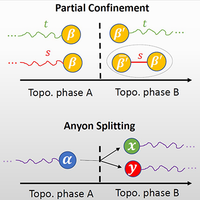
Complete characterization of non-Abelian topological phase transitions and detection of anyon splitting with projected entangled pair states

Wen-Tao Xu, Jose Garre-Rubio, and Norbert Schuch

Phys. Rev. B 106, 205139 (2022) - Published 23 November, 2022

Topological phases - systems with a global ordering in the entanglement - exhibit exotic excitations known as anyons which can display highly nontrivial (non-Abelian) statistics. Through transitions between such phases, these anyons can undergo rather surprising changes. Perhaps most surprisingly, one anyon can split into two or more anyons, some of which might condense or become confined. The authors propose here a complete set of order parameters which allow one to extract the full information about how the properties of anyons change through phase transitions, and to apply them to a range of topological phase transitions.

Bell-state generation for spin qubits via dissipative coupling

Ji Zou, Shu Zhang, and Yaroslav Tserkovnyak

Phys. Rev. B 106, L180406 (2022) - Published 23 November, 2022

Magnet-mediated dissipative coupling between spin qubits can be exploited to imprint long-lived quantum entanglement. This work points to a new direction for the application of spintronic schemes in future quantum information technologies, with an eye on the dynamical phase transitions associated with non-Hermitian dynamics of the reduced density matrix.

Many-body localization and the area law in two dimensions

K. S. C. Decker, D. M. Kennes, and C. Karrasch

Phys. Rev. B 106, L180201 (2022) - Published 22 November, 2022

Quantum systems are typically ergodic and can be described by a thermal ensemble. In this work, the authors use large-scale tensor network numerics to investigate if a generic two-dimensional disordered Heisenberg model of quantum spins exhibits a nonergodic phase. They provide evidence for the existence of a many-body localized regime at sufficiently strong disorder. They also estimate the critical disorder strength where a crossover into an ergodic regime occurs and address finite-size effects.

Wire construction of class DIII topological crystalline superconductors in two dimensions

Bingrui Peng, Hongming Weng, and Chen Fang

Phys. Rev. B 106, 174512 (2022) - Published 21 November, 2022

Topological superconductors have drawn wide interest as they host Majorana zero modes potentially useful in quantum computation. The crystalline symmetries remarkably enrich the family of topological superconductors. Here, the authors present a real-space method, called the “wire construction”, to construct two-dimensional topological superconductors. A complete classification of 2D topological crystalline superconductors in class DIII is obtained, with anomalous boundary states enumerated. The new method provides a real-space picture for understanding topological superconductors, and should guide the discovery of realistic topological superconducting materials.

Sign In to Your Journals Account

Filter

Section

Filter

Article Lookup

Enter a citation