Highlights

Melting of MgSiO3 determined by machine learning potentials

Jie Deng, Haiyang Niu, Junwei Hu, Mingyi Chen, and Lars Stixrude

Phys. Rev. B 107, 064103 (2023) - Published 13 February, 2023

The melting temperature of MgSiO3 is crucial in controlling the interior structures and dynamics of Earth and super-Earths. Here, the authors propose an iterative learning scheme that combines enhanced sampling, feature selection, and deep learning, and develop a unified machine learning potential of ab initio quality. This is valid over a wide pressure-temperature range to determine the melting temperature of MgSiO3. Modeling based on these results shows that heat flux from the core to the mantle is favorable of generating magnetic fields.

Elucidation of orbital moment, anisotropy, and magnetic damping in epitaxial Fe3O4 films

C. Love, J. E. Beevers, B. Achinuq, R. Fan, K. Matsuzaki, T. Susaki, V. K. Lazarov, S. S. Dhesi, G. van der Laan, and S. A. Cavill

Phys. Rev. B 107, 064414 (2023) - Published 13 February, 2023

Fe3O4, the archetypal half metal, is one of the most studied magnetic materials to date, yet still the cause of intense debate regarding its physical characteristics. One particular property, the magnitude of the orbital moment, has been contested for over a decade with previous works measuring either a vanishingly small or a large orbital moment. Using complementary spectroscopic techniques, the authors demonstrate here that a finite orbital moment exists in Fe3O4, in addition to observing the interplay between defects, anisotropy, and magnetic damping.

Universality of grain boundary phases in fcc metals: Case study on high-angle [111] symmetric tilt grain boundaries

Tobias Brink, Lena Langenohl, Hanna Bishara, and Gerhard Dehm

Phys. Rev. B 107, 054103 (2023) - Published 10 February, 2023

It has been reported that different ordered structures can appear at the same grain boundaries. Thermodynamically, they can be regarded as interface phases (“complexions”). The authors use atomistic simulations to show that several fcc transition and post-transition metals exhibit the same two grain boundary phases in [111] tilt grain boundaries. This remains true even when using unphysical pair potentials, highlighting that the occurrence of different grain boundary phases is not an exceptional special case, but common across different materials.

Entanglement dynamics and phase transitions of the Floquet cluster spin chain

Alberto D. Verga

Phys. Rev. B 107, 085116 (2023) - Published 9 February, 2023

One of the challenges in quantum information is to create quantum states that can be used as resources, for instance, in the measurement-based model of quantum computing. Here, the author investigates the generation, through a dynamical phase transition, of a topological entangled state, by the Floquet evolution of a chain of spins, whose ground state is the so-called cluster state, acted upon by a quantum walker. The nonergodic phase is characterized by the emergence of magnetic order, persistent at long times.

One-dimensional projection of two-dimensional systems using spiral boundary conditions

Masahiro Kadosawa, Masaaki Nakamura, Yukinori Ohta, and Satoshi Nishimoto

Phys. Rev. B 107, L081104 (2023) - Published 9 February, 2023

The spiral boundary conditions can project any two-dimensional or three-dimensional lattice onto a one-dimensional periodic chain with translational symmetry. It enables one to apply efficiently the existing one-dimensional techniques, such as density-matrix renormalization group (DMRG), bosonization, Jordan-Wigner transformation, etc., to studies of lattice systems in higher dimensions. Here, the authors demonstrate the utility of spiral boundary conditions by performing analytical and DMRG calculations for square and honeycomb lattice problems. Thus, the spiral boundary conditions emerge as a principal option in condensed matter physics.

Influence of chirp and carrier-envelope phase on noninteger high-harmonic generation

Maximilian Graml, Maximilian Nitsch, Adrian Seith, Ferdinand Evers, and Jan Wilhelm

Phys. Rev. B 107, 054305 (2023) - Published 8 February, 2023

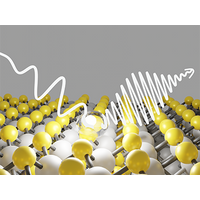
For high-harmonic generation, an intense laser pulse is targeted on a substrate producing high-frequency electromagnetic radiation. The high-harmonic spectrum emitted is strongly influenced by the properties of the substrate material and the laser pulse waveform. Here, the authors derive a simple analytical formula that describes the relation between laser pulse parameters and peak positions in the high-harmonic spectrum. The formula explains quantitatively why the high-harmonic spectrum may peak at frequencies that are not integer multiples of the laser pumping frequency.

Spin-dependent coupling of supercurrent and nonequilibrium quasiparticles in high-field superconductors

P. Maier and D. Beckmann

Phys. Rev. B 107, 054504 (2023) - Published 8 February, 2023

The interplay of the spin degree of freedom with supercurrents is investigated here in the context of superconducting spintronics. Based on a recent theoretical prediction, the authors experimentally demonstrate a spin-dependent coupling of supercurrent and nonequilibrium quasiparticles. The coupling appears when the superconductor is subject to a large spin splitting, in this case a Zeeman splitting induced by an applied magnetic field. The results may be useful for the mutual control of spin-polarized supercurrents and quasiparticles in superconducting spintronics devices.

Trajectory dependence of electronic energy-loss straggling at keV ion energies

S. Lohmann, R. Holeňák, P. L. Grande, and D. Primetzhofer

Phys. Rev. B 107, 085110 (2023) - Published 7 February, 2023

Accurate knowledge of ion energy deposition in materials is imperative for a wealth of scientific and technological applications. Here, the authors measure the energy-loss straggling, i.e., the energy distribution variance of transmitted ions, for keV ions of H, He, B, and Si in Si membranes. Straggling exhibits a significant trajectory dependence for all ions. Studying the velocity dependence of electronic energy-loss straggling and calculating transport cross sections, the authors obtain strong evidence for contributions of electron-promotion events to ion energy loss at low velocities.

Nonlinear spin current of photoexcited magnons in collinear antiferromagnets

Kosuke Fujiwara, Sota Kitamura, and Takahiro Morimoto

Phys. Rev. B 107, 064403 (2023) - Published 1 February, 2023

Generation of spin currents is currently actively studied from the viewpoint of magnon spintronics. Here, the authors propose that ac electric field can excite magnons and induce nonlinear spin currents in antiferromagnets with broken inversion symmetry. In particular, they show that linearly polarized light generates magnon spin shift current that originates from the nontrivial geometry of the magnon band and is closely related to the electronic shift current in semiconductors. The authors demonstrate that the photoinduced spin current is accessible for measurements in the multiferroic compound Mn2Mo3O8.

Migration of Ga vacancies and interstitials in β−Ga2O3

Ymir K. Frodason, Joel B. Varley, Klaus Magnus H. Johansen, Lasse Vines, and Chris G. Van de Walle

Phys. Rev. B 107, 024109 (2023) - Published 31 January, 2023

The authors present a systematic and comprehensive theoretical study of Ga vacancy and interstitial migration in monoclinic gallium sesquioxide, based on hybrid functional calculations and the nudged elastic band technique. Notably, it is shown that the Ga vacancy can form a favorable three-split configuration, consisting of three Ga vacancies and two Ga interstitials, which enables migration with a dramatically lower migration barrier than previously calculated, further demonstrating the important role of split vacancies in this material.

Pressure-induced metallization and superconductivity in the layered van der Waals semiconductor GaTe

Jin Jiang, Xuliang Chen (陈绪亮), Shuyang Wang, Chao An, Ying Zhou, Min Zhang, Yonghui Zhou, and Zhaorong Yang

Phys. Rev. B 107, 024512 (2023) - Published 31 January, 2023

Investigations show that the physical properties of the layered van der Waals semiconductor GaTe are strongly layer dependent. Here, the authors systematically study its properties by using external pressure as a tuning knob. They first find pressure-induced metallization and superconductivity simultaneously occurring at ~3 GPa, presumably owing to a quasi-two-dimensional to three-dimensional structural crossover and to an electronic phase transition due to a change of the bonding nature between layers from weak van der Waals interaction to strong Coulomb coupling. A second distinct superconducting phase is then observed at ~10 GPa due to a structural transition.

Ramp compression of tantalum to multiterapascal pressures: Constraints of the thermal equation of state to 2.3 TPa and 5000 K

M. G. Gorman, C. J. Wu, R. F. Smith, L. X. Benedict, C. J. Prisbrey, W. Schill, S. A. Bonev, Z. C. Long, P. Söderlind, D. Braun, D. C. Swift, R. Briggs, T. J. Volz, E. F. O'Bannon, P. M. Celliers, D. E. Fratanduono, J. H. Eggert, S. J. Ali, and J. M. McNaney

Phys. Rev. B 107, 014109 (2023) - Published 27 January, 2023

The authors use intense laser pulses to compress solid tantalum to pressures in excess of 20 million atmospheres. By combing their experimental measurements with existing high-pressure, high-temperature data on Ta, they can create an experimentally bounded high-temperature equation of state that is valid up to multiterapascal pressures and thousands of degrees kelvin. The equation of state may serve as a useful pressure standard at the extreme compressions and elevated temperatures now achievable in state-of-the-art static compression experiments. This work also provides a clear road map for building an accurate high-temperature equation of state catalogue of materials at extreme conditions.

Erbium and thulium on MgO(100)/Ag(100) as candidates for single atom qubits

S. Reale, A. Singha, S. L. Ahmed, D. Krylov, L. Colazzo, C. Wolf, C. S. Casari, A. Barla, E. Fernandes, F. Patthey, M. Pivetta, S. Rusponi, H. Brune, and F. Donati

Phys. Rev. B 107, 045427 (2023) - Published 27 January, 2023

Lanthanide atoms on surfaces are prospective platforms for realizing atomic-scale quantum logic units. Here, the authors combine scanning tunneling microscopy, x-ray magnetic circular dichroism, density functional theory, and atomic multiplet calculations to identify the quantum level structure of erbium and thulium atoms on MgO(100)/Ag(100), and to estimate their performance as spin qubits. Their analysis reveals that both atoms have a ground state that is suitable to perform efficient quantum coherent operations.

Stability of the Pb divalent state in insulating and metallic PbCrO3

Jianfa Zhao, Shu-Chih Haw, Xiao Wang, Lipeng Cao, Hong-Ji Lin, Chien-Te Chen, Christoph J. Sahle, Arata Tanaka, Jin-Ming Chen, Changqing Jin, Zhiwei Hu, and Liu Hao Tjeng

Phys. Rev. B 107, 024107 (2023) - Published 26 January, 2023

PbCrO3 is a perovskite that undergoes a large volume collapse and concurrently an insulator-metal transition with pressure. While one may think that the volume collapse can be associated with conversion of Pb2+ ions to the smaller Pb4+, the spectroscopic measurements in this experiment reveal that the Pb ions remain divalent. Instead, the Cr ions undergo a transition from a charge-disproportionated 2Cr3+/Cr6+ configuration to a homogenous Cr4+ with pressure. Thus, the authors can explain the insulating/metallic nature of PbCrO3 at low/high pressures, respectively.

Critical magnetic fields and electron pairing in magic-angle twisted bilayer graphene

Wei Qin, Bo Zou, and Allan H. MacDonald

Phys. Rev. B 107, 024509 (2023) - Published 26 January, 2023

The microscopic mechanism of superconductivity in magic-angle twisted bilayer graphene (MATBG) is currently under active debate. The authors propose here that valuable constraints are implied by the band-filling dependences of the critical temperature and the critical magnetic field, which together define an average Fermi velocity. They show that a robust inverse correlation between the critical temperature and the average Fermi velocity holds in models with band-filling independent pairing interactions. The absence of such an association in experiments suggests that the pairing glue in MATBG is strongly band-filling dependent.

Cavity-mediated superconductor–ferromagnetic-insulator coupling

Andreas T. G. Janssønn, Henning G. Hugdal, Arne Brataas, and Sol H. Jacobsen

Phys. Rev. B 107, 035147 (2023) - Published 26 January, 2023

Here, the authors develop a versatile effective theory of distant, cavity-mediated interactions between a ferromagnetic insulator and a superconductor. This remote sensing scheme enables their subjection to different drives and temperatures, and yields a numerically appreciable effective anisotropy field across the ferromagnetic insulator. It enables the study of their interactions across longer distances and without the same disruption of system orders as in conventional proximity structures.

Temperature dependence of the energy band gap in ZrTe5: Implications for the topological phase

I. Mohelsky, J. Wyzula, B. A. Piot, G. D. Gu, Q. Li, A. Akrap, and M. Orlita

Phys. Rev. B 107, L041202 (2023) - Published 25 January, 2023

Recently, zirconium pentatelluride (ZrTe5) has received a lot of attention, both theoretical and experimental. In spite of this, no consensus has been established so far about the basic nature of the electronic states in ZrTe5 with regard to whether this material is a strong or weak topological insulator. Here, the authors use Landau-level spectroscopy to deduce the temperature dependence of the energy band gap in ZrTe5. The observed behavior – a monotonic increase with T – implies, when confronted with theoretical expectations, that ZrTe5 is a weak topological insulator.

Tunable hole spin-photon interaction based on g-matrix modulation

V. P. Michal, J. C. Abadillo-Uriel, S. Zihlmann, R. Maurand, Y.-M. Niquet, and M. Filippone

Phys. Rev. B 107, L041303 (2023) - Published 25 January, 2023

The large spin-orbit interaction of holes in semiconductors is key to achieving strong spin-photon coupling in spin circuit-QED experiments. Here, the authors show that for a single hole this coupling is “reciprocally sweet”, meaning that the coupling can be tuned from fully transverse (allowing coherent spin rotations) to fully longitudinal (modulating the spin resonance frequency). Based on the longitudinal coupling, the authors highlight how distant spin-spin coupling and parametrically driven spin readout can be achieved.

Bismuth antiphase domain wall: A three-dimensional manifestation of the Su-Schrieffer-Heeger model

Jinwoong Kim, Cheng-Yi Huang, Hsin Lin, David Vanderbilt, and Nicholas Kioussis

Phys. Rev. B 107, 045135 (2023) - Published 24 January, 2023

The Su-Schrieffer-Heeger model describes the soliton excitations in polyacetylene due to the formation of antiphase domain walls from the alternating bond pattern. The topology of the two domains is characterized by trivial (0) and nontrivial (π) Zak phases, indicating a dimerization-dependent Zak phase. Here, it is demonstrated that pristine Bi also exhibits 0 and π Zak phases depending on the dimerization and develops topological states at antiphase domain walls as a three-dimensional analog of the Su-Schrieffer-Heeger model.

Spin-orbit enhancement in Si/SiGe heterostructures with oscillating Ge concentration

Benjamin D. Woods, M. A. Eriksson, Robert Joynt, and Mark Friesen

Phys. Rev. B 107, 035418 (2023) - Published 19 January, 2023

Electrons in Si/SiGe quantum dots are a promising platform for quantum computation. Many leading designs, however, rely on synthetic spin-orbit coupling arising from micromagnets, leading to challenges in scaling. Here, it is shown that the intrinsic spin-orbit coupling of the conduction-band valleys can be enhanced by over an order of magnitude by including Ge concentration oscillations of an appropriate wavelength within the quantum-well region. This enables fast spin manipulation using electric dipole spin resonance in the absence of micromagnets.

Sign In to Your Journals Account

Filter

Section

Filter

Article Lookup

Enter a citation