Highlights

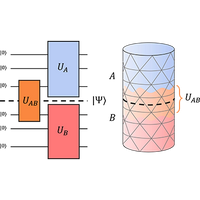
Symmetry-resolved entanglement of two-dimensional symmetry-protected topological states

Daniel Azses, David F. Mross, and Eran Sela

Phys. Rev. B 107, 115113 (2023) - Published 6 March, 2023

Entanglement spectra and their symmetries provide unique fingerprints of symmetry-protected topological states (SPTs). Unfortunately, using such calculations to identify SPTs numerically is notoriously difficult. Here, the authors develop a numerical method mapping this computation to a one-dimensional problem by utilizing the local nature of the quantum circuits that generate any SPT. Its application to models with Ising symmetry fully confirms field-theoretic predictions for their entanglement spectrum. Additionally, nontrivial deformations of the SPT manifest as many-body Aharonov-Bohm fluxes in the entanglement spectrum.

Hourglass-type bulk Ni 3d band and Ce 4f Kondo resonance states in the potential topological Kondo semimetal CeNiSn via angle-resolved photoemission spectroscopy

Seungho Seong, J. D. Denlinger, Kyoo Kim, B. I. Min, Y. Ōnuki, and J.-S. Kang

Phys. Rev. B 107, 125109 (2023) - Published 3 March, 2023

The electronic structure of CeNiSn, a potential topological Kondo insulator and a Dirac nodal-loop semimetal, is investigated here employing temperature-dependent angle-resolved photoemission spectroscopy (ARPES). Dispersive states crossing the Fermi level (EF) exhibit general agreement with theoretical predictions of bulk Ni 3d bands and show consistency with a topological hourglass-type crossing of bulk bands below EF. Flat Ce 4f states at EF exhibit a Kondo resonance temperature dependence consistent with bulk transport. This work demonstrates the importance of coherent Kondo states in determining the topological properties of CeNiSn.

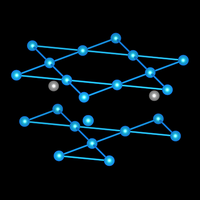
Multilayer graphenes as a platform for interaction-driven physics and topological superconductivity

Areg Ghazaryan, Tobias Holder, Erez Berg, and Maksym Serbyn

Phys. Rev. B 107, 104502 (2023) - Published 2 March, 2023

Multilayer graphene systems without a moiré superlattice have emerged as an alternative platform to study interaction and superconducting phases. This study systematically compares density of states of multilayer graphene with different stacking. It identifies tetralayer graphene with rhombohedral (ABCA) stacking as the most promising material for realization of broken-symmetry phases. In-depth analysis of the phase diagram of ABCA graphene shows that, for the accessible range of experimental parameters, the material supports corrugated Fermi surface, which can realize a topological p+ip superconducting state with chiral Majorana edge modes.

Superconducting properties and gap structure of the topological superconductor candidate Ti3Sb

R. Chapai, M. P. Smylie, H. Hebbeker, D. Y. Chung, W.-K. Kwok, J. F. Mitchell, and U. Welp

Phys. Rev. B 107, 104504 (2023) - Published 2 March, 2023

A15 materials have been studied extensively due to the importance of Nb3Sn for the fabrication of high-field superconducting magnets. Recently, their topological properties have generated substantial interest as these materials have potential to exhibit exotic phenomena, such as topological superconductivity and large spin Hall effect. Here, the authors employ various complementary bulk measurement techniques to characterize the superconducting properties of the A15 material Ti3Sb. They report modestly strong superconducting coupling, indications for paramagnetic limiting, and a full superconducting gap.

FeRhCrSi: Spin semimetal with spin-valve behavior at room temperature

Y. Venkateswara, Jadupati Nag, S. Shanmukharao Samatham, Akhilesh Kumar Patel, P. D. Babu, Manoj Raama Varma, Jayita Nayak, K. G. Suresh, and Aftab Alam

Phys. Rev. B 107, L100401 (2023) - Published 2 March, 2023

FeRhCrSi shows unconventional magnetic and transport properties. It belongs to one of the rare spintronic material classes, namely, spin semimetals. Transport measurements reveal its semimetallic nature, which is further confirmed by ab initio calculations on the partially disordered L21 structure, experimentally synthesized by the authors. The most striking feature is theasymmetric magnetoresistance variation with field at room temperature, clearly revealing spin-valve behavior. Disorder-induced ferrimagnetic regions within the ferromagnetic host are proposed to be the reason for this behavior. Simultaneous observation of spin semimetallic and spin valve features makes this alloy quite interesting both from fundamental and applied perspectives.

Magnons, magnon bound pairs, and their hybrid spin-multipolar topology

Alexander Mook, Rhea Hoyer, Jelena Klinovaja, and Daniel Loss

Phys. Rev. B 107, 064429 (2023) - Published 28 February, 2023

The fully polarized ferromagnetic ground state is arguably the least quantum of all magnetic ground states. Nonetheless, the authors show that it can support topological quantum spin excitations with exotic spin-multipolar properties if spin conservation is broken. These excitations are superpositions of dipolar magnons and quadrupolar two-magnon bound states. As a result of their topology, such quantum ferromagnets exhibit both chiral edge excitations, akin to edge states in Chern insulators but at finite energy, and an intrinsic thermal Hall effect.

Spin wave spectra of single crystal CoPS3

A. R. Wildes, B. Fåk, U. B. Hansen, M. Enderle, J. R. Stewart, L. Testa, H. M. Rønnow, C. Kim, and Je-Geun Park

Phys. Rev. B 107, 054438 (2023) - Published 27 February, 2023

CoPS3 is a van der Waals antiferromagnet with the Co2+ ions forming decoupled honeycomb layers. It was a candidate to host exotic magnetic properties such as valence-bond states or Kitaev-like physics. Here, the authors show, using neutron inelastic scattering, that CoPS3 does not have these states. Instead, well-defined excitations are observed that are accurately modeled using linear spin wave theory with high-spin S=3/2 and biaxial single-ion anisotropy, giving insight for the reasons behind the absence of exotic states.

Ferroelectric switching pathways and domain structure of SrBi2(Ta,Nb)2O9 from first principles

Nabaraj Pokhrel and Elizabeth A. Nowadnick

Phys. Rev. B 107, 054108 (2023) - Published 23 February, 2023

The energy barrier for polarization reversal is a key property that impacts the performance of ferroelectric materials. Here, the authors combine symmetry analysis and first-principles calculations to understand the origin of low-energy polarization switching in the Aurivillius-phase ferroelectrics SrBi2Ta2O9 and SrBi2Nb2O9. They show that polarization reverses via a low-energy two-step process facilitated by nonpolar structural order parameter rotations. Analysis of the ferroelectric domain structure shows that the formation of domain wall vortices is energetically favorable.

Heat conduction in herbertsmithite: Field dependence at the onset of the quantum spin liquid regime

Quentin Barthélemy, Étienne Lefrançois, Jordan Baglo, Patrick Bourgeois-Hope, Dipranjan Chatterjee, Pierre Lefloïc, Matias Velázquez, Victor Balédent, Bernard Bernu, Nicolas Doiron-Leyraud, Fabrice Bert, Philippe Mendels, and Louis Taillefer

Phys. Rev. B 107, 054434 (2023) - Published 23 February, 2023

Thermal conductivity and thermal Hall effect measurements in the quantum kagome antiferromagnet herbertsmithite reveal that there is no significant contribution to the heat conduction from mobile spin excitations. A clear field dependence of the thermal conductivity is discovered to onset at a new temperature scale, attributed to the establishment of a quantum spin liquid and the gradual polarization of magnetic defects. Their magnetization profile is extracted and found incompatible with a Brillouin function, indicating that they are not isolated paramagnetic objects.

Surface exciton formation on InP(110)−(1×1) studied by time- and angle-resolved photoemission spectroscopy

Hiroshi Tanimura, Katsumi Tanimura, and Jun'ichi Kanasaki

Phys. Rev. B 107, 075304 (2023) - Published 23 February, 2023

Time- and angle-resolved photoemission spectroscopy provides the ability to obtain deeper insight into the wave functions of excitons in semiconductors. In this paper, the method reveals that the exciton formed on InP(110)-(1x1) surface has a spheroidal radial probability density; the spread is 44 Å in the planes parallel to the surface, while it is confined within the surface region with 6-Å depth. Both the reduced screening and two-dimensional confinements at the surface govern the quasi–two-dimensional characteristics.

Scanning tunneling spectroscopy of Majorana zero modes in a Kitaev spin liquid

Tim Bauer, Lucas R. D. Freitas, Rodrigo G. Pereira, and Reinhold Egger

Phys. Rev. B 107, 054432 (2023) - Published 22 February, 2023

The experimental detection of Majorana zero modes represents a major open problem. In topological superconductors, scanning tunneling spectroscopy provides evidence through zero-bias conductance peaks, which can however be confused with disorder-induced Andreev states. The theory here suggests that the Majorana zero modes bound to vortices in Kitaev spin liquids offer a more favorable testing ground: the Majorana-induced conductance features found are quite distinct from those of an alternative scenario based on magnons.

Resolving Hall and dissipative viscosity ambiguities via boundary effects

Pranav Rao and Barry Bradlyn

Phys. Rev. B 107, 075148 (2023) - Published 22 February, 2023

In fluids without rotational symmetry, different components of the viscosity tensor can lead to physically indistinguishable effects in the bulk of a system. This “viscous redundancy” plays a role for both dissipative and nondissipative (time reversal odd) viscosities in two dimensions. Here, the authors examine the physical implications of the viscous redundancy for two-dimensional anisotropic fluids, providing microscopic examples of the redundancy and showing it can be resolved by studying wave propagation at the boundary of the fluid.

Quantitative theory of backscattering in topological HgTe and (Hg,Mn)Te quantum wells: Acceptor states, Kondo effect, precessional dephasing, and bound magnetic polaron

Tomasz Dietl

Phys. Rev. B 107, 085421 (2023) - Published 21 February, 2023

Which mechanism accounts for backscattering between helical edge states in two-dimensional topological insulators? Here and in a companion paper Phys. Rev. Lett. 130, 086202 (2023), the author demonstrates that the magnitude of the topological protection length can be explained by spin nonconserving Kondo scattering of edge electrons by holes, localized on background acceptors and residing in the band gap. Surprisingly, doping with Mn ions restores the quantization precision due to the formation of acceptor-bound magnetic polarons that destroy the Kondo effect.

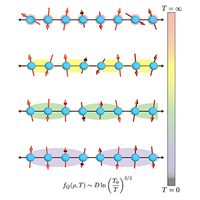
Multipartite entanglement in the one-dimensional spin-12 Heisenberg antiferromagnet

Varun Menon, Nicholas E. Sherman, Maxime Dupont, Allen O. Scheie, D. Alan Tennant, and Joel E. Moore

Phys. Rev. B 107, 054422 (2023) - Published 17 February, 2023

Multipartite entanglement was thought to be intrinsically difficult to measure in solids, but recent work has established connections between multipartite entanglement, dynamic susceptibilities, and neutron scattering data, via the quantum Fisher information. This work focuses on the paradigmatic spin-half chain and shows that there are further simplifications: even static structure factors contain quantitative information about multipartite entanglement at low temperatures. Theory, numerics, and experiment then suggest that a high degree of multipartite entanglement is observable in Heisenberg chain compounds, including KCuF3.

Magnetotransport induced by anomalous Hall effect

Jiaji Zhao, Bingyan Jiang, Jinying Yang, Lujunyu Wang, Hengjie Shi, Guang Tian, Zhilin Li, Enke Liu, and Xiaosong Wu

Phys. Rev. B 107, L060408 (2023) - Published 17 February, 2023

The authors demonstrate that the widely used empirical relation for the Hall effect of a magnetic metal, which treats ordinary and anomalous Hall resistivities on equal footing, is no longer valid when the ordinary or anomalous Hall angle is not small. They use a correct conductivity relation to predict several magnetotransport effects that can explain recent exotic observations in topological materials.

Antiferromagnetic real-space configuration probed by dichroism in scattered x-ray beams with orbital angular momentum

Margaret R. McCarter, Ahmad I. U. Saleheen, Arnab Singh, Ryan Tumbleson, Justin S. Woods, Anton S. Tremsin, Andreas Scholl, Lance E. De Long, J. Todd Hastings, Sophie A. Morley, and Sujoy Roy

Phys. Rev. B 107, L060407 (2023) - Published 15 February, 2023

Helical x rays carrying orbital angular momentum (OAM) are a promising addition to x-ray characterization techniques. Here, the authors study x-ray beams with OAM that are created by scattering from a topological defect in an artificial antiferromagnet. Helicity- and polarization-dependent x-ray scattering is used to distinguish two degenerate real-space magnetic configurations of the antiferromagnetic lattice — information that is usually inaccessible in scattering experiments with a Gaussian beam. This demonstrates the potential to use helical x rays for materials characterization.

Nodeless superconductivity in the noncentrosymmetric compound ThIrSi

D. Tay, T. Shang, Priscila F. S. Rosa, F. B. Santos, J. D. Thompson, Z. Fisk, H.-R. Ott, and T. Shiroka

Phys. Rev. B 107, 064507 (2023) - Published 14 February, 2023

ThIrSi is a noncentrosymmetric superconductor, where the presence of the heavy element Th results in a strong antisymmetric spin-orbit coupling (ASOC). A strong ASOC causes the splitting of the Fermi surface and may lead to unconventional triplet superconductivity or to multiband superconductivity. By combining μSR, NMR, and magnetometry measurements, the authors show here that, despite the strong ASOC, ThIrSi exhibits only nodeless superconductivity, most likely of multiband nature.

Charge quenching at defect states in transition metal dichalcogenide–graphene van der Waals heterobilayers

Daniel Hernangómez-Pérez, Andrea Donarini, and Sivan Refaely-Abramson

Phys. Rev. B 107, 075419 (2023) - Published 14 February, 2023

The electronic and spin properties of van der Waals materials are greatly influenced by the atomic features of the interface. Combining ab initio methods, model Hamiltonian, and quantum master equation, the authors calculate the electronic transition times and the dynamics of electron population and depopulation of chalcogen vacancies at the interface between graphene and transition metal dichalcogenides. Their findings give insight into the semiclassical dynamics, reveal the interplay between lattice symmetry and spin through the spin-orbit interaction, and examine its impact on the charge quenching.

Charge carrier density dependent Raman spectra of graphene encapsulated in hexagonal boron nitride

J. Sonntag, K. Watanabe, T. Taniguchi, B. Beschoten, and C. Stampfer

Phys. Rev. B 107, 075420 (2023) - Published 14 February, 2023

The authors use low-temperature Raman spectroscopy measurements on gate-tunable graphene encapsulated in hBN to explore in detail the Raman G and 2D mode frequencies and linewidths as function of the charge carrier density. This study provides a reference for Raman spectroscopy on ultraflat high-quality graphene (with a minimum 2D Raman line width of 14.5 cm−1) and is useful to investigate electron-phonon coupling and to benchmark graphene samples (including graphene-based heterostructures) when using Raman spectroscopy for process monitoring.

Surface dynamics of graphite probed by soft x-ray linear dichroism in Auger-emission yield

G. Schiwietz, T. Kachel, R. Mitzner, and K. Holldack

Phys. Rev. B 107, 054306 (2023) - Published 13 February, 2023

Element-specific investigation of the dynamics of surface atoms is not a trivial task. Here, the authors show that time-resolved near-edge x-ray absorption for strongly anisotropic excitation resonances – combined with Auger-electron detection – yields such information, whereby the small Auger-electron escape depth provides surface sensitivity. The method is applied to highly oriented graphite in a pump-probe scheme, based on femtosecond laser excitation and x-ray probe pulses with variable polarization direction and delay time, both of which influence transient changes in the KVV Auger yield.

Sign In to Your Journals Account

Filter

Section

Filter

Article Lookup

Enter a citation