Highlights

Free energy and specific heat near a quantum critical point of a metal

Shang-Shun Zhang, Erez Berg, and Andrey V. Chubukov

Phys. Rev. B 107, 144507 (2023) - Published 17 April, 2023

The authors examine the free energy and specific heat of fermions interacting with gapless bosons at a quantum critical point in a metal. Employing the Luttinger-Ward formula, they find that the total specific heat of the normal state is the sum of contributions from free fermions and critical bosons with a fully dressed propagator. They investigate several typical quantum critical points and confirm the thermal stability of the normal state for each case.

Neutron scattering sum rules, symmetric exchanges, and helicoidal magnetism in MnSb2O6

E. Chan, H. Lane, J. Pásztorová, M. Songvilay, R. D. Johnson, R. Downie, J-W. G. Bos, J. A. Rodriguez-Rivera, S.-W. Cheong, R. A. Ewings, N. Qureshi, and C. Stock

Phys. Rev. B 107, 144420 (2023) - Published 13 April, 2023

MnSb2O6 is a helicoidal magnetic that displays magnetic field induced ferroelectric switching. The magnetic ground state is complicated, requiring seven nearest-neighbor symmetric exchange constants. Given this underlying complex exchange network, the authors have applied zeroth- and first-moment sum rules of neutron scattering to a multiplexed data set, thereby extracting the symmetric Heisenberg exchange constants. These are then used to calculate long-wavelength excitations as a test of the stability of the cycloidal structure, validating the refined magnetic structure.

Superconductivity from electronic interactions and spin-orbit enhancement in bilayer and trilayer graphene

Alejandro Jimeno-Pozo, Héctor Sainz-Cruz, Tommaso Cea, Pierre A. Pantaleón, and Francisco Guinea

Phys. Rev. B 107, L161106 (2023) - Published 13 April, 2023

What drives superconductivity in non-moiré graphene? Here, an electron-electron mechanism is applied to the continuum framework of Bernal bilayer and rhombohedral trilayer graphene. Within a Kohn-Luttinger-like approach, the internal screening of the long-range Coulomb potential leads to an effective attraction between carriers, enabling the formation of Cooper pairs. The calculations provide a filling-dependent critical temperature that is remarkably enhanced due to Ising spin-orbit coupling, and determine the spin-triplet valley-singlet symmetry of the superconducting order parameter, in line with recent experimental advances.

Strong correlations in ABC-stacked trilayer graphene: Moiré is important

Adarsh S. Patri and T. Senthil

Phys. Rev. B 107, 165122 (2023) - Published 11 April, 2023

Recent experiments uncovering ferromagnetism and superconductivity in multilayer graphene have questioned the importance of moiré potentials in determining the myriad phenomena in two-dimensional materials. In this work, using Hartree-Fock analysis with a careful treatment of periodic potentials, the authors demonstrate that moiré potentials indeed crucially affect the strong correlation physics, with their impact as beyond that of a weak perturbation. In short: moiré is important.

Enhanced spin Seebeck effect in the paramagnetic phase of the three-dimensional Heisenberg antiferromagnet RbMnF3

J. D. M. de Lima, P. R. T. Ribeiro, F. L. A. Machado, and S. M. Rezende

Phys. Rev. B 107, L140406 (2023) - Published 11 April, 2023

The spin Seebeck effect (SSE) consists of the generation of a spin current in a magnetic material under a thermal gradient, detected by the electric current it produces in an attached metallic layer. Here, the authors report studies of the SSE in RbMnF3, a nearly isotropic, insulating antiferromagnet with a Néel temperature of 83 K. By varying the applied magnetic field, they observe the antisymmetric step variation typical of the SSE, both in the ordered and paramagnetic phases, even at room temperature.

Insulating vortex cores in disordered superconductors

Anushree Datta, Anurag Banerjee, Nandini Trivedi, and Amit Ghosal

Phys. Rev. B 107, L140502 (2023) - Published 11 April, 2023

In the standard paradigm, magnetic fields destroy superconductivity by creating Abrikosov vortices with metallic cores. Increasing field proliferates vortices, cores overlap, turning the system into a metal. In the disordered superconductors studied here, a starkly different scenario unfolds: Josephson vortices with insulating cores nucleate, long-range phase coherence of the superconductor and its energy-gap vanish at different critical fields, opening up a pseudogap region of Cooper-paired insulator. The resulting phase diagram uncovers an array of intriguing phenomena, including gigantic magnetoresistance peaks of disordered superconducting films.

Optical switch of electron-hole and electron-electron collisions in semiconductors

Yang Wang, Yu Liu, Pengzuo Jiang, Yunan Gao, Hong Yang, Liang-You Peng, Qihuang Gong, and Chengyin Wu

Phys. Rev. B 107, L161301 (2023) - Published 11 April, 2023

Optoelectronic information devices are being developed to achieve an ultrafast speed, an ultrasmall size, and an ultralow power consumption. Here, the authors demonstrate the precise switch of two light wave driven carrier dynamic processes in semiconductors by using a weak control laser. One is the electron-hole collision recombination leading to high-order harmonic generation. The other is the electron-electron impact excitation leading to stimulated simulation. This all-optical switch has an ultrafast speed, a low threshold, and a broad spectral responsiveness.

Image charge effect in layered materials: Implications for the interlayer coupling in MoS2

P. Marauhn and M. Rohlfing

Phys. Rev. B 107, 155407 (2023) - Published 7 April, 2023

Interlayer coupling often has profound effects on the electronic structure of layered materials. Its strength depends on the ratio between interlayer hopping and band offset. In multilayer materials, the image charge effect causes a layer-dependent variation of the band offset. Here, the authors study the effect of this variation on the interlayer coupling by combining the tight-binding method with an image self-energy. In MoS2, the image charge effect leads to the formation of a surface-layer band gap.

Theory of criticality for quantum ferroelectric metals

Avraham Klein, Vladyslav Kozii, Jonathan Ruhman, and Rafael M. Fernandes

Phys. Rev. B 107, 165110 (2023) - Published 6 April, 2023

Although ferroelectricity in metals was long considered to be impossible, a large family of materials hosting both states has been discovered in recent years, and these properties are often strongly coupled. The authors investigate here the quantum phase transition between the ferroelectric and paraelectric states in metals. They find unique quantum critical properties stemming from unconventional inversion-breaking fluctuations, along with enhanced tendencies to both spin singlet and triplet superconductivity, and provide protocols for strain control of the quantum state of these systems.

Electrostatic effects of MnBi2Te4-superconductor heterostructures in the chiral Majorana search

Li Chen, Zhan Cao, Ke He, Xin Liu, and Dong E. Liu

Phys. Rev. B 107, 165405 (2023) - Published 6 April, 2023

The realization of chiral Majorana modes is a significant and challenging task. The authors develop a self-consistent Schrödinger-Poisson method to study the electrostatic effect induced by the gate control. The electrostatic environment imposes constraints on both induced superconductivity and the tunability of the surface states, and therefore significantly influences the topological region compared to previous work. Their results provide a deep understanding of the real phase diagrams and parameter tunability of superconductor–quantum anomalous Hall insulator devices for the chiral Majorana search.

Reanalysis of experimental determinations of polariton-polariton interactions in microcavities

D. W. Snoke, V. Hartwell, J. Beaumariage, S. Mukherjee, Y. Yoon, D. M. Myers, M. Steger, Z. Sun, K. A. Nelson, and L. N. Pfeiffer

Phys. Rev. B 107, 165302 (2023) - Published 5 April, 2023

Inside solids, photons can become strongly interacting, which allows the possibility of optical transistors, in a which one light beam controls the transmission of another light beam. The strength of this interaction can be greatly increased in specially designed structures in which the photon frequency is near an electronic resonance known as an exciton. The exact value of this interaction strength has been much debated, ranging over orders of magnitude. This paper reviews a set of experiments and argues for a number well below some earlier estimates, but still large compared to the predictions of standard theory calculations.

Characteristic nanoscale deformation on a large-area coherent graphite moiré pattern

N. Sarkar, P. R. Bandaru, and R. C. Dynes

Phys. Rev. B 107, L161402 (2023) - Published 5 April, 2023

Highly oriented pyrolytic graphite (HoPG) is the only monoatomic crystal found to host naturally formed moiré patterns on its cleaved exfoliated surfaces, which are coherent over micrometers with fixed periodicities. The authors merge the idea of STM tip-induced deformation to probe in situ the gradual nanoscale structural changes on moiré patterns with strain. They show the first experimental proof that one-dimensional domain walls of moiré patterns can laterally split into two similar to the triangular networks of one-dimensional electronic channels in domain walls, topologically protected around AA nodes. Further, domain-wall edge states are also possibly probed with spectroscopy.

Photoinduced charge dynamics in 1T−TaS2

Francesco Petocchi, Jiyu Chen, Jiajun Li, Martin Eckstein, and Philipp Werner

Phys. Rev. B 107, 165102 (2023) - Published 3 April, 2023

Nonequilibrium cluster dynamical mean-field theory simulations of a realistic multilayer structure are used to study the charge carrier dynamics induced by a laser pulse in 1T-TaS2. The solution is propagated up to picosecond timescales and shows that long-lived charge excitations only exist in the surface state of a specific structure, while the disturbance of bonding states in the bilayers that make up the bulk of the structure explain the almost instantaneous appearance of in-gap states reported in recent experiments.

Persistent homology of quantum entanglement

Bart Olsthoorn

Phys. Rev. B 107, 115174 (2023) - Published 31 March, 2023

What shapes of entanglement are present in quantum states? Persistent homology provides an answer that contains both topological and geometrical information. This is a relatively new method from the field of topological data analysis, where shapes in discrete data are captured at varying length scales. In this case, the length scale is based on quantum mutual information, and the method is used to detect quantum phase transitions.

Orbital selective coupling in CeRh3B2: Coexistence of high Curie and high Kondo temperatures

Andrea Amorese, Philipp Hansmann, Andrea Marino, Peter Körner, Thomas Willers, Andrew Walters, Ke-Jin Zhou, Kurt Kummer, Nicholas B. Brookes, Hong-Ji Lin, Chien-Te Chen, Pascal Lejay, Maurits W. Haverkort, Liu Hao Tjeng, and Andrea Severing

Phys. Rev. B 107, 115164 (2023) - Published 29 March, 2023

Orbital selective coupling explains the exotic ferromagnetism in CeRh3B2, which combines a high Curie temperature, a strongly reduced ordered moment, strong intermediate valence, and a high Kondo temperature. The cigar-shaped Ce 4f |Jz = ½⟩ states couples with the Ce 5d states setting up the ferromagnetism, while the in-plane Ce 4f |Jz =⁵⁄₂⟩ hybridizes with the surrounding B states, forming the Kondo state. The image shows the crystal field potential of the Ce 4f states; the preferred directions of interaction are shown in blue, while the least favored ones are marked in red.

Supermoiré low-energy effective theory of twisted trilayer graphene

Yuncheng Mao, Daniele Guerci, and Christophe Mora

Phys. Rev. B 107, 125423 (2023) - Published 29 March, 2023

Twisted trilayer graphene features a supermoiré pattern on top of two moiré patterns between adjacent layers. Here, the authors have devised a supermoiré effective model for the staircase twisted trilayer graphene, manifesting a gauge field originating from non-Abelian Berry connection acting as a pseudo magnetic field, and a space-dependent anisotropic velocity for the low-energy Dirac electrons. The supermoiré low-energy band structures and profiles of density of states can therefore be accessed by solving the effective model numerically.

Unraveling the role of Sm 4f electrons in the magnetism of SmFeO3

Danila Amoroso, Bertrand Dupé, and Matthieu J. Verstraete

Phys. Rev. B 107, 104427 (2023) - Published 28 March, 2023

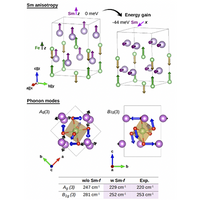
Magnetic rare-earth orthoferrite perovskites (RFeO3) host a variety of functional properties particularly suitable for next-generation, ultrafast spintronic devices. A key ingredient is the complex magnetic interaction at play between the two magnetic substructures. SmFeO3 has attracted particular interest because of its high-temperature spin reorientation transition and anomalous temperature-dependent lattice vibrational modes. Through first-principles calculations, the authors unveil here the interplay of the Sm-Fe exchange with the strong Sm f anisotropy as the dominant microscopic mechanism, and the nature of the anomalous vibrations.

Z2 spin Hopf insulator: Helical hinge states and returning Thouless pump

Penghao Zhu, A. Alexandradinata, and Taylor L. Hughes

Phys. Rev. B 107, 115159 (2023) - Published 28 March, 2023

The authors introduce here a time-reversal-symmetric analog of the Hopf insulator, dubbed as a spin Hopf insulator. The spin Hopf insulator harbors surface Kane-Mele ℤ2 order and gapless helical hinge modes. Remarkably, the spin Hopf insulator is the first example of a nonmagnetic delicate topological insulator with spin-orbital coupling. In the presence of fourfold rotational symmetry, the spin Hopf insulator also exhibits a returning Thouless pump. These studies of nonmagnetic spin Hopf insulators provide a pathway towards realizing a Hopf material in experiments.

From spin liquid to magnetic ordering in the anisotropic kagome Y-kapellasite Y3Cu9(OH)19Cl8: A single-crystal study

Dipranjan Chatterjee, Pascal Puphal, Quentin Barthélemy, Jannis Willwater, Stefan Süllow, Christopher Baines, Sylvain Petit, Eric Ressouche, Jacques Ollivier, Katharina M. Zoch, Cornelius Krellner, Michael Parzer, Alexander Riss, Fabian Garmroudi, Andrej Pustogow, Philippe Mendels, Edwin Kermarrec, and Fabrice Bert

Phys. Rev. B 107, 125156 (2023) - Published 28 March, 2023

Y3Cu9(OH)19Cl8, also known as Y-kapellasite, realizes an original anisotropic frustrated kagome model. Here, the authors study large phase-pure single crystals, obtained via an external gradient method, by susceptibility, specific heat, thermal expansion, neutron scattering, and local μSR and NMR techniques. These find subtle structural changes along with long-range magnetic ordering (1/3,1/3). Large quantum fluctuations reduce the Cu2+ moments, likely as a result of the proximity to a phase boundary in the rich magnetic phase diagram of the model.

Collective density fluctuations of strange metals with critical Fermi surfaces

Xuepeng Wang and Debanjan Chowdhury

Phys. Rev. B 107, 125157 (2023) - Published 28 March, 2023

A hallmark of a Fermi liquid is a collective excitation associated with fluctuations of the Fermi surface, which evolves into the well-known plasmon in the presence of Coulomb interactions. This paper addresses the fate of the plasmon excitation in non-Fermi liquid metals with a sharply defined Fermi surface, but where long-lived single-electron excitations are absent. The authors use two complementary theoretical techniques to analyze the collective density fluctuations and their decay into the two-particle continuum for three distinct solvable examples of non-Fermi liquids.

Sign In to Your Journals Account

Filter

Section

Filter

Article Lookup

Enter a citation