Highlights

Characterizing random-singlet state in two-dimensional frustrated quantum magnets and implications for the double perovskite Sr2CuTe1−xWxO6

Huan-Da Ren, Tian-Yu Xiong, Han-Qing Wu, D. N. Sheng, and Shou-Shu Gong

Phys. Rev. B 107, L020407 (2023) - Published 19 January, 2023

Understanding disorder-induced exotic states in two-dimensional magnets is one of the central topics in the study of frustrated magnetism. Here, the authors focus on the randomness-induced disordered phase in the spin-½ J1−J2 square-lattice Heisenberg model with a strong bond randomness, by using large-scale density matrix renormalization group (DMRG) simulations. The results not only reveal the absent spin-glass order, but also identify the power-law decay of the average spin correlation and the exponential decay of the typical spin correlation. These all agree with the corresponding behavior in the one-dimensional random-singlet state and characterize the random-singlet nature of this disordered phase. This shows that DMRG simulations provide opportunities for exploring the disorder effect in two-dimensional magnets.

Charge order with unusual star-of-David lattice in monolayer NbTe2

Taiki Taguchi, Katsuaki Sugawara, Hirofumi Oka, Tappei Kawakami, Yasuaki Saruta, Takemi Kato, Kosuke Nakayama, Seigo Souma, Takashi Takahashi, Tomoteru Fukumura, and Takafumi Sato

Phys. Rev. B 107, L041105 (2023) - Published 17 January, 2023

The authors fabricated a new two-dimensional material, monolayer NbTe2, and investigated its electronic states. They discovered a charge-density wave with a √19×√19 periodicity, accompanied by partially occupied metallic star-of-David clusters of Nb atoms, which is in sharp contrast to the fully occupied Mott-insulating monolayer NbSe2. Such an intriguing difference is found to originate from the underlying fermiology and hidden-Fermi-surface nesting. The present result lays the foundation for manipulating the two-dimensional Mott-insulator phase.

Influence of local symmetry on lattice dynamics coupled to topological surface states

Jonathan A. Sobota, Samuel W. Teitelbaum, Yijing Huang, José D. Querales-Flores, Robert Power, Meabh Allen, Costel R. Rotundu, Trevor P. Bailey, Ctirad Uher, Tom Henighan, Mason Jiang, Diling Zhu, Matthieu Chollet, Takahiro Sato, Mariano Trigo, Éamonn D. Murray, Ivana Savić, Patrick S. Kirchmann, Stephen Fahy, David A. Reis, and Zhi-Xun Shen

Phys. Rev. B 107, 014305 (2023) - Published 12 January, 2023

An ongoing challenge is to manipulate topological states using ultrafast pulses of light. One strategy is lattice engineering, whereby the surface state wavefunctions are modified through light-induced structural distortions. Here, the authors perform time-resolved photoemission, time-resolved diffraction, and theoretical calculations to reveal how topological surface states couple to photoinduced lattice vibrations. They show how the surface vibrational spectrum is qualitatively different from that of the bulk due to the translational and inversion symmetries broken at the surface.

Strain-coupled domains in BaTiO3(111)−CoFeB heterostructures

R. G. Hunt, K. J. A. Franke, P. M. Shepley, and T. A. Moore

Phys. Rev. B 107, 014409 (2023) - Published 12 January, 2023

The coupling of ferroelectric and ferromagnetic order holds promise for the realization of low-energy voltage-controlled multiferroic devices. Here, the authors show that using a (111)-oriented BaTiO3 substrate it is possible to create two distinct strain-coupled regions in a deposited CoFeB film, in which the in-plane magnetic easy axis rotates by either 60 or 120 degrees. These regions, which exist side by side in a sample heterostructure, contain different magnetic domain wall structures that exhibit different dependences on magnetic field.

Ab initio study of metastable occupation of tetrahedral sites in palladium hydrides and its impact on superconductivity

Antonella Meninno and Ion Errea

Phys. Rev. B 107, 024504 (2023) - Published 11 January, 2023

Palladium hydride is one of the rare examples of superconducting hydrides at ambient pressure, exhibiting a critical temperature of 10 K in its equilibrium structure, with hydrogen atoms occupying octahedral interstitial sites of the palladium fcc lattice. Making use of ab initio calculations considering quantum anharmonic lattice effects, the authors show here that full or partial occupation of tetrahedral sites is possible in metastable structures, but that their superconducting critical temperature is lower than the equilibrium case with full octahedral occupation.

Universal topological marker

Wei Chen

Phys. Rev. B 107, 045111 (2023) - Published 10 January, 2023

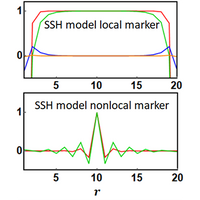
The topological order of Dirac models in any dimension and symmetry class can be mapped to lattice sites by a universal topological marker. From the topological operator that extracts this marker, one can further define a nonlocal marker that detects topological phase transitions. Several prototype models such as the Su-Schrieffer-Heeger model, Majorana chain, Chern insulator, Bernevig-Hughes-Zhang model, chiral and helical p-wave superconductors, three-dimensional time-reversal symmetric topological insulators, among many others, are employed to demonstrate the ubiquity of these markers.

Nature of visons in the perturbed ferromagnetic and antiferromagnetic Kitaev honeycomb models

Chuan Chen and Inti Sodemann Villadiego

Phys. Rev. B 107, 045114 (2023) - Published 10 January, 2023

The Kitaev honeycomb model features emergent anyons in the form of a Majorana fermion and a non-Abelian excitation known as the vison. While visons are static in the ideal model, certain perturbations can induce their motion. Here, it is demonstrated that the vison dynamics induced by Zeeman perturbations are sharply distinct in the ferromagnetic versus the antiferromagnetic model. Namely, in the ferromagnetic model the vison has a trivial translational symmetry and zero Berry curvature, whereas in the antiferromagnetic model it experiences a π flux per unit cell and has two bands with opposite Chern numbers, leading to an intrinsic contribution to the thermal Hall effect.

Andreev reflection spectroscopy in strongly paired superconductors

Cyprian Lewandowski, Étienne Lantagne-Hurtubise, Alex Thomson, Stevan Nadj-Perge, and Jason Alicea

Phys. Rev. B 107, L020502 (2023) - Published 6 January, 2023

One of the challenges in the pursuit of solid state BEC superconductors is the need for unambiguous experimental signatures. Here, the authors propose a new signature, relying on Andreev reflection, which distinguishes BEC from BCS superconductors. They demonstrate that, in a standard tunneling spectroscopy setup, a BEC superconductor exhibits suppressed Andreev reflection; however, if the tunneling barrier becomes a potential well, then appreciable Andreev reflection can be revived. Their predictions can be probed in various architectures that are also discussed.

Valence and magnetism in EuPd3S4 and (Y,La)xEu1−xPd3S4

D. H. Ryan, Sergey L. Bud'ko, Brinda Kuthanazhi, and Paul C. Canfield

Phys. Rev. B 107, 014402 (2023) - Published 5 January, 2023

The double Dirac candidate EuPd3S4 appears to exhibit a roughly 50:50 mixture of Eu2+ and Eu3+. Substituting yttrium rapidly drives the remaining europium divalent, whereas lanthanum has the opposite effect. Analysis shows that average site volumes play a dominant role in the valence distribution suggesting that local strains matter more than electron count. Remarkably, lanthanum substitution also promotes valence instability leading to the appearance of intermediate valence “Eu2.5+”, the fraction of which increases with both lanthanum content and temperature. Extrapolation of the onset temperature to zero lanthanum predicts Tonset ∼ 340 K matching recent reports of a structural transition attributed to a loss of valence order.

Optical properties and carrier localization in the layered phosphide EuCd2P2

C. C. Homes, Z.-C. Wang, K. Fruhling, and F. Tafti

Phys. Rev. B 107, 045106 (2023) - Published 5 January, 2023

The layered phosphide EuCd2P2 is a poor metal that is distinguished by an anomalous increase in the resistivity at ≃18 K, well above the Napos{e}el transition at TN≃11.5 K, by nearly two orders of magnitude, before reverting back to a metallic state below TN. The addition and removal of free carriers has a small effect on the optical conductivity. However, it has a dramatic effect on the electronic screening of the infrared-active lattice modes, yielding dramatically different line shapes in the reflectivity (see image), providing clues to the mechanism driving this unusual behavior.

Langevin dynamics of generalized spins as SU(N) coherent states

David Dahlbom, Cole Miles, Hao Zhang, Cristian D. Batista, and Kipton Barros

Phys. Rev. B 106, 235154 (2022) - Published 27 December, 2022

Quantum spin states often contain additional structure beyond the usual angular momentum dipole. The classical Landau-Lifshitz spin dynamics may be generalized to model the coupled dynamics of dipoles, quadrupoles, and higher order multipoles. This paper introduces temperature-dependent Langevin noise and damping terms to the generalized spin dynamics. High numerical efficiency is possible by working with coherent states in the Schrödinger picture. The method is illustrated via simulation of magnetic skyrmion dynamics both in and out of equilibrium.

Interwoven atypical quantum states in CeLiBi2

Mitchell M. Bordelon, Clément Girod, Filip Ronning, Km Rubi, Neil Harrison, Joe D. Thompson, Clarina dela Cruz, Sean M. Thomas, Eric D. Bauer, and Priscila F. S. Rosa

Phys. Rev. B 106, 214433 (2022) - Published 26 December, 2022

Typically, exotic quantum phases reside in different materials, but they can coexist given ideal conditions. This underexplored regime is realized in CeLiBi2, which is found to exhibit multiple atypical quantum phases including incommensurate cycloidal magnetic order, hard-axis metamagnetism, large and linear magnetoresistance, and mobile ultralight carriers. These results indicate that CeLiBi2 is an ideal material to experimentally and theoretically explore simultaneous quantum phenomena and their interdependent relationships.

Enhanced skyrmion metastability under applied strain in FeGe

M. T. Littlehales, L. A. Turnbull, M. N. Wilson, M. T. Birch, H. Popescu, N. Jaouen, J. A. T. Verezhak, G. Balakrishnan, and P. D. Hatton

Phys. Rev. B 106, 214434 (2022) - Published 26 December, 2022

Magnetic skyrmions offer a rich variety of exotic behaviors that have fascinated researchers in recent years. Here, the authors study the effects of mechanical strain on skyrmions in FeGe with x-ray magnetic holographic imaging and small angle x-ray scattering, and demonstrate enhancement of the metastable skyrmion energy barriers. Real-space imaging of the magnetization allows the authors to quantify the impact of strain on the magnetic spin textures, and discuss the effects of helical reorientations on skyrmion stability and metastability.

Temperature-dependent zero-field splittings in graphene

C. Bray, K. Maussang, C. Consejo, J. A. Delgado-Notario, S. Krishtopenko, I. Yahniuk, S. Gebert, S. Ruffenach, K. Dinar, E. Moench, J. Eroms, K. Indykiewicz, B. Jouault, J. Torres, Y. M. Meziani, W. Knap, A. Yurgens, S. D. Ganichev, and F. Teppe

Phys. Rev. B 106, 245141 (2022) - Published 26 December, 2022

The topological bandgap of graphene induced by intrinsic spin-orbit coupling is so narrow that it was experimentally identified for the first time only in 2019. In this work, the authors use a specific electron spin resonance technique, based on photoconductivity measurements using graphene-based terahertz detectors, to probe zero-field splittings of graphene as a function of temperature. They demonstrate experimentally that the intrinsic spin-orbit coupling and the staggered sublattice potential, which reduces the topological gap, are both temperature dependent.

Symmetry-dependent ultrafast manipulation of nanoscale magnetic domains

Nanna Zhou Hagström et al.

Phys. Rev. B 106, 224424 (2022) - Published 23 December, 2022

There are conflicting reports that ~100 femtosecond optical pumping causes ultrafast magnetic domain rearrangement. Such rearrangement implies a potential for unprecedented domain wall speeds. Ultrafast distortions in diffraction features via magnetic small angle x-ray scattering have been seen in some studies, while they have been absent in others. Here, the controversy is resolved by measuring a sample with domain-pattern symmetry varying from labyrinths to stripes. Importantly, spatial rearrangement occurs with labyrinths but not with stripes, suggesting novel and unexpected physics yet to be understood.

Spin Berry curvature of the Haldane model

Simon Michel and Michael Potthoff

Phys. Rev. B 106, 235423 (2022) - Published 21 December, 2022

The nearly adiabatic dynamics of magnetic moments exchange coupled to the spinful Haldane model, i.e., to a prototypical Chern insulator, is non-Hamiltonian due to the geometric spin torque. This results from the spin Berry curvature, which determines the feedback of the Berry phase, accumulated in the electron system, to the spin dynamics. Here, the authors study the spin Berry curvature in different parameter regimes, near a topological phase transition, and for magnetic moments coupled to the zigzag edge in a nanoribbon geometry.

Thermal conductivity and theory of inelastic scattering of phonons by collective fluctuations

Léo Mangeolle, Leon Balents, and Lucile Savary

Phys. Rev. B 106, 245139 (2022) - Published 21 December, 2022

Understanding thermal Hall conductivity poses a theoretical challenge in insulators, where low-energy excitations carry no charge. In undoped cuprates, where the signal is large, we expect phonons contribute significantly to the effect. While there is no obvious universal mechanism whereby phonons break time-reversal symmetry and acquire chirality, this paper provides a general treatment of the phonon Hall effect from the inelastic scattering of phonons off of other excitations in quantum materials. As an application, magnetoelastic coupling in square-lattice Néel antiferromagnets is investigated thoroughly using the formalism developed in the first part of the paper.

Current-enabled optical conductivity of superconductors

Michał Papaj and Joel E. Moore

Phys. Rev. B 106, L220504 (2022) - Published 20 December, 2022

While optical techniques are fundamental in the investigation of the superconducting state, in many clean superconductors the combination of particle-hole and inversion symmetries prevents momentum-conserving transitions. Here, the authors show that by driving supercurrent through the sample optical transitions across the superconducting gap become allowed even in clean single-band systems. As the signal depends strongly on the superconducting pairing as well as on the underlying normal state, supercurrent-driven optical conductivity provides a new way of determining the superconducting state properties.

Optical properties of SiV and GeV color centers in nanodiamonds under hydrostatic pressures up to 180 GPa

Baptiste Vindolet, Marie-Pierre Adam, Loïc Toraille, Mayeul Chipaux, Antoine Hilberer, Géraud Dupuy, Lukas Razinkovas, Audrius Alkauskas, Gergő Thiering, Adam Gali, Mary De Feudis, Midrel Wilfried Ngandeu Ngambou, Jocelyn Achard, Alexandre Tallaire, Martin Schmidt, Christoph Becher, and Jean-François Roch

Phys. Rev. B 106, 214109 (2022) - Published 19 December, 2022

The silicon-vacancy (SiV) and germanium-vacancy (GeV) centers in diamond have a sharp photoluminescence with high brightness. In this work, the photoluminescence of these centers is measured up to 180 GPa using nanodiamonds integrated in a diamond anvil cell. The results show blueshifts in the mean emission energy determined by the atomic radii of the impurity. The agreement with ab initio calculations based on the lattice compression of diamond demonstrates the potential of these centers for sensing under extreme pressure conditions.

Effects of leakage on the realization of a discrete time crystal in a chain of singlet-triplet qubits

Robert E. Throckmorton and S. Das Sarma

Phys. Rev. B 106, 245419 (2022) - Published 19 December, 2022

A chain of singlet-triplet qubits can be an excellent realization of the Ising model, which is in turn a good platform for realizing a discrete time crystal (DTC). However, leakage of the qubits out of their computational subspace may be a problem for such a realization. The authors show that, while leakage is indeed a serious problem for the realization of a DTC, it is not insurmountable - one can mitigate leakage by applying a magnetic field that alternates from one qubit to the next.

Sign In to Your Journals Account

Filter

Section

Filter

Article Lookup

Enter a citation