Highlights

Magnetic interactions in AB-stacked kagome lattices: Magnetic structure, symmetry, and duality

A. Zelenskiy, T. L. Monchesky, M. L. Plumer, and B. W. Southern

Phys. Rev. B 106, 144433 (2022) - Published 26 October, 2022

Magnetic compounds that combine the effects of geometric frustration and strong spin-orbit coupling (SOC) often host exotic magnetic phases. In many cases, anisotropic lattice-dependent interactions that originate from the SOC significantly reduce the symmetry of the system and constrain the magnetic moments to specific orientations. Using numerical simulations and symmetry analysis, this study demonstrates that, in compounds with the AB-stacked kagome layer structure, the anisotropy gives rise to a large number of duality transformations that provide exact mappings between the properties of distinct magnetic phases.

Chiral magnetic structure of spin-ladder multiferroic BaFe2Se3

W. G. Zheng, V. Balédent, E. Ressouche, V. Petricek, D. Bounoua, P. Bourges, Y. Sidis, A. Forget, D. Colson, and P. Foury-Leylekian

Phys. Rev. B 106, 134429 (2022) - Published 24 October, 2022

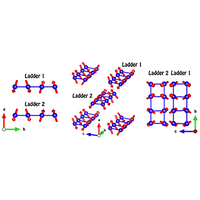
A complex magnetic structure with specific symmetry properties is a relevant ingredient for magnetoelectric multiferroicity. In BaFe2Se3, a member of the Fe spin-ladder family of pressure-induced superconductors, the authors reveal this complexity. Using polarized and unpolarized single-crystal neutron diffraction, they evidence a chiral, umbrella-like magnetic order made of blocks of quasiferromagnetic spins, antiferromagnetically ordered along the ladder. Such accurate information on the magnetism will help to understand the magnetoelectric coupling in this family and its puzzling phase diagram.

Laser-induced terahertz spin transport in magnetic nanostructures arises from the same force as ultrafast demagnetization

Reza Rouzegar, Liane Brandt, Lukáš Nádvorník, David A. Reiss, Alexander L. Chekhov, Oliver Gueckstock, Chihun In, Martin Wolf, Tom S. Seifert, Piet W. Brouwer, Georg Woltersdorf, and Tobias Kampfrath

Phys. Rev. B 106, 144427 (2022) - Published 24 October, 2022

The authors observe here that (a) laser-induced ultrafast demagnetization (UDM) of a metallic ferromagnet F has the same time evolution as (b) terahertz spin transport (TST) from F into an adjacent normal metal N. They conclude that UDM in F and TST in F|N samples are driven by the same force: (c) a generalized spin voltage, i.e., an excess magnetization of F. One can now apply the vast knowledge of UDM to TST to significantly increase spin-current amplitudes for ultrafast spintronic applications.

Flat bands and band-touching from real-space topology in hyperbolic lattices

Tomáš Bzdušek and Joseph Maciejko

Phys. Rev. B 106, 155146 (2022) - Published 24 October, 2022

Hopping models on geometrically frustrated lattices, such as the kagome and dice lattices, exhibit perfectly flat energy bands that result from eigenstates localized along contractible and/or noncontractible real-space loops. The degeneracy of such flat bands has been understood from an interplay of real-space topology and momentum-space band theory. Here, the authors generalize this paradigm to frustrated hyperbolic lattices, including those realized in recent circuit quantum electrodynamics experiments. They show that hyperbolic flat-band characteristics can similarly be understood by combining real-space topology arguments with the recently developed hyperbolic band theory.

Criticality and entanglement in nonunitary quantum circuits and tensor networks of noninteracting fermions

Chao-Ming Jian, Bela Bauer, Anna Keselman, and Andreas W. W. Ludwig

Phys. Rev. B 106, 134206 (2022) - Published 21 October, 2022

Entanglement dynamics in nonunitary quantum systems have been found to exhibit novel nonequilibrium quantum phase transitions and have attracted tremendous attention with connections to various aspects of quantum information theory. This work establishes, for systems of noninteracting fermions, an exact three-way correspondence between (i) nonunitary (as well as unitary) quantum circuits dynamics in d spatial dimensions; (ii) (d+1)-dimensional Gaussian tensor networks, and (iii) fermion systems in (d+1) spatial dimensions subject to unitary evolution with static Hamiltonians. Through this correspondence, d-dimensional random quantum circuits are connected with the classic subject area of Anderson localization in (d+1) spatial dimensions and consequently follow the “tenfold way’’ Altland-Zirnbauer classification. Selected examples of quantum circuits exhibiting entanglement phases and criticalities are used to illustrate these general principles.

Nonthermal current-induced transition from skyrmion lattice to nontopological magnetic phase in spatially confined MnSi

Takuro Sato, Wataru Koshibae, Akiko Kikkawa, Yasujiro Taguchi, Naoto Nagaosa, Yoshinori Tokura, and Fumitaka Kagawa

Phys. Rev. B 106, 144425 (2022) - Published 21 October, 2022

Whether a nonthermodynamic driving force, such as an electric current, can induce a global change like a thermodynamic phase transition of the whole system remains an open question. Here, the authors report on a current-driven skyrmion-to-nonskyrmion transition, detected both experimentally and numerically by targeting microscaled MnSi. This nonequilibrium phase change by current emerges when the system is spatially confined by an open boundary, suggesting that a range of novel nonequilibrium phenomena can be explored with attention to system size.

Dynamical l-bits and persistent oscillations in Stark many-body localization

Thivan M. Gunawardana and Berislav Buča

Phys. Rev. B 106, L161111 (2022) - Published 21 October, 2022

Stark many-body localization (MBL) occurs when interacting quantum particles are placed in a strong linear field gradient. Localization of excitations, coherent Bloch oscillations, Hilbert-space fragmentation, and scarring have been observed numerically and experimentally, but their origin is not understood. The authors explain these features analytically by perturbatively constructing an algebraic structure of Stark MBL Hamiltonians they name “dynamical l-bits”. These structures are exponentially stable in the field gradient strength. Thus, the work has potential implications for quantum information processing.

Sound attenuation in the hyperhoneycomb Kitaev spin liquid

Kexin Feng, Aysel Shiralieva, and Natalia B. Perkins

Phys. Rev. B 106, 144424 (2022) - Published 20 October, 2022

Here, the authors propose that phonon dynamics can be exploited to look for the signatures of fractionalization in three-dimensional Kitaev spin liquids. Motivated by recent studies of the hyperhoneycomb Kitaev material β-Li2IrO3, they compute the sound attenuation in the spin-phonon coupled Kitaev model on the hyperhoneycomb lattice, in which Majorana fermions have nodal-line band structure. They show that at low temperatures its angular dependence displays a characteristic pattern, which opens the possibility of detecting the proximity to the Kitaev spin liquid phase in this compound in ultrasound experiments.

Tuning domain wall conductivity in bulk lithium niobate by uniaxial stress

Ekta Singh, Henrik Beccard, Zeeshan H. Amber, Julius Ratzenberger, Clifford W. Hicks, Michael Rüsing, and Lukas M. Eng

Phys. Rev. B 106, 144103 (2022) - Published 19 October, 2022

Although ferroelectrics are electrical insulators, their domain walls (DWs) can be charged and can possess an exceptional large conductivity of an order of magnitude larger than in the bulk crystal. To shed light on the correlation between bound charges and conductivity of ferroelectric DWs, the authors in this work investigate the effect of piezoelectric charging via external uniaxial stress on the directionality of DW conductivity in single crystals of z-cut 5% MgO doped lithium niobate by combing a piezodriven stress cell with a scanning probe microscope.

Ultrafast perturbation of magnetic domains by optical pumping in a ferromagnetic multilayer

Dmitriy Zusin et al.

Phys. Rev. B 106, 144422 (2022) - Published 19 October, 2022

Ultrafast control of magnetism holds great promise for novel and efficient high-speed microelectronic devices. This includes manipulation of the domain walls that separate magnetic domains. Surprisingly, by use of a free-electron x-ray laser, the authors discover here that femtosecond laser pumping of a multidomain sample causes the domain walls to broaden from 29 to 51 nm in less than 1.6 picoseconds. They also find intriguing evidence of a simultaneous spatial rearrangement of domains. These unexpected results open new avenues for ultrafast optical manipulation of magnetism.

Crystal electric field and properties of 4f magnetic moments at the surface of the rare-earth compound TbRh2Si2

Artem V. Tarasov, Daria Glazkova, Susanne Schulz, Georg Poelchen, Kristin Kliemt, Alexej Kraiker, Matthias Muntwiler, Clemens Laubschat, Alexander Generalov, Craig Polley, Cornelius Krellner, Denis V. Vyalikh, and Dmitry Yu. Usachov

Phys. Rev. B 106, 155136 (2022) - Published 19 October, 2022

By means of 4f photoemission measurements and first-principles calculations, the authors demonstrate here how the crystal electric field (CEF) and related magnetic properties can be modified at the surface of rare-earth materials. For TbRh2Si2, CEF at the Tb surface makes the 4f moments orthogonal to those in the bulk. For the Tb layer below the Si termination, the temperature-dependent photoemission data reveal larger CEF splitting relative to the bulk. The methodology used here can facilitate unveiling of the surface magnetic properties of layered 4f systems.

Quantized bulk conductivity as a local Chern marker

Peru d'Ornellas, Ryan Barnett, and Derek K. K. Lee

Phys. Rev. B 106, 155124 (2022) - Published 13 October, 2022

Chern insulators display a remarkable insensitivity to spatial disorder and imperfections. Despite this, the Chern number itself is defined in momentum space, and can only be calculated in a clean crystalline material. The authors propose here a spatial Chern marker defined on physical grounds – as the local cross-conductivity around a chosen point in the bulk of the system. The formulation can be related to several other proposed local measures but has the advantage that it constitutes a physical observable of the system. Examples are probed, showing that it is quantized when calculated sufficiently far from the boundary and resistant against disorder.

Terahertz spectroscopy of spin excitations in magnetoelectric LiFePO4 in high magnetic fields

L. Peedu, V. Kocsis, D. Szaller, B. Forrai, S. Bordács, I. Kézsmárki, J. Viirok, U. Nagel, B. Bernáth, D. L. Kamenskyi, A. Miyata, O. Portugall, Y. Tokunaga, Y. Tokura, Y. Taguchi, and T. Rõõm

Phys. Rev. B 106, 134413 (2022) - Published 12 October, 2022

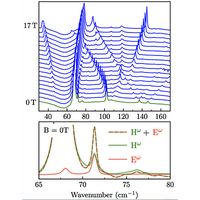
Magnetoelectric multiferroics feature crosscoupling between magnetic and charge order. Here, the authors study the absorption of electromagnetic radiation by spin waves in magnetoelectric LiFePO4 in the terahertz (THz) spectral range. Using linearly polarized THz radiation, they establish that there are spin waves that interact with magnetic and electric components of radiation. This is unusual for electron spins since they are susceptible to magnetic fields only. Another striking observation is that the number of spin-wave modes in the THz spectrum exceeds four times the number of modes expected for a four-spin system. Using the mean-field model and the magnetic field dependence of the THz spectra, the authors identify four conventional spin-wave modes in LiFePO4. It is proposed that other THz-active spin-wave modes are more exotic quadrupolar excitations, such as spin-stretching modes and two-magnon excitations.

Direct visualization and control of antiferromagnetic domains and spin reorientation in a parent cuprate

K. L. Seyler, A. Ron, D. Van Beveren, C. R. Rotundu, Y. S. Lee, and D. Hsieh

Phys. Rev. B 106, L140403 (2022) - Published 12 October, 2022

The mesoscopic magnetism of undoped cuprates is not well studied because the antiferromagnetic states and domain walls are difficult to locally detect. The authors overcome this challenge using optical second-harmonic generation on the cuprate Sr2Cu3O4Cl2, allowing direct visualization of the antiferromagnetic microstructure. They discover an unusual 90° domain reorientation transition, which enables deterministic antiferromagnetic switching and causes a divergent domain wall susceptibility that generates sample-sized single-domain antiferromagnetic states.

Parametric resonance of spin waves in ferromagnetic nanowires tuned by spin Hall torque

Liu Yang, Alejandro A. Jara, Zheng Duan, Andrew Smith, Brian Youngblood, Rodrigo E. Arias, and Ilya N. Krivorotov

Phys. Rev. B 106, 144410 (2022) - Published 10 October, 2022

Edge magnons play a key role in the magnetization reversal of ferromagnetic nanoelements and may find applications in the field of magnonics. The authors tune the parametric excitation of edge magnons in ferromagnetic nanowires by spin Hall torque in order to probe the magnon ellipticity. The study reveals that the edge magnon ellipticity is significantly lower than that predicted by a simple model of the magnetic edge. This work presents a sensitive probe of magnetic properties at nanoelement edges.

Fast high-fidelity single-qubit gates for flip-flop qubits in silicon

F. A. Calderon-Vargas, Edwin Barnes, and Sophia E. Economou

Phys. Rev. B 106, 165302 (2022) - Published 10 October, 2022

Flip-flop qubits, encoded in the antiparallel spin states of electron and nuclear spins in phosphorus donors in silicon, are promising for quantum processors due to their long coherence times, long-range two-qubit coupling, and CMOS compatibility. However, the large Hilbert space complicates understanding and controlling the dynamics. In this work, the authors use sophisticated techniques to derive effective flip-flop qubit Hamiltonians and design optimal control pulses that implement high-fidelity single-qubit gates that are much faster and more robust than previous proposals.

Observing quasiparticles through the entanglement lens

Yizhi You, Elisabeth Wybo, Frank Pollmann, and S. L. Sondhi

Phys. Rev. B 106, L161104 (2022) - Published 10 October, 2022

The quantum entanglement of a wave function generates the information entropy carried by each qubit of the many-body system and correspondingly creates unique quantum matter. In this work, the authors attempt to visualize distinct quasiparticles and collective motions from an entanglement perspective. Remarkably, many salient features of the quasiparticles, including their quantum numbers, locality, and fractionalization, are reflected in the entanglement spectrum and in the mutual information.

Ground state of Ce3Bi4Pd3 unraveled by hydrostatic pressure

M. O. Ajeesh, S. M. Thomas, S. K. Kushwaha, E. D. Bauer, F. Ronning, J. D. Thompson, N. Harrison, and P. F. S. Rosa

Phys. Rev. B 106, L161105 (2022) - Published 10 October, 2022

Noncentrosymmetric Ce3Bi4Pd3 has recently attracted tremendous attention as a strongly correlated topological semimetal candidate. Conflicting experimental results, however, argue for either a Weyl Kondo semimetallic or a narrow-gap Kondo insulating ground state. Using electrical transport measurements on bulk crystals and microstructure devices under hydrostatic pressure, the authors show that Ce3Bi4Pd3 exhibits a narrow-gap Kondo insulating ground state. The results provide important evidence for the ground state of a sought-after Weyl Kondo semimetal candidate and shed light on the experimental and theoretical search for strongly correlated topological materials.

Competing quantum spin liquids, gauge fluctuations, and anisotropic interactions in a breathing pyrochlore lattice

Li Ern Chern, Yong Baek Kim, and Claudio Castelnovo

Phys. Rev. B 106, 134402 (2022) - Published 4 October, 2022
Geometric frustration in spin systems offers potential routes to realize unusual phases of matter. The authors consider emergent quantum spin liquids of interacting S=1/2 moments on the pyrochlore lattice with a breathing anisotropy, where two inequivalent sets of tetrahedra are present. They classify possible Z2 and U(1) quantum spin liquids in this system and find a small number of physically motivated candidates. In particular, two degenerate U(1) spin liquids are identified for the antiferromagnetic Heisenberg model. The degeneracy is robust with respect to tuning the breathing anisotropy, but it can be lifted by a finite Dzyaloshinskii-Moriya interaction. The effect of gauge fluctuations in a gapless U(1) spin liquid is investigated for comparison with future experiments.

Ferroaxial moment induced by vortex spin texture

Satoru Hayami

Phys. Rev. B 106, 144402 (2022) - Published 4 October, 2022

An electric ferroaxial moment is a fundamental dipole moment like the ferroelectric, ferromagnetic, and ferromagnetic-toroidal moments. Nevertheless, its nature has been masked compared to the ferromagnetic and ferroelectric cases. Based on symmetry and microscopic-model analyses, the author reveals when and how such a ferroaxial entity appears in magnetic materials. It is demonstrated that a vortex spin configuration naturally induces a ferroaxial moment. The finding will stimulate future exploration of magnetic ferroaxial materials.

Sign In to Your Journals Account

Filter

Section

Filter

Article Lookup

Enter a citation