Highlights

Quantum criticality using a superconducting quantum processor

Maxime Dupont and Joel E. Moore

Phys. Rev. B 106, L041109 (2022) - Published 13 July, 2022

Noisy intermediate-scale quantum (NISQ) computers are a promising platform for solving quantum many-body problems. Here, the authors access the universal properties emerging at the transition between different quantum phases of matter on a superconducting chip, obtain scaling laws and estimate critical exponents. Classical emulations reveal how these estimates converge with larger-scale systems and decreasing noise. Moreover, the authors show that the effect of noise is analogous to that of temperature for the many-body system. It can be accounted for without any prior knowledge through modified scaling laws, enhancing the power of NISQ processors considerably for addressing quantum criticality and potentially other phenomena and algorithms.

Combined surface x-ray diffraction and density functional theory study of the germanene/Al(111)-(7×7)R19.1∘ structure

K. Zhang, M.-C. Hanf, D. Sciacca, R. Bernard, Y. Borensztein, A. Resta, Y. Garreau, A. Vlad, A. Coati, I. Lefebvre, M. Derivaz, C. Pirri, P. Sonnet, R. Stephan, and G. Prévot

Phys. Rev. B 106, 045412 (2022) - Published 12 July, 2022

Several papers have reported the epitaxial growth of germanene, a honeycomb layer of Ge atoms. However, these studies are controversial due to a lack of precise structural analyses. Here, the authors combine surface x-ray diffraction with density functional theory calculations to demonstrate that Ge deposited on Al(111) at room temperature forms a surface alloy, organized in a Ge3Al3 honeycomb structure, and not a germanene layer as previously reported.

Unbiased identification of the Griffiths phase in intercalated transition metal dichalcogenides by using Lee-Yang zeros

A. S. Ovchinnikov, J. G. Ruziev, N. M. Nosova, E. M. Sherokalova, N. V. Selezneva, and N. V. Baranov

Phys. Rev. B 106, L020401 (2022) - Published 12 July, 2022

The Griffiths phase, consisting of ordered magnetic clusters, may arise in a nominally paramagnetic state. However, univocal identification of this peculiar state in materials still remain elusive. Here, the authors show that the problem may be resolved by verification of a scaling law specific to the Griffiths phase. Analyzing magnetization data in intercalated titanium and the niobium dichalcogenides FexTiS2 and CrxNbSe2 with the aid of the scaling law, the compounds with and without the Griffiths phase can be unambiguously identified.

Antibonding ground states in crystal phase quantum dots

Martyna Patera and Michał Zieliński

Phys. Rev. B 106, L041405 (2022) - Published 12 July, 2022

Atomistic approaches enable computational studies ofnanostructures with unusual properties. Here, the authors showthat the indium phosphate zinc-blende section embedded in a wurtzitenanowire, thus forming so-called crystal phase quantum dots, mayexhibit a rare antibonding hole ground state. The authors also findthat even a small lattice mismatch at the wurtzite/zinc-blendeinterface can profoundly mix the lowest hole states, resulting inunusual double-peak features in the excitonic optical spectra. Furtherresearch is, however, needed to determine strained band offsets inpolytype homostructures, allowing for better agreement betweenexperiment and theory.

Magnetization dynamics affected by phonon pumping

Richard Schlitz, Luise Siegl, Takuma Sato, Weichao Yu, Gerrit E. W. Bauer, Hans Huebl, and Sebastian T. B. Goennenwein

Phys. Rev. B 106, 014407 (2022) - Published 11 July, 2022

Combining the ultralow attenuation of phonon modes with the widely tunable properties of magnetic waves opens an avenue for improving magnon-based applications. In high-resolution experiments and corresponding modeling, the authors find here that the mode overlap between phonon and magnon modes is the key parameter governing the magnon-phonon interaction. Furthermore, they observe a transition from the high cooperativity regime to the weak coupling regime, where the magnon-phonon interaction gives rise to a broadband emission of phonons by the excited magnetization dynamics.

Colossal piezoresistance in narrow-gap Eu5In2Sb6

S. Ghosh, C. Lane, F. Ronning, E. D. Bauer, J. D. Thompson, J.-X. Zhu, P. F. S. Rosa, and S. M. Thomas

Phys. Rev. B 106, 045110 (2022) - Published 11 July, 2022

A remarkably large reduction in the electrical resistivity of the quantum material Eu5In2Sb6 is discovered as a function of applied uniaxial pressure. This phenomenon, called colossal piezoresistance, is linked to a colossal magnetoresistance effect previously observed in this material. There is a common origin for the two phenomena, namely the interaction-driven formation of magnetic metallic clusters in semiconducting Eu5In2Sb6. These results will aid our understanding of colossal magnetoresistance and piezoresistance effects in a broad set of quantum materials.

Ephemeral data derived potentials for random structure search

Chris J. Pickard

Phys. Rev. B 106, 014102 (2022) - Published 7 July, 2022

First-principles structure prediction enables the computational discovery of materials with extreme, or exotic properties. A notable example being the dense hydrides, which, following computational searches, were found to exhibit high-Tc superconductivity. The rapid construction of ephemeral, or disposable, interatomic potentials, dramatically accelerates the exploration of energy landscapes, even accounting for the time to create the potentials. This approach is used to uncover a complex and overlooked phase of dense silane, suggesting that the binary hydrides should be revisited.

Tracking the evolution from isolated dimers to many-body entanglement in NaLuxYb1−xSe2

Luke Pritchard Cairns, Ryan Day, Shannon Haley, Nikola Maksimovic, Josue Rodriguez, Hossein Taghinejad, John Singleton, and James Analytis

Phys. Rev. B 106, 024404 (2022) - Published 7 July, 2022

Detecting signatures of many-body entanglement in frustrated magnetic systems remains a grand challenge in condensed matter. In this work, the authors show that this problem can be made more tractable by looking at the evolution of dilute magnetic systems to fully packed frustrated magnets. They study the system NaLu1−xYbxSe2 as a model example, showing evidence that single defects evolve into entangled dimers, which in turn evolve into entangled multimers as x approaches unity.

Geometric energy transport and refrigeration with driven quantum dots

Juliette Monsel, Jens Schulenborg, Thibault Baquet, and Janine Splettstoesser

Phys. Rev. B 106, 035405 (2022) - Published 5 July, 2022

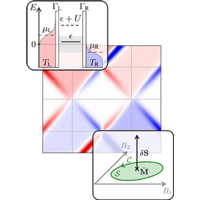
Geometric energy transport is of high interest both for spectroscopy of quantum devices and as a way to realize cyclic thermal machines at the nanoscale. Using a recently discovered dissipative symmetry, this work derives compact and insightful analytical expressions characterizing energy pumping with a slowly driven quantum dot subject to strong many-body interactions. Equipped with these results, the authors analyze the dot as a refrigerator or a heat pump, revealing a direct link between its efficiency and its well-known steady-state thermoelectric properties.

Negative-chirality order in the S=12 kagome antiferromagnet CdCu3(OH)6(NO3)2·H2O

Yoshihiko Ihara, Ryoga Hiyoshi, Masakazu Shimohashi, Kaoru Hayashi, Ryutaro Okuma, Fabio Orlandi, Pascal Manuel, Gøran J. Nilsen, and Zenji Hiroi

Phys. Rev. B 106, 024401 (2022) - Published 1 July, 2022

By the complementary combination of NMR and neutron diffraction measurements, and a symmetry analysis using the previously reported magnetization measurements, a negative-chirality q=0 magnetic structure is successfully identified as the ground state of CdCu3(OH)6(NO3)2⋅H2O, the S=½ perfect kagome antiferromagnet. Detailed investigation of the internal fields leads the authors to suggest a spin-locked magnetic structure with <100> anisotropy, which is stabilized by the Dzyaloshinskii-Moriya interaction and the interactions slightly modified by the orientational order of the NO3 units.

Nonequilibrium quasistationary spin disordered state in α−RuCl3

R. B. Versteeg, A. Chiocchetta, F. Sekiguchi, A. Sahasrabudhe, J. Wagner, A. I. R. Aldea, K. Budzinauskas, Zhe Wang, V. Tsurkan, A. Loidl, D. I. Khomskii, S. Diehl, and P. H. M. van Loosdrecht

Phys. Rev. B 105, 224428 (2022) - Published 30 June, 2022

The authors use optical excitation as a way to alter the magnetic free energy landscape and the resulting phase diagram of the frustrated honeycomb magnet α-RuCl3. They time-track experimentally the magneto-optical response from the α-RuCl3’s zigzag-ordered ground state after photoexcitation and they reproduce the observed dynamics within a Ginzburg-Landau model. A quasistationary spin disordered state is induced above a critical photoexcitation density, suggesting a new route to reach a nontrivial spin disordered state in Kitaev-like magnets such as α-RuCl3.

Classification of (2+1)D invertible fermionic topological phases with symmetry

Maissam Barkeshli, Yu-An Chen, Po-Shen Hsin, and Naren Manjunath

Phys. Rev. B 105, 235143 (2022) - Published 29 June, 2022

Integer quantum Hall states and their generalization to topological insulators and superconductors are paradigmatic examples of invertible fermionic topological states of matter. Here, the authors develop a comprehensive characterization and classification of invertible fermionic topological phases of matter in two spatial dimensions for general symmetry groups. The results are nonperturbative and apply to strongly interacting systems. In particular, they extend previous classification results to account for the possible chiral nature of invertible phases.

Probing the interlayer coupling in 2H−NbS2 via soft x-ray angle-resolved photoemission spectroscopy

D. Huang, H. Nakamura, K. Küster, U. Wedig, N. B. M. Schröter, V. N. Strocov, U. Starke, and H. Takagi

Phys. Rev. B 105, 245145 (2022) - Published 29 June, 2022

One secret to the charm of two-dimensional (2D) van der Waals materials is that their interlayer coupling lies in a sweet spot: weak enough to render the individual layers electronically quasi-2D, yet strong enough to produce distinct behavior upon stacking individual layers. Here, the authors utilize soft-x-ray angle-resolved photoemission spectroscopy to extract the interlayer hopping parameters in the typical transition metal dichalcogenide 2H-NbS2. Comparison with first-principles calculations reveals the influence of atomic distances and hybrid functionals on interlayer coupling.

Renormalization group analysis of the finite two-dimensional XY model with fourfold anisotropy: Application to the magnetic susceptibility of a ferromagnetic ultrathin film

D. Venus

Phys. Rev. B 105, 235440 (2022) - Published 28 June, 2022

The topological phase transition introduced by Kosterlitz and Thouless has become a central concept in condensed matter physics. With the increasing relevance of topological phases to applications in spintronics, it is important to extend the description of the Kosterlitz-Thouless transition in an infinite, isotropic two-dimensional XY ferromagnet to experimentally realizable systems such as a finite, anisotropic ultrathin film with fourfold in-plane anisotropy. Using a renormalization group analysis, this description is used to calculate the magnetic susceptibility for comparison to experiment.

Entanglement transitions from stochastic resetting of non-Hermitian quasiparticles

Xhek Turkeshi, Marcello Dalmonte, Rosario Fazio, and Marco Schirò

Phys. Rev. B 105, L241114 (2022) - Published 28 June, 2022

Entanglement is a key tool to classify quantum phases of matter in and out of equilibrium. Here, the authors introduce a phenomenological quasiparticle picture for entanglement dynamics in monitored systems evolving under the effect of quantum jumps. Within this picture, entanglement is carried by non-Hermitian quasiparticles, associated to the no-click limit of the measurement protocol, that propagate ballistically and are randomly reset with a rate given by their inverse lifetime. The authors show how this picture qualitatively reproduces the entanglement transition in the monitored Ising chain.

Fluctuation-induced odd-frequency spin-triplet pairing in a disordered electron liquid

Vladimir A. Zyuzin and Alexander M. Finkel'stein

Phys. Rev. B 105, 214523 (2022) - Published 27 June, 2022

The authors mix fluctuations of different origin to obtain pairing in the odd-frequency spin-triplet channel. Such fluctuations are enhanced in disordered two-dimensional systems, and the pairing is predicted to be sufficient for the instability in the odd-frequency spin-triplet channel.

Fluctuating spin-orbital texture of Rashba-split surface states in real and reciprocal space

Takuto Nakamura, Yoshiyuki Ohtsubo, Ayumi Harasawa, Koichiro Yaji, Shik Shin, Fumio Komori, and Shin-ichi Kimura

Phys. Rev. B 105, 235141 (2022) - Published 27 June, 2022

Spin-orbit interaction in a crystal surface typically causes helical spin polarization, namely topological or Rashba states. The authors have noticed that the known cases of such surface spin polarization are limited to ideal models because of the symmetry operations in the surface atomic structure. Here, they reveal numerous hidden surface spin textures in a surface quasi-1D system, which vary from ferromagnetic to antiferromagnetic depending on the wave vector, with a small number of symmetry operations. This achievement suggests that versatile spin texture at the surface would be tailored by tuning the symmetry operations.

Conditional probability density functional theory

Ryan Pederson, Jielun Chen (陈捷伦), Steven R. White, and Kieron Burke

Phys. Rev. B 105, 245138 (2022) - Published 24 June, 2022

Conditional probability density functional theory (CP-DFT) determines the ground-state energy of a many-electron system by finding the conditional probability density from a parallelizable series of Kohn-Sham DFT calculations. By directly calculating conditional probability densities, the authors bypass the need for an approximate exchange-correlation (XC) energy functional. CP-DFT is formally exact, but approximate potentials are used in practice. We explore a suitable approximation that satisfies many presented exact constraints and even properly dissociates neutral hydrogen chains.

Scattering of spin waves by a Bloch domain wall: Effect of the dipolar interaction

Victor Laliena, Athanasios Athanasopoulos, and Javier Campo

Phys. Rev. B 105, 214429 (2022) - Published 23 June, 2022

It is known that if the dipolar interaction is ignored or replaced by an effective magnetic anisotropy, the theoretical computations predict that a domain wall is transparent to spin waves. Taking into account the full complexity of this interaction, the authors show that the domain wall does indeed reflect spin waves. The scattering parameters are computed by treating the dipolar interaction perturbatively in the Born approximation, which is not straightforward due to the nonlocality of this interaction. A lateral shift of the scattered waves is also predicted.

Unveiling the spin-singlet states of two electron-hole pair complexes using two-photon excitation in a GaAs/AlAs quantum dot

S. Germanis, P. Atkinson, A. Bach, R. Hostein, R. Braive, M. Vabre, F. Margaillan, M. Bernard, V. Voliotis, and B. Eble

Phys. Rev. B 105, 235430 (2022) - Published 23 June, 2022

The ability to initialize excitonic states in the high-energy orbital levels of quantum dots provides additional degrees of freedom for all-optical spin-driving protocols. Here, the authors show that unconventional two-photon excitation can simultaneously photocreate two electron-hole pairs located on distinct orbital levels of a GaAs quantum dot. Tuning the laser energy allows the triplet and singlet spin states of the biexciton to be selectively addressed. The measured radiative cascades suggest the importance of many-body effects in these weakly confined dots.

Sign In to Your Journals Account

Filter

Section

Filter

Article Lookup

Enter a citation