Highlights

Improved estimator for numerical renormalization group calculations of the self-energy

Fabian B. Kugler

Phys. Rev. B 105, 245132 (2022) - Published 23 June, 2022

The numerical renormalization group is the gold standard for solving quantum impurity models. To compute the self-energy, one routinely employs an equation of motion instead of inverting Dyson’s equation. Still, in challenging regimes, the results often suffer from artifacts. The author shows here that a new estimator, derived by a twofold application of the equation of motion, yields greatly improved results, as key aspects of the retarded self-energy require only the imaginary parts of auxiliary correlators and not their real parts obtained by a Kramers-Kronig transform.

Bound states in the continuum in multipolar lattices

Sergei Gladyshev, Artem Shalev, Kristina Frizyuk, Konstantin Ladutenko, and Andrey Bogdanov

Phys. Rev. B 105, L241301 (2022) - Published 22 June, 2022

A general theory of bound states in the continuum (BICs) in multipolar lattices composed of Mie-resonant or plasmonic nanoparticles is developed. It is revealed that the BICs, which are usually very sensitive to parameters of the photonic structure, can be completely robust, remaining pinned to specific directions in k space. The developed approach sets a direct relation between the topological charge of BIC and the asymptotic behavior of its Q factor that is important for engineering the photonic structures supporting BICs.

Beyond the freshman's dream: Classical fractal spin liquids from matrix cellular automata in three-dimensional lattice models

Sounak Biswas, Yves H. Kwan, and S. A. Parameswaran

Phys. Rev. B 105, 224410 (2022) - Published 21 June, 2022

The Newman-Moore model on the 2D triangular lattice is a classic example of a statistical mechanical model with immobile fractal excitations: fractons. These result in kinetic constraints leading to glassy behavior. Here, the authors generalize this construction to two 3D lattices, trillium and hyperhyperkagome. While these models exhibit a similar phenomenology, the authors show that the underlying fractons have a richer structure and are intimately connected to the matrix cellular automata that describe the manifold of ground states.

Band filling effects on the emergence of magnetic skyrmions: Pd/Fe and Pd/Co bilayers on Ir(111)

I. P. Miranda, A. B. Klautau, A. Bergman, and H. M. Petrilli

Phys. Rev. B 105, 224413 (2022) - Published 21 June, 2022

Structurally similar transition metal systems can exhibit very different magnetic properties. An instructive example is the widely studied Pd/Fe/Ir(111) multilayer, which shows a spin-spiral ground state, while Pd/Co/Ir(111) presents a ferromagnetic (single-domain) ground state. Here, the authors analyze the origin of this difference combining ab initio and atomistic spin-dynamics calculations, demonstrating that the distinct behaviors can be explained by a simple rigid-band-like model. This analysis highlights the possibility of tuning topological magnetic structures by alloying and/or external agents, e.g., electric fields.

In-plane anisotropic charge dynamics in the layered polar Dirac semimetal BaMnSb2

H. Yoshizawa, H. Sakai, M. Kondo, M. Ochi, K. Kuroki, N. Hanasaki, and J. Fujioka

Phys. Rev. B 105, L241110 (2022) - Published 15 June, 2022

The layered antiferromagnet BaMnSb2 is a polar Dirac semimetal with asymmetrically distorted Sb square lattice. By means of optical spectroscopy and ab initio calculations, the authors show here that the lattice asymmetry causes large in-plane anisotropy in the quasi-two-dimensional Dirac band. It is likely that the intersite orbital hybridization in the direction perpendicular to the zigzag chain in the distorted Sb square lattice is selectively reduced due to the crystal symmetry, resulting in a highly anisotropic band dispersion.

Challenges to observation of many-body localization

Piotr Sierant and Jakub Zakrzewski

Phys. Rev. B 105, 224203 (2022) - Published 14 June, 2022

Many-body localization (MBL) freezes the dynamics of a disordered quantum interacting system, inhibiting thermalization and resulting in a persistent memory of the initial state. Here, with the help of extensive numerical simulations, the authors find slow decay of the imbalance, a quantity often employed in experimental studies of MBL, even though the disorder strength considerably exceeds the current estimates of the position of the MBL transition. This suggests a slow approach to thermal equilibrium and identifies challenges for unequivocal numerical and experimental demonstrations of MBL.

Solvable theory of a strange metal at the breakdown of a heavy Fermi liquid

Erik E. Aldape, Tessa Cookmeyer, Aavishkar A. Patel, and Ehud Altman

Phys. Rev. B 105, 235111 (2022) - Published 13 June, 2022

The authors introduce exactly solvable models of the quantum phase transition, marking the breakdown of the heavy Fermi liquid in heavy-fermion materials. The solutions capture the puzzling non-Fermi liquid transport with linear-in-temperature resistivity, as seen in experiments. Furthermore, they reveal a broad regime in which a “Planckian” strange metal is established, namely the quasiparticle lifetime in this regime is set only by fundamental constants and the temperature. The new large-N approach introduced in the paper may be useful for describing a broader class of quantum critical points in systems with strong electronic correlations.

Reduced crystal symmetry as the origin of the ferroelectric polarization within the incommensurate magnetic phase of TbMn2O5

N. Narayanan, P. J. Graham, P. Rovillain, J. O’Brien, J. Bertinshaw, S. Yick, J. Hester, A. Maljuk, D. Souptel, B. Büchner, D. Argyriou, and C. Ulrich

Phys. Rev. B 105, 214413 (2022) - Published 10 June, 2022

The precise crystal symmetry, and hence the emergence of the electric polarization, still remains an open question in multiferroic RMn2O5 (R=rare earth, Bi, Y). While previous diffraction studies have indicated the centrosymmetric space group Pbam, an atomic displacement allowing for electric polarization would require a noncentrosymmetric symmetry. Here, single-crystal neutron diffraction experiments on TbMn2O5 provide direct evidence of a reduced crystallographic symmetry with the polar space group P1211 already above the multiferroic phase transition, indicating that a symmetric Si⋅Sj spin coupling, i.e., magnetostriction is the dominant mechanism in the commensurate magnetic phase.

Enhancement of giant magnetoelectric effect in Ni-doped CaBaCo4O7

M. Gen, A. Miyake, H. Yagiuchi, Y. Watanabe, A. Ikeda, Y. H. Matsuda, M. Tokunaga, T. Arima, and Y. Tokunaga

Phys. Rev. B 105, 214412 (2022) - Published 9 June, 2022

The polar ferrimagnet CaBaCo4O7 exhibits the largest magnetic field driven electric polarization change ΔP reported so far in a narrow temperature range. Here, the authors demonstrate that only 2.5% of Ni substitution for Co increases the magnitude of ΔP by about 30%, as well as expanding the temperature range in which the giant ΔP appears down to a low temperature. This is attributable to the switching of the low-temperature zero magnetic field state from a ferrimagnetic to an antiferromagnetic state.

Vortex jets generated by edge defects in current-carrying superconductor thin strips

A. I. Bezuglyj, V. A. Shklovskij, B. Budinská, B. Aichner, V. M. Bevz, M. Yu. Mikhailov, D. Yu. Vodolazov, W. Lang, and O. V. Dobrovolskiy

Phys. Rev. B 105, 214507 (2022) - Published 8 June, 2022

At sufficiently large transport currents, a defect at the edge of a superconducting strip acts as a gate for the vortices entering it. These vortices form a jet, which is narrow near the defect and expands due to the repulsion of vortices as they move to the opposite edge of the strip, giving rise to a transverse voltage. Here, the authors predict a nonmonotonicity of the transverse current-voltage curve which can be measured with Hall voltage leads placed at a rather small distance apart from the edge defect. The authors corroborate their findings experimentally for MoSi thin strips with individual edge defects as well as numerically, reproducing the calculated vortex jet shapes and transverse I-V curves.

Symmetry constraints on superconductivity in twisted bilayer graphene: Fractional vortices, 4e condensates, or nonunitary pairing

Eslam Khalaf, Patrick Ledwith, and Ashvin Vishwanath

Phys. Rev. B 105, 224508 (2022) - Published 8 June, 2022

Twisted bilayer graphene has recently emerged as an exciting platform to study interaction-driven phases. Among these, superconductivity has received intense theoretical effort to understand its underlying mechanism. In this work, the authors establish general symmetry constraints on the nature of superconductivity in twisted bilayer graphene that are independent of its mechanism. These constraints are sufficient to limit the nature of superconductivity to one of three unconventional possibilities: nonunitary pairing, unitary pairing with fractional vortices, or higher-charge condensates. They identify parameter regimes where each possibility is likely to occur.

Yu-Shiba-Rusinov states in two-dimensional superconductors with arbitrary Fermi contours

Jon Ortuzar, Stefano Trivini, Miguel Alvarado, Mikel Rouco, Javier Zaldivar, Alfredo Levy Yeyati, Jose Ignacio Pascual, and F. Sebastian Bergeret

Phys. Rev. B 105, 245403 (2022) - Published 8 June, 2022

Magnetic impurities on a superconductor induce subgap Yu-Shiba-Rusinov (YSR) bound states, localized at the impurity site, decaying over distances dependent on microscopical details. Here, the authors present an effective model providing analytical expressions of their spatial distribution for a two-dimensional superconductor with an arbitrary Fermi contour. These results prove that vector nesting in anisotropic Fermi contours focuses YSR states into one-dimensional-like beams, extending to coherence length scales. The authors check the accuracy of the approximation by comparing the results to an exact numerical calculation based on a tight-binding Hamiltonian and to STM results on Mn dimers on a superconductor.

Cumulant methods for electron-phonon problems. I. Perturbative expansions

Paul J. Robinson, Ian S. Dunn, and David R. Reichman

Phys. Rev. B 105, 224304 (2022) - Published 7 June, 2022

The cumulant expansion has become a popular tool for describing the dynamics of electrons coupled to phonons. Here, using the Holstein model, the authors study the behavior of low-order cumulants, and present a self-consistent formulation of the cumulant expansion. They find that the second-order cumulant performs well at zero electronic momentum or high temperature, and the fourth order cumulant becomes pathological, preventing its general application. The self-consistent formulation greatly improves the spectra by including non-perturbative effects, but also presents pathologies. These results have implications for calculations of transport properties and ab initio systems.

Ferrimagnetic spin waves in honeycomb and triangular layers of Mn3Si2Te6

G. Sala, J. Y. Y. Lin, A. M. Samarakoon, D. S. Parker, A. F. May, and M. B. Stone

Phys. Rev. B 105, 214405 (2022) - Published 6 June, 2022

The compound Mn3Si2Te6 consists of alternating honeycomb and triangular lattice layers of Mn sites along the c axis. This geometry leads to competing antiferromagnetic interactions that result in ferrimagnetic order. This arrangement, coupled with a small spin-orbit coupling on the Mn sites, results in anisotropic thermodynamic measurements. Here, inelastic neutron scattering experiments are examined to refine the exchange interactions and to examine the extent of the spin-orbit coupling via quantification of the anisotropic exchange parameters.

Spin dynamics in the square-lattice cupola system Ba(TiO)Cu4(PO4)4

Luc Testa, Peter Babkevich, Yasuyuki Kato, Kenta Kimura, Virgile Favre, Jose A. Rodriguez-Rivera, Jacques Ollivier, Stéphane Raymond, Tsuyoshi Kimura, Yukitoshi Motome, Bruce Normand, and Henrik M. Rønnow

Phys. Rev. B 105, 214406 (2022) - Published 6 June, 2022

Quantum disordered magnetic states in two-dimensional spin-½ systems remain a key research problem. The “cupola” material Ba(TiO)Cu4(PO4)4 has a square-lattice geometry featuring frustrated magnetic interactions with spin and spatial anisotropies. Here, inelastic neutron scattering is used to measure the full spin excitation spectrum at zero and finite applied fields, and thus deduce all of the relevant interactions. The Dzyaloshinskii-Moriya coupling within each cupola ensures a gapped state with robust noncoplanar magnetic order, which has clear potential for field-induced topological properties.

Interaction-induced spatial correlations in a disordered glass

Z. Ovadyahu

Phys. Rev. B 105, 235101 (2022) - Published 2 June, 2022

Sufficiently strong disorder localizes the wave functions of a degenerate Fermi gas. The Coulomb interaction in such a medium renders the system a glass, exhibiting slow relaxation and a rich variety of memory effects. These establish the electron glass as a versatile system for the study of the interplay between disorder and interaction. Here, the author reports on a reversible charge-ordering process in an amorphous electron glass. This occurs while the disorder is considerably stronger than the interaction, which may suggest the relevance of quantum coherent effects.

Intrinsic first- and higher-order topological superconductivity in a doped topological insulator

Harley D. Scammell, Julian Ingham, Max Geier, and Tommy Li

Phys. Rev. B 105, 195149 (2022) - Published 31 May, 2022

Higher-order topological superconductors (HOTSs) are topological states possessing gapless modes at the corners (hinges) of 2d (3d) samples. While these phases of matter have recently attracted immense theoretical interest, experimental candidates remain scarce. This paper demonstrates a mechanism for HOTSs in doped topological insulators, and provides explicit modeling for a particular realization. The mechanism is effective in materials with localized orbitals. It requires a minimum doping beyond which superconductivity ensues, thus offering a useful criterion in the search for material realizations.

Thermodynamic signature of SU(4) spin-orbital liquid and symmetry fractionalization from Lieb-Schultz-Mattis theorem

Masahiko G. Yamada and Satoshi Fujimoto

Phys. Rev. B 105, L201115 (2022) - Published 31 May, 2022

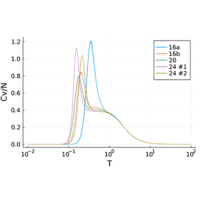
The state-of-the-art numerical simulation of the SU(4) Heisenberg model on a honeycomb lattice reveals a characteristic peak-and-shoulder specific heat behavior. The low-temperature peak is associated with a color gap, which suggests the existence of a gapped symmetric ground state in this model.

Strong magnetoelastic coupling in Mn3X (X=Ge, Sn)

Florian Theuss, Sayak Ghosh, Taishi Chen, Oleg Tchernyshyov, Satoru Nakatsuji, and B. J. Ramshaw

Phys. Rev. B 105, 174430 (2022) - Published 26 May, 2022

Kagome lattices host strongly correlated electronic phases and topological band structures. In Mn3X (X = Ge, Sn), anomalous transport behavior is induced by chiral antiferromagnetic ordering of the manganese spins. Here, the authors measure the elastic tensors of Mn3X and Mn3Sn and discover some of the largest magnetoelastic coupling ever reported for itinerant antiferromagnets. This highlights the importance of strain for controlling the magnetism of Mn3X, and the authors suggest that Mn3Ge may be particularly favorable for straintronic applications.

Optomechanical parametric oscillation of a quantum light-fluid lattice

A. A. Reynoso, G. Usaj, D. L. Chafatinos, F. Mangussi, A. E. Bruchhausen, A. S. Kuznetsov, K. Biermann, P. V. Santos, and A. Fainstein

Phys. Rev. B 105, 195310 (2022) - Published 26 May, 2022

Optical parametric oscillators are one of the building pillars of nonlinear and quantum optics, the basis of minimum-uncertainty quantum states and entangled photon pairs. Transferring similar ideas to mechanical vibrations, the authors demonstrate an optomechanical parametric oscillator based on a lattice of traps that confine and couple fluids of light and sound. Nonresonant continuous laser excitation leads to 20 GHz self-induced oscillations of the phonon field, a coherent process associated with a tailored intertrap coupling that is quadratic in the mechanical displacement.

Sign In to Your Journals Account

Filter

Section

Filter

Article Lookup

Enter a citation