Highlights

From SU(2)5 to SU(2)3 Wess-Zumino-Witten transitions in a frustrated spin-52 chain

Natalia Chepiga, Ian Affleck, and Frédéric Mila

Phys. Rev. B 105, 174402 (2022) - Published 5 May, 2022

The authors have identified critical points in the Wess-Zumino-Witten (WZW) SU(2)5 universality class in the phase diagram of a spin-5/2 chain with frustrated next-nearest-neighbor and 3-site interactions, providing a concrete example of this universality class in a realistic, nonintegrable model. These points lie on a transition line to a dimerized phase and occur when the transition turns from first order into WZW SU(2)3 in agreement with the generic possibilities allowed by field theory arguments.

Superconductivity and quantum oscillations in single crystals of the compensated semimetal CaSb2

M. Oudah, J. Bannies, D. A. Bonn, and M. C. Aronson

Phys. Rev. B 105, 184504 (2022) - Published 3 May, 2022

Identifying new bulk superconductors with topologically nontrivial bands in the normal state is critical for achieving topological superconductivity with Majorana fermions for applications in quantum computing. Here, the authors perform measurements on the nodal-line semimetal CaSb2 using single crystals for the first time, which reveal superconductivity and electron-hole compensation. The Sb atoms form a distorted square net in the crystal structure and contribute strongly to the electron bands at the Fermi level, and connections may be drawn to the well-known square net semimetals. The meeting of superconductivity and topology here should open up the diantimonides as a platform for realizing topological superconductivity.

Kohn-Luttinger superconductivity and intervalley coherence in rhombohedral trilayer graphene

Yi-Zhuang You and Ashvin Vishwanath

Phys. Rev. B 105, 134524 (2022) - Published 29 April, 2022

The recent experimental discovery of spin-valley symmetry breaking phases and superconductivity in rhombohedral trilayer graphene has generated much excitement. This research attempts to provide theoretical understanding of these phases. A prominent feature of the system is the existence of van Hove singularities in the electronic band structure. Under interactions, these electronic states exhibit a high tendency toward intervalley coherence (IVC) ordering. Upon doping, the IVC order can melt, and the low-lying IVC fluctuations can mediate superconductivity with spin-singlet pairing.

All-order correlation of single excitons in nanocrystals using a k·p envelope-function approach: Application to lead halide perovskites

S. A. Blundell and C. Guet

Phys. Rev. B 105, 155420 (2022) - Published 27 April, 2022

The authors revisit the theory of strongly correlated excitons confined in semiconductor nanocrystal quantum dots, motivated by recent experiments on nanocrystals of all-inorganic cesium lead halide perovskites (e.g., CsPbBr3), which have outstanding optoelectronic properties. Using a variety of k⋅p many-body approaches, including many-body perturbation theory, configuration interaction, the Bethe-Salpeter equation, and the random-phase approximation with exchange, they show that the strong correlation arises exclusively from the all-order summation of particle-hole ladder diagrams, as in the bulk, although finite-size effects are substantial.

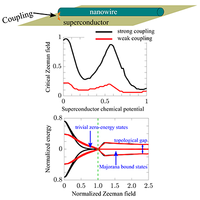
Robust topological superconductivity in weakly coupled nanowire-superconductor hybrid structures

Oladunjoye A. Awoga, Jorge Cayao, and Annica M. Black-Schaffer

Phys. Rev. B 105, 144509 (2022) - Published 26 April, 2022

The emergence of topological superconductivity and Majorana bound states in superconductor nanowire structures relies on a large induced topological gap, usually assumed to require strong coupling between superconductor and nanowire. However, strong coupling also brings detrimental effects such as the need for large critical Zeeman fields and the emergence of trivial zero-energy states. This work demonstrates that the aforementioned problems can be drastically mitigated in the weak-coupling regime, while retaining the robust properties of topological superconductivity including large topological gaps.

Coexistence of extended flat band and Kekulé order in Li-intercalated graphene

Changhua Bao, Hongyun Zhang, Xi Wu, Shaohua Zhou, Qian Li, Pu Yu, Jia Li, Wenhui Duan, and Shuyun Zhou

Phys. Rev. B 105, L161106 (2022) - Published 26 April, 2022

Heavily doped graphene near 14-filling has attracted intense interest due to the extended flat band which is shifted to the Fermi level with anticipated superconductivity and spin density wave.This work reports progress with the experimental observation of an extended flat band below the Fermi level by Li intercalation of bilayer graphene. Moreover, the Li-intercalated graphene shows interesting coexistence and codevelopment of an extended flat band, Kekulé order, and electron-phonon interaction, thereby providing opportunities for investigating their interplay and flat-band-related electronic instabilities.

Three-dimensional electronic structure of LiFeAs

R. P. Day, M. X. Na, M. Zingl, B. Zwartsenberg, M. Michiardi, G. Levy, M. Schneider, D. Wong, P. Dosanjh, T. M. Pedersen, S. Gorovikov, S. Chi, R. Liang, W. N. Hardy, D. A. Bonn, S. Zhdanovich, I. S. Elfimov, and A. Damascelli

Phys. Rev. B 105, 155142 (2022) - Published 21 April, 2022

Despite its ubiquity in the characterization of the electronic structure of solids, the interpretation of angle-resolved photoemission spectroscopy measurements is by no means a trivial exercise. Here, the authors implement a combined experimental and computational methodology to exemplify this problem and its solutions in application to the canonical Fe-based superconductor LiFeAs. This work acts to reconcile many years of conflicting experimental studies, while also presenting a viable route forwards in the rapidly growing field of topological superconductivity.

Frustration model and spin excitations in the helimagnet FeP

A. S. Sukhanov, Y. V. Tymoshenko, A. A. Kulbakov, A. S. Cameron, V. Kocsis, H. C. Walker, A. Ivanov, J. T. Park, V. Pomjakushin, S. E. Nikitin, I. V. Morozov, I. O. Chernyavskii, S. Aswartham, A. U. B. Wolter, A. Yaresko, B. Büchner, and D. S. Inosov

Phys. Rev. B 105, 134424 (2022) - Published 20 April, 2022

Magnetic frustration in a material may drive spin-spiral order, spontaneously breaking the translation and chiral symmetries of the crystal. The underlying hierarchy of magnetic interactions is reflected in the magnon excitations, which can be probed by inelastic neutron scattering. Here, the authors study the dispersions of magnons in the helimagnet FeP and compare the experimentally observed spectra with simulations. Upon examination of alternative models, the authors are able to correctly describe the spin excitations in FeP and unveil the corresponding frustration mechanism.

Ungappable edge theories with finite-dimensional Hilbert spaces

Sriram Ganeshan and Michael Levin

Phys. Rev. B 105, 155137 (2022) - Published 20 April, 2022

Edge excitations of (2+1)d topological phases are usually described using continuum field theories. But the boundaries of some (2+1)d topological phases can also be described using latticelike edge theories that have a finite-dimensional Hilbert space for a finite-sized boundary. Here, the authors construct such finite-dimensional edge theories for a family of Abelian topological phases. The most interesting examples are “ungappable”: they have the property that they cannot be gapped by any local interaction.

Moiré Landau levels of a C4-symmetric twisted bilayer system in the absence of a magnetic field

Yuki Soeda, Koichi Asaga, and Takahiro Fukui

Phys. Rev. B 105, 165422 (2022) - Published 20 April, 2022

Twisted bilayer graphene exhibits flat bands, for which C3 rotational symmetry is responsible. Therefore, to address the question whether other symmetries allow flat bands, the authors investigate here a twisted bilayer model with C4 rotational symmetry, composed of the square lattice with π flux per plaquette. It turns out that the model shows stable flat bands at arbitrarily small twist angles, and in particular, the gapped model allows many flat bands within the gap, which are reminiscent of the Landau levels.

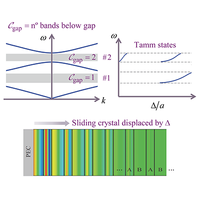
Topological pumping and Tamm states in photonic systems

Solange V. Silva, David E. Fernandes, Tiago A. Morgado, and Mário G. Silveirinha

Phys. Rev. B 105, 155133 (2022) - Published 19 April, 2022

The topology of typical Chern insulators is rooted in the system periodicity along two directions of real space. Here, the authors depart from this paradigm and demonstrate that a generic non-Hermitian photonic waveguide periodic along a single direction can be regarded as a topological system with a synthetic dimension. The gap Chern number of the extended system is identical to the number of bands below the gap and controls the number of Tamm state branches at an interface with another waveguide.

Extreme many-body scarring in a quantum spin chain via weak dynamical constraints

Shane Dooley and Graham Kells

Phys. Rev. B 105, 155127 (2022) - Published 15 April, 2022

Thermalization is usually difficult to avoid in large complicated quantum systems. However, it was recently discovered that some models with dynamical constraints can fail to thermalize due to quantum many-body scarring. To explore the connection between dynamical constraints and scarring, the authors here construct a class of spin-chain models in which the strength of the constraints can be tuned. It is observed that the scarring becomes more extreme as the constraint is weakened.

Nonlocal conductance and the detection of Majorana zero modes: Insights from von Neumann entropy

Abhishek Kejriwal and Bhaskaran Muralidharan

Phys. Rev. B 105, L161403 (2022) - Published 14 April, 2022

The authors employ entanglement entropy as the means to reliably predict the presence of Majorana zero modes (MZMs) in experimentally relevant setups. Connecting with quantum transport calculations of the conductance spectra, they present ways to reliably signal the presence of topological MZMs that possess true nonlocal correlations, thereby distinguishing topological phase transitions from trivial ones. The detection of MZMs is a contentious issue, and the models presented here set the stage for looking beyond conductance spectra for their reliable identification.

Probing optically induced spin currents using terahertz spin waves in noncollinear magnetic bilayers

Tom Lichtenberg, Maarten Beens, Menno H. Jansen, Bert Koopmans, and Rembert A. Duine

Phys. Rev. B 105, 144416 (2022) - Published 13 April, 2022

The mechanism responsible for the generation of optically induced spin currents upon femtosecond laser-pulse excitation of ultrathin ferromagnetic layers is still a heavily debated topic. In this paper, the authors study the phase of spin-current induced terahertz spin waves in noncollinear bilayer structures to probe spin currents in Fourier space. They measure a significant laser-pulse energy dependence of the spin-wave phase, which is quantitatively consistent with a spin current that is proportional to the time derivative of the magnetization.

Experimental signatures of a versatile Weyl semimetal in a pyrochlore iridate with spin-ice-like magnetic orders

Kentaro Ueda, Hiroaki Ishizuka, Markus Kriener, Shunsuke Kitou, Denis Maryenko, Minoru Kawamura, Taka-hisa Arima, Masashi Kawasaki, and Yoshinori Tokura

Phys. Rev. B 105, L161102 (2022) - Published 13 April, 2022

A geometrically frustrated lattice provides an ideal platform to search for novel electromagnetic phenomena, since it is proven to yield exotic topological electronic states as well as novel magnetic ground states. This paper reports magnetotransport properties across the spin-ice-like magnetic order and liquid-gas-type magnetic transitions in the well-characterized pyrochlore semimetal Pr2Ir2O7. Remarkable field and pressure dependence of the anomalous Hall conductivity points to the dramatic change of the Weyl point locations in momentum space. These findings open up a new direction for topological band engineering in hybrid quantum materials with relativistic conduction electrons and localized magnetic moments.

Surface plasmon driven enhancement of linear and nonlinear magneto-optical Kerr effects in bimetallic magnetoplasmonic crystals in conical diffraction

V. B. Novikov, A. M. Romashkina, D. A. Ezenkova, I. A. Rodionov, K. N. Afanasyev, A. V. Baryshev, and T. V. Murzina

Phys. Rev. B 105, 155408 (2022) - Published 12 April, 2022

Nowadays, control of light based on the manipulation of surface plasmon polaritons (SPPs) in plasmonic crystals becomes a cornerstone of photonics. The authors study the SPP-driven enhancement of linear and nonlinear magneto-optical effects in magnetoplasmonic crystals (MPCs) based on corrugated gold and ferromagnetic films. A signature of the considered MPCs is the magnetic anisotropy mediated by the surface profile of a thin ferromagnetic layer, which allows to intertwine plasmonic effects with nonuniform magnetization, providing an extra venue for control of magneto-optical effects.

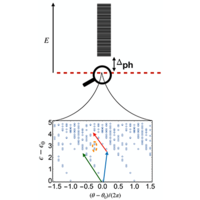
Hessian characterization of the pinning landscape in a type-II superconductor

R. Willa, V. B. Geshkenbein, and G. Blatter

Phys. Rev. B 105, 144504 (2022) - Published 11 April, 2022

Supercurrent transport requires vortices in superconductors to be pinned by material defects. Vortices are trapped in minima of the pinning potential landscape, and one has to determine what fraction of this landscape comes with a positive curvature. Such a curvature analysis is done by studying the Hessian matrix of the landscape. The authors find the stable area fraction to be unexpectedly low (yellow color in the figure). In particular, for Gaussian random landscapes it is (3−3)/6≈21%. The results offer new hints for optimizing pinning landscapes. Their transdisciplinary application to natural landscapes exhibits a surprising universality.

Tunable artificial topological Hall effects in van der Waals heterointerfaces

Meri Algarni, Cheng Tan, Guolin Zheng, Sultan Albarakati, Xiangde Zhu, James Partridge, Yanglin Zhu, Lawrence Farrar, Mingliang Tian, Jianhui Zhou, Xiaolin Wang, Zhiqiang Mao, and Lan Wang

Phys. Rev. B 105, 155407 (2022) - Published 11 April, 2022

Multichannel transport may mask the intrinsic topological Hall effects and give rise to artificial topological Hall effects in van der Waals heterointerfaces. Here, the authors systematically investigate the multichannel transport in van der Waals ferromagnetic-ferromagnetic and ferromagnetic-metal heterostructures. Interestingly, both positive and negative topological Hall effects can be mimicked. The observations have been made with a proven lack of relation to chiral spin textures and are attributed to multichannel Hall effects occurring at the heterointerfaces.

Hydrodynamic thermal transport in silicon at temperatures ranging from 100 to 300 K

Albert Beardo, Sami Alajlouni, Lluc Sendra, Javier Bafaluy, Amirkoushyar Ziabari, Yi Xuan, Juan Camacho, Ali Shakouri, and F. Xavier Alvarez

Phys. Rev. B 105, 165303 (2022) - Published 8 April, 2022

Energy dissipation in current microelectronic devices is an inefficient process due to its non-Fourier behavior. By using thermoreflectance imaging, the authors measure the temperature distribution around nanoscale heaters of different sizes and shapes on a silicon substrate to test state-of-the-art modeling. The results indicate that hydrodynamiclike thermal transport equations successfully predict the local system response at temperatures ranging from 100 to 300 K. This is contrasted with kinetic interpretations based on the suppression of long mean free path phonons, which are shown not to become manifest in the experiments.

Anomalous Nernst and Seebeck coefficients in epitaxial thin film Co2MnAlxSi1−x and Co2FeAl

A. T. Breidenbach, H. Yu, T. A. Peterson, A. P. McFadden, W. K. Peria, C. J. Palmstrøm, and P. A. Crowell

Phys. Rev. B 105, 144405 (2022) - Published 6 April, 2022

The anomalous Nernst effect (ANE), in which a thermal gradient drives a transverse charge current, can have both extrinsic and intrinsic origins. The intrinsic ANE should be enhanced when the Fermi level is in close proximity to Weyl points in the band structure. Magnetic Heusler alloys allow for tuning both the topology of the band structure and the position of the Fermi level. Here, the authors show that this tunability can be used to enhance the intrinsic ANE in epitaxial Heusler alloy thin films.

Sign In to Your Journals Account

Filter

Section

Filter

Article Lookup

Enter a citation