Highlights

Crystallography of hyperbolic lattices

Igor Boettcher, Alexey V. Gorshkov, Alicia J. Kollár, Joseph Maciejko, Steven Rayan, and Ronny Thomale

Phys. Rev. B 105, 125118 (2022) - Published 15 March, 2022

Hyperbolic lattices are intricately wired networks that constitute an exciting experimental platform for tabletop simulations of physical models in synthetic negatively curved spaces. This work reveals a hidden crystal order underneath the labyrinthine beauty of such lattices - an order made of unit cells arranged periodically onto the scaffold of a hyperbolic Bravais lattice. This sets the stage for applying powerful techniques from crystallography and band theory to describe experiments in circuit quantum electrodynamics and topoelectrical circuit networks as well as to search for novel phases of matter.

Antiferromagnetic domain wall dynamics in magnetoelectric MnTiO3 studied by optical imaging

Tatsuki Sato, Nobuyuki Abe, Yusuke Tokunaga, and Taka-hisa Arima

Phys. Rev. B 105, 094417 (2022) - Published 14 March, 2022

Domain-wall velocity is one of the key parameters which governs the switching dynamics in antiferromagnets. Antiferromagnetic domain walls in magnetoelectric materials are driven by the joint action of electric and magnetic fields. Here, the authors capture by optical magnetochiral imaging the millisecond dynamics in domain switching in the collinear antiferromagnet MnTiO3. Detailed investigation of the domain-wall motion with varying temperature and external-field strength reveals the thermal effects on the domain-wall mobility.

Topology invisible to eigenvalues in obstructed atomic insulators

Jennifer Cano, L. Elcoro, M. I. Aroyo, B. Andrei Bernevig, and Barry Bradlyn

Phys. Rev. B 105, 125115 (2022) - Published 11 March, 2022

Although symmetry indicators are a powerful new tool for identifying band topology, they do not tell the whole story. Here, the authors study pairs of atomic limit phases where the locations of Wannier orbitals differ, even though they share the same symmetry data (irreps) everywhere in the Brillouin zone. The authors give examples of such phases and show how Berry phase invariants can be used to distinguish between them. Finally, the authors classify all such “irrep-equivalent” atomic limit phases using band representations.

Entanglement phase transitions in random stabilizer tensor networks

Zhi-Cheng Yang, Yaodong Li, Matthew P. A. Fisher, and Xiao Chen

Phys. Rev. B 105, 104306 (2022) - Published 10 March, 2022

The authors explore a class of random tensor network models with stabilizer local tensors and study the entanglement phase transitions in these models. They find that an entanglement phase transition can be induced by randomly breaking bulk tensor legs and they extract a set of universal data characterizing the conformal invariance at the critical points. The results clearly demonstrate regimes where a geometric bond percolation picture does or does not apply at the transitions. This work may open new connections to holographic quantum error correcting codes, built from tensor networks.

Temperature effect on charge-state transition levels of defects in semiconductors

Shuang Qiao, Yu-Ning Wu, Xiaolan Yan, Bartomeu Monserrat, Su-Huai Wei, and Bing Huang

Phys. Rev. B 105, 115201 (2022) - Published 8 March, 2022

Intrinsic defects and external impurities are unavoidable in solids and play a central role in determining their fundamental physical properties. Unfortunately, most existing defect theories in semiconductors are built on a temperature-independent approximation. By deriving the basic formulas of temperature-dependent defect level evolution, the authors establish two fundamental rules for the temperature dependence of charge-state transition levels in semiconductors, which could be adopted as guidelines for understanding or optimizing doping behavior in semiconductors at finite temperatures.

Spin current density functional theory of Weyl semimetals

Filippo Bodo, Jacques K. Desmarais, and Alessandro Erba

Phys. Rev. B 105, 125108 (2022) - Published 8 March, 2022

Weyl fermions are massless solutions of the Dirac equation, described by two-component complex spinors. Such elusive objects emerge as quasiparticles in the so-called Weyl semimetals (WSM). The authors discuss the generalization of the standard one-component density functional theory to a two-component approach (the spin-current density functional theory) as well as its application to the practical quantum-mechanical description of WSMs through a self-consistent treatment of the spin-orbit coupling and nonlocal Fock exchange. In particular, the authors demonstrate the key role played by spin-current densities in the characterization of Weyl nodes in TaAs.

Magnetoelastic coupling anisotropy in the Kitaev material α−RuCl3

Vilmos Kocsis, David A. S. Kaib, Kira Riedl, Sebastian Gass, Paula Lampen-Kelley, David G. Mandrus, Stephen E. Nagler, Nicolás Pérez, Kornelius Nielsch, Bernd Büchner, Anja U. B. Wolter, and Roser Valentí

Phys. Rev. B 105, 094410 (2022) - Published 7 March, 2022

In this combined theoretical and experimental research, the authors investigate the anisotropic magnetic and magnetoelastic properties of the quantum spin-liquid candidate α-RuCl3. They find that the magnetostriction anisotropy is unusually large compared to the anisotropy of the magnetization, which they relate to the strong magnetoelastic Γ’-type coupling. They also observe nonsymmetric anisotropy for magnetic fields canted out of the honeycomb plane in opposite directions, which they relate to the relative orientation of the magnetic field with respect to the RuCl6 octahedra.

Strong-coupling emergence of dark states in XX central spin models

Claude Dimo and Alexandre Faribault

Phys. Rev. B 105, L121404 (2022) - Published 7 March, 2022

In an XX central spin model, a particular spin interacts with a bath of other spins through a term which only couples their XY-plane components. In the presence of an arbitrarily oriented magnetic field, it is shown that certain eigenstates of this model are such that the central spin remains in a pure state, completely disentangled from the bath. Remarkably, this decoupling from the environment becomes possible only when the interaction becomes strong enough.

Magnetic field dependent thermodynamic properties of square and quadrupolar artificial spin ice

M. Goryca, X. Zhang, J. D. Watts, C. Nisoli, C. Leighton, P. Schiffer, and S. A. Crooker

Phys. Rev. B 105, 094406 (2022) - Published 4 March, 2022

The static and dynamic magnetic properties of Artificial Spin Ices (ASIs) are typically investigated in zero magnetic field. However, magnetic fields can provide a versatile tuning parameter, by driving phase transitions between different magnetic orders, or tuning through regimes where quasiparticle excitations (e.g., “magnetic monopoles”) can readily form and proliferate. Here, using simulations supported by noise experiments, the authors map out the equilibrium thermodynamic properties and magnetic phases of square and quadrupolar ASIs as a function of applied in-plane magnetic fields.

Complex magnetic structure and spin waves of the noncollinear antiferromagnet Mn5Si3

N. Biniskos, F. J. dos Santos, K. Schmalzl, S. Raymond, M. dos Santos Dias, J. Persson, N. Marzari, S. Blügel, S. Lounis, and T. Brückel

Phys. Rev. B 105, 104404 (2022) - Published 4 March, 2022

Frustrated antiferromagnets can feature a wide variety of noncollinear magnetic ground states. The resulting states have been associated with anomalous transport properties and interesting thermodynamic phenomena. Here, by combining inelastic neutron scattering measurements and density functional theory calculations, the authors investigate the complex ground state of Mn5Si3, its evolution under magnetic field, and its spin excitation spectrum. Furthermore, they model the instability of some Mn magnetic moments in a frustrated environment to unveil their behavior under an external field. This general model can be potentially applied to several frustrated antiferromagnets.

Doping dependence of the electron-phonon coupling in two families of bilayer superconducting cuprates

Yingying Peng, Leonardo Martinelli, Qizhi Li, Matteo Rossi, Matteo Mitrano, Riccardo Arpaia, Marco Moretti Sala, Qiang Gao, Xuefei Guo, Gabriella Maria De Luca, Andrew Walters, Abhishek Nag, Andi Barbour, Genda Gu, Jonathan Pelliciari, Nicholas B. Brookes, Peter Abbamonte, Marco Salluzzo, Xingjiang Zhou, Ke-Jin Zhou, Valentina Bisogni, Lucio Braicovich, Steven Johnston, and Giacomo Ghiringhelli

Phys. Rev. B 105, 115105 (2022) - Published 4 March, 2022

Electron-phonon coupling (EPC) is essential for Cooper pairing in conventional superconductors, while its role in high-Tc cuprates is still debated. Exploiting O K-edge resonant inelastic x-ray scattering, the authors reveal here the momentum dependence of EPC strength in two bilayer cuprate families. The strength of EPC decreases with doping at q//=(-0.25, 0) r.l.u., while it has a nonmonotonic trend at smaller momenta. The results provide experimental input to theories invoking a synergistic role for EPC in d-wave pairing.

Evidence for Dirac nodal-line fermions in a phosphorous square-net superconductor

S. Ishizaka, A. Ino, T. Kono, Y. Miyai, S. Kumar, K. Shimada, H. Kitô, I. Hase, S. Ishida, K. Oka, H. Fujihisa, Y. Gotoh, Y. Yoshida, A. Iyo, H. Ogino, H. Eisaki, K. Kawashima, Y. Yanagi, and A. Kimura

Phys. Rev. B 105, L121103 (2022) - Published 4 March, 2022

The fastest Dirac fermions of 1200 km/s with a nodal loop are discovered here in the superconductor ZrP2−xSex, surpassing the velocity record held by the point-node Dirac fermions in graphene. By using angle-resolved photoemission spectroscopy, the authors demonstrate that nonsymmorphic phosphorous-based square nets provide the hoped-for stage for high Dirac velocity, nodal line, and superconductivity to meet together. This finding should pave the way for future fast and low-loss electronics, and hopefully will lead to discovery of the elusive Majorana fermion.

Phase space crystal vibrations: Chiral edge states with preserved time-reversal symmetry

Lingzhen Guo, Vittorio Peano, and Florian Marquardt

Phys. Rev. B 105, 094301 (2022) - Published 3 March, 2022

Phase-space crystal is a solidlike crystalline state in phase space formed by atoms, subject to a time-periodic drive. The authors show that interactions between these atoms can give rise to vibrational band structures with nontrivial Chern numbers and chiral edge states in phase space. Remarkably, these arise even in the presence of time-reversal symmetry in contrast to all topological transport scenarios in real space. Phase-space crystal vibrations offer a new platform for phononic topological transport whereby chiral properties arise naturally.

Tunable critical correlations in kagome ice

A. A. Turrini, A. Harman-Clarke, G. Haeseler, T. Fennell, I. G. Wood, P. Henelius, S. T. Bramwell, and P. C. W. Holdsworth

Phys. Rev. B 105, 094403 (2022) - Published 2 March, 2022

In applied field, spin ice enters the kagome ice phase, a two-dimensional Coulomb phase characterized by divergence-free topology. The present study combines polarized neutron scattering experiments, numerical simulations, and thermodynamic arguments to demonstrate how the critical correlations in this phase can be fine-tuned by varying the applied field, temperature, and crystal orientation. The critical phase is terminated by Kasteleyn transitions which suppress fluctuations while sustaining symmetry. The experiments demonstrate exquisite control of critical and topological correlations in a real system.

Skyrmion clusters and chains in bulk and thin-layered cubic helimagnets

Andrey O. Leonov

Phys. Rev. B 105, 094404 (2022) - Published 2 March, 2022

Here, the author overviews the properties and the internal structure of isolated skyrmions within a cone phase of cubic helimagnets and chiral liquid crystals. The nascent conical state is shown to substantiate the attracting skyrmion-skyrmion interaction, which leads to the formation of skyrmion clusters and/or skyrmions chains. Whereas in bulk helimagnets skyrmion clusters exhibit the hexagonal arrangement of constituent skyrmions, in thin layers skyrmions align into polar skyrmion chains. Such behavior is thickness dependent and depends on the characteristic energy profiles.

Spin-exchange Hamiltonian and topological degeneracies in elemental gadolinium

A. Scheie, Pontus Laurell, P. A. McClarty, G. E. Granroth, M. B. Stone, R. Moessner, and S. E. Nagler

Phys. Rev. B 105, 104402 (2022) - Published 2 March, 2022

Elemental Gd is a textbook example of a spin-only ferromagnet, but due to its complex magnon dispersion, its magnetic exchange Hamiltonian has never been fully determined. Here, the authors use modern inelastic time-of-flight neutron scattering to fully map and fit the Gd spectrum to a spin wave model. The results show long-range magnetic interactions, in accord with RKKY conduction-mediated exchange. The authors also identify symmetry-protected topological degeneracies in the magnon dispersion, which should appear in other ferromagnetic hcp metals.

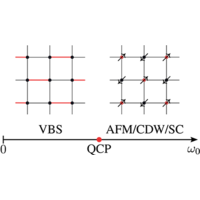
Valence-bond solid to antiferromagnet transition in the two-dimensional Su-Schrieffer-Heeger model by Langevin dynamics

A. Götz, S. Beyl, M. Hohenadler, and F. F. Assaad

Phys. Rev. B 105, 085151 (2022) - Published 28 February, 2022

Electron-phonon coupling is typically not associated with magnetic order but with either charge density waves (patterns of high and low electron density) or valence-bond solids (patterns of strong and weak electronic bonds). Using quantum Monte Carlo simulations, the authors demonstrate that, within the paradigmatic two-dimensional Su-Schrieffer-Heeger model, the electron-phonon interaction favors antiferromagnetic order in large regions of the phase diagram. A valence-bond solid is observed in the adiabatic regime, while the two phases are connected by an apparently direct phase transition.

Electron recoil effect in electrically tunable MoSe2 monolayers

Jonas Zipfel, Koloman Wagner, Marina A. Semina, Jonas D. Ziegler, Takashi Taniguchi, Kenji Watanabe, Mikhail M. Glazov, and Alexey Chernikov

Phys. Rev. B 105, 075311 (2022) - Published 24 February, 2022

Radiative recombination of bound-exciton carrier complexes in semiconductors often occurs under simultaneous excitation of either electrons or holes to unbound states. This phenomenon, known as the electron recoil effect, manifests itself in pronounced asymmetric spectral lineshapes of the resulting emission. Monitoring the dynamics of the electron recoil effect in monolayer semiconductors offers access to transient nonequilibrium distributions of the exciton-carrier complexes and their cooling dynamics.

Anomalous Gurzhi effect

P. O. Sukhachov and Björn Trauzettel

Phys. Rev. B 105, 085141 (2022) - Published 23 February, 2022

In the hydrodynamic regime of transport, electrons conserve their momentum while moving in the bulk but relax it in collisions with boundaries. This leads to an unusual decrease of the resistivity of thin samples with temperature known as the Gurzhi effect. In Weyl semimetals, a nontrivial spatial distribution of the valley charge density caused by the combined effect of the chiral anomaly and the boundaries also results in nonmonotonic dependence of magnetoresistivity on temperature.

Quantum criticality and spin liquid phase in the Shastry-Sutherland model

Jianwei Yang, Anders W. Sandvik, and Ling Wang

Phys. Rev. B 105, L060409 (2022) - Published 23 February, 2022

The two-dimensional quantum spin model proposed by Shastry and Sutherland more than four decades ago is notable for its realization in SrCu2(BO3)2. Here, the authors present numerical evidence of a gapless spin liquid phase in the model and discuss its connection to a deconfined quantum critical point. The new phase exists in a parameter regime where recent high-pressure heat capacity measurements on SrCu2(BO3)2 did not detect any low-temperature order, in contrast to the antiferromagnetic and plaquette-singlet phases existing at higher and lower pressures, respectively. Thus, the elusive spin liquid may exist in SrCu2(BO3)2.

Sign In to Your Journals Account

Filter

Section

Filter

Article Lookup

Enter a citation