Highlights

Scar states in a system of interacting chiral fermions

I. Martin and K. A. Matveev

Phys. Rev. B 105, 045119 (2022) - Published 14 January, 2022

In generic quantum many-body systems, the exact eigenstates are expected to satisfy the eigenstate thermalization hypothesis: Eigenstates near any given energy are expected to be thermodynamically equivalent. The authors demonstrate that in a system of chiral fermions with generic interaction this expectation is violated by some states. They find a coexistence of fermionic and bosonic types of eigenstates in some regions of the many-body spectrum. This allows for observable density oscillations even at weak coupling.

Canonical derivation of the fermionic influence superoperator

Mauro Cirio, Po-Chen Kuo, Yueh-Nan Chen, Franco Nori, and Neill Lambert

Phys. Rev. B 105, 035121 (2022) - Published 13 January, 2022

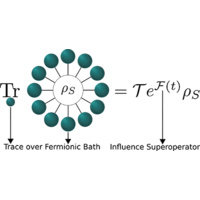
The Feynman-Vernon influence functional is a powerful result, based on path integrals, for describing the reduced state of a system interacting with a Gaussian environment. Here, the authors derive in detail a canonical (i.e., operatorial) form of the influence functional for fermionic environments, and show how it can be used to compute the dynamics under arbitrary parity-symmetry initial conditions as well as to derive generalized versions of the Lindblad master equation and the hierarchical equations of motion.

Superconducting piezoelectric effect

Michiya Chazono, Hikaru Watanabe, and Youichi Yanase

Phys. Rev. B 105, 024509 (2022) - Published 12 January, 2022

The authors propose a supercurrent-induced lattice distortion in superconductors lacking both inversion and time-reversal symmetry. They dub this the superconducting piezoelectric effect (SCPE). They demonstrate the effect for a two-dimensional Rashba superconductor under in-plane magnetic field, in which Cooper pairs have finite total momentum, and clarify the close relation between the SCPE and momentum. The SCPE is a phenomenon unique to superconductors. It could become a sensitive probe of symmetry-breaking effects and of Cooper-pair momentum in exotic superconductors.

Weyl points in multiterminal hybrid superconductor-semiconductor nanowire devices

E. V. Repin and Y. V. Nazarov

Phys. Rev. B 105, L041405 (2022) - Published 12 January, 2022

The technology of superconductor-semiconductor nanowire devices has matured in the last years in the course of Majorana research. This makes it feasible to design more complex and sophisticated devices. The authors investigate multiterminal superconductor-semiconductor wires to probe the feasibility of another topological phenomenon, namely, Weyl singularities in their Andreev spectrum. They discover an abundance of Weyl singularities for devices with intermediate spacing between the electrodes.

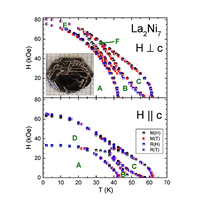
Small-moment antiferromagnetic ordering in single-crystalline La2Ni7

R. A. Ribeiro, S. L. Bud'ko, L. Xiang, D. H. Ryan, and P. C. Canfield

Phys. Rev. B 105, 014412 (2022) - Published 11 January, 2022

Transition-metal-based itinerant antiferromagnets are rare, especially ones with greatly reduced ordered moments. In this paper, the authors present a detailed study of the thermodynamic and transport properties of La2Ni7 and present anisotropic field (H) – temperature (T) phase diagrams and pressure dependence of its three low-field phase-transition temperatures. The six magnetic phases as well as the relative pressure insensitivity of the three ordering temperatures will serve as starting points for further experimental and computational studies of this system.

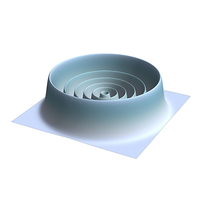
Effects of interlayer exchange on collapse mechanisms and stability of magnetic skyrmions

Hendrik Schrautzer, Stephan von Malottki, Pavel F. Bessarab, and Stefan Heinze

Phys. Rev. B 105, 014414 (2022) - Published 11 January, 2022

Despite the great success of realizing magnetic skyrmions in multilayers even at room temperature, little is known about their thermal stability. This study presents the rich diversity of skyrmion collapse mechanisms, the corresponding energy barriers, and collapse rates in systems incorporating several magnetic monolayers as a function of interlayer exchange coupling. The results outline a comprehensive picture of thermal stability of skyrmions in magnetic multilayers and reveal an unexpected scaling relation between the number of layers and the energy barrier.

Easy-plane spin Hall nano-oscillators as spiking neurons for neuromorphic computing

Danijela Marković, Matthew W. Daniels, Pankaj Sethi, Andrew D. Kent, Mark D. Stiles, and Julie Grollier

Phys. Rev. B 105, 014411 (2022) - Published 10 January, 2022

Ferromagnetic nanoconstrictions can serve as integrate-and-fire neurons, communicating via spin-wave pulses analogous to neural spikes. The nanoconstriction geometry leads to easy-plane oscillators which manifest phase dynamics analogous to damped driven oscillators. The authors propose a sample geometry where nanoconstrictions undergo phase slips and produce pulses of spin-wave signals when triggered by a small spin torque. They show with the help of macrospin modeling and micromagnetic simulations that these spin-wave pulses can excite other nanoconstriction neurons and that they possess the basic fan-in and fan-out capability required for neuromorphic systems.

Characterizing two-dimensional superconductivity via nanoscale noise magnetometry with single-spin qubits

Pavel E. Dolgirev, Shubhayu Chatterjee, Ilya Esterlis, Alexander A. Zibrov, Mikhail D. Lukin, Norman Y. Yao, and Eugene Demler

Phys. Rev. B 105, 024507 (2022) - Published 10 January, 2022

Atomically thin materials are highly versatile platforms to sharpen our understanding of two-dimensional superconductivity. However, such materials are not amenable to many conventional experimental techniques used for three-dimensional superconductors, making it difficult to probe the origin and symmetry of Cooper pairing. To investigate superconducting transitions and access the pairing wave function, the authors propose a wireless, table-top probe - noise magnetometry by a single-spin qubit. The technique can elucidate various nonlocal transport regimes inaccessible to other probes. It can also detect elusive collective modes like Josephson plasmons.

Ratchet effect in spatially modulated bilayer graphene: Signature of hydrodynamic transport

E. Mönch, S. O. Potashin, K. Lindner, I. Yahniuk, L. E. Golub, V. Yu. Kachorovskii, V. V. Bel'kov, R. Huber, K. Watanabe, T. Taniguchi, J. Eroms, D. Weiss, and S. D. Ganichev

Phys. Rev. B 105, 045404 (2022) - Published 7 January, 2022

The authors study here the transition between drift-diffusion and hydrodynamic regimes of ac electron transport in bilayer graphene, focusing on one of the most general photovoltaic phenomenon: the ratchet effect. Compared to conventional dc transport measurements, this effect offers a number of additional possibilities to probe hydrodynamic flow of the electron fluid. A signature of the hydrodynamic regime — a very sharp frequency dependence of the generated ratchet current — is clearly demonstrated experimentally, in excellent agreement with the developed theory.

Toric-code insulator enriched by translation symmetry

Pok Man Tam, Jörn W. F. Venderbos, and Charles L. Kane

Phys. Rev. B 105, 045106 (2022) - Published 4 January, 2022

As was suggested twenty years ago, double-vortex condensation can drive a superconductor into a fractionalized insulator with ℤ2 topological order. With the advent of symmetry-protected topological phases, the authors explore here the effect of strong correlation in a weak topological superconductor, showing that double-vortex condensation gives rise to a translation symmetry-enriched ℤ2 topological order. This toric-code insulator features two types of visons with mutual semionic statistics, which transform into each other under discrete translation. This work also sheds light on realizing topological order and fractionalization by gapping semimetals.

Phase transitions in partial summation methods: Results from the three-dimensional Hubbard model

Sergei Iskakov and Emanuel Gull

Phys. Rev. B 105, 045109 (2022) - Published 4 January, 2022

A minimal model of a correlation-driven phase transition is the half-filled Hubbard model in three dimensions, for which numerically exact solutions are available. The authors compare exact results to results obtained from a range of diagrammatic perturbation theories, generalizable to real materials problems. They demonstrate that quantum embedding leads to an efficient elimination of finite-size effects. However, perturbative methods do not provide an accurate description of the phase transition even in the regime of weak-to-intermediate coupling.

Understanding the flat band in 1T−TaS2 using a rotated basis

Li Cheng, Xuanyu Long, Xiaobin Chen, Xiaolong Zou, and Zheng Liu

Phys. Rev. B 104, L241114 (2021) - Published 29 December, 2021

The emergence of electronic flat bands in moiré superlattices has attracted much attention. Actually, a charge density wave (CDW) superlattice can play the same role, and 1T-TaS2 represents an example. Although there has been a lively debate on the strongly correlated physics in 1T-TaS2, a transparent theoretical understanding of the starting point – the single-electron band dispersion – is still elusive. This Letter shows how to understand the flat band in this compound with a rotated basis, a simple trigonometric function, and a 3×3 matrix.

Theory of the charge density wave in AV3Sb5 kagome metals

Morten H. Christensen, Turan Birol, Brian M. Andersen, and Rafael M. Fernandes

Phys. Rev. B 104, 214513 (2021) - Published 27 December, 2021

The kagome metals AV3Sb5 (A=K, Rb, Cs) feature a three-dimensional charge density wave of a presently unknown character and origin. In this work, the authors use group-representation theory to construct a Landau free energy and demonstrate how the interplay between in- and out-of-plane ordering tendencies can stabilize nematic phases. The phases uncovered exhibit many features consistent with experimental observations.

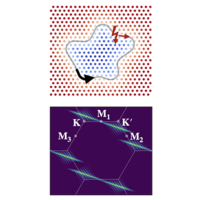
Tunneling in the Brillouin zone: Theory of backscattering in valley Hall edge channels

Tirth Shah, Florian Marquardt, and Vittorio Peano

Phys. Rev. B 104, 235431 (2021) - Published 27 December, 2021

In many time-reversal-symmetric implementations of topological transport of classical waves, backscattering is nominally forbidden only within a description that does not include large momentum transfer. Here, the authors introduce a more refined picture, in which backscattering is induced by tunneling transitions in the reciprocal (quasimomentum) space. They predict enhanced backscattering at discrete centers, whose locations depend both on the energy and the local slope of the domain wall. The theory provides guidance to the design of future topological devices with reduced backscattering.

Van der Waals anomaly: Analog of dark energy with ultracold atoms

Itai Y. Efrat and Ulf Leonhardt

Phys. Rev. B 104, 235432 (2021) - Published 27 December, 2021

What has dark energy to do with van der Waals forces? Why does the stress from van der Waals forces appear to violate Maxwell’s equations? Why are ultracold atoms good candidates for testing this analog of dark energy? Find out in this paper.

Sparse expansions of multicomponent oxide configuration energy using coherency and redundancy

Luis Barroso-Luque, Julia H. Yang, and Gerbrand Ceder

Phys. Rev. B 104, 224203 (2021) - Published 22 December, 2021

The computational study of configuration thermodynamics of crystalline materials relies heavily on accurate representations of the internal energy in terms of configurational variables. Considering the growth of configuration space dimensionality and the relatively constant number of training points, compressed sensing (CS) has been used as an effective paradigm to fit accurate expansions. However, when using a basis, CS only provides guarantees on accurate coefficient recovery under strict sampling requirements. Here, the authors demonstrate how replacing bases with frames, and thus obtaining redundant representations, allows obtaining accurate and highly sparse expansions with less strict sampling requirements.

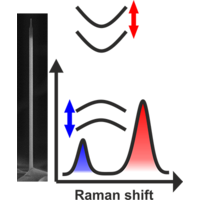
Intersubband excitations in ultrathin core-shell nanowires in the one-dimensional quantum limit probed by resonant inelastic light scattering

Sebastian Meier, Paulo E. Faria Junior, Ferdinand Haas, Emma-Sophia Heller, Florian Dirnberger, Viola Zeller, Tobias Korn, Jaroslav Fabian, Dominique Bougeard, and Christian Schüller

Phys. Rev. B 104, 235307 (2021) - Published 22 December, 2021

The observation of electronic Raman scattering in one-dimensional semiconductors has so far been limited to arrays of laterally structured quantum wells. Recent progress in the growth of core-shell nanowires has opened the possibility to reach the quantum confinement regime for single nanowires. Here, the authors present measurements of the one-dimensional subband structure of single wurtzite-phase GaAs nanowires by resonant Raman spectroscopy. The obtained energetic distances between consecutive electron or hole subbands are nicely reproduced by realistic k∙p band structure calculations.

Pinwheel valence bond crystal ground state of the spin-12 Heisenberg antiferromagnet on the shuriken lattice

Nikita Astrakhantsev, Francesco Ferrari, Nils Niggemann, Tobias Müller, Aishwarya Chauhan, Augustine Kshetrimayum, Pratyay Ghosh, Nicolas Regnault, Ronny Thomale, Johannes Reuther, Titus Neupert, and Yasir Iqbal

Phys. Rev. B 104, L220408 (2021) - Published 22 December, 2021

Quantum spin models on two-dimensional corner-sharing triangular arrangements, e.g., the kagome lattice, are fertile playgrounds for realizing exotic phases. Following the recent report of a gapless spin liquid in KCu6AlBiO4(SO4)5Cl, wherein the Cu2+ spin-½ ions form a perfect two-dimensional shuriken lattice, the authors employ state-of-the-art quantum many-body approaches to reveal a pinwheel valence-bond-crystal ground state of the isotropic Heisenberg antiferromagnet. This work thus points to the important role of spatial anisotropy in triggering the gapless spin liquid, in contrast to the kagome material herbertsmithite.

Relativistic first-principles theory of Yu-Shiba-Rusinov states applied to Mn adatoms and Mn dimers on Nb(110)

Bendegúz Nyári, András Lászlóffy, László Szunyogh, Gábor Csire, Kyungwha Park, and Balázs Ujfalussy

Phys. Rev. B 104, 235426 (2021) - Published 21 December, 2021

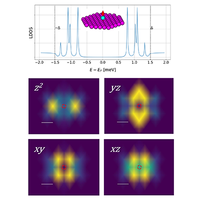
The authors introduce a first-principles material-specific description of Yu-Shiba-Rusinov (YSR) states where relativity, superconductivity, magnetism, and the entire host electronic structure are treated on the same footing. They achieve this by solving the fully relativistic Bogoliubov–de Gennes equations via band-theoretical methods for the entire host-embedded impurity system. The method is used to make a direct comparison with the most recent experiments. Furthermore, one immediately gains a deeper insight into the formation of the YSR states by artificially manipulating the exchange field of the impurity, the spin-orbit coupling, and the induced moments. Comparison with experiments is extended to magnetic dimers, where the authorsdiscuss the hybridization of the YSR states in the ferromagnetic and antiferromagnetic configurations. The importance of such first-principles calculations for the interpretation of future experiments on similar or longer chains and on other nanostructures with a zero-bias peak has been elucidated.

Temporal equivalent of the Brewster angle

Victor Pacheco-Peña and Nader Engheta

Phys. Rev. B 104, 214308 (2021) - Published 20 December, 2021
Can the Brewster angle have a temporal equivalent? Here, the authors exploit time-dependent metamaterials to propose the idea of such a temporal analog. When the permittivity of the medium rapidly changes in time from an isotropic to anisotropic value, the backward wave may be absent for such an angle of incidence. A closed-form mathematical expression, along with numerical simulations, for this temporal analog of the Brewster angle is provided.

Sign In to Your Journals Account

Filter

Section

Filter

Article Lookup

Enter a citation