Highlights

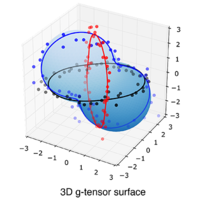
Electrical control of the g tensor of the first hole in a silicon MOS quantum dot

S. D. Liles, F. Martins, D. S. Miserev, A. A. Kiselev, I. D. Thorvaldson, M. J. Rendell, I. K. Jin, F. E. Hudson, M. Veldhorst, K. M. Itoh, O. P. Sushkov, T. D. Ladd, A. S. Dzurak, and A. R. Hamilton

Phys. Rev. B 104, 235303 (2021) - Published 17 December, 2021

Hole spins are highly promising for spin-qubit technology due to the ability to electrically manipulate the hole g tensor. However, gaps remain in our understanding of the mechanisms that couple hole spins to electric fields. Here, the authors investigate the effect of unintentional strain on the spin state of a single hole confined in a metal-oxide-semiconductor (MOS) quantum dot. Results show that the metal electrodes produce a nonuniform strain profile, resulting in nanometer-scale variations in the heavy-hole–light-hole splitting. Therefore, local electric fields can be used to displace the hole wavefunction relative to the nonuniform strain, allowing a mechanism for electric control of the hole g tensor.

Dark exciton-exciton annihilation in monolayer WSe2

Daniel Erkensten, Samuel Brem, Koloman Wagner, Roland Gillen, Raül Perea-Causín, Jonas D. Ziegler, Takashi Taniguchi, Kenji Watanabe, Janina Maultzsch, Alexey Chernikov, and Ermin Malic

Phys. Rev. B 104, L241406 (2021) - Published 17 December, 2021

Excitons govern the optical properties of semiconducting transition metal dichalcogenides. At elevated electron-hole densities excitons are subject to efficient exciton-exciton annihilation (EEA), an Auger recombination process that fundamentally limits the performance of optoelectronic devices. Here, the authors combine microscopic modeling with time-resolved photoluminescence measurements to demonstrate the crucial role of dark intervalley excitons for an efficient EEA in WSe2 monolayers. In particular, they find both in theory and experiment a drastic increase in the EEA at intermediate temperatures.

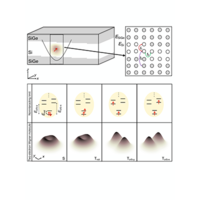
Strong electron-electron interactions in Si/SiGe quantum dots

H. Ekmel Ercan, S. N. Coppersmith, and Mark Friesen

Phys. Rev. B 104, 235302 (2021) - Published 13 December, 2021

The authors implement a nonperturbative method for calculating the effects of strong electron-electron interactions, nearly degenerate electronic valleys, and interface disorder in multielectron silicon quantum dots. They show that all three ingredients play an important role in qubit experiments, and that Wigner-molecule physics in silicon can be substantially different from that in materials without valley degeneracy. The results provide key insights for the design and implementation of quantum dot qubits in silicon.

Local versus nonlocal correlation effects in interacting quantum spin Hall insulators

L. Crippa, A. Amaricci, S. Adler, G. Sangiovanni, and M. Capone

Phys. Rev. B 104, 235117 (2021) - Published 8 December, 2021

When supplemented by a local electron-electron interaction, the Bernevig-Hughes-Zhang model becomes an ideal platform to investigate correlated topological phases. Employing DMFT-based cluster methods, the authors identify two different parameter regions: (i) for intermediate to large orbital polarization, spatially local correlations suffice to describe the interaction-induced transition from trivial to nontrivial topology, confirming the single-site DMFT picture; (ii) in contrast, nonlocal self-energy effects become predominant at low orbital polarization and near the transition from semimetal to Mott phase.

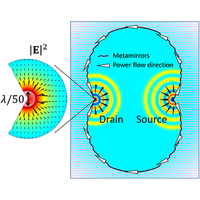
Subwavelength focusing by engineered power-flow conformal metamirrors

Hamidreza Taghvaee, Fu Liu, Ana Díaz-Rubio, and Sergei Tretyakov

Phys. Rev. B 104, 235409 (2021) - Published 8 December, 2021

It is highly desirable to break the diffraction limit on the resolution of optical devices and achieve subwavelength focusing. Here, the authors show that curved and inhomogeneous reflectors offer a practical method for achieving this goal. The surface profile of the focusing reflector is designed to be tangential to the desired power flow so that the metamirror can be described locally by lossless impedance boundaries and can be easily implemented using simple lossless meta-atoms. We envisage some practical applications of subwavelength focusing that become possible using this method.

Orbital and spin character of doped carriers in infinite-layer nickelates

M. Rossi, H. Lu, A. Nag, D. Li, M. Osada, K. Lee, B. Y. Wang, S. Agrestini, M. Garcia-Fernandez, J. J. Kas, Y.-D. Chuang, Z. X. Shen, H. Y. Hwang, B. Moritz, Ke-Jin Zhou, T. P. Devereaux, and W. S. Lee

Phys. Rev. B 104, L220505 (2021) - Published 8 December, 2021

The discovery of superconductivity in infinite-layer nickelate thin films has produced fervent theoretical research about the doping evolution of their electronic structure. Here, by means of x-ray spectroscopy and atomic multiplet calculations, the authors show that doped holes are mainly introduced in Ni sites in a spin-singlet configuration. The dominant role of the Ni 3dx2−y2 band implies that infinite-layer nickelates are likely a strongly correlated electronic system, reminiscent of their cuprate siblings.

Single-stage direct Langevin dynamic simulations of transitions over arbitrarily high energy barriers: Concept of energy-dependent temperature

Dmitry Berkov, Elena K. Semenova, and Natalia L. Gorn

Phys. Rev. B 104, 224408 (2021) - Published 7 December, 2021

The authors propose the fastest possible numerical solution of the escape-rate evaluation in systems with high-energy barriers (also known as the Kramers’ problem), which is of paramount importance in physics, chemistry, biology, materials, and other branches of science. To this end, they introduce the concept of energy-dependent temperature (EDT), which is equal to the actual temperature for energies near the barrier, but is much larger below the saddle point, thus greatly enhancing the switching probability. The results are in excellent agreement with standard forward-flux sampling, while the EDT computation time is much shorter and, even more importantly, does not grow with the barrier height.

Emergent anomalies and generalized Luttinger theorems in metals and semimetals

Chong Wang, Alexander Hickey, Xuzhe Ying, and A. A. Burkov

Phys. Rev. B 104, 235113 (2021) - Published 7 December, 2021

Whether a given material is a metal or an insulator is determined by a single parameter, the number of electrons per unit cell per spin, that is, by the filling number. When the latter is integer, the material is an insulator or a compensated semimetal. When it is fractional, the material is a metal with a Fermi surface, enclosing a volume in momentum space, determined by the fractional part of the filling – a statement known as Luttinger’s theorem. Topological semimetals provide a realization of the metallic phase, distinct from ordinary metals, as they exist at integer fillings, which normally correspond to insulators. Here, the authors develop a framework that unifies Luttinger’s theorem for ordinary metals and analogous exact statements for topological semimetals. They use the language of quantum anomalies of the emergent low-energy charge conservation symmetry at each point on the Fermi surface. This framework allows one to connect topological responses in all nodal semimetals to their low-energy properties, such as the distance between the point nodes in momentum space or the area, enclosed by the nodal line.

Thermalization dynamics and spectral statistics of extended systems with thermalizing boundaries

Pavel Kos, Tomaž Prosen, and Bruno Bertini

Phys. Rev. B 104, 214303 (2021) - Published 6 December, 2021

Quantitatively understanding the role of chaos and ergodicity in the thermalization process is crucial in our quest to decipher out-of-equilibrium quantum matter. Here, the authors address this question for a finite time-periodic quantum circuit coupled to an extended dual-unitary circuit acting as a perfect Markovian bath. The system’s dynamics can thus be described by a simple quantum channel, the ergodicity of which is completely characterized. A class of gates is identified for which the channel is preserving the memory of the initial condition, while for generic gates the channel is ergodic. Moreover, the authors provide a quantitative characterization of the thermalization rate for nearly dual-unitary gates.

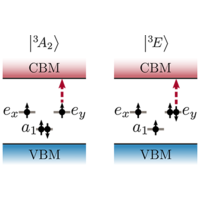
Photoionization of negatively charged NV centers in diamond: Theory and ab initio calculations

Lukas Razinkovas, Marek Maciaszek, Friedemann Reinhard, Marcus W. Doherty, and Audrius Alkauskas

Phys. Rev. B 104, 235301 (2021) - Published 6 December, 2021

A nitrogen-vacancy center in diamond is a defect that has become a key platform for testing and eventually implementing various quantum technologies. During optical illumination, the center can change its charge state via a photoionization process. In this work, the authors present ab initio calculations of photoionization thresholds and cross sections of the nitrogen-vacancy center. The results explain several puzzling experimental findings.

Superexchange dominates in magnetic topological insulators

Cezary Śliwa, Carmine Autieri, Jacek A. Majewski, and Tomasz Dietl

Phys. Rev. B 104, L220404 (2021) - Published 6 December, 2021

The anomalous quantum Hall effect and axion electrodynamics are among features discovered in ferromagnetic topological materials, such as Cr- or V-doped Bi-Sb chalcogenides. The ferromagnetism has also appeared as a topological phenomenon resulting from enhanced Van Vleck’s interband spin susceptibility of band carriers. Here, the authors demonstrate theoretically that the interband susceptibility is conquered by a self-interaction term that does not contribute to the strength of the spin-spin interaction between different magnetic ions. By quantitative computations of the coupling magnitude for neighboring Mn pairs in topological HgTe and nontopological CdTe, the team shows that the interband term Jhe is rather small and merely antiferromagnetic. Actually, the superexchange appears as the prevailing spin-spin exchange mechanism without carriers. This finding explains, so far mysterious, results of ab initio studies, in particular, a change of the interaction sign when passing from the early to late transition metals in magnetically doped Bi-Sb chalcogenides.

Competing magnetic states in transition metal dichalcogenide moiré materials

Nai Chao Hu and Allan H. MacDonald

Phys. Rev. B 104, 214403 (2021) - Published 3 December, 2021

Transition metal dichalcogenide moiré materials have recently been identified as versatile quantum simulators for triangular lattice generalized Hubbard models. The interaction-to-bandwidth ratio, electron-filling, and the Bravais lattice types can all be easily tuned by current experimental tools. Here, the authors provide insights for every controlling parameter, supported by Hartree-Fock theory, at a fixed density of one electron per moiré period. Surprisingly, ferromagnets, stabilized by nonlocal direct exchange interactions, win the energy competition against antiferromagnets at large interaction-to-bandwidth ratios, creating new possibilities for exotic spin states.

Classification of Dirac points with higher-order Fermi arcs

Yuan Fang and Jennifer Cano

Phys. Rev. B 104, 245101 (2021) - Published 1 December, 2021

Dirac semimetals lack stable surface Fermi arcs. However, they can exhibit a bulk-hinge correspondence: when terminated in a rod geometry, zero energy arclike states appear on the hinges connecting the projections of the bulk Dirac points. In this work, the authors derive symmetry indicators that determine the existence of higher-order Fermi arcs for general symmetry groups. The results show that Dirac points with linear dispersion in all directions always exhibit higher-order Fermi arcs, while Dirac points with quadratic dispersion in two directions do not.

Nearly fully opened charge density wave gap in the quasi-two-dimensional conductor γ−Mo4O11: A comparative study with η−Mo4O11

J. Z. Ke, M. Yang, H. P. Zhu, C. Dong, M. Y. Shi, Z. Y. Wu, X. F. Xu, H. K. Zuo, Y. Liu, J. Shi, and J. F. Wang

Phys. Rev. B 104, 195154 (2021) - Published 30 November, 2021

The accommodation of Luttinger liquid behavior and unique quasiparticles in the charge density wave (CDW) state has led to renewed interest in the low-dimensional molybdenum bronzes. Here, the authors report a comprehensive experimental study on the quasi-two-dimensional CDW oxide bronzes Mo4O11, in which the CDW instability is dominated by hidden Fermi surface nesting, resulting in magnetic field induced quantum oscillations. Different from the monoclinic η phase, the orthorhombic γ phase shows a flexible CDW transition with a nearly fully opened gap, as seen in nonlinear transport behavior related to the CDW sliding motion, which is only observed in quasi-one-dimensional systems.

Magnetic structure determination of high-moment rare-earth-based laminates

D. Potashnikov, E. N. Caspi, A. Pesach, Q. Tao, J. Rosen, D. Sheptyakov, H. A. Evans, C. Ritter, Z. Salman, P. Bonfa, T. Ouisse, M. Barbier, O. Rivin, and A. Keren

Phys. Rev. B 104, 174440 (2021) - Published 29 November, 2021

The laminate (Mo2/3Gd1/3)2AlC, based on high-moment Gd, grows as pristine crystals and might exfoliate or be etched into two-dimensional magnets, but its properties are unknown since Gd is a strong neutron absorber. Bypassing this difficulty, the authors succeed in determining the magnetic structure by combining neutron diffraction studies on isostructural compounds with muon spin rotation studies including first-principles site calculations and, most importantly, initial muon spin polarization variations.

Critical drag as a mechanism for resistivity

Dominic V. Else and T. Senthil

Phys. Rev. B 104, 205132 (2021) - Published 29 November, 2021

The authors show that there is a general connection between the ability of a quantum many-body system to carry dissipationless electrical current and a continuous symmetry, possibly emergent, that has a “mixed anomaly” with the electric charge. When such a condition is satisfied (for example, due to momentum conservation), there is one and only way to still obtain nonzero resistivity: through a mechanism the authors dub “critical drag”, where the resistivity comes from critical fluctuations of an order parameter.

Magnetic properties of the intercalated compound Lu2Fe3O7

Sabreen S. Hammouda, Thomas Mueller, Eugen Weschke, and Manuel Angst

Phys. Rev. B 104, 174437 (2021) - Published 24 November, 2021

Complex spin and charge order in the frustrated Fe/O bilayers of rare-earth ferrites RFe2O4 and proposed multiferroicity for R = Lu have attracted a lot of interest. The authors focus on intercalated Lu2Fe3O7, with additional Fe/O single layers inserted between the bilayers. Macroscopic magnetization measurements, polarized neutron scattering, and x-ray magnetic circular dichroism indicate that spin-charge coupling and the local spin arrangement in each individual bilayer is the same as in the nonintercalated compound, with the Fe spins in the single layers giving rise to an additional paramagneticlike contribution.

Emergent magnetic states due to stacking and strain in the van der Waals magnetic trilayer CrI3

Zhen Zhang, Jing-Yang You, Bo Gu, and Gang Su

Phys. Rev. B 104, 174433 (2021) - Published 23 November, 2021

To reveal the crystal structure of three observed magnetic states in trilayer CrI3, the authors investigate, by means of first-principles calculations, four stacking structures in trilayer CrI3, in which the magnetic state was found to be well tuned by stacking structure along with tensile strain. After applying some tensile strain, structure I (rhombohedral) maintains FM-↑↑↑, structures II (monoclinic) and III (hexagonal) favor FM-↓↑↓, while structure IV (triclinic) prefers FM-↑↑↓. These are good interpretations of the experimentally obtained magnetic phases.

Microwave response of an Andreev bound state

Pavel D. Kurilovich, Vladislav D. Kurilovich, Valla Fatemi, Michel H. Devoret, and Leonid I. Glazman

Phys. Rev. B 104, 174517 (2021) - Published 23 November, 2021

The simplest junction between two superconductors hosts one Andreev bound state, which can be occupied by 0, 1, or 2 quasiparticles. The properties of these many-body states are sensitive to the spatial structure of single-particle wave functions as well as to charging effects. These influences are revealed through the microwave response of the junction.

Quantized phase-coherent heat transport of counterpropagating Majorana modes

Alexander G. Bauer, Benedikt Scharf, Laurens W. Molenkamp, Ewelina M. Hankiewicz, and Björn Sothmann

Phys. Rev. B 104, L201410 (2021) - Published 23 November, 2021

Propagating Majorana modes at the edge of topological superconductors are promising candidates for future qubits in fault-tolerant quantum computing. However, their experimental detection by electrical means is challenging. In this work, the authors propose the phase-dependent transverse thermal conductance of Josephson junctions as a new way to probe helical Majorana modes. They give rise to a thermal conductance that is quantized by half the thermal conductance quantum, while trivial Andreev bound states lead to an exponentially suppressed thermal conductance.

Sign In to Your Journals Account

Filter

Section

Filter

Article Lookup

Enter a citation