Highlights

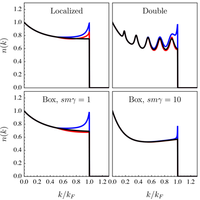
Shape effects of localized losses in quantum wires: Dissipative resonances and nonequilibrium universality

Thomas Müller, Marcel Gievers, Heinrich Fröml, Sebastian Diehl, and Alessio Chiocchetta

Phys. Rev. B 104, 155431 (2021) - Published 26 October, 2021

The authors study the role of the shape of dissipative impurities in quantum wires of ultracold atoms and predict a variety of resonance effects at the single-particle level. The interplay between interactions and dissipative impurities of finite width is further analyzed. In the case of attractive interactions, a line of renormalization-group fixed points emerges, showing that non-Hermiticity induces a novel kind of universality compared to the Hermitian counterpart.

Incipient geometric lattice instability of cubic fluoroperovskites

R. M. Dubrovin, A. C. Garcia-Castro, N. V. Siverin, N. N. Novikova, K. N. Boldyrev, Aldo H. Romero, and R. V. Pisarev

Phys. Rev. B 104, 144304 (2021) - Published 25 October, 2021

Metal halide perovskites are promising materials for modern technologies with unique physical properties. In particular, search and investigation for ferroelectricity and multiferroicity in them are very active research topics. Here, the authors study the lattice dynamics of cubic fluoroperovskites AMF3, and show that these materials exhibit affinity to incipient ferroelectrics, which manifests itself in the softening of polar phonons. The value of this softening correlates with the perovskite tolerance factor t, which speaks for the geometric origin of the observed effect.

Transport in the two-dimensional Fermi-Hubbard model: Lessons from weak coupling

Thomas G. Kiely and Erich J. Mueller

Phys. Rev. B 104, 165143 (2021) - Published 25 October, 2021

Strongly correlated materials, where electron-electron interactions dominate, display a range of important yet poorly understood phenomena including high-temperature superconductivity and exotic magnetism. Many such materials also feature unusual “strange-metal” transport, corresponding to unexpected temperature dependence of the resistivity. The authors show that, due to band-structure nesting and a bounded spectrum, even a weakly interacting system can display resistivity signatures that are typically associated with such strange metals. Their results are particularly important for interpreting recent cold-atom experiments which explore transport in the Fermi Hubbard model.

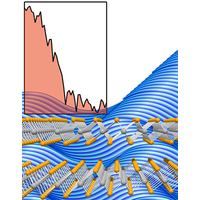
Signatures of the charge density wave collective mode in the infrared optical response of VSe2

Xuanbo Feng (馮翾博), Jans Henke, Corentin Morice, Charles J. Sayers, Enrico Da Como, Jasper van Wezel, and Erik van Heumen

Phys. Rev. B 104, 165134 (2021) - Published 21 October, 2021

The layered transition-metal dichalcogenide VSe2 undergoes a phase transition from a good metal to a charge density wave phase. Recent advances in crystal growth enable a detailed study of the imprint of the charge density wave on the optical conductivity. The authors observe emerging infrared active phonon modes and a mass enhancement of the charge carriers due to the interaction with the lattice. They identify key signatures of the elusive sliding mode associated with the charge order in this material.

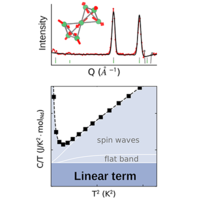
Beyond magnons in Nd2ScNbO7: An Ising pyrochlore antiferromagnet with all-in–all-out order and random fields

A. Scheie, M. Sanders, Xin Gui, Yiming Qiu, T. R. Prisk, R. J. Cava, and C. Broholm

Phys. Rev. B 104, 134418 (2021) - Published 20 October, 2021

Many magnetic materials have quantum disordered magnetic ground states, but it is not always clear what drives them. Here, the authors study the pyrochlore magnet Nd2ScNbO7 using neutron diffraction, heat capacity, and neutron-sampled nuclear hyperfine excitations. The static magnetic moments inferred from these three techniques are inconsistent, pointing to some fraction of spins remaining dynamic to the lowest temperatures – an observation confirmed by the anomalous low-energy density of states in the specific heat. Similar behavior is seen in Nd2Zr2O7. It could indicate either quantum spin-liquid behavior or local disorder-induced spin singlets.

Submonolayer copper telluride phase on Cu(111): Ad-chain and trough formation

Tilman Kißlinger, M. Alexander Schneider, and Lutz Hammer

Phys. Rev. B 104, 155426 (2021) - Published 20 October, 2021

A new surface telluride phase on Cu(111) is revealed and structurally characterized with picometer accuracy by a concerted application of LEED-IV, STM, and DFT. It is demonstrated that tellurium interacts strongly with the surface, inducing a complex displacive reconstruction in order to increase the number of available tellurium sites. This finding suggests that the CuTe/Cu interfaces that are used in photovoltaic cells might also be of equally complex structure.

Resolving the Berezinskii-Kosterlitz-Thouless transition in the two-dimensional XY model with tensor-network-based level spectroscopy

Atsushi Ueda and Masaki Oshikawa

Phys. Rev. B 104, 165132 (2021) - Published 20 October, 2021

The discovery of the Berezinskii-Kosterlitz-Thouless transition some fifty years ago was a subject of the 2016 Nobel Prize in Physics. However, quantitative study of the transition in the two-dimensional XY spin model still suffers from significant finite-size effects. The authors implement the level-spectroscopy method, originally developed for quantum systems. They utilize the modern tensor-network renormalization scheme. This allows for an extremely accurate determination of the critical point as well as for a visualization of the celebrated Kosterlitz renormalization-group flow.

Revealing the competition between charge density wave and superconductivity in CsV3Sb5 through uniaxial strain

Tiema Qian, Morten H. Christensen, Chaowei Hu, Amartyajyoti Saha, Brian M. Andersen, Rafael M. Fernandes, Turan Birol, and Ni Ni

Phys. Rev. B 104, 144506 (2021) - Published 19 October, 2021

The authors apply uniaxial strain on the layered kagome superconductor CsV3Sb5. They show that its charge density wave (CDW) and superconductivity (SC) transitions are dominated by the change in the c axis, and the effect of the explicit rotational symmetry breaking by strain is negligible on the competition between CDW and SC. Together with theoretical studies, they propose that the trilinear coupling between the M1+ and L2− phonon modes plays an important role in the CDW.

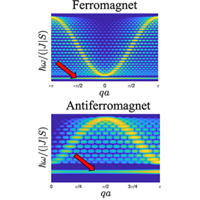
Confined magnons

Seamus Beairsto, Maximilien Cazayous, Randy S. Fishman, and Rogério de Sousa

Phys. Rev. B 104, 134415 (2021) - Published 18 October, 2021

The common belief is that excitations of magnets are always deconfined “bulk” spin waves spread out in space, whose quanta are called magnons. In reality all materials have surfaces and interfaces that break translation symmetry, giving rise to excitations that are confined to them, in addition to the deconfined ones. The conditions for the existence of these confined magnons are still unknown. The authors show that extra magnetic anisotropy at the surface or interface plays a key role in magnon confinement, and obtain a characteristic length scale for their spatial localization. Calculations of the spin-scattering function show how confined magnons can be observed with neutron, electron, and photon scattering experiments in a wide variety of materials. The accompanying image shows the heat map for magnon energy versus wave vector in ferromagnetic and antiferromagnetic materials. The confined magnon appears as a flat dispersion (delocalized in q space, localized in real space) with energy below the lowest bulk mode.

Pairing interaction in superconducting UCoGe tunable by magnetic field

K. Ishida, S. Matsuzaki, M. Manago, T. Hattori, S. Kitagawa, M. Hirata, T. Sasaki, and D. Aoki

Phys. Rev. B 104, 144505 (2021) - Published 18 October, 2021

Spin fluctuations, instead of phonons, have been considered to be responsible for the formation of Cooper pairs. However, experimental confirmation has not yet been achieved, although a qualitative consensus seems to have been obtained. The authors show here a semiquantitative comparison between the superconducting transition temperature and spin fluctuations derived from an NMR experiment on the ferromagnetic superconductor UCoGe, in which the ferromagnetic fluctuations and superconductivity are tunable by external fields. The present comparisons strongly support the theoretical formalism of spin-fluctuation-mediated superconductivity.

Topological charge pumping in quasiperiodic systems characterized by the Bott index

Mao Yoshii, Sota Kitamura, and Takahiro Morimoto

Phys. Rev. B 104, 155126 (2021) - Published 18 October, 2021

Quasiperiodic systems are a class of materials with long-range order but no translational symmetry. While they are an interesting platform for novel topological phases, conventional topological characterization is not directly applicable due to the lack of translational symmetry. Here, the authors study topological charge pumping in quasiperiodic systems, using a real-space formulation called the Bott index. They study one-dimensional quasiperiodic models based on the Fibonacci lattice, and demonstrate a fractal structure of charge pumping associated with the quasiperiodicity.

Suppressed incommensurate order in swedenborgite Ca0.5Y0.5BaCo4O7

Shang Gao, Vilmos Kocsis, Minoru Soda, Feng Ye, Yaohua Liu, Andrew F. May, Yasujiro Taguchi, Yoshinori Tokura, Taka-hisa Arima, Werner Schweika, Andrew D. Christianson, and Matthew B. Stone

Phys. Rev. B 104, L140408 (2021) - Published 18 October, 2021

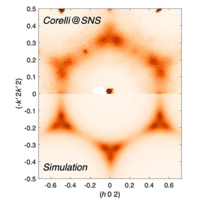
Swedenborgite Ca0.5Y0.5BaCo4O7, with geometrically frustrated kagome and triangular lattices, exhibits a disordered ground state in spite of strong antiferromagnetic coupling between the Co spins. Here, the authors perform single-crystal diffuse neutron scattering experiments to fully characterize the short-range spin correlations in this compound and determine that long-range incommensurate spin correlations are suppressed by exchange disorder. This result reveals a general correspondence between unequal interactions and incommensurate spin correlations on the swedenborgite lattice.

Homogeneous optical anisotropy in an ensemble of InGaAs quantum dots induced by strong enhancement of the heavy-hole band Landé parameter q

A. V. Trifonov, I. A. Akimov, L. E. Golub, E. L. Ivchenko, I. A. Yugova, A. N. Kosarev, S. E. Scholz, C. Sgroi, A. Ludwig, A. D. Wieck, D. R. Yakovlev, and M. Bayer

Phys. Rev. B 104, L161405 (2021) - Published 18 October, 2021

The authors report on a mechanism of strong enhancement of the band Landé parameter q due to in-plane confinement of holes and the valence-band warping. This explains the surprisingly large in-plane hole g factor in symmetric self-assembled (In,Ga)As/GaAs quantum dots with D2d symmetry as revealed by coherent optical spectroscopy. The proposed mechanism results in uniform magnetic field induced optical anisotropy for the entire quantum dot ensemble, which is a prerequisite for the realization of spin quantum memories and spin-photon entanglement in the ensemble.

Measurement of the thulium ion spin Hamiltonian in an yttrium gallium garnet host crystal

Jacob H. Davidson, Philip J. T. Woodburn, Aaron D. Marsh, Kyle J. Olson, Adam Olivera, Antariksha Das, Mohsen Falamarzi Askarani, Wolfgang Tittel, Rufus L. Cone, and Charles W. Thiel

Phys. Rev. B 104, 134103 (2021) - Published 11 October, 2021

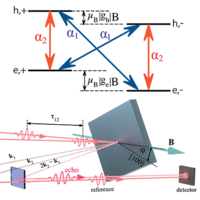
The magnetic properties of crystals doped with rare-earth ions have long been studied for their long coherence times and applications in signal processing. Here, the authors measure a complete tensor description of the hyperfine structure for a pair of optically addressable levels belonging to the Tm3+-ion defects within the host material. Certain orientations of interest stand out, such as some that realize optical clock transitions; they are shown to have an invariant response to fluctuations in the local magnetic environment.

Minimal model for Hilbert space fragmentation with local constraints

Bhaskar Mukherjee, Debasish Banerjee, K. Sengupta, and Arnab Sen

Phys. Rev. B 104, 155117 (2021) - Published 11 October, 2021

Interacting quantum systems may exhibit fragmentation of their Hilbert space into dynamically disconnected sectors leading to unusual properties like nonergodicity. Fragmentation usually stems from the simultaneous conservation of charge and dipole moment. The authors demonstrate that an alternative scenario occurs in the absence of dipole conservation via a minimal model of interacting spins where fragmentation, including a novel secondary fragmentation in an entangled basis, emerges. A Floquet version of the model yields detectable stroboscopic freezing of certain states at specific drive frequencies.

Non-Abelian statistics in light-scattering processes across interacting Haldane chains

Vladimir Gnezdilov, Vladimir Kurnosov, Yurii Pashkevich, Anup Kumar Bera, A. T. M. Nazmul Islam, Bella Lake, Bodo Lobbenmeier, Dirk Wulferding, and Peter Lemmens

Phys. Rev. B 104, 165118 (2021) - Published 11 October, 2021

The Haldane chain compound SrNi2V2O8 represents a topological system where magnetic degrees of freedom stem from local singlet dimer products on a chain. Topological states only exist at the edges of these chains, i.e. on the surface of the sample. In contrast, Raman light scattering induces topological states different from the Haldane host via interchain spin exchange. These states lead to non-Abelian statistics in close analogy to Kitaev spin liquids.

Ultrafast nonlinear phonon response of few-layer hexagonal boron nitride

Taehee Kang, Jia Zhang, Achintya Kundu, Klaus Reimann, Michael Woerner, Thomas Elsaesser, Bernard Gil, Guillaume Cassabois, Christos Flytzanis, Giorgia Fugallo, Michele Lazzeri, Ryan Page, and Debdeep Jena

Phys. Rev. B 104, L140302 (2021) - Published 11 October, 2021

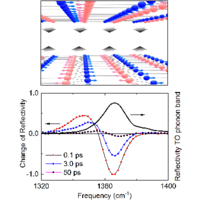
Ultrafast optical-phonon dynamics and the related nonlinear lattice response of few-layer hexagonal boron nitride (h-BN) are elucidated in a combined experimental and theoretical study. The lifetimes of transverse optical (TO) phonons and interlayer modes are 1.2 and 20 ps. In-plane TO phonon displacements are shown to couple to interlayer shear and breathing motions. In the nonlinear phonon response, a transient reduction of the TO phonon frequency arises from this anharmonic coupling, which is a particular property of few-layer h-BN.

Yang-Lee edge singularity triggered entanglement transition

Shao-Kai Jian, Zhi-Cheng Yang, Zhen Bi, and Xiao Chen

Phys. Rev. B 104, L161107 (2021) - Published 11 October, 2021

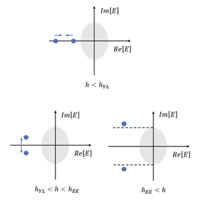
The authors demonstrate a mechanism whereby the Yang-Lee edge singularity in certain PT-symmetric non-Hermitian Hamiltonians can trigger a first-order entanglement transition. At the transition, the entanglement entropy of the steady state jumps discontinuously from a volume-law to an area-law scaling. Physically, such non-Hermitian Hamiltonian evolutions arise when post-selecting a particular quantum trajectory of a system subject to continuous weak measurements.

Measurement-induced criticality and entanglement clusters: A study of one-dimensional and two-dimensional Clifford circuits

Oliver Lunt, Marcin Szyniszewski, and Arijeet Pal

Phys. Rev. B 104, 155111 (2021) - Published 7 October, 2021

Measurement-induced entanglement transitions in quantum dynamics represent a new class of nonequilibrium transitions, akin to thresholds in quantum error correction. In this work, the authors explore the universal properties of entanglement transitions in one- and two-dimensional monitored Clifford circuits, using a graph-state-based algorithm to unravel geometric properties of entanglement. A study of entanglement clusters in the steady state reveals that, despite similarities in the bulk, the surface critical exponents show strong deviations from classical percolation.

Time-resolved optical conductivity and Higgs oscillations in two-band dirty superconductors

Rafael Haenel, Paul Froese, Dirk Manske, and Lukas Schwarz

Phys. Rev. B 104, 134504 (2021) - Published 5 October, 2021

In two-band superconductors, amplitude and phase fluctuations of the superconducting condensates can be quantized as bosonic Higgs and Leggett quasiparticles. Although these modes do not couple linearly to electromagnetic fields, impurity scattering can significantly enhance the nonlinear light-Higgs coupling, resulting in marked signals in nonlinear terahertz spectroscopic experiments. Here, the authors present a general theory of collective-mode spectroscopy in dirty two-band superconductors with detailed simulations of transient optical conductivity measurements and third-harmonic generation for the case of MgB2.

Sign In to Your Journals Account

Filter

Section

Filter

Article Lookup

Enter a citation