Highlights

Time-resolved investigation of plasmon mode along interface channels in integer and fractional quantum Hall regimes

Chaojing Lin, Masayuki Hashisaka, Takafumi Akiho, Koji Muraki, and Toshimasa Fujisawa

Phys. Rev. B 104, 125304 (2021) - Published 13 September, 2021

The authors investigate here the fundamental charge dynamics of interface quantum Hall (QH) channels, formed at the interface of two QH regions, by using a time-resolved scheme. The measured plasmon mode is delayed and broadened due to the influence of charge puddles formed around the channel. The transport behavior can be understood with a distributed circuit model, which reveals the importance of gate-puddle capacitive coupling on plasmon dissipation. By reducing the puddle capacitance, a high-quality fractional interface channel can be realized.

Heterobilayer moiré magnets: Moiré skyrmions and commensurate-incommensurate transitions

Kasra Hejazi, Zhu-Xi Luo (罗竹悉), and Leon Balents

Phys. Rev. B 104, L100406 (2021) - Published 10 September, 2021

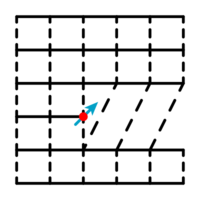
Magnetic van der Waals materials provide a rich venue for two-dimensional magnetism. Here, the authors study heterobilayers with a moiré pattern comprised of one ferromagnetic layer and one antiferromagnetic layer, with a Dzyaloshinskii-Moriya interaction in the ferromagnetic layer. Combining perturbative and strong-coupling analyses with numerical optimization, they uncover a rich phase diagram containing diverse moiré-periodic commensurate and incommensurate phases. This includes an interesting state with a nontrivial topological texture: a skyrmion lattice on the moiré scale.

Determination of spin chirality using x-ray magnetic circular dichroism

Gerrit van der Laan

Phys. Rev. B 104, 094414 (2021) - Published 9 September, 2021

Common wisdom has it that antiferromagnetic materials show no x-ray magnetic circular dichroism (XMCD). Surprisingly, a kagome lattice that has negative spin chirality can give a nonzero XMCD signal, even though the total spin moment reduces to zero. Here, the author explains this by evoking a rule for the rotational symmetry invariance of the XMCD signal, whereby the existence of an anisotropic XMCD signal for the local magnetic atom is a necessary condition.

Magnetic impurities at quantum critical points: Large-N expansion and connections to symmetry-protected topological states

Shang Liu, Hassan Shapourian, Ashvin Vishwanath, and Max A. Metlitski

Phys. Rev. B 104, 104201 (2021) - Published 9 September, 2021

Motivated by recent studies of symmetry protected topological states that are stabilized even in the absence of an energy gap, the authors study analytically the interaction of a (0+1)D impurity spin, which in some cases may be viewed as a topological state bound to a lattice defect, with a (2+1)D strongly interacting bulk, composed of bosonic excitations tuned to a quantum critical point. The question of whether the spin is (partially) screened is addressed within the framework of four different models, using mainly the large-N technique. The authors also point out intriguing connections with the physics of the Sachdev-Ye-Kitaev model.

Mapping out the emergence of topological features in the highly alloyed topological Kondo insulators Sm1−xMxB6(M=Eu,Ce)

Yishuai Xu, Erica C. Kotta, M. S. Song, B. Y. Kang, J. W. Lee, B. K. Cho, Shouzheng Liu, Turgut Yilmaz, Elio Vescovo, Jonathan D. Denlinger, Lin Miao, and L. Andrew Wray

Phys. Rev. B 104, 115118 (2021) - Published 9 September, 2021

SmB6 is a strongly correlated material that has been considered as a topological insulator and a Kondo insulator. Here, the authors use angle-resolved photoemission spectroscopy to chart the evolution of topologically linked electronic structure features versus doping in Sm1−xMxB6 (M=Eu, Ce). Topological band coherence phenomena are observed out to remarkably high alloy compositions (30% Eu and 50% Ce). Combined with numerical modeling, these results suggest that the topological surface-state spectral feature is protected by a hybridization gap much larger than the insulating gap.

Differentiating Hund from Mott physics in a three-band Hubbard-Hund model: Temperature dependence of spectral, transport, and thermodynamic properties

K. M. Stadler, G. Kotliar, S.-S. B. Lee, A. Weichselbaum, and J. von Delft

Phys. Rev. B 104, 115107 (2021) - Published 7 September, 2021

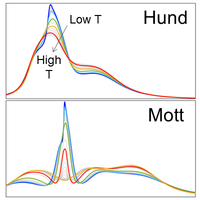
For many years, strong electronic correlations in metals have mainly been associated with ‘Mottness’ driven by the Coulomb repulsion, which suppresses charge fluctuations. Recently, ‘Hundness’, induced by Hund’s rule coupling that affects spin dynamics, has gained recognition as another route to strong correlations. Using dynamical mean-field theory and the numerical renormalization group, the authors identify numerous fingerprints distinguishing Hundness from Mottness in the temperature dependence of various physical quantities for a minimal model of Hund metals.

Frustrated Kondo impurity triangle: A simple model of deconfinement

Elio J. König, Piers Coleman, and Yashar Komijani

Phys. Rev. B 104, 115103 (2021) - Published 3 September, 2021

Concepts of topological order are central to our understanding of strongly correlated quantum materials. In this work, the authors propose that such concepts – which transcend the Landau paradigm – also appear in frustrated impurity models. In particular, they show that a variety of defining characteristics of topological order appear in a frustrated Kondo triangle: an irrational ground-state degeneracy reminiscent of anyons, ordering of a Wilson-loop-like order parameter, and a phase transition driven by the proliferation of monopoles of an emergent gauge field.

Metastable antiphase boundary ordering in CaFe2O4

H. Lane, E. E. Rodriguez, H. C. Walker, Ch. Niedermayer, U. Stuhr, R. I. Bewley, D. J. Voneshen, M. A. Green, J. A. Rodriguez-Rivera, P. Fouquet, S.-W. Cheong, J. P. Attfield, R. A. Ewings, and C. Stock

Phys. Rev. B 104, 104404 (2021) - Published 2 September, 2021

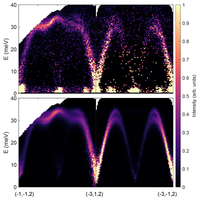
CaFe2O4 is an antiferromagnet that exhibits two competing magnetic orders. It has previously been suggested that the transition between these two phases is mediated by a temperature-dependent exchange interaction, favoring the B phase at high temperature and the A phase at low temperature. Through a combination of neutron scattering measurements and theoretical analysis, the authors propose here that the low-temperature magnetic phase is metastable and arises due to the freezing of antiphase domain boundaries in the B-phase structure, stabilized by single-ion anisotropy.

Optical control protocols for high-fidelity spin rotations of single SiV− and SnV− centers in diamond

Evangelia Takou and Sophia E. Economou

Phys. Rev. B 104, 115302 (2021) - Published 2 September, 2021

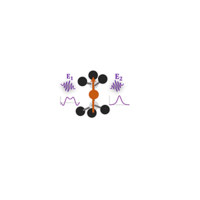
Group-IV defects in diamond are attractive qubit candidates that can be controlled optically. However, they have multiple excited states, leading to unwanted off-resonant transitions, which induce errors that lower the fidelity of quantum gate operations. Here, the authors design high-fidelity gate protocols that are tailored to these defects. Based on laser polarization tuning and pulse shaping, the proposed schemes counteract the errors and ensure high-fidelity operations.

Magnetic proximity effect in magnetic-insulator/heavy-metal heterostructures across the compensation temperature

Jackson J. Bauer, Paige Quarterman, Alexander J. Grutter, Bharat Khurana, Subhajit Kundu, K. Andre Mkhoyan, Julie A. Borchers, and Caroline A. Ross

Phys. Rev. B 104, 094403 (2021) - Published 1 September, 2021

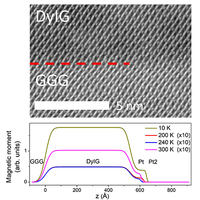
Nonmagnetic heavy metals can develop a magnetic moment due to the proximity of a magnetic layer. Here, the sign of the proximity effect in Pt and W grown on the ferrimagnetic insulator Dy3Fe5O12 (DyIG) is examined. Polarized neutron reflectometry indicates the importance of a clean metal/garnet interface, and shows that the proximity effect in Pt/DyIG is positive above and below the DyIG compensation temperature, indicating a different origin compared to that of Pt adjacent to a ferrimagnetic metal alloy.

Strain-induced time reversal breaking and half quantum vortices near a putative superconducting tetracritical point in Sr2RuO4

Andrew C. Yuan, Erez Berg, and Steven A. Kivelson

Phys. Rev. B 104, 054518 (2021) - Published 26 August, 2021

Motivated by continuing debate concerning the pairing symmetries of Sr2RuO4, the authors develop a general description of a situation in which superconducting orders are nearly degenerate. They suggest that many seemingly contradictory experimental findings can be reconciled if one assumes this material is near a tetracritical point, where small variations in strain can lead to rich phenomenology. More specifically, the authors characterize possible superconducting domain walls, allowing for spontaneous time-reversal symmetry breaking and the stabilization of half-quantum vortices.

Hartree-Fock study of the moiré Hubbard model for twisted bilayer transition metal dichalcogenides

Jiawei Zang, Jie Wang, Jennifer Cano, and Andrew J. Millis

Phys. Rev. B 104, 075150 (2021) - Published 26 August, 2021

The authors use Hartree-Fock methods to provide a comprehensive understanding of the moiré Hubbard model, believed to describe the low-energy physics of the twisted bilayer dichalcogenide material WSe2. They present a comprehensive phase diagram, reveal a previously unnoticed gauge symmetry, demonstrate a region of a reentrant metal-insulator transition, and elucidate the roles of fermiology and commensurability in the transitions. Comparison to experimental data locates the currently studied systems in the intermediate coupling region of the phase diagram.

Electronic nature of chiral charge order in the kagome superconductor CsV3Sb5

Zhiwei Wang, Yu-Xiao Jiang, Jia-Xin Yin, Yongkai Li, Guan-Yong Wang, Hai-Li Huang, Sen Shao, Jinjin Liu, Peng Zhu, Nana Shumiya, Md Shafayat Hossain, Hongxiong Liu, Youguo Shi, Junxi Duan, Xiang Li, Guoqing Chang, Pengcheng Dai, Zijin Ye, Gang Xu, Yanchao Wang, Hao Zheng, Jinfeng Jia, M. Zahid Hasan, and Yugui Yao

Phys. Rev. B 104, 075148 (2021) - Published 25 August, 2021

CsV3Sb5 has been recently discovered to be a kagome superconductor. Here, the authors use scanning tunneling microscopy to study its charge order and superconductivity at the atomic scale. Through mapping the energy gap of the charge order, the authors identify its chiral electronic nature. They also elucidate the surface nature of the 1×4 superlattice and superconducting excitations.

Unidirectional magnetoresistance and spin-orbit torque in NiMnSb

J. Železný, Z. Fang, K. Olejník, J. Patchett, F. Gerhard, C. Gould, L. W. Molenkamp, C. Gomez-Olivella, J. Zemen, T. Tichý, T. Jungwirth, and C. Ciccarelli

Phys. Rev. B 104, 054429 (2021) - Published 23 August, 2021

Electrical detection of magnetization reversal typically requires three-terminal devices or nanoscopic heterostructures, such as magnetic tunnel junctions. Recently, the so-called unidirectional magnetoresistance has been discovered, which allows detecting magnetization reversals using two-terminal measurements. Here, the authors theoretically and experimentally study the unidirectional magnetoresistance in bulk ferromagnetic NiMnSb and show that its origin is not directly related to the current-induced spin accumulation that gives rise to the spin-orbit torques. They also show the emergence of components transverse to the electric field.

Coupled valence carrier and core-exciton dynamics in WS2 probed by few-femtosecond extreme ultraviolet transient absorption spectroscopy

Hung-Tzu Chang, Alexander Guggenmos, Christopher T. Chen, Juwon Oh, Romain Géneaux, Yi-De Chuang, Adam M. Schwartzberg, Shaul Aloni, Daniel M. Neumark, and Stephen R. Leone

Phys. Rev. B 104, 064309 (2021) - Published 23 August, 2021

Understanding the interaction between photoexcited carriers and valence excitons is crucial to the development of optoelectronics. However, the influence of carriers on core excitons, the strongly bound core-level excitations due to electron–core-hole interactions, is not fully explored. By conducting optical–extreme-ultraviolet transient absorption spectroscopy at two different core-level absorption edges in WS2 simultaneously, the authors here not only measure the picosecond relaxation of optically excited carriers, but also observe carrier-induced modifications to core-exciton transitions and their few-femtosecond free induction decay.

Electric polarization and nonlinear optical effects in noncentrosymmetric magnets

Takahiro Morimoto, Sota Kitamura, and Shun Okumura

Phys. Rev. B 104, 075139 (2021) - Published 23 August, 2021

Magnetic excitations in multiferroic materials accompany electric polarization, known as electromagnons. The authors develop here a general framework to study electric polarization and nonlinear optical responses of noncentrosymmetric magnets based on spin models. They theoretically demonstrate the optical excitation of electromagnon-induced dc current generation (i.e., a photovoltaic effect) from the so-called shift current mechanism.

Stability of the particle-hole Pfaffian state and the 52-fractional quantum Hall effect

Edward H. Rezayi, Kiryl Pakrouski, and F. D. M. Haldane

Phys. Rev. B 104, L081407 (2021) - Published 23 August, 2021

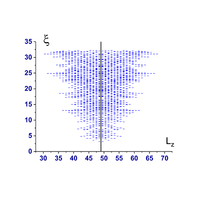
After decades since its discovery, a complete understanding of the topological phase of matter at 52 filling appears to be lacking. Previous numerical studies have narrowed the candidates to the Moore-Read Pfaffian or the anti-Pfaffian. Recent thermal transport measurements point to another variant, the particle-hole Pfaffian, which has a nonholomorphic pairing part that complicates comparison with other competing states. Here, the authors have constructed the exact holomorphic particle-hole Pfaffian wave function with full particle-hole symmetry and compared its energetics with the Moore-Read Pfaffian and the anti-Pfaffian.

Superconducting state of Sr2RuO4 in the presence of longer-range Coulomb interactions

Astrid T. Rømer, P. J. Hirschfeld, and Brian M. Andersen

Phys. Rev. B 104, 064507 (2021) - Published 20 August, 2021

The material Sr2RuO4 is notorious for the difficulty in reconciling all experimental characterizations of its superconducting order parameter. In this theoretical study, the authors explore what superconducting order parameters are most favorable from the perspective of spin-fluctuation mediated pairing, taking into account the multiorbital nature of the system and its sizable spin-orbit coupling. They find that longer-range Coulomb interactions induce a near-degeneracy between nodal s-wave and dxy superconductivity, suggesting a ground-state condensate with time-reversal symmetry breaking of the form s+idxy.

Intrinsically gapless topological phases

Ryan Thorngren, Ashvin Vishwanath, and Ruben Verresen

Phys. Rev. B 104, 075132 (2021) - Published 18 August, 2021

Most topological properties of quantum systems, such as the braiding of anyons or protected edge modes, are easiest to define in systems with an energy gap. While some topological phenomena persist in the presence of gapless modes, this paper explores such properties that are only possible without a gap. These systems are here dubbed intrinsically gapless topological phases. The authors study a simple model – a hole-doped one-dimensional antiferromagnet – and describe a mechanism based on anomalies that applies in all dimensions.

Ubiquity of amplitude-modulated magnetic ordering in the H−T phase diagram of the frustrated non-Fermi-liquid YbAgGe

C. B. Larsen, E. Canévet, D. G. Mazzone, Ch. Rüegg, B. Fåk, D. F. McMorrow, E. Ressouche, G. J. McIntyre, S. L. Bud'ko, P. C. Canfield, and O. Zaharko

Phys. Rev. B 104, 054424 (2021) - Published 17 August, 2021

YbAgGe contains a magnetic geometrically frustrated kagome-like lattice that features significant local single-ion anisotropy. The electronic state is established by hybridization of 4f and conduction electrons, leading to heavy electronic masses. Competition between these various interactions leads to nontrivial behavior under external magnetic field. Here, the authors present neutron diffraction experiments under magnetic fields up to 8 T in the hexagonal plane, revealing the microscopic nature of the first four subsequent magnetic states, and propose further steps to understand the microscopic interactions.

Sign In to Your Journals Account

Filter

Section

Filter

Article Lookup

Enter a citation