Highlights

General connection between time-local and time-nonlocal perturbation expansions

K. Nestmann and M. R. Wegewijs

Phys. Rev. B 104, 155407 (2021) - Published 5 October, 2021

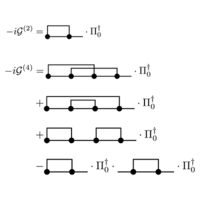
The time-evolution equation of an open quantum system has long been known to come in two equivalent, yet fundamentally different flavors: a time-nonlocal one with a memory kernel and a time-local one with a generator, whose connection has been discovered only recently [phys_rev_x_11_021041_2021]. Here, the authors show that this implies a recursive relation between their perturbative series: the complicated time-local series can be computed from the simpler time-nonlocal one by disentangling the time ordering of microscopic interactions with the environment.

Topological descendants of a multicritical Dirac semimetal with magnetism and strain

Lin-Lin Wang, Hoi Chun Po, Robert-Jan Slager, and Ashvin Vishwanath

Phys. Rev. B 104, 165107 (2021) - Published 5 October, 2021

The past decades have seen an ever increasing rise in classification and characterization of topological materials. One of the most important questions is how to control and manipulate topological phases. Here, the authors predict a multicritical topological paradigm in EuTl2. Starting from a paramagnetic Dirac semimetallic phase, a plethora of descendant topological phases are accessible with magnetism and strain, including Dirac and Weyl magnetic semimetals, axion insulators, and a variety of other topological crystalline insulators protected by different symmetries.

Dynamical vortices in electron-phonon superconductors

Morten H. Christensen and Andrey V. Chubukov

Phys. Rev. B 104, L140501 (2021) - Published 5 October, 2021

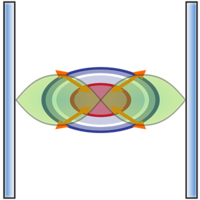
The authors study the frequency dependence of the superconducting gap function in systems with both electronic repulsion and electron-phonon attraction. Depending on the balance between attractive and repulsive interactions, the gap function can develop nodes in frequency space. They demonstrate that such nodes correspond to centers of a dynamical analog of vortices, albeit without an antivortex counterpart. Hence, such dynamical vortices can only be removed by pushing them to infinite frequencies or by moving them to the lower complex half-plane.

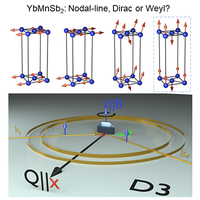
Magnetic structure of the topological semimetal YbMnSb2

Jian-Rui Soh, Siobhan M. Tobin, Hao Su, Ivica Zivkovic, Bachir Ouladdiaf, Anne Stunault, J. Alberto Rodríguez-Velamazán, Ketty Beauvois, Yanfeng Guo, and Andrew T. Boothroyd

Phys. Rev. B 104, L161103 (2021) - Published 5 October, 2021

Recently, the antiferromagnet YbMnSb2 has been predicted to be a topological semimetal driven by time-reversal symmetry breaking, where the magnetic order is key to its behavior as a topological material. Depending on the magnetic order, YbMnSb2 can have Weyl, nodal-line, or Dirac topological features. In this Letter, the authors use a combination of unpolarized and polarized neutron diffraction to determine unambiguously the magnetic structure of YbMnSb2 and the topology of the electronic bands.

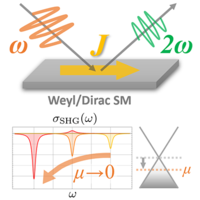
Current-induced second harmonic generation in inversion-symmetric Dirac and Weyl semimetals

Kazuaki Takasan, Takahiro Morimoto, Joseph Orenstein, and Joel E. Moore

Phys. Rev. B 104, L161202 (2021) - Published 5 October, 2021

Topological materials have gained attention as a platform to explore novel nonlinear optical responses. To date, this research has largely focused on acentric materials, leaving the inversion-symmetric systems largely unexplored. In this work, the authors demonstrate that inversion-symmetric topological semimetals show perturbatively divergent second-harmonic generation when a finite current is applied. Because the response is both large and highly controllable, it can be used to investigate the nonequilibrium physics of topological materials and design future optical devices.

Strong magnetoresistance in a graphene Corbino disk at low magnetic fields

Masahiro Kamada, Vanessa Gall, Jayanta Sarkar, Manohar Kumar, Antti Laitinen, Igor Gornyi, and Pertti Hakonen

Phys. Rev. B 104, 115432 (2021) - Published 29 September, 2021

In the Hall bar geometry, both the transverse and longitudinal bulk conductivities – σxy(B) and σxx(B), respectively – determine the resistivity ρxx(B). Consequently, magnetoresistance R(B) becomes independent of the applied magnetic field B in the simplest one-band model. In the corresponding Corbino-ring setting, σxy drops out and the resistivity is obtained as ρxx(B)=1/σxx(B). Strong, pure B2 magnetoresistance is observed in the reported experimental work and used to extract information about scattering mechanisms in graphene, which amply demonstrates the usefulness of the Corbino-ring geometry for transport studies of 2D materials.

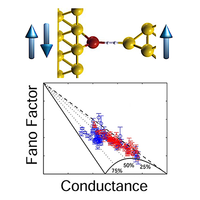
Current shot noise in atomic contacts: Fe and FeH2 between Au electrodes

Michael Mohr, Alexander Weismann, Dongzhe Li, Mads Brandbyge, and Richard Berndt

Phys. Rev. B 104, 115431 (2021) - Published 28 September, 2021

The shot noise of the current through an iron atom on gold and through FeH2 is measured and calculated. The authors find hydrogen to substantially increase the spin polarization up to values of about 80%. The data suggest that the quantum motion of hydrogen and the associated zero-point energy, which are not described by the density functional theory modeling here, may play an important role.

Multifaceted moiré superlattice physics in twisted WSe2 bilayers

S. J. Magorrian, V. V. Enaldiev, V. Zólyomi, F. Ferreira, V. I. Fal'ko, and D. A. Ruiz-Tijerina

Phys. Rev. B 104, 125440 (2021) - Published 28 September, 2021

Moiré superlattices in twisted van der Waals bilayers of WSe2 are determined by weak ferroelectric charge transfer in inversion-asymmetric structures, piezoelectricity, and interlayer hybridization. Here, the authors map out the properties of twisted WSe2 bilayers using an abinitio k⋅p tight-binding multiscale modeling approach, taking into account the lack of inversion symmetry in the monolayer unit cell, and analyzing both parallel (P) and antiparallel (AP) interlayer orientations. They demonstrate that mesoscale Hubbard lattices with high spin-valley degeneracy, and highly anisotropic delocalized states, are accessible by the choice of twist angle and relevant valley.

Classical approaches to prethermal discrete time crystals in one, two, and three dimensions

Andrea Pizzi, Andreas Nunnenkamp, and Johannes Knolle

Phys. Rev. B 104, 094308 (2021) - Published 27 September, 2021

Prethermal discrete time crystals (pDTC) are new collective nonequilibrium phases of matter that break, up to exponentially long times, the discrete time translational symmetry of a periodic drive. Previously studied as a quantum phenomenon, this paper establishes that pDTCs also emerge for classical Hamiltonian dynamics even in their ‘higher-order and fractional’ version. This enables efficient simulations of such phenomena in experimentally relevant settings, including a study of the interplay between dimensionality and interaction range.

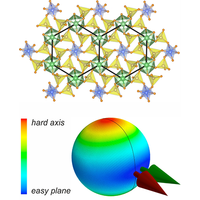
MoP3SiO11: A 4d3 honeycomb antiferromagnet with disconnected octahedra

Danis I. Badrtdinov, Lei Ding, Clemens Ritter, Jan Hembacher, Niyaz Ahmed, Yurii Skourski, and Alexander A. Tsirlin

Phys. Rev. B 104, 094428 (2021) - Published 22 September, 2021

Transition metal compounds can feature different types of magnetic anisotropy. By studying a honeycomb-lattice material with disconnected transition-metal octahedra, the authors reveal the crucial role of the single-ion anisotropy term that arises despite the nominally quenched orbital moment of the d3 magnetic ion. Their findings suggest that the effect of single-ion anisotropy should not be ignored when searching for signatures of Kitaev interactions in spin-3/2 honeycomb magnets.

Theory of competing excitonic orders in insulating WTe2 monolayers

Yves H. Kwan, T. Devakul, S. L. Sondhi, and S. A. Parameswaran

Phys. Rev. B 104, 125133 (2021) - Published 22 September, 2021

The excitonic insulator is a long-sought-after phase of matter whose experimental detection has only seen substantial progress in the past decade. Here, the authors investigate theoretically a recent proposal that monolayer WTe2 realizes such a state, and show that the rich orbital, spin, and valley structure inherent to this material can stabilize distinct excitonic phases with different observable signatures.

Tunable cooperativity in coupled spin-cavity systems

Lukas Liensberger, Franz X. Haslbeck, Andreas Bauer, Helmuth Berger, Rudolf Gross, Hans Huebl, Christian Pfleiderer, and Mathias Weiler

Phys. Rev. B 104, L100415 (2021) - Published 22 September, 2021

The authors experimentally demonstrate the tunable coupling between microwave photons and the magnetic excitations (magnons) in the topologically nontrivial skyrmion lattice phase of the helimagnet Cu2OSeO3. They exploit distinct microwave excitation geometry of the skyrmion lattice breathing mode to achieve a wide tunability of the effective magnon-photon coupling rate by small variations of the external magnetic field. The authors succeed in realizing high cooperativity for the dispersive magnon-photon coupling in the skyrmion lattice phase.

Interacting defects generate stochastic fluctuations in superconducting qubits

J. H. Béjanin, C. T. Earnest, A. S. Sharafeldin, and M. Mariantoni

Phys. Rev. B 104, 094106 (2021) - Published 21 September, 2021

Superconducting quantum computers have long been plagued by defects causing unreliable performance. Here, the authors confirm the fundamental mechanism behind unwanted time fluctuations: ‘hot’ defects kick ‘colder’ ones, which, in turn, randomly jolt the qubits in a device. This domino effect results in a jitter that prevents scientists from conducting ideal quantum operations. Will it be possible to eliminate this jitter? The authors show here that the underlying physics is now well understood, a key step towards remedying the corresponding errors.

Fluctuation-driven transitions in localized insulators: Intermittent metallicity and path chaos precede delocalization

Valentina Ros and Markus Müller

Phys. Rev. B 104, 094205 (2021) - Published 20 September, 2021

The localization of interacting particles is affected by thermal fluctuations that change the effective local disorder. In the insulating regime, the time-averaged conductance is dominated by rare temporal fluctuations, whereby three distinct phases occur as disorder is decreased: (i) a nonresonating insulator where conductance remains exponentially small even during rare fluctuations, (ii) an intermittent metal, where the conductance on a single optimal path becomes metallic for an exponentially small fraction of time, and (iii) an intermittent metal, where the optimal path itself fluctuates, implying temporal path chaos.

Adiabatic construction of hierarchical quantum Hall states

Martin Greiter and Frank Wilczek

Phys. Rev. B 104, L121111 (2021) - Published 20 September, 2021

Intuitive arguments and numerical simulations have long been used to argue for the incompressibility of fractionally quantized Hall states at the most prominent odd-denominator Landau-level filling fractions ν = p/(p (m - 1) + 1), where p is an integer and m an odd integer. Here, the authors strengthen the case by deriving these states more rigorously via adiabatic localization of magnetic flux onto the particles. They arrive at wave functions suggested by Jain’s composite-fermion picture.

Topological Goldstone phases of matter

Dominic V. Else

Phys. Rev. B 104, 115129 (2021) - Published 16 September, 2021

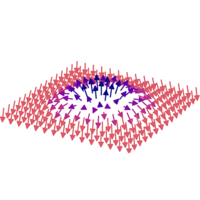
The author gives a general theory of the circumstances, in which Goldstone modes associated with spontaneous symmetry breaking can be “topologically nontrivial” in the sense, for example, that topological defects, such as skyrmions, carry nontrivial quantum numbers. The core physical idea is that such defects can always be mapped to nontrivial configurations of a background gauge field for the residual symmetry, such as fluxes and monopoles.

Magnetic properties and signatures of moment ordering in the triangular lattice antiferromagnet KCeO2

Mitchell M. Bordelon, Xiaoling Wang, Daniel M. Pajerowski, Arnab Banerjee, Mark Sherwin, Craig M. Brown, M. S. Eldeeb, T. Petersen, L. Hozoi, U. K. Rößler, Martin Mourigal, and Stephen D. Wilson

Phys. Rev. B 104, 094421 (2021) - Published 15 September, 2021

Bordelon et al. explore here the magnetic properties of the layered triangular lattice compound KCeO2. This material is a member of a family of rare earth based delafossite-like compounds, some of which were recently reported to harbor intrinsically quantum disordered ground states. The authors show that the Ce ions decorating this lattice type instead realize a weak low-temperature antiferromagnetic ground state, presenting a strong contrast to the spin liquid states formed by their Yb-based counterparts.

Spectroscopy of the local density of states in nanowires using integrated quantum dots

Frederick S. Thomas, Malin Nilsson, Carlo Ciaccia, Christian Jünger, Francesca Rossi, Valentina Zannier, Lucia Sorba, Andreas Baumgartner, and Christian Schönenberger

Phys. Rev. B 104, 115415 (2021) - Published 15 September, 2021

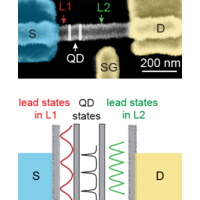
The high control in the growth of single-crystalline semiconducting nanowires enables the integration of a single quantum dot (QD) by axial heteroepitaxy. These QDs have highly desired properties: electrically stable eigenstates with a large confinement and clean one-dimensional leads (L1 and L2) that connect the zero-dimensional QD with the two Fermi reservoirs. However, the one-dimensional nature of the leads causes a modulation in the density of states at each side of the QD. A procedure is introduced that allows to distinguish these lead features from excited states in the QD.

Conformal invariance and quantum nonlocality in critical hybrid circuits

Yaodong Li, Xiao Chen, Andreas W. W. Ludwig, and Matthew P. A. Fisher

Phys. Rev. B 104, 104305 (2021) - Published 14 September, 2021

Local measurements in random quantum circuits lead to a new class of “entanglement phase transitions”. Through extensive calculations at the critical point of “stabilizer” circuits — organized by a mapping from the finite rectangular geometry to the semi-infinite plane — the authors find here an emergent conformal field theory description of the entanglement dynamics, whose critical exponents are beyond any known theory. As we show, conformal symmetry implies a measurement-induced Bell-like nonlocality, where distant qubits become entangled with an infinite speed.

Fragile versus stable two-dimensional fermionic quasiparticles

Seongjin Ahn and Sankar Das Sarma

Phys. Rev. B 104, 125118 (2021) - Published 13 September, 2021

The authors provide a comprehensive theoretical investigation of the validity of the Fermi-liquid quasiparticle description in a two-dimensional electron gas interacting via the long-range Coulomb interaction. Contrary to popular belief, they find that quasiparticles are robust far above the Fermi momentum, perhaps providing a clue as to why the energy-band description works well far from the Fermi surface. The authors also find that there exists a small region around a critical wave vector where the quasiparticles become fragile due to their coupling to the collective modes. They also provide three-dimensional results.

Sign In to Your Journals Account

Filter

Section

Filter

Article Lookup

Enter a citation