Highlights

Experimental measurement of the isolated magnetic susceptibility

D. Billington, C. Paulsen, E. Lhotel, J. Cannon, E. Riordan, M. Salman, G. Klemencic, C. Cafolla-Ward, D. Prabhakaran, S. R. Giblin, and S. T. Bramwell

Phys. Rev. B 104, 014418 (2021) - Published 15 July, 2021

The wonder of quantum mechanics – epitomized by Schrödinger’s both-alive-and-dead cat – is rarely encountered in macroscopic measurements, where quantum details are often obscured. This paper shows how a macroscopic measurement of magnetic susceptibility – using a simple coil of wire -– reveals the tunable superposition or “concurrence” of ionic spin up and down states – just like Schrödinger’s thought experiment reveals the superposition of alive and dead. The measurement further provides a means of measuring nonequilibrium populations of these quantum states.

Quantum critical dynamics of a Josephson junction at the topological transition

Vladislav D. Kurilovich, Chaitanya Murthy, Pavel D. Kurilovich, Bernard van Heck, Leonid I. Glazman, and Chetan Nayak

Phys. Rev. B 104, 014509 (2021) - Published 15 July, 2021

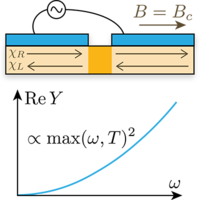
Suppression of conventional superconductivity by a magnetic field closes the gap in electronic excitations and brings back the normal-state conductivity. This simple pattern does not apply to a Majorana wire tuned to the topological phase transition. While the spectral gap also vanishes at the transition in such a wire, the dissipative dynamic response may still be suppressed, showing a strong dependence on frequency and temperature. This unusual behavior is controlled by the symmetries of the wire.

Complex charge density waves at Van Hove singularity on hexagonal lattices: Haldane-model phase diagram and potential realization in the kagome metals AV3Sb5 (A=K, Rb, Cs)

Yu-Ping Lin and Rahul M. Nandkishore

Phys. Rev. B 104, 045122 (2021) - Published 14 July, 2021

The recent discovery of topological charge density waves in the superconducting kagome metals AV3Sb5 (A=K, Rb, Cs) has attracted enormous attention. Motivated by the experiments, the authors analyze here the interplay of real and imaginary charge density waves at the Van Hove singularity, but in a broader scope of general hexagonal lattices. Phenomenological analysis uncovers a rich Haldane-model phase diagram. The theoretical model sheds light on the experimental observations in these kagome metals and future experiments of hexagonal lattice materials.

Antichiral ferromagnetism

Filipp N. Rybakov, Anastasiia Pervishko, Olle Eriksson, and Egor Babaev

Phys. Rev. B 104, L020406 (2021) - Published 13 July, 2021

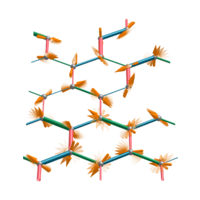
Crystals with full tetrahedral symmetry may exhibit antichiral ferromagnetic ordering. This spontaneous modulation of the magnetization direction is characterized by a spatial alternation between right and left handedness. In addition to the unconventional ground state, the revealed ordering gives rise to rich phenomena, such as unique magnetic domains and skyrmions.

NMR determination of Van Hove singularity and Lifshitz transitions in the nodal-line semimetal ZrSiTe

Yefan Tian, Yanglin Zhu, Rui Li, Zhiqiang Mao, and Joseph H. Ross, Jr.

Phys. Rev. B 104, L041105 (2021) - Published 13 July, 2021

ZrSiTe is of great interest due to its nonsymmorphic symmetry-protected Dirac nodal line close to the Fermi energy. Here, the authors show that the nodal line behaves energetically as a quasi-two-dimensional feature using nuclear magnetic resonance spectroscopy. They furthermore identify a 2D Van Hove singularity, an unusual occurrence in a bulk material akin to the analogous feature in twisted bilayer graphene. These results drive a temperature-dependent Lifshitz transition, opening the prospect for engineering new electronic transformations with Fermi level tuning.

Nature of the ferromagnetic-antiferromagnetic transition in Y1−xLaxTiO3

S. Hameed, S. El-Khatib, K. P. Olson, B. Yu, T. J. Williams, T. Hong, Q. Sheng, K. Yamakawa, J. Zang, Y. J. Uemura, G. Q. Zhao, C. Q. Jin, L. Fu, Y. Gu, F. Ning, Y. Cai, K. M. Kojima, J. W. Freeland, M. Matsuda, C. Leighton, and M. Greven

Phys. Rev. B 104, 024410 (2021) - Published 9 July, 2021

A rare ferromagnet-antiferromagnet transition is known to exist in the solid-solution Y1−xLaxTiO3 at x ≈ 0.3. Here, the authors study this transition using a unique battery of techniques, including magnetometry, x-ray absorption spectroscopy, x-ray magnetic circular dichroism, muon spin rotation, neutron diffraction, and small-angle neutron scattering. The thermal magnetic phase transitions are observed not to be of conventional second-order type, but rather to be first order in nature. Furthermore, complex changes in the magnetic ground state are revealed.

Two-component electronic phase separation in the doped Mott insulator Y1−xCaxTiO3

S. Hameed, J. Joe, D. M. Gautreau, J. W. Freeland, T. Birol, and M. Greven

Phys. Rev. B 104, 045112 (2021) - Published 9 July, 2021

The Mott insulator-metal transition has been the subject of intense research in condensed matter physics. Here, the authors study this transition in the prototypical perovskite oxide Y(Ca)TiO3, using a combination of x-ray absorption spectroscopy measurements and density functional theory calculations. They uncover electronic phase separation into hole-poor Mott-insulating and hole-rich metallic regions, i.e., an inherent first-order and percolative nature of the transition that occurs at nonzero hole doping.

Geometrical frustration and competing orders in the dipolar trimerized triangular lattice

Kevin Hofhuis, Charlotte F. Petersen, Michael Saccone, Scott Dhuey, Armin Kleibert, Sebastiaan van Dijken, and Alan Farhan

Phys. Rev. B 104, 014409 (2021) - Published 8 July, 2021

The authors introduce here an artificial spin system consisting of single-domain nanomagnets that are lithographically defined into trimers. Placing these trimers into a triangular lattice with a variable lattice parameter allows for direct control of competing interactions. The result is a system that can move between two long-range ordered phases: a vortex-dominated phase and a ferromagnetic phase. When competing interactions are perfectly tuned, however, the system gets caught within a highly disordered phase with short-range correlations.

Spin dynamics in the Kitaev model with disorder: Quantum Monte Carlo study of dynamical spin structure factor, magnetic susceptibility, and NMR relaxation rate

Joji Nasu and Yukitoshi Motome

Phys. Rev. B 104, 035116 (2021) - Published 8 July, 2021

The Kitaev quantum spin liquid provides an ideal playground for the spin fractionalization to Majorana and vison excitations. The fingerprints manifest themselves in spin dynamics, which are accessible via many experimental techniques. However, extrinsic disorder effects are inevitable in real materials. Here, the authors compute finite-temperature spin dynamics in disordered Kitaev spin liquids and clarify that disorder seriously affects the vison excitations rather than Majorana quasiparticles. Furthermore, the softening of the vison excitations and Majorana zero modes emerge due to disorder, which will help identify Kitaev magnets.

Lattice collective modes from a continuum model of magic-angle twisted bilayer graphene

Ajesh Kumar, Ming Xie, and A. H. MacDonald

Phys. Rev. B 104, 035119 (2021) - Published 8 July, 2021

Utilizing a time-dependent mean-field approximation, the authors calculate collective particle-hole modes in a correlated insulating phase of magic-angle twisted bilayer graphene. They find that the low-energy modes are well described by a model with a local pseudospin composed of spin, valley, and orbital degrees of freedom in each moiré unit cell. They further show that the intra-flavor collective mode couples strongly to terahertz light, giving a significant signature in the system’s optical response.

Concurrence of anomalous Hall effect and charge density wave in a superconducting topological kagome metal

F. H. Yu, T. Wu, Z. Y. Wang, B. Lei, W. Z. Zhuo, J. J. Ying, and X. H. Chen

Phys. Rev. B 104, L041103 (2021) - Published 8 July, 2021

As one of the most fundamental physical phenomena, the anomalous Hall effect (AHE) typically occurs in ferromagnetic materials but is not expected in conventional superconductors. Here, the authors find a giant AHE in the kagome superconductor CsV3Sb5. Strikingly, the AHE develops spontaneously with the occurrence of a charge density wave (CDW), indicating a strong correlation between the CDW state and AHE. These discoveries make CsV3Sb5 an ideal platform to study the interplay among nontrivial band topology, CDW, and unconventional superconductivity

Rare thermal bubbles at the many-body localization transition from the Fock space point of view

Giuseppe De Tomasi, Ivan M. Khaymovich, Frank Pollmann, and Simone Warzel

Phys. Rev. B 104, 024202 (2021) - Published 6 July, 2021

A relation between the local integrals of motions and the Hilbert-space structure of eigenstates is found across the many-body localization transition. Absence of self-averaging of wave function spread in the Hilbert space at the transition is related to the jump in the fractal dimensions and the localization length.

Flat bands by latent symmetry

C. V. Morfonios, M. Röntgen, M. Pyzh, and P. Schmelcher

Phys. Rev. B 104, 035105 (2021) - Published 2 July, 2021

The geometry of a lattice may cause energy eigenstates to localize compactly by destructive interference, resulting in flat energy bands. This effect is often induced by symmetry. A “latent” symmetry, inspired from graph theory, is a hidden permutation symmetry revealed upon reduction of the original system onto a subsystem; here, an effective two-site dimer. Combined with collective symmetries between possible pathways connecting the dimer sites to special site subsets in the lattice unit cell, latent symmetry provides a novel systematic way to explore and construct flat bands.

Lattice dynamics of the excitonic insulator Ta2Ni(Se1−xSx)5

Mai Ye, Pavel A. Volkov, Himanshu Lohani, Irena Feldman, Minsung Kim, Amit Kanigel, and Girsh Blumberg

Phys. Rev. B 104, 045102 (2021) - Published 2 July, 2021

What role does the crystalline lattice play in the emergence of electronic order? Here the authors explore the lattice dynamics of the excitonic insulator candidate family Ta2Ni(Se1−xSx)5 by means of Raman scattering. Strong interactions between optical phonons and a continuum of soft quadrupolar excitons lead to broad asymmetric line shapes and anomalous temperature dependence of the phonon signatures. They further develop a model allowing disentanglement of the intrinsic responses of excitons and phonons, and assess their respective contributions to the excitonic insulator phase transition.

Origin of charge density wave in the kagome metal CsV3Sb5 as revealed by optical spectroscopy

Xiaoxiang Zhou, Yongkai Li, Xinwei Fan, Jiahao Hao, Yaomin Dai, Zhiwei Wang, Yugui Yao, and Hai-Hu Wen

Phys. Rev. B 104, L041101 (2021) - Published 2 July, 2021

The recently discovered kagome metals AV3Sb5 (A=K, Rb or Cs) have generated great interest as they exhibit an unconventional charge density wave (CDW), superconductivity, and nontrivial band topology. Here, the authors combine infrared spectroscopy and first-principles calculations to shed light on the origin of the CDW. They find that below the CDW transition the optical conductivity component associated with the saddle points is significantly suppressed, while that arising from the light-electron and Dirac bands is not affected. These observations attest to the importance of saddle point nesting in driving the CDW instability in CsV3Sb5.

Localization transition, spectrum structure, and winding numbers for one-dimensional non-Hermitian quasicrystals

Yanxia Liu, Qi Zhou, and Shu Chen

Phys. Rev. B 104, 024201 (2021) - Published 1 July, 2021

By analyzing the Lyapunov exponent, the authors develop here a general scheme for the study of one-dimensional non-Hermitian quasicrystals. Based on Avila’s global theory, they establish a correspondence between a series of non-Hermitian quasicrystals and their corresponding Hermitian models, which allows them to obtain the phase transition properties of non-Hermitian systems just by studying the corresponding Hermitian cases. They also unveil an intriguing feature in the robust spectrum and the intrinsic relation between the winding number and slope of the Lyapunov exponent.

Measurement-induced entanglement transitions in the quantum Ising chain: From infinite to zero clicks

Xhek Turkeshi, Alberto Biella, Rosario Fazio, Marcello Dalmonte, and Marco Schiró

Phys. Rev. B 103, 224210 (2021) - Published 30 June, 2021

Recent years have witnessed major progress in the understanding of monitored quantum dynamics, an open quantum setting where the environment is a measurement apparatus that probes the system locally. For the resulting quantum trajectory, unitary evolution and local measurements have competing tendencies in the building of quantum correlations: while the coherent interactions in the former increase the entanglement, the resolving nature of the local measurement collapses the state of the system. Here, the authors study the interplay of monitoring and system dynamics by focusing on the monitored quantum Ising chain as the measurement strength is varied, going from the regime of weak detection, corresponding to the limit of infinite small jumps, to the case of post-selected no-jump case. A sharp transition is found between a logarithmic law phase to an area law phase for the entanglement entropy, which occurs at the same value of the measurement rate in the two limiting situations.

Field-temperature phase diagram of the enigmatic Nd2(Zr1−xTix)2O7 pyrochlore magnets

M. Léger, E. Lhotel, E. Ressouche, K. Beauvois, F. Damay, C. Paulsen, A. Al-Mawla, E. Suard, M. Ciomaga Hatnean, G. Balakrishnan, and S. Petit

Phys. Rev. B 103, 214449 (2021) - Published 28 June, 2021

The ground state of the Nd2Zr2O7 pyrochlore oxide is a peculiar antiferromagnetic order that forms out of a spin ice, and which involves octupole degrees of freedom. Here, the authors test the robustness of this enigmatic phase by combining low-temperature magnetization measurements with neutron diffraction, and establish the field-temperature phase diagram. These results underline the remarkable stability of the antiferromagnetic phase, which is even enhanced in substituted samples. The data analysis indicates several magnetization processes corresponding to different paths in the energy landscape.

Witnessing entanglement in quantum magnets using neutron scattering

A. Scheie, Pontus Laurell, A. M. Samarakoon, B. Lake, S. E. Nagler, G. E. Granroth, S. Okamoto, G. Alvarez, and D. A. Tennant

Phys. Rev. B 103, 224434 (2021) - Published 28 June, 2021

Measuring quantum entanglement in solid state systems has been a long-standing challenge. Here, the authors use three entanglement witnesses borrowed from quantum information theory to directly detect quantum entanglement in the 1D Heisenberg spin chain system KCuF3 using inelastic neutron scattering data. The results are validated using density matrix renormalization group calculations and show that model-independent measures of quantum spin entanglement are experimentally possible, as well as reveal which witnesses are more experimentally robust.

Quasi-four-component method with numeric atom-centered orbitals for relativistic density functional simulations of molecules and solids

Rundong Zhao, Victor Wen-zhe Yu, Kimberly Zhang, Yunlong Xiao, Yong Zhang, and Volker Blum

Phys. Rev. B 103, 245144 (2021) - Published 28 June, 2021

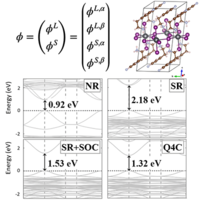
Relativistic effects are essential ingredients of electronic structure based theory and simulation of molecules and solids. The consequences of Dirac’s equation are already measurable in the lightest-element solids (e.g., graphene) and they cannot be neglected in materials containing mid-range or heavy elements. The quasi-four-component method, here implemented and benchmarked across a broad range of systems, seamlessly incorporates all four components of Dirac’s equation in efficient, precise electronic structure based simulations of materials up to large and complex systems.

Sign In to Your Journals Account

Filter

Section

Filter

Article Lookup

Enter a citation