Highlights

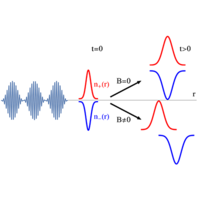
Anomalous sound attenuation in Weyl semimetals in magnetic and pseudomagnetic fields

P. O. Sukhachov and L. I. Glazman

Phys. Rev. B 103, 214310 (2021) - Published 25 June, 2021

A sound wave propagating through a semimetal causes a redistribution of electrons between different valleys of the electron spectrum. This dynamic redistribution leads to sound attenuation. Such an attenuation mechanism is effective as long as the redistribution between the valleys is not accompanied by local charge perturbations. In the presence of magnetic field, the chiral anomaly in Weyl semimetals couples the intervalley redistribution with the charge perturbations. Thus, the magnetic field weakens the sound attenuation and, in certain cases, induces its dichroism.

Evolution of the electronic structure in Ta2NiSe5 across the structural transition revealed by resonant inelastic x-ray scattering

Haiyu Lu, Matteo Rossi, Jung-ho Kim, Hasan Yavas, Ayman Said, Abhishek Nag, Mirian Garcia-Fernandez, Stefano Agrestini, Ke-Jin Zhou, Chunjing Jia, Brian Moritz, Thomas P. Devereaux, Zhi-Xun Shen, and Wei-Sheng Lee

Phys. Rev. B 103, 235159 (2021) - Published 25 June, 2021

Ta2NiSe5’s candidacy as an excitonic insulator has remained unclear due to contradictory interpretations about its phase transition and the temperature evolution of its gap structure. Here, the authors use resonant inelastic x-ray scattering (RIXS) at both the Ta and Ni L edges to probe the excitation spectrum and evolution of the momentum-dependent gap. The results, which agree well with element-specific calculations of the joint density of states, place constraints on Ta2NiSe5, and highlight the role of the structural transition in sculpting the electronic structure.

Imaging and controlling vortex dynamics in mesoscopic superconductor–normal-metal–superconductor arrays

Tyler R. Naibert, Hryhoriy Polshyn, Rita Garrido-Menacho, Malcolm Durkin, Brian Wolin, Victor Chua, Ian Mondragon-Shem, Taylor Hughes, Nadya Mason, and Raffi Budakian

Phys. Rev. B 103, 224526 (2021) - Published 24 June, 2021

The ability to locally probe and control superconducting vortices is crucial for both fundamental science and technological applications. Here, the authors use a modality of magnetic force microscopy to investigate the dynamics of small groups of vortices trapped by the magnetic field of a cantilever in superconductor–normal-metal–superconductor arrays. The observed striking patterns of vortex transitions enable the authors to extract the energy scales of the vortex interactions and also to study the effects of trapping potential shape and DC currents.

Quenched disorder at antiferromagnetic quantum critical points in two-dimensional metals

Johannes Halbinger and Matthias Punk

Phys. Rev. B 103, 235157 (2021) - Published 24 June, 2021

The effects of disorder on metallic quantum critical points have been primarily studied using the Hertz approach, where fermionic degrees offreedom are integrated out. Since this approach is invalid for clean two-dimensional systems, the authors study here spin density wave quantum critical points in two-dimensional metals in the presence of quenched disorder via an ε expansion around three spatial dimensions, where the interplay between electrons and bosonic order parameter fluctuations is fully incorporated. A flow to strong disorder with indications towards an Anderson-localized ground state is observed.

Single-particle tunneling spectroscopy and superconducting gaps in the layered iron-based superconductor KCa2Fe4As4F2

Wen Duan, Kailun Chen, Wenshan Hong, Xiaoyu Chen, Huan Yang, Shiliang Li, Huiqian Luo, and Hai-Hu Wen

Phys. Rev. B 103, 214518 (2021) - Published 23 June, 2021

KCa2Fe4As4F2 and its sister compounds provide a new platform to study superconducting mechanism of iron-based superconductors. Using scanning tunneling microscopy/spectroscopy, the authors observe here a full gap feature with a gap value close to 4.6 meV in tunneling spectra measured in KCa2Fe4As4F2. Quasiparticle interference patterns only show the intraband scattering of the holelike α pocket. The derived Fermi energy of this band is only about 24 meV, which indicates a deviation from the basic requirement of the weak-coupling BCS theory.

Orbital dichotomy of Fermi liquid properties in Sr2RuO4 revealed by Raman spectroscopy

Jean-Côme Philippe, Benoît Baptiste, Chanchal Sow, Yoshiteru Maeno, Anne Forget, Dorothée Colson, Maximilien Cazayous, Alain Sacuto, and Yann Gallais

Phys. Rev. B 103, 235147 (2021) - Published 23 June, 2021

Polarization-resolved Raman spectroscopy is used to access the Fermi liquid properties of Sr2RuO4 in an orbital-resolved way. A clear orbital dependence is observed in the energy and temperature dependence of the quasiparticle scattering rate and mass, with the dxy-derived quasiparticles being significantly more correlated than the dyz/dxz-derived ones. The observed dichotomy is consistent with the picture of Sr2RuO4 as a Hund’s metal with significant orbital differentiation among quasiparticles.

Behavior of rubidium at over eightfold static compression

C. V. Storm, J. D. McHardy, S. E. Finnegan, E. J. Pace, M. G. Stevenson, M. J. Duff, S. G. MacLeod, and M. I. McMahon

Phys. Rev. B 103, 224103 (2021) - Published 21 June, 2021

The behavior and structure of Rb are explored up to 264 GPa, a pressure at which the density is increased more than eightfold. The previously predicted double-hexagonal close packed structure is stable above 200 GPa, while at lower pressures a change in compressibility at 30 GPa arises from s-d charge transfer. Above 30 GPa, the authors find that Rb has the regular compression of a d-type transition metal.

Topological excitations and bound photon pairs in a superconducting quantum metamaterial

Ilya S. Besedin, Maxim A. Gorlach, Nikolay N. Abramov, Ivan Tsitsilin, Ilya N. Moskalenko, Alina A. Dobronosova, Dmitry O. Moskalev, Alexey R. Matanin, Nikita S. Smirnov, Ilya A. Rodionov, Alexander N. Poddubny, and Alexey V. Ustinov

Phys. Rev. B 103, 224520 (2021) - Published 17 June, 2021

Topological photonics enables resilient routing and localization of light. Of special interest are topological states of quantum light promising disorder-robust quantum correlations. Here, the authors design and fabricate a one-dimensional dimerized array of superconducting qubits. Performing microwave spectroscopy of this fabricated quantum metamaterial, they observe not only single-photon topological states but also the bands of exotic bound photon pairs mediated by the anharmonicity of qubits. They also discuss the two-photon bound edge-localized state and analyze the robustness of photon-photon correlations.

Dynamical screening in SrVO3: Inelastic x-ray scattering experiments and ab initio calculations

Kari Ruotsalainen, Alessandro Nicolaou, Christoph J. Sahle, Anna Efimenko, James M. Ablett, Jean-Pascal Rueff, Dharmalingam Prabhakaran, and Matteo Gatti

Phys. Rev. B 103, 235136 (2021) - Published 16 June, 2021

One of the key physical processes in solids is screening, the modification of a potential felt by an electron due to the rearrangement of other electrons. Here, the authors combine inelastic x-ray scattering experiments and first-principles calculations to characterize the frequency-dependent screening of SrVO3, a prototypical metallic cubic perovskite. They show that the local variations at the microscopic level of the classical electrostatic potential between charges dominate the high-frequency response of this material.

Topological correspondence between magnetic space group representations and subdimensions

Adrien Bouhon, Gunnar F. Lange, and Robert-Jan Slager

Phys. Rev. B 103, 245127 (2021) - Published 16 June, 2021

This paper identifies a general class of electronic configurations that in a magnetic background necessarily induce topological structure. The phases additionally feature a correspondence relating antiferromagnetic and ferro/ferrimagnetic realizations. More importantly, the authors find novel types of magnetic topology upon considering this mechanism in all space groups. These phases are exclusively mapped out in this analysis that takes into account planes and lines in the Brillouin zone, prompting a new notion of subdimensional topology that nonetheless has full 3D physical signatures, such as Fermi arcs.

Multipolar topological field theories: Bridging higher order topological insulators and fractons

Yizhi You, F. J. Burnell, and Taylor L. Hughes

Phys. Rev. B 103, 245128 (2021) - Published 16 June, 2021

The concepts of multipolar insulators and multipole symmetries have hinted at tantalizing connections between the disparate fields of higher-order topological insulators and fracton phases. Here, the authors show that these connections are not superficial, but instead arise from a unified field theory description of the topological response of these systems to external fields, similar to the quantized Hall conductance of Chern insulators, and the quantized axion magnetoelectric polarizability in 3D topological insulators. These response theories are built from the recently introduced higher-rank tensor gauge potentials, and can be interpreted, in some scenarios, as the topological response to ordinary electric and magnetic field gradients.

Probing strong coupling between a microwave cavity and a spin ensemble with Raman heterodyne spectroscopy

Gavin G. G. King, Peter S. Barnett, John G. Bartholomew, Andrei Faraon, and Jevon J. Longdell

Phys. Rev. B 103, 214305 (2021) - Published 14 June, 2021

Rare-earth ions in solids are under active investigation for quantum microwave-optical signal converters. Here, light passed through an Er:YSO crystal sitting in a driven microwave resonator develops modulation due to three-wave mixing in the erbium dopants. Strong coupling between the microwave cavity and the spins causes modulation when the microwaves are resonant with the spin-cavity polaritons rather than the spins. This work extends the rare-earth microwave-optical conversion to both millikelvin temperatures and isotopically pure dopants.

Hard x-ray photoemission spectroscopy of LaVO3/SrTiO3: Band alignment and electronic reconstruction

M. Stübinger, J. Gabel, P. Scheiderer, M. Zapf, M. Schmitt, P. Schütz, B. Leikert, J. Küspert, M. Kamp, P. K. Thakur, T.-L. Lee, P. Potapov, A. Lubk, B. Büchner, M. Sing, and R. Claessen

Phys. Rev. B 103, 235128 (2021) - Published 14 June, 2021

The authors study, as a promising candidate for photovoltaic applications, the Mott insulator LaVO3, epitaxially grown as a thin film on SrTiO3. They elucidate the electronic properties by electrical transport and photoemission measurements. The origin of the conducting interface is identified to be electronic reconstruction due to the polar discontinuity between film and substrate. The authors find a potential gradient in the film and a downward band bending in the substrate, with the electrons residing in interfacial Ti states.

Large-N theory of critical Fermi surfaces

Ilya Esterlis, Haoyu Guo, Aavishkar A. Patel, and Subir Sachdev

Phys. Rev. B 103, 235129 (2021) - Published 14 June, 2021

Critical Fermi surfaces appear in many physical systems, including the half-filled Landau level, and certain spin liquids. Many theories have studied the nonquasiparticle excitations near the Fermi surface, and possible instabilities to pairing or density wave orders, but without a fully systematic method. Here, the authors study an ensemble of self-averaging theories with random coupling constants, and obtain a controlled large-N expansion.

Orbital-order phase transition in Pr1−xCaxMnO3 probed by photovoltaics

B. Kressdorf, T. Meyer, M. ten Brink, C. Seick, S. Melles, N. Ottinger, T. Titze, H. Meer, A. Weisser, J. Hoffmann, S. Mathias, H. Ulrichs, D. Steil, M. Seibt, P. E. Blöchl, and C. Jooss

Phys. Rev. B 103, 235122 (2021) - Published 11 June, 2021

The orbital-order phase transition in low-doped Pr1−xCaxMnO3 (x ≤ 0.3) is investigated through variation of different physical properties, including photovoltaic response, static and ultrafast transient optical absorption, electric transport, magnetization, and lattice structure. The results suggest that spontaneous orbital order emerges at room temperature and thus at much lower temperatures than previously reported. The requisite modification of the famous phase diagram of the manganite is supported by theoretical calculations, which imply that the observed finite orbital polarization above the orbital-order transition temperature is only induced order caused by octahedral tilting.

Absence of moment fragmentation in the mixed B-site pyrochlore Nd2GaSbO7

S. J. Gomez, P. M. Sarte, M. Zelensky, A. M. Hallas, B. A. Gonzalez, K. H. Hong, E. J. Pace, S. Calder, M. B. Stone, Y. Su, E. Feng, M. D. Le, C. Stock, J. P. Attfield, S. D. Wilson, C. R. Wiebe, and A. A. Aczel

Phys. Rev. B 103, 214419 (2021) - Published 10 June, 2021

Nd-based pyrochlore oxides have garnered significant interest owing to the moment-fragmentation physics observed in Nd2Zr2O7 and speculated in Nd2Hf2O7. Notably, this phenomenon is absent in Nd2Sn2O7, which features a smaller B-site ionic radius. Here, bulk characterization and neutron scattering measurements reveal a similar absence of moment fragmentation in Nd2GaSbO7, which is characterized by significant B-site disorder and an extremely small average ionic radius on the B site. These results may indicate that chemical pressure (and not necessarily the B-site disorder) plays a key role in the presence or absence of this exotic phenomenon.

Pressure-induced reemergence of superconductivity in the topological kagome metal CsV3Sb5

Zhuyi Zhang (张朱一), Zheng Chen, Ying Zhou, Yifang Yuan, Shuyang Wang, Jing Wang, Haiyang Yang, Chao An, Lili Zhang, Xiangde Zhu, Yonghui Zhou, Xuliang Chen (陈绪亮), Jianhui Zhou, and Zhaorong Yang

Phys. Rev. B 103, 224513 (2021) - Published 9 June, 2021

The quasi-two-dimensional kagome superconductors AV3Sb5 (A = K, Rb, and Cs) have attracted great interest due to various exotic quantum phenomena, such as topological charge density waves and the giant anomalous Hall effect. Here, the authors find two-dome unconventional superconductivity in CsV3Sb5 under high pressure. They also confirm the absence of a structural phase transition up to 43.1 GPa through high-pressure synchrotron x-ray diffraction measurements, suggesting that the novel reemergent superconductivity dome can be attributed to the Fermi surface reconstruction caused by the Lifshitz transition.

Closing of the induced gap in a hybrid superconductor-semiconductor nanowire

D. Puglia, E. A. Martinez, G. C. Ménard, A. Pöschl, S. Gronin, G. C. Gardner, R. Kallaher, M. J. Manfra, C. M. Marcus, A. P. Higginbotham, and L. Casparis

Phys. Rev. B 103, 235201 (2021) - Published 8 June, 2021

Conclusively identifying Majorana modes in nanowires is an long-standing experimental challenge. Within the field, consensus is emerging that achieving this goal will require measurements on three-terminal devices. Here, the authors report some of the first results on such devices using nonlocal conductance. They find that zero-bias peaks are preceded by the closure of the bulk gap, which indicates that in these devices zero-bias peaks are associated with bulk properties of the nanowire. However, the behavior of the device after gap closure suggests that disorder remains an important limitation.

Spontaneous interlayer compression in commensurately stacked van der Waals heterostructures

Nicholas A. Pike, Antoine Dewandre, François Chaltin, Laura Garcia Gonzalez, Salvatore Pillitteri, Thomas Ratz, and Matthieu J. Verstraete

Phys. Rev. B 103, 235307 (2021) - Published 7 June, 2021

Stacks of nanostructured 2D materials can display properties distinct from those of the parent materials. In heterostructures of transition metal dichalcogenides, the authors find here that dissimilar chalcogen species induce a spontaneous compression of the van der Waals gap. This compression is a result of the induced charge displacement within and between the layers, which modifies the out-of-plane polarizability, and can stabilize charge density waves or induce ferroelectricity. The authors hope to stimulate experimental investigation of tunability in mixed chalcogen systems.

Magnetic and electronic ordering phenomena in the Ru2O6-layer honeycomb lattice compound AgRuO3

Walter Schnelle, Beluvalli E. Prasad, Claudia Felser, Martin Jansen, Evgenia V. Komleva, Sergey V. Streltsov, Igor I. Mazin, Dmitry Khalyavin, Pascal Manuel, Sukanya Pal, D. V. S. Muthu, A. K. Sood, Ekaterina S. Klyushina, Bella Lake, Jean-Christophe Orain, and Hubertus Luetkens

Phys. Rev. B 103, 214413 (2021) - Published 4 June, 2021

Ruthenium is a unique metal that can admit valence states from −2 to +8. In particular, Ru3+ is one of the best known Kitaev magnets, Ru4+ dimerizes forming a covalent-bond fluid, while Ru5+ in SrRu2O6 is argued to feature unusual quasimolecular orbitals (QMO), combining strong electronic localization on the QMO level with full intra-QMO delocalization. Here, the authors study, using a battery of experimental and theoretical methods, another putative QMO compound – AgRuO3 – and find a rich spectrum of interesting phenomena.

Sign In to Your Journals Account

Filter

Section

Filter

Article Lookup

Enter a citation