Highlights

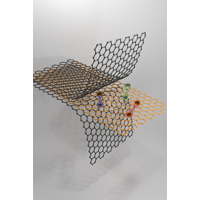
Twisted symmetric trilayer graphene: Single-particle and many-body Hamiltonians and hidden nonlocal symmetries of trilayer moiré systems with and without displacement field

Dumitru Călugăru, Fang Xie, Zhi-Da Song, Biao Lian, Nicolas Regnault, and B. Andrei Bernevig

Phys. Rev. B 103, 195411 (2021) - Published 10 May, 2021

At the single-particle level, twisted mirror-symmetric trilayer graphene decouples into a twisted graphene-bilayer-like contribution and a high-velocity Dirac fermion. This simple picture breaks down in the presence of interactions or perpendicular displacement fields, which couple the two mirror-symmetry sectors. Prompted by recent experimental discoveries, the authors derive and analyze the many-body Hamiltonian for twisted symmetric trilayer graphene. They unveil enlarged continuous symmetries beyond spin-valley rotations, including a hidden nonlocal one.

Current-induced dynamics of skyrmion tubes in synthetic antiferromagnetic multilayers

Jing Xia, Xichao Zhang, Kai-Yu Mak, Motohiko Ezawa, Oleg A. Tretiakov, Yan Zhou, Guoping Zhao, and Xiaoxi Liu

Phys. Rev. B 103, 174408 (2021) - Published 7 May, 2021

The topological spin textures in three-dimensional nanostructures may show complex dynamic behavior that cannot be found in any two-dimensional nanostructures. Here, the authors study computationally the current-induced motion of a skyrmion tube in three-dimensional synthetic antiferromagnetic bilayer and multilayer nanostructures. They show that the dynamics of the synthetic antiferromagnetic skyrmion tube depend on several factors, such as thickness of ferromagnetic layers, number of interfaces, and strength of driving forces.

Weyl nodal-line surface half-metal in CaFeO3

Run-Wu Zhang, Da-Shuai Ma, Jian-Min Zhang, and Yugui Yao

Phys. Rev. B 103, 195115 (2021) - Published 7 May, 2021

The degrees of freedom of band topology and magnetic order create opportunities for the application of novel quantum effects, a field that has attracted much attention in fundamental and applied research. Here, the authors explore the interplay of band topology and magnetic order in the realistic half-metal CaFeO3 by proposing a new quantum state, referred to as a Weyl nodal-line surface half-metal, which features fully spin-polarized fermions and may stimulate further efforts on quantum states in condensed matter physics.

Conductance quantization in topological Josephson trijunctions

Julia S. Meyer and Manuel Houzet

Phys. Rev. B 103, 174504 (2021) - Published 6 May, 2021

Here, the authors predict that topological Josephson trijunctions generically display a nonzero quantized transconductance. This result originates from a combination of two different aspects of topology: topological superconductivity in the leads, thus hosting Majorana end modes, and a synthetic topological band structure in the multiterminal Josephson junction. Many groups are currently studying multiterminal junctions using various superconducting hybrid platforms. An experimental check of this prediction would constitute an important milestone on the roadmap toward demonstrating Majorana braiding in trijunctions.

Fully resolved currents from quantum transport calculations

R. S. Nair and P. J. Kelly

Phys. Rev. B 103, 195406 (2021) - Published 5 May, 2021

Here, the authors use first-principles quantum mechanical scattering calculations to determine current distributions in thin metallic films and multilayers at finite temperatures, where the effect of electron-phonon scattering is included in the adiabatic approximation. The fully relativistic calculations describe transient shunting and size effects for layers more than 100 atoms thick. This makes it possible to search for improved interconnect materials or to study the influence of finite layer thicknesses on various effects in spintronics, such as the spin Hall effect.

Magnon-spinon dichotomy in the Kitaev hyperhoneycomb β−Li2IrO3

Alejandro Ruiz, Nicholas P. Breznay, Mengqun Li, Ioannis Rousochatzakis, Anthony Allen, Isaac Zinda, Vikram Nagarajan, Gilbert Lopez, Zahirul Islam, Mary H. Upton, Jungho Kim, Ayman H. Said, Xian-Rong Huang, Thomas Gog, Diego Casa, Robert J. Birgeneau, Jake D. Koralek, James G. Analytis, Natalia B. Perkins, and Alex Frano

Phys. Rev. B 103, 184404 (2021) - Published 4 May, 2021

The spin-orbit entangled nature of the magnetic moments in Kitaev materials is expected to give rise to a quantum spin liquid (QSL) state with fractional excitations. Using resonant inelastic x-ray scattering under a magnetic field, here the authors map the excitation spectra of β-Li2IrO3. They observe a dichotomy between a magnon-like response at low energies, originating from intertwined field-induced ground states, and a multi-spinon-like continuum at higher energies, originating from pairwise excitations of long-lived Majorana fermions of the proximate QSL.

Plasmonically assisted channels of photoemission from metals

Dino Novko, Vito Despoja, Marcel Reutzel, Andi Li, Hrvoje Petek, and Branko Gumhalter

Phys. Rev. B 103, 205401 (2021) - Published 3 May, 2021

Recent two-photon photoemission studies of silver have demonstrated that the energies of certain spectral lines do not exhibit Einstein’s linear scaling with the photon energy but stay pinned at double the plasmon energy above the Fermi level. Here, a theory of this peculiar effect is presented based on plasmonically assisted channels of photoemission, in which real plasmons excited in secondary processes act as excitation field for emitting electrons from the Fermi level at multiples of the plasmon energy. This reveals non−Einsteinianchannelsofphotoemission from metals.

Induced order and collective excitations in three-singlet quantum magnets

Peter Thalmeier

Phys. Rev. B 103, 144435 (2021) - Published 29 April, 2021

For even f-electron compounds (e.g., Pr, U) the ground state may be a nonmagnetic singlet, nevertheless magnetic order appears. The moments are induced simultaneously with the ordering. This excitonic quantum magnetism is investigated by the author within a general three-singlet model. The precursor soft magnetic excitons, the transition temperature, and the induced saturation moment are derived. Furthermore, the phase diagram with possible first- and second-order transitions and critical behavior of magnetic exciton dispersions across the transition are obtained.

Reference plane for the electronic states in thin films on stepped surfaces

P. Moras, T. O. Menteş, F. Schiller, L. Ferrari, D. Topwal, A. Locatelli, P. M. Sheverdyaeva, and C. Carbone

Phys. Rev. B 103, 165426 (2021) - Published 27 April, 2021

During the photoemission process the parallel component of the photoelectron momentum is conserved across the modulation plane of the wavefunction, which is the so-called reference plane. The identification of this plane is straightforward for low Miller-index surfaces, but questionable for surfaces of lower symmetry. In this work, the authors show experimentally the coexistence of two different reference planes for surface and bulklike quantum-well states of thin nanostructured films grown on a regularly stepped substrate.

Neutron scattering study of magnetic anisotropy in the tetragonal antiferromagnet Bi2CuO4

Bo Yuan, Nicholas P. Butch, Guangyong Xu, Barry Winn, J. P. Clancy, and Young-June Kim

Phys. Rev. B 103, 134436 (2021) - Published 26 April, 2021

Using neutron spectroscopy, the authors map out the full magnon dispersion in the easy-plane antiferromagnet Bi2CuO4 and determine its complete spin Hamiltonian. In particular, they solve a long-standing puzzle in this material by determining its small anisotropic spin interactions. Equipped with the complete set of interaction parameters, the authors establish Bi2CuO4 as a rare example of quantum order by disorder, where quantum fluctuations break the in-plane spin degeneracy and are manifested as a spin-flop transition observed by neutron scattering.

Valley-protected one-dimensional states in small-angle twisted bilayer graphene

J. D. Verbakel, Q. Yao, K. Sotthewes, and H. J. W. Zandvliet

Phys. Rev. B 103, 165134 (2021) - Published 23 April, 2021

In twisted bilayer graphene at small twist angles, the application of an electric field can break the inversion symmetry between AB- and BA-stacked domains. This causes a network of one-dimensional topologically protected states to emerge in the material, which can transport current without dissipation as long as intervalley scattering is absent, according to theoretical predictions. In this work, using atomic-resolution STM images of the network taken at room temperature, the authors show that the topological network is indeed valley protected.

Proper and improper chiral magnetic interactions

Manuel dos Santos Dias, Sascha Brinker, András Lászlóffy, Bendegúz Nyári, Stefan Blügel, László Szunyogh, and Samir Lounis

Phys. Rev. B 103, L140408 (2021) - Published 23 April, 2021

There is currently a strong need to understand noncollinear magnetic phases where generalized chiral magnetic interactions can play a prominent role. Here, the authors give a clear and accessible discussion of improper chiral magnetic interactions and how they can arise from proper isotropic or chiral interactions. For example, the energy landscape of noncollinear magnets with chiral degeneracy can be mistakenly interpreted in terms of large improper Dzyaloshinskii-Moriya interactions that in fact originate from isotropic biquadratic interactions.

Fractional chiral hinge insulator

Anna Hackenbroich, Ana Hudomal, Norbert Schuch, B. Andrei Bernevig, and Nicolas Regnault

Phys. Rev. B 103, L161110 (2021) - Published 23 April, 2021

The recent theoretical and experimental discovery of higher-order topological insulators raises the question whether the interplay of this new topology and strong interactions could lead to a three-dimensional generalization of the fractional quantum Hall effect. The authors answer this question here using a model wavefunction ansatz and Monte Carlo simulations. They show that this interplay leads to fractional chiral hinge modes, similar to the Laughlin physics. Surprisingly, these results indicate a clear departure from conventional two-dimensional topological order on the gapped surfaces, akin to half a Laughlin state.

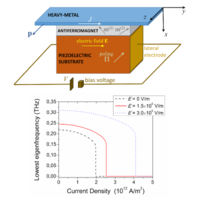
Theory of the electric field controlled antiferromagnetic spin Hall oscillator and detector

G. Consolo, G. Valenti, A. R. Safin, S. A. Nikitov, V. Tyberkevich, and A. Slavin

Phys. Rev. B 103, 134431 (2021) - Published 22 April, 2021

A theory of an electrically controlled terahertz-frequency auto-oscillator is developed here within the framework of the antiferromagnetic sigma model. The structure is based on a trilayer heterostructure: a piezoelectric ceramic, NiO-based antiferromagnet (AFM), and a heavy metal. The authors demonstrate that the frequency of the AFM resonance of the layered structure in a passive subcritical regime can be controlled by the external electric field applied to the piezoelectric, by choosing a proper piezoelectric material, and by the magnitude of the electric current flowing in the heavy metal.

Probing the superconducting gap structure in the noncentrosymmetric topological superconductor ZrRuAs

Debarchan Das, D. T. Adroja, M. R. Lees, R. W. Taylor, Z. S. Bishnoi, V. K. Anand, A. Bhattacharyya, Z. Guguchia, C. Baines, H. Luetkens, G. B. G. Stenning, Lei Duan, Xiancheng Wang, and Changqing Jin

Phys. Rev. B 103, 144516 (2021) - Published 20 April, 2021

The ternary transition metal pnictide ZrRuAs has been suggested to be a rare example of a superconducting topological crystalline insulator, with evidence for topological states along with bulk superconductivity below Tc = 7.9 K. Here, the authors have probed the superconducting gap structure of this compound using muon-spin rotation and relaxation spectroscopy. Their results reveal a nodeless isotropic s-wave gap structure and confirm that time-reversal symmetry is preserved in the superconducting state of noncentrosymmetric ZrRuAs.

Non-Bloch band theory in bosonic Bogoliubov–de Gennes systems

Kazuki Yokomizo and Shuichi Murakami

Phys. Rev. B 103, 165123 (2021) - Published 20 April, 2021

Diagonalization of a bosonic Bogoliubov–de Gennes system is intrinsically a non-Hermitian problem, although its Hamiltonian is Hermitian. Here, the authors study the non-Hermitian nature of bosonic Bogoliubov–de Gennes systems by constructing a non-Bloch band theory. Such systems have a unique non-Hermitian Brillouin zone, where Hermitian and non-Hermitian regions coexist. Accordingly, its non-Hermitian skin effect shows instability against infinitesimal instability and reentrant behavior.

Gapless state of interacting Majorana fermions in a strain-induced Landau level

Adhip Agarwala, Subhro Bhattacharjee, Johannes Knolle, and Roderich Moessner

Phys. Rev. B 103, 134427 (2021) - Published 19 April, 2021

The authors demonstrate here a theoretical realization of a Kitaev “non-Fermi” spin liquid, where interacting Majorana fermions collectively realize a gapless state that resembles fractional quantum Hall physics at half filling. They show how the action of strain in a Kitaev material can potentially generate such a phase, in which pair hopping of fermions, constrained by symmetries, dominates the ground-state physics and the excitations. This study lies at the crossroad of diverse fields, such as quantum Hall physics, frustrated magnets, flat-band physics, and interacting Majorana fermions.

Unveiling the phase diagram of a bond-alternating spin-12 K−Γ chain

Qiang Luo, Jize Zhao, Xiaoqun Wang, and Hae-Young Kee

Phys. Rev. B 103, 144423 (2021) - Published 15 April, 2021

The quantum spin chain with bond-directional interactions can host fascinating phenomena. Here, the authors study such a spin chain, built of a Kitaev interaction and an off-diagonal exchange (dubbed the Γ term). This model possesses a self-dual relation and a mirror symmetry, and is found to exhibit a multicritical point, two topological phase transitions of distinct universality classes, three magnetically ordered states, and four disordered phases including the preeminent Haldane phase. These findings demonstrate a fertile playground to study quantum magnetism and topological phase transitions.

Colossal magnetoresistance via avoiding fully polarized magnetization in the ferrimagnetic insulator Mn3Si2Te6

Yifei Ni, Hengdi Zhao, Yu Zhang, Bing Hu, Itamar Kimchi, and Gang Cao

Phys. Rev. B 103, L161105 (2021) - Published 14 April, 2021

Magnetic polarization reduces spin scattering and underpins colossal magnetoresistance (CMR) in the manganites and almost all other CMR materials. In sharp contrast, the observed CMR in the ferrimagnetic insulator Mn3Si2Te6, which features a resistivity drop by an astonishing seven orders of magnitude, emerges only when the fully polarized magnetization is avoided. This intriguing type of electrical transport fits no existing theoretical models, providing a new paradigm for studying CMR and its applications.

Elucidation of the strong effect of an interfacial monolayer on magnetoresistance in giant magnetoresistive devices with current perpendicular to the plane

Björn Büker, JinWon Jung, Taisuke Sasaki, Yuya Sakuraba, Yoshio Miura, Tomoya Nakatani, Andreas Hütten, and Kazuhiro Hono

Phys. Rev. B 103, L140405 (2021) - Published 12 April, 2021

Electronic band matching at the heterointerface between magnetic and nonmagnetic metals influences spin-dependent transport through that interface. However, the impact of atomic-level interfacial structure on the electronic band matching and the resultant transport properties have not been clarified. Here, the authors have fabricated high-quality epitaxial giant magnetoresistance devices with half-metallic Heusler electrodes with interfacial ultrathin Ni insertion layers. Through state-of-the-art microstructure analysis, they demonstrate that even a monolayer of Ni strongly affects interfacial band matching and giant magnetoresistance.

Sign In to Your Journals Account

Filter

Section

Filter

Article Lookup

Enter a citation