Highlights

Ab initio calculation of the magnetic Gibbs free energy of materials using magnetically constrained supercells

Eduardo Mendive-Tapia, Jörg Neugebauer, and Tilmann Hickel

Phys. Rev. B 105, 064425 (2022) - Published 17 February, 2022

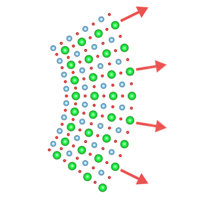
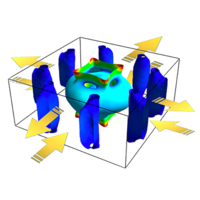
Complex magnetic phases are exploited in many important solid-state technologies, but their first-principles modeling at finite temperature is a major challenge. The authors present an approach to the ab initio description of temperature-dependent noncollinear magnetic structures, based on supercell calculations. It generalizes an approximate method to compute the magnetic Gibbs free energies of disordered local moments to more accurate density functional theory codes. The application uncovers structural and electronic mechanisms of discontinuous transitions to magnetic phases with technological functionality.

Dissipation-assisted operator evolution method for capturing hydrodynamic transport

Tibor Rakovszky, C. W. von Keyserlingk, and Frank Pollmann

Phys. Rev. B 105, 075131 (2022) - Published 16 February, 2022

Transport properties are among the most practically important features of materials, yet their precise calculation in strongly interacting systems poses a formidable challenge. One might even expect that it requires a quantum computer. The authors introduce an algorithm that tackles this challenge with only moderate resources on a classical computer. It relies on introducing an artificial dissipation process that only affects nonlocal observables, thus reducing the computational cost without strongly influencing physically relevant quantities. The algorithm is tested on various paradigmatic models with good convergence results.

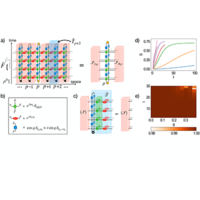
Quantum phases of two-dimensional Z2 gauge theory coupled to single-component fermion matter

Umberto Borla, Bhilahari Jeevanesan, Frank Pollmann, and Sergej Moroz

Phys. Rev. B 105, 075132 (2022) - Published 16 February, 2022

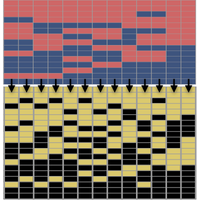
Gauge theories are ubiquitous in contemporary physics. Here, the authors investigate the many-body phase diagram of a model where dynamical discrete Ising gauge fields mediate interactions between single-component fermionic matter. Such a system remained intractable for years, due to the lack of sign-problem-free Monte-Carlo simulations. With the help of a combination of analytical and state-of-the-art numerical tensor-network-based methods, the authors uncover the salient features of an intricate quantum phase diagram and reveal surprising aspects of quantum constrained dynamics. The recent advances in cold-atoms-based setups might soon allow experimental explorations of this model.

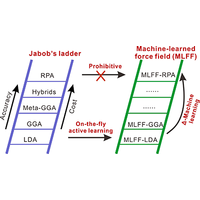
Phase transitions of zirconia: Machine-learned force fields beyond density functional theory

Peitao Liu, Carla Verdi, Ferenc Karsai, and Georg Kresse

Phys. Rev. B 105, L060102 (2022) - Published 16 February, 2022

Machine-learned force fields (MLFFs) are becoming an increasingly important tool in materials science and physics. However, most MLFFs are constructed based on density functional theory (DFT) calculations, which come with significant limitations. Here, the authors combine an efficient on-the-fly active learning procedure and a ∆-machine learning approach, enabling the generation of MLFFs with an accuracy that exceeds DFT accuracy at a modest computational cost. Using this method, they generated an MLFF for the random phase approximation that allows highly accurate predictions of the phase transition temperatures of zirconia.

Nonequilibrium stationary states of quantum non-Hermitian lattice models

A. McDonald, R. Hanai, and A. A. Clerk

Phys. Rev. B 105, 064302 (2022) - Published 8 February, 2022

While the band theory of non-Hermitian Hamiltonians and the dynamics they generate have received considerable recent interest, the quantum steady states of such models remain largely unexplored. Here, the authors systematically characterize such states for fermions and bosons using an open quantum system approach. Surprisingly, these steady states exhibit features that cannot be extracted readily from the non-Hermitian Hamiltonian. This includes a macroscopic length scale which characterizes the steady-state occupation but differs from the localization length of the eigenvectors.

Towards a quantum interface between spin waves and paramagnetic spin baths

C. Gonzalez-Ballestero, Toeno van der Sar, and O. Romero-Isart

Phys. Rev. B 105, 075410 (2022) - Published 8 February, 2022

Spin waves are prime candidates for information processing. The recent demonstration of their coupling to dense ensembles of solid-state spins paves the way toward coherent spin wave control in a similar fashion as, e.g., slow light in optics. Here, the authors provide a quantum theory describing mutual backaction between spin waves and spin ensembles and predict that external control of the latter enables to largely and dynamically modify spin wave properties such as propagation length. They also propose localized spin ensembles as spin wave sensors able to detect even vacuum spin-wave fluctuations. These results pave the way toward nanophotonics-inspired magnonic devices and protocols.

Exotic magnetic and electronic properties of layered CrI3 single crystals under high pressure

Anirudha Ghosh, D. Singh, T. Aramaki, Qingge Mu, V. Borisov, Y. Kvashnin, G. Haider, M. Jonak, D. Chareev, S. A. Medvedev, R. Klingeler, M. Mito, E. H. Abdul-Hafidh, J. Vejpravova, M. Kalbàč, R. Ahuja, Olle Eriksson, and Mahmoud Abdel-Hafiez

Phys. Rev. B 105, L081104 (2022) - Published 8 February, 2022

CrI3, a member of the two-dimensional family of materials, offers unique and very rich magnetic and electronic phases. The authors show experimental evidence for the transition from ferromagnetic semiconductor to antiferromagnetic metal at high pressure and low temperature. The junction between these phases is magnetically complex and reminiscent of quantum spin liquid or self-induced spin-glass state. Calculations using density functional theory suggest that competition between intralayer ferromagnetic and interlayer antiferromagnetic interactions is responsible for the emergence of the complex magnetic phase.

Noninteracting fermionic systems with localized losses: Exact results in the hydrodynamic limit

Vincenzo Alba and Federico Carollo

Phys. Rev. B 105, 054303 (2022) - Published 3 February, 2022

Within a hydrodynamic framework, the authors describe the out-of-equilibrium dynamics of noninteracting one-dimensional fermionic systems, featuring localized gain and loss of particles at the center of the system. They discuss quenches from equilibrium and nonequilibrium homogeneous initial states as well as from inhomogeneous ones. The results demonstrate the existence of a Zeno effect for large loss rates and the emergence of exotic nonequilibrium steady states with a stepwise uniform density profile that is discontinuous in correspondence with the localized loss.

Lattice-mediated bulk flexoelectricity from first principles

Miquel Royo and Massimiliano Stengel

Phys. Rev. B 105, 064101 (2022) - Published 3 February, 2022

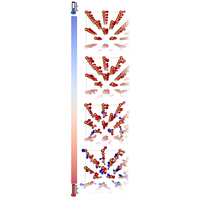
First-principles calculations of flexoelectricity - the electromechanical coupling whereby a strain gradient produces a macroscopic polarization - are challenging due to the inherent breakdown of crystal periodicity. An effective workaround for these difficulties was demonstrated in the recent past via a careful long-wavelength analysis of acoustic phonons. Following these guidelines, the authors develop here a practical formalism and a code implementation providing the lattice-mediated contributions to the bulk flexoelectric tensor. This work completes the first-principles theory and implementation of bulk flexoelectricity and makes it available for public use.

Magnetically controllable band splittings in Pnma ferromagnetic materials

Peng Liu, Yanchao Wang, Hong Jian Zhao, Laurent Bellaiche, and Yanming Ma

Phys. Rev. B 105, 054402 (2022) - Published 2 February, 2022

The manipulation of band splittings of materials is one of the central themes in spin-orbitronics. The conventional electrically or magnetically controllable band splittings are mainly categorized into Rashba, Dresselhaus, or Zeeman types. In this work, by symmetry analysis and first-principles simulations, the authors have identified a type of band splitting in Pnma ferromagnets that is different from the previously known types. Such band splittings involve electronic orbital degrees of freedom and can be controllable by magnetic field.

Multidimensional multiphoton momentum microscopy of the anisotropic Ag(110) surface

Andi Li, Marcel Reutzel, Zehua Wang, David Schmitt, Marius Keunecke, Wiebke Bennecke, G. S. Matthijs Jansen, Daniel Steil, Sabine Steil, Dino Novko, Branko Gumhalter, Stefan Mathias, and Hrvoje Petek

Phys. Rev. B 105, 075105 (2022) - Published 2 February, 2022

Silver mirrors reflect light naturally because no discrete optical transitions modify their spectra. Yet, nonlinear spectroscopy has gleaned the electronic bands and collective responses from its most stable Ag(111) surface. (110) surfaces, whose band structure is hardly explored, form at intersections of two proximate (111) surfaces. This union creates new anisotropic bands whose three-dimensional energy-𝑘∥ structures are investigated by powerful two-photon photoemission momentum spectromicroscopy. The spectra reveal how novel properties arise when bands of proximate surfaces collide.

Time-dependent exchange-correlation potential in lieu of self-energy

F. Aryasetiawan

Phys. Rev. B 105, 075106 (2022) - Published 2 February, 2022

The equation of motion of the Green’s function of a many-electron system is shown to be governed by a multiplicative exchange-correlation potential, in contrast to the self-energy. Crucially, this exchange-correlation potential is simply the Coulomb potential of an exchange-correlation hole and fulfills a sum rule. The formulation offers a simple physical interpretation for the propagation of an added electron or hole and may provide a route for density-functional-like approximations for calculating the Green’s function.

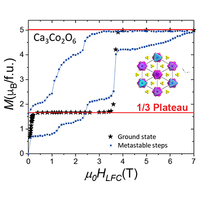
Reaching the equilibrium state of the frustrated triangular Ising magnet Ca3Co2O6

Ivan Nekrashevich, Xiaxin Ding, Fedor Balakirev, Hee Taek Yi, Sang-Wook Cheong, Leonardo Civale, Yoshitomo Kamiya, and Vivien S. Zapf

Phys. Rev. B 105, 024426 (2022) - Published 31 January, 2022

Ca3Co2O6 is a triangular frustrated Ising magnet whose magnetic properties have puzzled the community for decades and have generated many theoretical descriptions. The magnetization shows regular steps with magnetic field that are metastable for days to weeks at low temperatures. Here, the authors explore ways to bypass metastability and reach the ground state. They compare Monte Carlo simulations and different experimental approaches to identify the elusive ground state.

Characterizing many-body localization via exact disorder-averaged quantum noise

Michael Sonner, Alessio Lerose, and Dmitry A. Abanin

Phys. Rev. B 105, L020203 (2022) - Published 31 January, 2022

Systems with quenched disorder host fascinating dynamical phases including many-body localization. Theoretical description of such phases proves challenging since it requires disorder-averaging over many configurations, and very rare configurations may have an important effect. Here, the authors introduce a new method, based on the Feynman-Vernon influence functional, that allows one to directly access the disorder-averaged dynamics of quantum spin chains. This formulation provides a starting point for describing the many-body localization transition using variational and analytical techniques.

Interplay between magnetism and superconductivity in UTe2

Di S. Wei, David Saykin, Oliver Y. Miller, Sheng Ran, Shanta R. Saha, Daniel F. Agterberg, Jörg Schmalian, Nicholas P. Butch, Johnpierre Paglione, and Aharon Kapitulnik

Phys. Rev. B 105, 024521 (2022) - Published 26 January, 2022

Time-reversal symmetry breaking in the strongly paramagnetic UTe2 is inferred from its spontaneous Kerr response below the superconducting critical temperature Tc. Focusing a Sagnac interferometer beam on the center of the sample, the authors present an extensive study of the magnetic-field-trained Kerr effect in this material, particularly of the nature of the critical state, which is dominated by magnetic vortices. Measurements in the presence of magnetic field reveal the competition between vortex-induced magnetization and the shielding currents of the superconductor.

Exact quantum scars in the chiral nonlinear Luttinger liquid

Frank Schindler, Nicolas Regnault, and B. Andrei Bernevig

Phys. Rev. B 105, 035146 (2022) - Published 26 January, 2022

While the chiral linear Luttinger liquid is integrable via bosonization, its nonlinear counterpart does not admit of an analytic solution. Nonetheless, the authors find a number of exact eigenstates for a large family of density-density interaction terms. These quantum many-body scar states are embedded in a continuum of strongly correlated excited states. They exhibit identically zero momentum-space entanglement. Among other properties, this sets them apart from many previous examples of quantum many-body scars.

Superconducting dome in ferroelectric-type materials from soft mode instability

Chandan Setty, Matteo Baggioli, and Alessio Zaccone

Phys. Rev. B 105, L020506 (2022) - Published 25 January, 2022

An unexpectedly simple extension to a theory explains the critical temperature anomalies observed in ferroelectric superconductors.

Elasto-Raman scattering: Arsenic optical phonon as a probe of nematicity in BaFe2As2

Jean-Côme Philippe, Jimmy Faria, Anne Forget, Dorothée Colson, Sarah Houver, Maximilien Cazayous, Alain Sacuto, and Yann Gallais

Phys. Rev. B 105, 024518 (2022) - Published 24 January, 2022

Nematicity in the iron-based superconductor parent compound BaFe2As2 is studied using Raman scattering under tunable uniaxial strain. The authors use the polarization-resolved arsenic phonon intensity to monitor the nematic order parameter as a function of both temperature and strain. This elasto-Raman approach showcases the interest of combining anisotropic strain with a symmetry-resolved probe such as Raman scattering. It can be applied to a wide variety of quantum materials where strain can serve as a nonthermal control parameter.

Nonsymmorphic symmetry and field-driven odd-parity pairing in CeRh2As2

D. C. Cavanagh, T. Shishidou, M. Weinert, P. M. R. Brydon, and Daniel F. Agterberg

Phys. Rev. B 105, L020505 (2022) - Published 24 January, 2022

CeRh2As2 has attracted attention for a field-induced transition between two distinct superconducting states. The authors argue that the nonsymmorphic symmetry of the crystal lattice enables this. This symmetry enforces the spin polarization of the Bloch states at the Brillouin zone edges to be parallel to the edges. Such a spin polarization ensures a near-degeneracy between even- and odd-parity superconducting channels, provided the Fermi surface sits near these edges. First-principles calculations incorporating electronic correlations reveal a Fermi surface consistent with this picture.

Spatially indirect intervalley excitons in bilayer WSe2

Zhiheng Huang, Yanchong Zhao, Tao Bo, Yanbang Chu, Jinpeng Tian, Le Liu, Yalong Yuan, Fanfan Wu, Jiaojiao Zhao, Lede Xian, Kenji Watanabe, Takashi Taniguchi, Rong Yang, Dongxia Shi, Luojun Du, Zhipei Sun, Sheng Meng, Wei Yang, and Guangyu Zhang

Phys. Rev. B 105, L041409 (2022) - Published 20 January, 2022

Spatially indirect intervalley excitons, with electrons and holes separate in both real and momentum space, represent an advantageous scenario for numerous theoretical and experimental advances. The authors demonstrate three types of spatially indirect intervalley excitons and their quantum confined Stark effects in bilayer WSe2. Their energy order and dominant luminescence can be switched by electric fields because of different dipole moments. Remarkably, these spatially indirect intervalley excitons exhibit highly tunable negative circular polarization, providing new ways to exploit valley physics.

Sign In to Your Journals Account

Filter

Section

Filter

Article Lookup

Enter a citation