Highlights

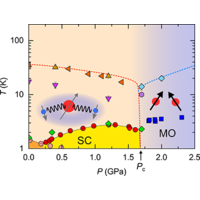
Drastic change in magnetic anisotropy of UTe2 under pressure revealed by Te125-NMR

Katsuki Kinjo, Hiroki Fujibayashi, Genki Nakamine, Shunsaku Kitagawa, Kenji Ishida, Yo Tokunaga, Hironori Sakai, Shinsaku Kambe, Ai Nakamura, Yusei Shimizu, Yoshiya Homma, Dexin Li, Fuminori Honda, and Dai Aoki

Phys. Rev. B 105, L140502 (2022) - Published 6 April, 2022

The discovery of the paramagnetic spin-triplet superconductor UTe2 has made a large impact on condensed matter physics. The multiple superconducting phases in UTe2 under pressure are a fingerprint of the spin-triplet superconductivity. Here, the authors study the physical properties of this material under pressure using 125Te nuclear magnetic resonance measurements. NMR Knight shift and nuclear spin-lattice relaxation rate measurements reveal that Kondo coherence and superconductivity simultaneously disappear, indicating the importance of the heavy-fermion state for the superconductivity.

Electron-phonon coupling in the charge density wave state of CsV3Sb5

Yaofeng Xie, Yongkai Li, Philippe Bourges, Alexandre Ivanov, Zijin Ye, Jia-Xin Yin, M. Zahid Hasan, Aiyun Luo, Yugui Yao, Zhiwei Wang, Gang Xu, and Pengcheng Dai

Phys. Rev. B 105, L140501 (2022) - Published 5 April, 2022

The discovery of charge density wave (CDW) order in the kagome-lattice superconductor AV3Sb5 is interesting because of the potential interplay between CDW and superconductivity. This paper demonstrates that the CDW order is associated with a sudden hardening of a longitudinal optical phonon mode at the CDW ordering wave vector, thus establishing that the wave vector dependent electron-phonon coupling must play an important role in the CDW order of AV3Sb5.

Observation of broken inversion and chiral symmetries in the pseudogap phase in single- and double-layer bismuth-based cuprates

Sejoon Lim, Chandra M. Varma, Hiroshi Eisaki, and Aharon Kapitulnik

Phys. Rev. B 105, 155103 (2022) - Published 4 April, 2022

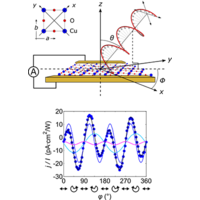
One of the long-standing questions in the study of the high-Tc cuprate superconductors has been the understanding of the nature of the boundary between the strange metal phase and the so-called pseudogap phase, which is a precursor to superconductivity. Testing for a possible symmetry breaking transition through that boundary, a detailed study of the photogalvanic effect along a set of crystallographic axes in BSCCO reveals a transition to a state with broken inversion and chiral symmetries, thus strongly constraining the possible theoretical proposals for this phenomenon.

Charge density wave order in the kagome metal AV3Sb5 (A=Cs,Rb,K)

Shangfei Wu, Brenden R. Ortiz, Hengxin Tan, Stephen D. Wilson, Binghai Yan, Turan Birol, and Girsh Blumberg

Phys. Rev. B 105, 155106 (2022) - Published 4 April, 2022

Tremendous interest has recently emerged in the kagome metal superconductors, since they are associated with an unconventional multicomponent charge density wave order parameter that may break time-reversal symmetry or obey other uncommon properties required for unconventional superconductivity. Here, the authors present spectroscopic evidence for the interplay between interacting order parameter components. The authors further develop a free-energy model and consistently describe experimental data, providing a basis for studying the interplay between multicomponent orders in the kagome metal systems.

Negatively charged boron vacancy center in diamond

T. Umeda, K. Watanabe, H. Hara, H. Sumiya, S. Onoda, A. Uedono, I. Chuprina, P. Siyushev, F. Jelezko, J. Wrachtrup, and J. Isoya

Phys. Rev. B 105, 165201 (2022) - Published 4 April, 2022

The negatively charged boron-vacancy pair - the BV− center - was a missing defect in diamond. It is expectedly very similar to the NV− center, which is one of the most famous spin defects or spin qubits in semiconductors. The BV− center has now been identified by electron paramagnetic resonance on specially prepared diamonds. Its spin-triplet state resembles a lot that of NV−, while its optically detected magnetic resonance signal was invisible, posing a puzzle why the BV− luminescence is so weak.

Interorbital singlet pairing in Sr2RuO4: A Hund's superconductor

Stefan Käser, Hugo U. R. Strand, Nils Wentzell, Antoine Georges, Olivier Parcollet, and Philipp Hansmann

Phys. Rev. B 105, 155101 (2022) - Published 1 April, 2022

Strontium ruthenate (Sr2RuO4) has become one of the cornerstone compounds in research on correlated electron materials. While the room-temperature Hund’s metal phase is rather well understood, the low-temperature superconductivity remains contested. By confronting state-of-the-art quantum many-body calculations with a great variety of experiments, the authors claim here that there is reason to believe that also the superconducting instability of Sr2RuO4 is driven by interorbital spin fluctuations, which at Tc turn the Hund’s metal into a Hund’s superconductor.

Nonlinear spectroscopy of excitonic states in transition metal dichalcogenides

Yaroslav V. Zhumagulov, Vyacheslav D. Neverov, Alexander E. Lukyanov, Dmitry R. Gulevich, Andrey V. Krasavin, Alexei Vagov, and Vasili Perebeinos

Phys. Rev. B 105, 115436 (2022) - Published 31 March, 2022

Methods in nonlinear optics attract much interest because they capture physical effects beyond linear spectroscopy. Here, the authors demonstrate that second harmonic generation (SHG) can be used to investigate details of the many-body effects, particularly the structure of excitonic states in low-dimensional materials. The dependence of the SHG signal on the polarization angle changes qualitatively with the frequency and intensity of the excitation light, which allows users to employ SHG to probe the fine structure of strongly bound excitonic states.

Pair density wave and reentrant superconducting tendencies originating from valley polarization

Zhaoyu Han and Steven A. Kivelson

Phys. Rev. B 105, L100509 (2022) - Published 31 March, 2022

For dilute electrons in two valleys at the K points of a triangular lattice Brillouin Zone, the authors identify multiple singlet superconducting tendencies that are comparable in strength and tunable by an in-plane (Zeeman) magnetic field. The results suggest a route to pair-density-wave order at zero field, a large but finite violation of the Pauli limit, and the dramatic possibility of reentrant superconductivity at high fields. In part, the results are reminiscent of observations in a recent experiment on magic-angle twisted trilayer graphene [nature_595_526_2021]. The approach adopted can be easily generalized.

Transformation optics approach to mesoscopic plasmonics

Fan Yang and Kun Ding

Phys. Rev. B 105, L121410 (2022) - Published 30 March, 2022

The development of nanofabrication brings the nanostructure to a scale of a few nanometers or even subnanometer, where the quantum effects of electrons become essential in the optical response. This work establishes an analytical method that combines transformation optics and Feibelman d parameters to investigate the nonclassical effects of plasmonic systems. The introduction of the d parameter incorporates most of the quantum effects, while transformation optics vastly simplifies the problem by converting the complex nanostructure in physical space into a simple slab geometry in virtual space.

DFT+Σ2 method for electron correlation effects at transition metal surfaces

Andrea Droghetti, Miloš M. Radonjić, Anita Halder, Ivan Rungger, and Liviu Chioncel

Phys. Rev. B 105, 115129 (2022) - Published 24 March, 2022

Density functional theory is the most popular method to study ferromagnetic transition metals. However, it is often insufficient for describing correlation effects in magnetic thin-film heterostructures. This work presents a computational approach that combines Density Functional Theory and Dynamical Mean Field Theory for transition metal thin films, using a multiorbital perturbative solver for the many-body problem. Calculations accurately describe the 3d-state spin splitting at low computational cost, thus enabling the investigation of correlation effects at spintronic interfaces.

Counterintuitive gate dependence of weak antilocalization in bilayer graphene/WSe2 heterostructures

Julia Amann, Tobias Völkl, Tobias Rockinger, Denis Kochan, Kenji Watanabe, Takashi Taniguchi, Jaroslav Fabian, Dieter Weiss, and Jonathan Eroms

Phys. Rev. B 105, 115425 (2022) - Published 24 March, 2022

Theory recently predicted that the strength of spin-orbit coupling in bilayer graphene, touching on one side a transition metal dichalcogenide layer such as WSe2, can be tuned easily by moderate gate voltages. Here, the authors show in both theory and experiment that, while spin-orbit splitting of the band structure is a monotonic function of the applied electric field, the visibility of weak antilocalization, a measure of the spin-orbit coupling strength, follows a largely opposite, and nonmonotonic trend.

Model for coupled 4f−3d magnetic spectra: A neutron scattering study of the Yb-Fe hybridization in Yb3Fe5O12

Viviane Peçanha-Antonio, Dharmalingam Prabhakaran, Christian Balz, Aleksandra Krajewska, and Andrew T. Boothroyd

Phys. Rev. B 105, 104422 (2022) - Published 23 March, 2022

In modern technologies, the usefulness of materials displaying magnetism arising from d and f electronic orbitals is encoded in their magnetic excitations. Recent progress in neutron scattering has made it possible to measure the magnetic spectrum of such compounds in exquisite detail. In this work, the authors develop a highly accurate method to describe the effect of d-f coupling on the magnetic excitations of ytterbium iron garnet, a textbook d-f system. Moreover, they show that the approach can be applied to other important real world materials.

Charge transport in topological graphene nanoribbons and nanoribbon heterostructures

Mark J. J. Mangnus, Felix R. Fischer, Michael F. Crommie, Ingmar Swart, and Peter H. Jacobse

Phys. Rev. B 105, 115424 (2022) - Published 23 March, 2022

The structure of graphene nanoribbons crucially affects their electronic properties and transport. Here, the authors elucidate the transport in various nanoribbons and nanoribbon heterostructures via transport measurements with the scanning tunneling microscope and theoretical modeling based on an atomistic mean-field Hubbard model. This reveals an intricate interplay between transport, topology, eigenstate localization, magnetism, and emergent negative differential resistance.

Chiral anomaly induced nonlinear Nernst and thermal Hall effects in Weyl semimetals

Chuanchang Zeng, Snehasish Nandy, and Sumanta Tewari

Phys. Rev. B 105, 125131 (2022) - Published 22 March, 2022

The chiral anomaly (CA) is one the most remarkable topological properties in Weyl semimetals (WSMs). Here, the authors investigate the second-order nonlinear planar Nernst and thermal Hall effects in WSMs, manifested by thermal CA with coplanar thermal gradient and magnetic field. With intrinsic chiral chemical potential, these nonlinear effects can exist in WSMs with pairs of oppositely tilted or nontilted Weyl cones. Interestingly, their transport coefficients follow novel fundamental relations consistent with that of Berry-dipole-induced nonlinear effects.

Influence of channel mixing in fermionic Hong-Ou-Mandel experiments

Matteo Acciai, Preden Roulleau, Imen Taktak, D. Christian Glattli, and Janine Splettstoesser

Phys. Rev. B 105, 125415 (2022) - Published 21 March, 2022

The authors consider a Hong-Ou-Mandel (HOM) interferometer in the integer quantum Hall effect, where electronic states generated by two ac-driven ohmic contacts collide at a quantum point contact. For perfectly synchronized sources, a full suppression of the output noise power is expected due to the antibunching effect of fermionic particles. This paper shows that the noise suppression is not complete when mixing between edge channels occurs, thus representing an important mechanism for the interpretation of fermionic HOM experiments.

Double-dome superconductivity under pressure in the V-based kagome metals AV3Sb5 (A=Rb and K)

C. C. Zhu, X. F. Yang, W. Xia, Q. W. Yin, L. S. Wang, C. C. Zhao, D. Z. Dai, C. P. Tu, B. Q. Song, Z. C. Tao, Z. J. Tu, C. S. Gong, H. C. Lei, Y. F. Guo, and S. Y. Li

Phys. Rev. B 105, 094507 (2022) - Published 17 March, 2022

The kagome metals AV3Sb5 (A = Cs, Rb, and K) host a wide range of exotic physics, including charge density wave, superconductivity, and topological state. Here, the authors present high-pressure resistance measurements on RbV3Sb5 and KV3Sb5. Two superconducting domes under pressure are unambiguously observed in both compounds, as they were previously observed in CsV3Sb5. The authors construct an integrated temperature-pressure phase diagram of AV3Sb5, showing that double-dome superconductivity under pressure is a common feature of these V-based kagome metals.

Compositional phase stability in medium-entropy and high-entropy Cantor-Wu alloys from an ab initio all-electron Landau-type theory and atomistic modeling

Christopher D. Woodgate and Julie B. Staunton

Phys. Rev. B 105, 115124 (2022) - Published 17 March, 2022

Short-range order in high-entropy alloys (HEA) prompts exciting physical questions: What are the implications for material properties, and what underlying mechanisms are drivers? In this theoretical work the authors describe a rigorous, first-principles approach combined with atomistic modeling to assess the nature of compositional order in the prototypical HEA, NiCoFeMnCr, and its derivatives. In particular, this work shows that finding the range of interactions, and representing the resulting behavior in reciprocal space, is important for understanding the stability of these materials.

Quasiparticle interference observation of the topologically nontrivial drumhead surface state in ZrSiTe

B. A. Stuart, Seokhwan Choi, Jisun Kim, Lukas Muechler, Raquel Queiroz, Mohamed Oudah, L. M. Schoop, D. A. Bonn, and S. A. Burke

Phys. Rev. B 105, L121111 (2022) - Published 17 March, 2022

Dirac nodal-line semimetals with one or more closed loops give rise to a surface state that stretches across the topologically nontrivial regions. While these drumhead states have been predicted and explored with simple models, few real materials have been explored experimentally. Here, the authors use quasiparticle interference (QPI) measurements to probe the topologically nontrivial drumhead state spanning occupied and unoccupied states in ZrSiTe, confirming that this state is robust to perturbations like spin-orbit coupling and demonstrating that QPI is a valuable tool to probe drumhead states.

Unconventional superconductivity due to interband polarization

Valentin Crépel, Tommaso Cea, Liang Fu, and Francisco Guinea

Phys. Rev. B 105, 094506 (2022) - Published 16 March, 2022

An important question about unconventional superconductors is how attractions can emerge in a purely repulsive electronic system. Here, the authors study comprehensively one such electronic mechanism, where pairing is induced by a third electron undergoing a virtual interband transition. Their exact solution of an illustrative Hubbard model establishes superconductivity due to interband polarization in both the weak and strong coupling regimes. Relevance of this pairing mechanism for twisted bilayer graphene is also discussed.

Projective symmetry group classification of chiral Z2 spin liquids on the pyrochlore lattice: Application to the spin-12 XXZ Heisenberg model

Benedikt Schneider, Jad C. Halimeh, and Matthias Punk

Phys. Rev. B 105, 125122 (2022) - Published 16 March, 2022

Simplified models for quantum spin-ice materials, such as the XXZ model on the pyrochlore lattice, may host interesting new spin-liquid ground states. In this work, the authors provide a complete classification of nearest-neighbor chiral Z2 spin-liquid states on the pyrochlore lattice using a projective symmetry group analysis. Moreover, the newly classified states are applied to the XXZ model within a self-consistent mean-field scheme. Observable signatures in neutron scattering experiments are discussed.

Sign In to Your Journals Account

Filter

Section

Filter

Article Lookup

Enter a citation