Highlights

Signatures of fragmentation for periodically driven fermions

Somsubhra Ghosh, Indranil Paul, and K. Sengupta

Phys. Rev. B 109, 214304 (2024) - Published 12 June, 2024

The occurrence of prethermal Hilbert space fragmentation (HSF) in periodically driven quantum systems has its roots in the emergence of additional, approximate, kinetic constraints at special driving frequencies. Here, the authors show that the out-of-time-ordered correlators (OTOCs) of a driven fermion chain with open boundary condition exhibit a signature of such HSF. At the special drive frequencies where such prethermal HSF occurs, the OTOCs display periodic unscrambling of information, which provides a yet unexplored, experimentally testable, marker for prethermal fragmentation.

Laser-enhanced magnetism in SmFeO3

Mohsen Yarmohammadi, Marin Bukov, Vadim Oganesyan, and Michael H. Kolodrubetz

Phys. Rev. B 109, 224417 (2024) - Published 12 June, 2024

Quantum magnetic materials enable the clean realization of many-body states on macroscopic length scales. Dynamic control at terahertz (THz) frequencies is a new frontier for both fundamental physics and applications in quantum technologies. Here, the authors propose THz magnetophononics at low temperatures to control spin excitations in SmFeO3 (a functional rare-earth orthoferrite in spintronics) through lattice excitations (phonons). This approach uncovers a dynamical magnetophononic first-order phase transition that enhances magnetism in SmFeO3.

Spin fluctuations sufficient to mediate superconductivity in nickelates

Paul Worm, Qisi Wang, Motoharu Kitatani, Izabela Biało, Qiang Gao, Xiaolin Ren, Jaewon Choi, Diana Csontosová, Ke-Jin Zhou, Xingjiang Zhou, Zhihai Zhu, Liang Si, Johan Chang, Jan M. Tomczak, and Karsten Held

Phys. Rev. B 109, 235126 (2024) - Published 12 June, 2024

Many mechanisms for unconventional superconductivity have been proposed, but actually proving which one is in charge is challenging. Quite astonishingly, dynamical vertex approximation predict the superconducting phase diagram of novel nickelate superconductors, with the microscopic origin being antiferromagnetic spin fluctuations. The authors compare the antiferromagnetic spin fluctuations behind these calculations to experiment. The again good agreement gives an overall coherent and complete picture, and thus a high level of confidence that superconductivity in nickelates is indeed mediated by spin fluctuations.

Ultrahigh resolution x-ray Thomson scattering measurements at the European X-ray Free Electron Laser

Thomas Gawne, Zhandos A. Moldabekov, Oliver S. Humphries, Karen Appel, Carsten Baehtz, Victorien Bouffetier, Erik Brambrink, Attila Cangi, Sebastian Göde, Zuzana Konôpková, Mikako Makita, Mikhail Mishchenko, Motoaki Nakatsutsumi, Kushal Ramakrishna, Lisa Randolph, Sebastian Schwalbe, Jan Vorberger, Lennart Wollenweber, Ulf Zastrau, Tobias Dornheim, and Thomas R. Preston

Phys. Rev. B 109, L241112 (2024) - Published 12 June, 2024

The authors implement here a setup for ultrahigh resolution measurements of x-ray Thomson scattering spectra, with a spectral range of several tens of eV. As an example, they study the Al plasmon and resolve longstanding discrepancies between ab initio simulations and experiments. By fully utilizing the capabilities of modern XFEL facilities, the setup opens up new avenues for the diagnosis of matter under extreme conditions, as they occur in inertial fusion energy applications and astrophysical objects.

Stochastic methodology shows molecular interactions protect two-dimensional polaritons

Nadine C. Bradbury, Raphael F. Ribeiro, Justin R. Caram, and Daniel Neuhauser

Phys. Rev. B 109, L241303 (2024) - Published 12 June, 2024

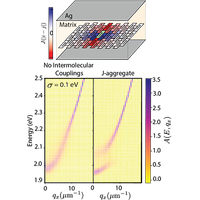
Using stochastic trace techniques, the authors simulate molecular aggregate crystals of millions of dyes inside Fabry-Pérot cavities containing many modes of light. They show that strong intermolecular interactions in the aggregate protect the formation of a polariton state in the face of strong molecular disorder due to persistent delocalization of the molecular dark states.

Emergence of radial Rashba spin-orbit fields in twisted van der Waals heterostructures

Tobias Frank, Paulo E. Faria Junior, Klaus Zollner, and Jaroslav Fabian

Phys. Rev. B 109, L241403 (2024) - Published 12 June, 2024

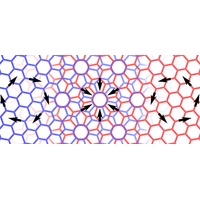
The Rashba effect is quintessential in condensed matter physics, appearing in virtually any electronic heterostructure. Its well-known manifestation is a tangential spin texture. Here, the authors theoretically demonstrate the emergence and engineering of radial Rashba spin textures in twisted van der Waals heterostructures using rigorous first-principles simulations and phenomenological modeling. These predictions offer new opportunities for controlling spin manipulation, as well as tuning correlated states and superconductivity in the van der Waals realm.

Lone-pair-delayed persistent excitonic UV photochromism and charge transfer in Bi-doped and (Bi,Mg)-codoped stoichiometric lithium niobate single crystals

L. Kovács, G. Corradi, Zs. Szaller, L. Bencs, G. Mandula, and K. Lengyel

Phys. Rev. B 109, 214105 (2024) - Published 11 June, 2024

For a deeper understanding of the outstanding real-time photorefractive medium LiNbO3:(Bi,Mg) and excitonic processes in general, stoichiometric LiNbO3 (SLN) crystals are investigated using low-intensity near-ultraviolet (UV) irradiation and infrared-ultraviolet absorption spectroscopy. Absorption bands separated in SLN:Bi and SLN:(Bi,Mg) are assigned to specific Bi defect types and their persistent association with self-trapped excitons (pinned STEs, PSTEs) generated by near-UV irradiation. Processes on widely differing timescales are predicted for one- and two-photon excitations involving different excited states, relevant for further optimization of the system.

Large anomalous Nernst effect and its bipolarity in the quaternary equiatomic Heusler alloys CrRuXGe (X=Co and Mn)

Amit Chanda, Jadupati Nag, Noah Schulz, Aftab Alam, K. G. Suresh, Manh-Huong Phan, and Hariharan Srikanth

Phys. Rev. B 109, 224415 (2024) - Published 11 June, 2024

Anomalous Nernst effect (ANE)-based thermopiles can be constructed by combining materials with positive and negative ANE coefficients. While most of the magnetic materials show positive ANE, only a limited number of materials exhibit a negative ANE. Furthermore, the majority of the materials showing negative ANE have low Curie temperatures (TC). Here, the authors demonstrate that high-TC quaternary Heusler alloys with large spin polarizations can exhibit both positive and negative ANE coefficients, depending on their chemical compositions, and hence, can be potential candidates for developing efficient room-temperature ANE-based thermopiles.

Electronic excitation spectra of molecular hydrogen in phase I from quantum Monte Carlo and many-body perturbation methods

Vitaly Gorelov, Markus Holzmann, David M. Ceperley, and Carlo Pierleoni

Phys. Rev. B 109, L241111 (2024) - Published 11 June, 2024

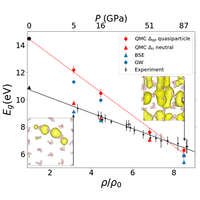
The electronic excitations in solid molecular hydrogen at room temperature for pressures varying from 5 to 90 GPa are calculated using quantum Monte Carlo methods and many-body perturbation theory. A crossover from a wide-gap insulator to a semiconductor is observed, showing the changing nature of the excitations from localized molecular (left inset figure) to delocalized (right inset figure) excitations. These findings are in agreement with experimental results, demonstrating the capability of accurately predicting band gaps in many-body systems with strong zero point and thermal effects.

Real-time quantum dynamics of thermal states with neural thermofields

Jannes Nys, Zakari Denis, and Giuseppe Carleo

Phys. Rev. B 109, 235120 (2024) - Published 10 June, 2024

Solving the time-dependent quantum many-body Schrquotodinger equation is a challenging task, especially for states at a finite temperature, where the environment affects the dynamics. Most existing approximating methods are designed to represent static thermal density matrices, 1D systems, and/or zero-temperature states. Here, the authors propose a method to study the real-time dynamics of thermal states in two dimensions, based on thermofield dynamics, variational Monte Carlo, and neural-network quantum states.

Effects of strain and defects on the topological properties of HfTe5

Na Hyun Jo, Omar A. Ashour, Zhixue Shu, Chris Jozwiak, Aaron Bostwick, Yang Wang, Eoghan Downey, Sae Hee Ryu, Kai Sun, Tai Kong, Sinéad M. Griffin, and Eli Rotenberg

Phys. Rev. B 109, 235122 (2024) - Published 10 June, 2024

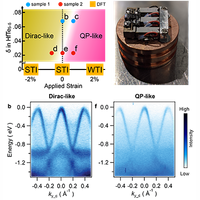
Manipulating topological states holds significant interest in the field of condensed matter physics. Here, the authors control the topological phase and corresponding quasiparticle dynamics by managing defects, and further reverse these effects through in situ uniaxial stress control in HfTe5. The findings showcase the potential of employing both defect chemistry and strain engineering as tools to manipulate topological phase transitions and related many-body physics.

Disorder-induced local strain distribution in Y-substituted TmVO4

Yuntian Li, Mark P. Zic, Linda Ye, W. Joe Meese, Pierre Massat, Yanbing Zhu, Rafael M. Fernandes, and Ian R. Fisher

Phys. Rev. B 109, 224201 (2024) - Published 7 June, 2024

Quenched disorder induced by chemical substitution is potentially important in shaping phase diagrams of strongly correlated quantum materials. Chemical substitution results in local strain, and hence conventional theoretical approaches often treat the effects of chemical substitution as random fields. However, this assumption is not fully justified given the long-range nature of strains in solids. Here, the authors explore the disorder effect arising from chemical substitution in TmVO4, an insulator, which undergoes ferroquadrupolar (nematic) order at low temperatures. They find quantitative evidence that the local strain fields are indeed correlated. This result implies that the effects of chemical substitution in all-electronic nematic materials need to be treated with greater degrees of sophistication than the ‘simple’ random field Ising model.

Spin-orbital ordering in alkali superoxides

Kohei Shibata, Makoto Naka, Harald O. Jeschke, and Junya Otsuki

Phys. Rev. B 109, 235115 (2024) - Published 7 June, 2024

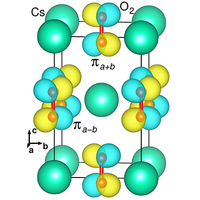
Alkali superoxides have spin and orbital degrees of freedom due to an open p shell of the oxygen ion O2− with degenerate π orbitals. The complex magnetic, orbital, and structural phase transitions observed experimentally in this family of materials are only partly understood. Geometrical frustration is found, based on density functional theory, to be a key for understanding the rich variety in the behavior of these compounds. Solving the Kugel-Khomskii model for CsO2 in a mean field reveals an orbital ordering transition below which the material becomes a highly frustrated two-dimensional magnet.

Anomalous Fermi pockets on the Hund's metal surface of Sr2RuO4 induced by correlation-enhanced spin-orbit coupling

Takeshi Kondo, Masayuki Ochi, Shuntaro Akebi, Yuyang Dong, Haruka Taniguchi, Yoshiteru Maeno, and Shik Shin

Phys. Rev. B 109, L241107 (2024) - Published 6 June, 2024

Much attention has been given to the spin-orbit coupling (SOC) effect on strongly correlated systems. Here, the authors investigate the electronic structure of the surface layer consisting of rotated RuO6 octahedrons in strongly correlated Sr2RuO4. They demonstrate that the octahedral rotation generates small Fermi pockets. Furthermore, it enhances the strong correlation, which increases the effective SOC, causing high orbital mixing. This result reasonably explains why the orbital-selective Mott transition is not realized in perovskite oxides with crystal distortion of octahedral rotation and tilt.

Dynamical correlation functions from complex time evolution

Xiaodong Cao, Yi Lu, E. Miles Stoudenmire, and Olivier Parcollet

Phys. Rev. B 109, 235110 (2024) - Published 5 June, 2024

As quantum systems evolve in time, their entanglement usually grows quickly, making tensor network methods inefficient. “Imaginary time” evolution is efficient, but extrapolating back to the real axis is ill-conditioned. Here, the authors show that complex time, a mixture of the two, remains efficient while allowing a controlled reconstruction technique. Therefore, one can reach significantly longer times, which they demonstrate by obtaining high-accuracy results for impurity models at low energies.

Band-gap discontinuity in semiconductor alloys with dissimilar wavefunction characters at the band edges

Xuefen Cai, Su-Huai Wei, Peter Deák, Jingxiu Yang, Chen Zhang, Bin Wang, Shu-Shen Li, and Hui-Xiong Deng

Phys. Rev. B 109, 235205 (2024) - Published 5 June, 2024

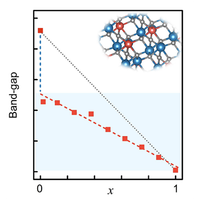
The authors clarify here the cause behind the discontinuous bandgap behavior in certain isovalent alloys by studying α-(Rh,Ga)2O3 alloys using first-principles calculations. This challenges the applicability of conventional empirical continuous rules. They demonstrate that this unusual behavior is due to the unconventional evolution of the wavefunction character at the band edges. This work emphasizes the importance of considering specific band-edge wavefunction character differences in endpoint materials for more accurate predictions of semiconductor alloy properties, which will help in designing better materials for electronics and optoelectronics.

Gapless symmetry-protected topological phases and generalized deconfined critical points from gauging a finite subgroup

Lei Su and Meng Zeng

Phys. Rev. B 109, 245108 (2024) - Published 5 June, 2024

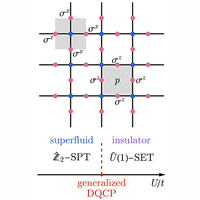
This work taps into the idea of gauging finite subgroups of global symmetries in conventional systems to obtain unconventional phases and phase transitions, greatly expanding the conventional Landau paradigm. Assisted by analytical anomaly computations and numerical density-matrix renormalization group calculations, the authors map the ordinary superfluid-insulator transition of the Bose-Hubbard model to novel phase transitions between exotic topological and/or symmetry-breaking phases. The general framework has potential applications in cold atom experiments and digital quantum simulators.

Evidence for giant surface Dzyaloshinskii-Moriya interaction in the chiral magnetic insulator Cu2OSeO3

Wancong Tan, Haonan Jin, Raymond Fan, Kejing Ran, and Shilei Zhang

Phys. Rev. B 109, L220402 (2024) - Published 5 June, 2024

The depth-dependent skyrmion twisting angle evolution in the chiral magnet Cu2OSeO3 is found to be temperature dependent, which is unexpected from a standard micromagnetic model. Here, the authors experimentally identify that the extra twisting of the topological textures is strongly correlated with the noncollinear electric polarization from the same material, suggesting a new mechanism that can control the magnetic skyrmions.

Impedance spectroscopy of chiral symmetric topoelectrical circuits

Selma Franca, Torsten Seidemann, Fabian Hassler, Jeroen van den Brink, and Ion Cosma Fulga

Phys. Rev. B 109, L241103 (2024) - Published 5 June, 2024

While topoelectrical circuits are a successful tool for realizing various topological phases of matter, experiments mostly focus on detecting topological boundary phenomena originating from an underlying circuit Laplacian. Here, the authors introduce appropriate signal processing techniques that allow the recovery of the full spectrum of the chiral symmetric system from a single two-point impedance measurement. The robustness of these techniques is demonstrated by constructing the Fibonacci topoelectrical circuit for the first time, suggesting that topoelectrical circuits are an ideal metamaterial platform for studying different properties of quasi(crystalline) systems.

Single-crystal growth and characterization of antiferromagnetically ordered EuIn2

Brinda Kuthanazhi, Simon X. M. Riberolles, Dominic H. Ryan, Philip J. Ryan, Jong-Woo Kim, Lin-Lin Wang, Robert J. McQueeney, Benjamin G. Ueland, and Paul C. Canfield

Phys. Rev. B 109, 214401 (2024) - Published 3 June, 2024

Using magnetization, Mössbauer spectroscopy, and x-ray resonant magnetic scattering (XRMS), this study investigates the magnetic transitions and magnetic states in EuIn2, a novel topological semimetal candidate. The authors find three closely spaced transitions reflecting the effects of competing magnetic interactions within the triangular lattice of Eu atoms in this compound. Mössbauer spectroscopy and XRMS further suggest modulated magnetic ordering and an incommensurate propagation vector that persists down to 5 K.

Sign In to Your Journals Account

Filter

Section

Filter

Article Lookup

Enter a citation