Highlights

Generation of charge current by the inverse Stern-Gerlach effect in semiconductors

N. J. Harmon, E. Z. Kurth, D. Coleman, and L. Flanigan

Phys. Rev. B 109, 195423 (2024) - Published 15 May, 2024

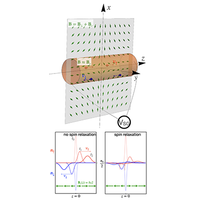
In the 100 years since the Stern-Gerlach experiment, ideas to use inhomogeneous magnetic fields for spintronics have been rare. In the theory here, the authors consider an inverse Stern-Gerlach effect in solid state systems of reduced dimension, in which charge current is produced by an injected carrier spin polarization in a nonuniform field. They find the combination of counter-flowing spin plus spin relaxation leads to interesting dynamics that produce a “Stern-Gerlach” potential, while at the same time reducing the spin transport length.

Free-form acoustic topological waveguides enabled by topological lattice defects

Yin Wang, Yong Ge, Yu-Jing Lu, Shuai Gu, Yi-Jun Guan, Qiao-Rui Si, Shou-Qi Yuan, Qiang Wang, Hong-Xiang Sun, and Haoran Xue

Phys. Rev. B 109, L180101 (2024) - Published 15 May, 2024

The interplay between real-space topological lattice defects and momentum-space band topology can lead to new topological states. Here, the authors demonstrate that disclinations in acoustic valley-Hall crystals can induce valley-like transport. Using this mechanism, various acoustic topological waveguides with irregular shapes and multiple internal terminations are experimentally realized, providing a novel way for robust free-from waveguiding.

Statistical mechanics model for Clifford random tensor networks and monitored quantum circuits

Yaodong Li, Romain Vasseur, Matthew P. A. Fisher, and Andreas W. W. Ludwig

Phys. Rev. B 109, 174307 (2024) - Published 13 May, 2024

The authors explore critical properties of entanglement phase transitions in random tensor networks and monitored quantum circuits with Clifford tensors/gates for on-site Hilbert space dimensions which are powers of a prime number p. Exact mappings to replica spin models and characterizations of their symmetry groups predict that all universal properties will depend only on p. These predictions are confirmed with extensive numerical simulations. The authors also establish multifractal scaling of the purity, reflected in a continuous spectrum of critical exponents, while the typical exponent is the prefactor of the logarithm in the entanglement entropy.

Unconventional properties of the noncentrosymmetric superconductor Re8NbTa

R. K. Kushwaha, Arushi, S. Sharma, S. Srivastava, P. K. Meena, M. Pula, J. Beare, J. Gautreau, A. D. Hillier, G. M. Luke, and R. P. Singh

Phys. Rev. B 109, 174518 (2024) - Published 13 May, 2024

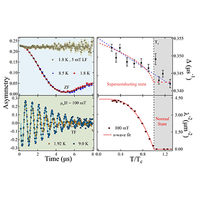
Here, the authors report on the superconducting properties of the ternary noncentrosymmetric superconductor Re8NbTa, a new member of the Re-based superconductors that are known for the frequent occurrence of time-reversal symmetry breaking and their complex superconducting ground states. Bulk and transverse field muon spin rotation/relaxation (μSR) measurements confirm moderately coupled, fully gapped superconductivity. However, zero-field μSR measurements indicate the possible presence of spin fluctuation/time-reversal symmetry breaking in the superconducting ground state, suggesting the unconventional superconductivity in Re8NbTa.

Influence of the electron density on the giant negative magnetoresistance in two-dimensional electron gases

L. Bockhorn, D. Schuh, C. Reichl, W. Wegscheider, and R. J. Haug

Phys. Rev. B 109, 205416 (2024) - Published 13 May, 2024

Ultrahigh-mobility two-dimensional electron gases show an astonishing robust negative magnetoresistance at zero magnetic field. In situ variation of the electron density enables a deep insight into the nature of this negative magnetoresistance. Here, the authors investigate the temperature-dependent giant negative magnetoresistance (GNMR) as a function of the electron density for several temperatures and currents. They find that the GNMR behavior depends decisively on the electron density. This observation is attributed to a changed disorder potential with electron density.

Conformal field theory approach to parton fractional quantum Hall trial wave functions

Greg J. Henderson, G. J. Sreejith, and Steven H. Simon

Phys. Rev. B 109, 205128 (2024) - Published 10 May, 2024

Conformal field theory (CFT) has played a pivotal role in understanding the topological phases of matter represented by many fractional quantum Hall effect (FQHE) trial wave functions. Previous papers have shown how the topological properties of a trial wave function expressible as a CFT correlation function can be related to properties of the corresponding CFT, assuming a field-theoretic generalization of Laughlin’s plasma analogy holds. Here, the authors show how these methods can be extended to understand certain topological properties of parton-type FQHE trial wave functions.

Competing anisotropies in the chiral cubic magnet Co8Zn8Mn4 unveiled by resonant x-ray magnetic scattering

Victor Ukleev, Oleg I. Utesov, Chen Luo, Florin Radu, Sebastian Wintz, Markus Weigand, Simone Finizio, Moritz Winter, Alexander Tahn, Bernd Rellinghaus, Kosuke Karube, Yoshinori Tokura, Yasujiro Taguchi, and Jonathan S. White

Phys. Rev. B 109, 184415 (2024) - Published 8 May, 2024

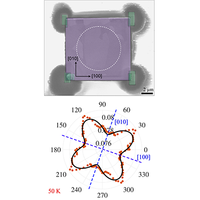
Using x-ray resonant magnetic scattering in vector magnetic fields, this work explores the effect of the anisotropic exchange interaction on the magnetic spiral pitch in the cubic chiral magnet Co8Zn8Mn4. The experimental data reveal up to a 5% variation in the helical pitch within the (001) plane depending on temperature. Furthermore, the results reveal the existence of intrinsic competition between magnetocrystalline and exchange anisotropies in this material, with each favoring different orientations of the helical vector in the ground state.

Multipolar magnetism in 5d2 vacancy-ordered halide double perovskites

Koushik Pradhan, Arun Paramekanti, and Tanusri Saha-Dasgupta

Phys. Rev. B 109, 184416 (2024) - Published 8 May, 2024

In contrast to dipolar refrigerator magnets, multipolar magnets possess more than just a north pole and a south pole. Using first principles and exact diagonalization calculations, this work establishes transition metal based vacancy-ordered halide double perovskites as new candidates for octupolar magnetism. The authors uncover a non-Kramers doublet ground state in these materials, explain the strong temperature-dependent effective magnetic moment, highlight the breakdown of the classic Kotani plot, and predict hidden octupolar order which may be tested in future experiments.

Magnetoelectric coupling in the multiferroic hybrid-improper ferroelectric Ca3Mn1.9Ti0.1O7

Yannik Zemp, Morgan Trassin, Elzbieta Gradauskaite, Bin Gao, Sang-Wook Cheong, Thomas Lottermoser, Manfred Fiebig, and Mads C. Weber

Phys. Rev. B 109, 184417 (2024) - Published 8 May, 2024

In hybrid-improper ferroelectrics, two nonpolar structural distortions jointly give rise to a spontaneous electric polarization. In Ca3Mn1.9Ti0.1O7, this ferroelectric state coexists with antiferromagnetism to yield a new type of multiferroic. Here, the authors show that it is characterized by a pronounced magnetoelectric response of the ferroelectric state to the intrinsic magnetic ordering and to external magnetic fields. Optical second harmonic generation is of particular advantage to this study, as it provides access to the electric polarization with spatial resolution of its domains.

Unified theory of optical absorption and luminescence including both direct and phonon-assisted processes

Sabyasachi Tiwari, Emmanouil Kioupakis, José Menendez, and Feliciano Giustino

Phys. Rev. B 109, 195127 (2024) - Published 8 May, 2024

Here, the authors make a fundamental theoretical advancement by unifying the theory of optical transitions in semiconductors including direct and phonon-assisted processes. This unification overcomes the fundamental limitation in the textbook theory of phonon-assisted optical absorption that gives unphysical absorption rates for photon energies greater than the direct band gap. They demonstrate the predictive power of their theory by calculating optical absorption and luminescence in standard semiconductors, and they achieve excellent quantitative agreement with the best available experiments. This work brings a paradigm shift in the theory of optical transitions, and opens the pathway for precise calculations of semiconductor optical properties.

Exact conditions for ensemble density functional theory

Thais R. Scott, John Kozlowski, Steven Crisostomo, Aurora Pribram-Jones, and Kieron Burke

Phys. Rev. B 109, 195120 (2024) - Published 7 May, 2024

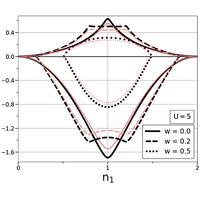
Ensemble density functional theory (EDFT) offers a promising path for computing excitation energies via a theory of the ensemble density — a weighted sum of interacting excited-state densities. Recovering excitation energies is theoretically simple, but practical application requires approximations dependent on weight choice. Here, the authors derive exact conditions for EDFT. Using an exactly solvable model, they illustrate violations of exact conditions, weight-dependent derivative discontinuities in the strong-interaction limit, and ultimately the significance of weight dependence for future functional design.

Moiré fractional Chern insulators. I. First-principles calculations and continuum models of twisted bilayer MoTe2

Yujin Jia, Jiabin Yu, Jiaxuan Liu, Jonah Herzog-Arbeitman, Ziyue Qi, Hanqi Pi, Nicolas Regnault, Hongming Weng, B. Andrei Bernevig, and Quansheng Wu

Phys. Rev. B 109, 205121 (2024) - Published 7 May, 2024

The researchers here shed new light on the elusive single-particle model of twisted bilayer MoTe2, a material recently highlighted for hosting fractional Chern insulators at zero magnetic field. By leveraging an advanced machine learning method and density functional theory, the team meticulously maps out the band structure across various twist angles, revealing a pivotal band inversion and refining the theoretical landscape. By enhancing the continuum model with higher harmonic terms, they unveil opposite Chern numbers in the valence bands for key angles, paving the way for predicting diverse Chern states. This comprehensive analysis lays the groundwork for accurately pinpointing correlated phases in this intriguing material, offering a beacon for future explorations.

Moiré fractional Chern insulators. II. First-principles calculations and continuum models of rhombohedral graphene superlattices

Jonah Herzog-Arbeitman, Yuzhi Wang, Jiaxuan Liu, Pok Man Tam, Ziyue Qi, Yujin Jia, Dmitri K. Efetov, Oskar Vafek, Nicolas Regnault, Hongming Weng, Quansheng Wu, B. Andrei Bernevig, and Jiabin Yu

Phys. Rev. B 109, 205122 (2024) - Published 7 May, 2024

The observation of fractional Chern insulators in rhombohedral pentalayer graphene twisted on hexagonal boron nitride has initiated a flurry of theoretical work seeking its explanation. As a step towards understanding the origin of these phases, the authors undertake here a first-principles study of the large family of multilayer rhombohedral graphene/boron nitride superlattices, including structural relaxation. The moiré models they obtain faithfully capture the microscopic band structure and are the starting point for understanding the observed topological phases and predicting new ones.

Magnetic structure and magnetoelectric properties of the spin-flop phase in LiFePO4

Sofie Holm-Janas, Mitsuru Akaki, Ellen Fogh, Takumi Kihara, Manh Duc Le, Paola Catarina Forino, Stanislav E. Nikitin, Tom Fennell, Adheena Painganoor, David Vaknin, Masao Watanabe, Niels Bech Christensen, Hiroyuki Nojiri, and Rasmus Toft-Petersen

Phys. Rev. B 109, 174413 (2024) - Published 6 May, 2024

Using neutron diffraction in pulsed magnetic fields, employing the challenging backscattering geometry, this work establishes the magnetic structure in the spin flop phase of magnetoelectric LiFePO4 above 32 Tesla. Using pulsed field electric polarization measurements, an unexpectedly complex set of magnetoelectric couplings are found above the critical field. Finally, mean field calculations of the phase diagram demonstrate how access to high field (H,T) phase diagrams can be complementary to other techniques in pinpointing the spin Hamiltonian

Tuning spinaron and Kondo resonances via quantum confinement

Markus Aapro, Abraham Kipnis, Jose L. Lado, Shawulienu Kezilebieke, and Peter Liljeroth

Phys. Rev. B 109, 195415 (2024) - Published 6 May, 2024

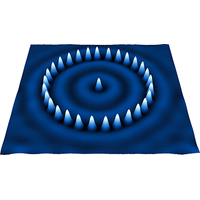
The interactions between conduction electrons and magnetic impurities lead to exotic entangled many-body states. Scanning tunneling microscope allows us to probe many-body excitations of a magnetic impurity and create tunable conduction electron environments by building quantum corrals atom by atom. Combining these techniques, the authors explore here how electronic confinement in quantum corrals affects two types of quantum impurity models, one realizing a candidate system for Kondo physics, and a second realizing a candidate system of spinaron many-body excitations.

Preempted phonon-mediated superconductivity in the infinite-layer nickelates

Q. N. Meier, J. B. de Vaulx, F. Bernardini, A. S. Botana, X. Blase, V. Olevano, and A. Cano

Phys. Rev. B 109, 184505 (2024) - Published 3 May, 2024

To be, or not to be, phonon mediated. That is the first question to answer for new superconductors, especially if they show important analogies with the cuprates. Here, the infinite-layer nickelates are scrutinized by means of first-principles calculations, including dynamical correlations in the GW approximation. The results suggest phonon-mediated superconductivity with low-Tc in the parent compounds. However, the analysis of doping and pressure confirm the non-phonon mediated nature of the mechanism behind the maximal Tc observed in these systems.

Polariton-assisted long-distance energy transfer between excitons in two-dimensional semiconductors

Tuomas Pajunpää, Fedor Nigmatulin, Suvi-Tuuli Akkanen, Henry Fernandez, Gerrit Groenhof, and Zhipei Sun

Phys. Rev. B 109, 195409 (2024) - Published 3 May, 2024

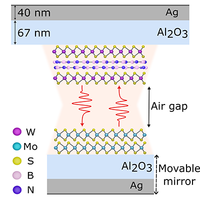
Polaritons formed by strong exciton-photon coupling can drastically increase the distance of coherent energy exchange between excitonic materials, but poor durability or low operational temperature in previously demonstrated materials has limited the range of possible applications. Here, the authors demonstrate two-dimensional transition metal dichalcogenide semiconductors placed in a tunable optical microcavity as a durable, room-temperature platform for polariton-mediated energy transfer between excitons. The full quantum mechanical simulations based on experimental parameters reveal efficient energy transfer over 1 μm distance on a femtosecond timescale.

Realization of nodal-ring semimetal in pressurized black phosphorus

Kazuto Akiba, Yuichi Akahama, Masashi Tokunaga, and Tatsuo C. Kobayashi

Phys. Rev. B 109, L201103 (2024) - Published 3 May, 2024

Nodal-ring semimetals have attracted attention for their unique band topology and resulting nontrivial quantum phenomena. Using fermiology under high pressure, the authors reveal here a pure nodal-ring semimetal state in pressurized black phosphorus. Semimetallic black phosphorus can provide an ideal platform to explore the true nature of this topological quantum state using external pressure as an effective tuning parameter.

Magnetic resonance study of rare-earth titanates

A. Najev, S. Hameed, A. Alfonsov, J. Joe, V. Kataev, M. Greven, M. Požek, and D. Pelc

Phys. Rev. B 109, 174406 (2024) - Published 2 May, 2024

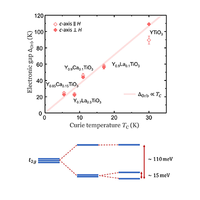
The rare-earth titanate perovskites exhibit a rich interplay among spin, orbital and structural degrees of freedom. Here, electron spin resonance and nuclear magnetic resonance are combined to study the low-energy spin properties of a series of rare-earth titanates. The measurements reveal slow spin fluctuations at temperatures far above the ferromagnetic transition, as well as a low-lying electronic excited state that likely plays a pivotal role in the formation of magnetic order.

Unconventional parametric spin-wave pumping in single-crystal iron films

Shoki Nezu, Thomas Scheike, Hiroaki Sukegawa, and Koji Sekiguchi

Phys. Rev. B 109, 184402 (2024) - Published 2 May, 2024
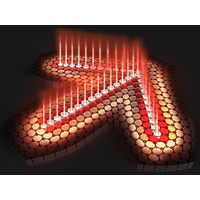
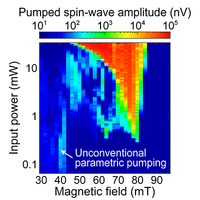
This study explores a novel approach to exciting spin waves in single-crystal iron using parametric pumping. This technique achieves significant results at exceptionally low power levels, revealing unconventional behavior in this material. These findings suggest that single-crystal iron holds immense promise as a platform for spin-wave manipulation. A systematic investigation of parametric pumping in single-crystal iron paves the way for the development of low-power spin-wave devices.

Sign In to Your Journals Account

Filter

Section

Filter

Article Lookup

Enter a citation