Highlights

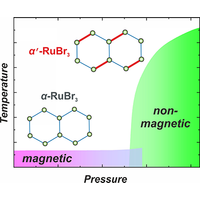
Magnetic versus nonmagnetic polymorphs of RuBr3 under pressure

Bin Shen, Victoria A. Ginga, Angel M. Arévalo-López, Gaston Garbarino, Ece Uykur, Marcos Gonçalves-Faria, Prashanta K. Mukharjee, Philipp Gegenwart, and Alexander A. Tsirlin

Phys. Rev. B 109, 224402 (2024) - Published 3 June, 2024

The delicate balance between magnetic and nonmagnetic states is central to the electronic properties of 4d and 5d honeycomb compounds, including prospective Kitaev materials. External pressure drives the recent Kitaev candidate α-RuBr3 toward the magnetism collapse via structural dimerization, while at lower pressures this material evolves along the boundary between the ferromagnetic and zigzag orders. The alternative chain-like β polymorph is avoided despite its higher thermodynamic stability.

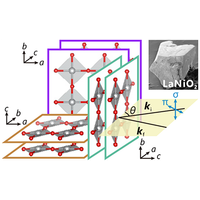
Investigation of spin excitations and charge order in bulk crystals of the infinite-layer nickelate LaNiO2

S. Hayashida, V. Sundaramurthy, P. Puphal, M. Garcia-Fernandez, Ke-Jin Zhou, B. Fenk, M. Isobe, M. Minola, Y.-M. Wu, Y. E. Suyolcu, P. A. van Aken, B. Keimer, and M. Hepting

Phys. Rev. B 109, 235106 (2024) - Published 3 June, 2024

Infinite-layer nickelates are an emergent family of unconventional superconductors. Previous investigations have mostly focused on thin film samples, due to the complex crystal growth involving topochemical reductions. Here, the authors present the first spectroscopic investigation of bulk crystal infinite-layer nickelate LaNiO2 using resonant inelastic x-ray scattering. Their findings indicate that spin excitations are ubiquitous in infinite-layer nickelates, while the presence of charge order remains a subject of debate.

Corrections to the Bethe lattice solution of Anderson localization

Matilde Baroni, Giulia Garcia Lorenzana, Tommaso Rizzo, and Marco Tarzia

Phys. Rev. B 109, 174216 (2024) - Published 31 May, 2024

Anderson localization is a fundamental phenomenon in condensed matter physics, with strong connections with many-body localization and quantum chaos. A crucial theoretical problem is that its behavior on the Bethe lattice, an infinite loop-less tree, differs dramatically from realistic models in finite dimensions. To amend the theory, the authors study here tree-like lattices with one loop of arbitrary length. The outcome opens the way to the computation of the critical exponents and explains some puzzling finite-size effects observed in numerical simulations.

Bose-Einstein condensation of magnons under coherent pumping by light

Liang Li and Tianyu Liu

Phys. Rev. B 109, 184447 (2024) - Published 31 May, 2024

Room-temperature quantum computing and solid-state quantum simulations have been long-standing goals in the field of quantum information science. Magnon Bose-Einstein condensation at room temperature may provide a key advance towards these objectives. Normally, the magnon Bose-Einstein condensation is driven by microwave pumping and detected by light. Here, the authors propose a method to create stable magnon condensate using lasers in a magneto-optical cavity, opening new avenues for all-optical control in quantum magnonics.

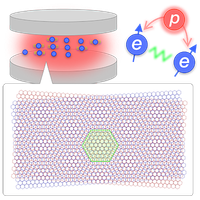
Cavity moiré materials: Controlling magnetic frustration with quantum light-matter interaction

Kanta Masuki and Yuto Ashida

Phys. Rev. B 109, 195173 (2024) - Published 31 May, 2024

Cavity quantum electrodynamics (QED) studies the interaction between light and matter at the single quantum level and has played a central role in quantum science and technology. Combining the idea of cavity QED with moiré materials, the authors develop here a theory of cavity moiré materials, i.e., moiré materials confined in a cavity. These results indicate that the cavity confinement enables one to control magnetic frustration of moiré materials and might allow the realization of various exotic phases, such as the quantum spin liquid.

Coexistence of one-dimensional and two-dimensional topology and genesis of Dirac cones in the chiral Aubry-André model

T. V. C. Antão, D. A. Miranda, and N. M. R. Peres

Phys. Rev. B 109, 195436 (2024) - Published 31 May, 2024

The chiral Aubry-André model is introduced as an atomic chain with staggered hoppings and a superimposed hopping modulation, revealing a unique interplay of one-dimensional and two-dimensional topological properties. Here, the authors describe the model’s phases and the coexistence of a 2D Chern number and a 1D winding number, combining features of the integer and half-integer quantum Hall effect with SSH-type 1D protected edge modes, motivating the engineering of complex topological insulators using the physics of quasicrystallinity.

Relationship between magnetic asymmetry and magnetization in ultrafast transverse magneto-optical Kerr effect spectroscopy in the extreme ultraviolet spectral range

Johanna Richter, Somnath Jana, Martin Hennecke, Daniel Schick, Clemens von Korff Schmising, and Stefan Eisebitt

Phys. Rev. B 109, 184440 (2024) - Published 30 May, 2024

Ultrafast transverse magneto-optical Kerr effect (T-MOKE) spectroscopy in the extreme ultraviolet provides element-specific insights into magnetization dynamics. However, the relationship between T-MOKE magnetic asymmetry and sample magnetization can be complex, even in the absence of nonequilibrium magnetization dynamics. Here, the authors present static and time-resolved data, together with wave propagation simulations, for a prototypical magnetic heterostructure that shows significant deviations from linearity, including increasing asymmetry despite decreasing magnetization. They also propose sample structures and experimental geometries in which a linear T-MOKE response remains valid.

Zero to ultralow magnetic field NMR of [1−13C]pyruvate and [2−13C]pyruvate enabled by SQUID sensors and hyperpolarization

John Z. Myers, Friedemann Bullinger, Nicolas Kempf, Markus Plaumann, Adam Ortmeier, Thomas Theis, Pavel Povolni, Jannik Romanowski, Jörn Engelmann, Klaus Scheffler, Jan-Bernd Hövener, Kai Buckenmaier, Rainer Körber, and Andrey N. Pravdivtsev

Phys. Rev. B 109, 184443 (2024) - Published 30 May, 2024

Nuclear magnetic resonance is typically performed at high magnetic fields, where heteronuclei are weakly coupled and resonate at their own frequences. This paper presents how hyperpolarization enables detection in the intermediate and strong-coupling regimes by using ultrasensitive SQUID setups. The authors also analytically derived product operators for this system (13C-labeled pyruvate) at arbitrary magnetic field. This confirms that spin precession does not occur at zero field, but rather that spins oscillate along an axis, demonstrating the importance of detection direction.

Onset of transmon ionization in microwave single-photon detection

Yuki Nojiri, Kedar E. Honasoge, Achim Marx, Kirill G. Fedorov, and Rudolf Gross

Phys. Rev. B 109, 174312 (2024) - Published 29 May, 2024

Transmon ionization (TI) is detrimental to qubit coherence and manipulation. This study explores how TI, triggered by strong microwave pulses, affects microwave single-photon detectors (SPDs) based on a 3D multimode cavity coupled to a transmon qubit. Experimental and numerical investigations reveal that at a critical pump power transmon population suddenly increases, indicating a quantum-to- classical transition. The authors also outline the challenges and potential solutions for increasing the quantum efficiency of SPDs, being crucial for advancing quantum communication and sensing technologies.

Polaronic polariton quasiparticles in a dark excitonic medium

Kenneth Choo, Olivier Bleu, Jesper Levinsen, and Meera M. Parish

Phys. Rev. B 109, 195432 (2024) - Published 28 May, 2024

The authors present here a new paradigm for hybrid light-matter particles based on Landau’s quasiparticle concept. Specifically, they show that exciton polaritons form novel polaronlike quasiparticles due to interactions with the dark excitonic medium that is typically present in a semiconductor microcavity. This theory provides a new mechanism for the loss of light-matter coupling commonly observed in experiments, and it explains recent puzzling measurements on polariton interactions in atomically thin semiconductors, thus opening a pathway for engineering strong interactions in light-matter systems.

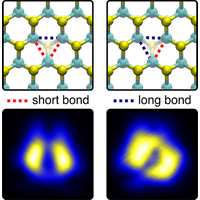
Tip-induced creation and Jahn-Teller distortions of sulfur vacancies in single-layer MoS2

Daniel Jansen, Tfyeche Tounsi, Jeison Fischer, Arkady V. Krasheninnikov, Thomas Michely, Hannu-Pekka Komsa, and Wouter Jolie

Phys. Rev. B 109, 195430 (2024) - Published 24 May, 2024

Vacancies in semiconducting 2D transition metal dichalcogenides enable studies of quantum phenomena at the nanoscale, such as single photon emission or Jahn-Teller distortions. Here, the authors show that a scanning tunneling microscope can enable local creation of single vacancies as well as vacancy dimers in single-layer MoS2. Charging the vacancy through local gating leads to two distinct types of Jahn-Teller distortions, in quantitative agreement with ab initio calculations. Strong hybridization within vacancy dimers illustrates the potential for artificial defect lattices with tailored electronic band structures.

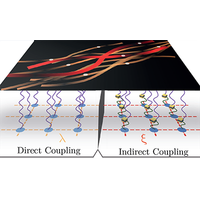
Electrostatic nature of cavity-mediated interactions between low-energy matter excitations

Petros-Andreas Pantazopoulos, Johannes Feist, Akashdeep Kamra, and Francisco J. García-Vidal

Phys. Rev. B 109, L201408 (2024) - Published 23 May, 2024

Here, the authors demonstrate that cavity quantum electrodynamical effects induce electrostatic interactions between low-energy matter excitations when these are off-resonantly coupled either directly to the cavity field or indirectly via resonant mediator modes. These findings expose the limitations of previous models that have used just one cavity mode in the electromagnetic description of the cavity. The results provide critical insights for designing nanophotonic structures leading to significant cavity-induced interactions, which could open new avenues for modifying material properties using vacuum fields.

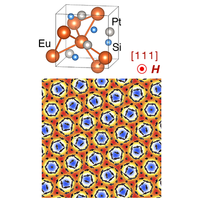
Single helicity of the triple-q triangular skyrmion lattice state in the cubic chiral helimagnet EuPtSi

Takeshi Matsumura, Chihiro Tabata, Koji Kaneko, Hironori Nakao, Masashi Kakihana, Masato Hedo, Takao Nakama, and Yoshichika Ōnuki

Phys. Rev. B 109, 174437 (2024) - Published 22 May, 2024

The magnetic skyrmion lattice is a crystallization of spin-swirling particle-like objects composed of multiple helimagnetic modulation waves with the same helicity (sense of rotation). Despite the widespread observation of this spectacular structure, the experimental verification of the unified helicity has not yet been achieved. Using circularly polarized resonant x-ray diffraction, the authors study here the triangular skyrmion lattice in the chiral helimagnet EuPtSi and demonstrate that the helicity is indeed unified. This method has great potential for unraveling the chiral structures of emergent magnetic phases.

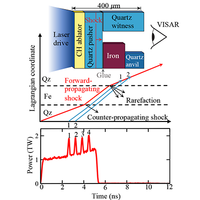
Sound speed and Grüneisen parameter up to three terapascal in shock-compressed iron

M. F. Huff, D. E. Fratanduono, M. C. Marshall, C. A. McCoy, L. E. Hansen, D. N. Polsin, T. Suer, E. A. Smith, B. J. Henderson, X. Gong, G. W. Collins, and J. R. Rygg

Phys. Rev. B 109, 184311 (2024) - Published 22 May, 2024

The warm dense matter regime is generally found in materials compressed to several times their densities on the Earth’s surface at temperatures hot enough to produce a conducting fluid, but not so hot that the cohesive binding is overwhelmed by the temperature. This region of phase space is notoriously difficult to constrain with theoretical models. Iron is the most stable element, and is relevant to astrophysics, planetary physics, and industry. The paper here describes experiments using giant kilojoule lasers to shock compress iron to warm dense matter conditions and then send acoustic waves through this compressed material. This method yields the first experimental measurements of sound speed and Grüneisen parameter in shocked iron in the terapascal range, and reveals an interesting dependence on density and melting for these physically important derivatives of the equation of state.

First-principles calculation of orbital Hall effect by Wannier interpolation: Role of orbital dependence of the anomalous position

Dongwook Go, Hyun-Woo Lee, Peter M. Oppeneer, Stefan Blügel, and Yuriy Mokrousov

Phys. Rev. B 109, 174435 (2024) - Published 21 May, 2024

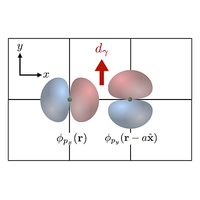
In the emerging field of orbitronics, the orbital Hall effect stands out as one of the most important transport phenomena of orbital angular momentum. Here, the authors present a highly efficient and accurate first-principles method to compute the orbital Hall effect by Wannier interpolation and point out the crucial role of the anomalous position for the gauge-covariant description. The work guides the ongoing experimental efforts on the quantitative measurement of orbital currents.

Integrability as an attractor of adiabatic flows

Hyeongjin Kim and Anatoli Polkovnikov

Phys. Rev. B 109, 195162 (2024) - Published 21 May, 2024

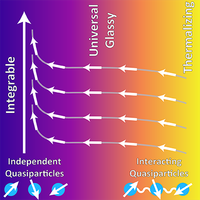
Generic many-body particle systems typically exhibit chaos and thermalization. Amidst this chaotic landscape there are special systems called integrable, for example, systems of noninteracting particles that are neither chaotic nor thermalizing. Integrable systems usually require a high degree of fine-tuning of the Hamiltonian that defines their dynamics. The authors find that these special systems act as natural geometric attractors of adiabatic flows that follow the directions of fastest relaxation of observables. They also found that near integrability observables exhibit universal slow relaxation in time, forming long-lived nonequilibrium states similar to turbulent cascades.

Magnetism and spin dynamics of the S=32 frustrated trillium lattice compound K2CrTi(PO4)3

J. Khatua, Suheon Lee, Gyungbin Ban, Marc Uhlarz, G. Senthil Murugan, R. Sankar, Bassam Hitti, Gerald Morris, Kwang-Yong Choi, and P. Khuntia

Phys. Rev. B 109, 184432 (2024) - Published 17 May, 2024

The subtle interplay between competing degrees of freedom offers an ideal route for the experimental realization of emergent quantum and topological phenomena with exotic quasiparticle excitations in three-dimensional noncentrosymmetric frustrated magnets on a trillium lattice. Here, the authors demonstrate the coexistence of competing magnetic states and short-range spin correlations well above the magnetic phase transition in a frustrated double trillium lattice comprised of Cr3+ ions decorated on a three-dimensional chiral network of corner-shared equilateral triangular motifs.

Vector detection of ac magnetic fields by nitrogen vacancy centers of single orientation in diamond

Pooja Lamba, Akshat Rana, Sougata Halder, Siddharth Dhomkar, Dieter Suter, and Rama K. Kamineni

Phys. Rev. B 109, 195424 (2024) - Published 17 May, 2024

Nitrogen vacancy (NV) centers in diamond are highly sensitive nanoscale sensors of dc and ac magnetic fields. Vector detection of ac magnetic fields, where both strength and orientation of the applied field is determined, requires at least three NV centers of different orientations by the conventional method. Here, the authors propose and demonstrate a method for vector detection of ac magnetic fields by using NV centers having a single orientation. This method is equally applicable for single NV centers.

Phases and exotic phase transitions of a two-dimensional Su-Schrieffer-Heeger model

Anika Götz, Martin Hohenadler, and Fakher F. Assaad

Phys. Rev. B 109, 195154 (2024) - Published 16 May, 2024

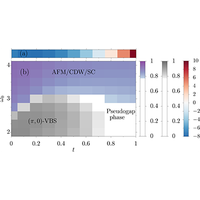
The authors study here a Su-Schrieffer-Heeger model on a square lattice by auxiliary-field quantum Monte Carlo. A novel approach allows analytical integration over the phonons, considerably reducing autocorrelation times and allowing investigation of new regions of the phase diagram. By varying the strength of the direct hopping at the O(4) symmetric point, they discover novel phases in this textbook model. In particular, for small values of the direct hopping, they observe emergent orthogonal Dirac fermions, with an exotic quantum phase transition akin to deconfined quantum criticality.

Nematic heavy fermions and coexisting magnetic order in CeSiI

Aayush Vijayvargia and Onur Erten

Phys. Rev. B 109, L201118 (2024) - Published 16 May, 2024

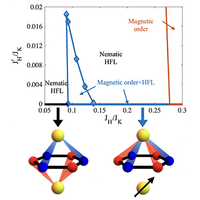
The authors construct here a low-energy model for CeSiI, a new van der Waals (vdW) material that exhibits heavy Fermi liquid behaviour coexisting with magnetic order. Using Abrikosov mean field theory, they observe that the unique geometry of the material facilitates the existence of a nematic heavy Fermi liquid phase as well as a coexistence of heavy Fermi liquid and magnetic order phase. In particular, it is shown that an electric field applied perpendicular to the material consolidates the coexistence phase, demonstrating the high tunability of this new vdW heavy fermion material.

Sign In to Your Journals Account

Filter

Section

Filter

Article Lookup

Enter a citation