Highlights

Effects of spin-orbit coupling in a valley chiral kagome network

P. Wittig, F. Dominguez, and P. Recher

Phys. Rev. B 109, 245429 (2024) - Published 26 June, 2024

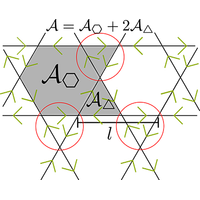
Chern mosaic systems exhibit weakly protected chiral modes propagating in the bulk of the material. This novel phase of matter has recently been found in twisted bilayer graphene and double-aligned graphene-hexagonal boron nitride. Here, the authors investigate the spectrum and transport properties of a valley chiral kagome scattering network. The interplay of the network geometry, magnetic field, and spin-orbit coupling gives rise to peculiar interference phenomena, including a sizable zero-field spin polarization of the conductance.

Electronic transport, metal-insulator transition, and Wigner crystallization in transition metal dichalcogenide monolayers

Yi Huang and Sankar Das Sarma

Phys. Rev. B 109, 245431 (2024) - Published 26 June, 2024

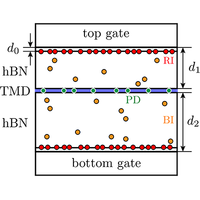
By analyzing transport data from high-mobility transition metal dichalcogenide (TMD) WSe2 monolayers and considering realistic disorder scattering, the authors explain here the observed nonmonotonic carrier density dependence of mobility and the linear temperature-dependent resistivity in the metallic phase. They theoretically examine the metal-insulator transition (MIT) critical density and the melting temperature of Wigner crystallization (WC), suggesting that the observed two-dimensional low-density MIT likely results from the complex interplay between disorder effects and interaction-driven WC physics.

Quartet tomography in multiterminal Josephson junctions

David Christian Ohnmacht, Marco Coraiola, Juan José García-Esteban, Deividas Sabonis, Fabrizio Nichele, Wolfgang Belzig, and Juan Carlos Cuevas

Phys. Rev. B 109, L241407 (2024) - Published 26 June, 2024

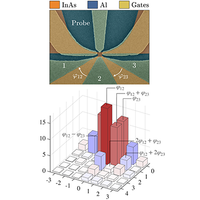
The authors propose here how to detect quartets in hybrid multiterminal Josephson junctions from the analysis of the current-phase relation and Andreev bound state (ABS) spectra. The methods are applied to the partial ABS spectrum of a three-terminal Josephson junction realized in an InAs/Al heterostructure, which is extracted from spectroscopic measurements with the help of a deep-learning algorithm. The authors’ analysis confirms the existence of quartets in these hybrid structures and illustrates their close relationship with ABS hybridization.

Impact of spin torques and spin-pumping phenomena on magnon-plasmon polaritons in antiferromagnetic insulator-semiconductor heterostructures

Vemund Falch, Jeroen Danon, Alireza Qaiumzadeh, and Arne Brataas

Phys. Rev. B 109, 214436 (2024) - Published 25 June, 2024

At interfaces between insulating magnets and conductors, spin pumping and spin transfer torques can couple spin and charge dynamics in the two materials through the spin Hall effect. Here, the authors develop a formalism to study how these effects modify surface magnon polaritons localized at antiferromagnet-semiconductor interfaces. Perturbatively derived analytical results, in good agreement with numerical results, show the influence of various material parameters, and can serve as a guide to explore new materials for magneto-plasmonic applications.

Universality of the cross-entropy in Z2 symmetric monitored quantum circuits

Maria Tikhanovskaya, Ali Lavasani, Matthew P. A. Fisher, and Sagar Vijay

Phys. Rev. B 109, 224313 (2024) - Published 25 June, 2024

In monitored quantum many-body dynamics, information about the evolving state can “leak” into the measurement record, as quantified by the linear-cross entropy (LXE). Here, the authors show that the LXE serves as an order parameter that also distinguishes various area-law-entangled phases of monitored circuits with a global Ising symmetry. The behavior of the LXE at a critical point separating these phases quantitatively agrees with predictions from the conformal field theory describing this critical point. This connection between out-of-equilibrium dynamics and equilibrium statistical mechanics suggests the possibility of the LXE as a probe of universal critical behavior in other kinds of monitored quantum evolution.

Classification of electronic nematicity in three-dimensional crystals and quasicrystals

Matthias Hecker, Anant Rastogi, Daniel F. Agterberg, and Rafael M. Fernandes

Phys. Rev. B 109, 235148 (2024) - Published 25 June, 2024

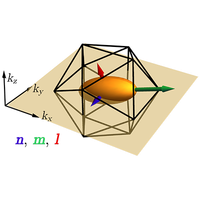
Electronic nematicity, proposed as a novel correlated state of matter more than two decades ago, is being reported in an ever-growing number of materials. Yet, research on this topic has focused on realizations in quasi-two-dimensional lattices with fourfold or sixfold rotational symmetries. This work presents a systematic and unifying classification scheme for electronic nematicity in all crystallographic point groups and noncrystallographic groups relevant to quasicrystals and twisted materials. It reveals a rich nematic phenomenology described in terms of distinct types of Potts and clock models.

Applicability of Eliashberg theory for systems with electron-phonon and electron-electron interaction: A comparative analysis

Shang-Shun Zhang, Zachary M. Raines, and Andrey V. Chubukov

Phys. Rev. B 109, 245132 (2024) - Published 24 June, 2024

The applicability of Eliashberg theory, for fermions interacting with fluctuations of a soft collective boson near a quantum-critical point (QCP) in two dimensions, remains a subject of debate. The velocity of the soft boson is comparable to the Fermi velocity. Hence, Migdal’s justification of Eliashberg theory is formally not applicable. The authors argue here that some elements of Migdal’s reasoning remain valid because the collective boson is overdamped, yet vertex corrections to Eliashberg theory are O(1). At the same time, they show that these corrections are numerically small, at least near an Ising-nematic QCP.

Terahertz ratchet in graphene two-dimensional metamaterial formed by a patterned gate with an antidot array

I. Yahniuk, M. Hild, L. E. Golub, J. Amann, J. Eroms, D. Weiss, Wun-Hao Kang, Ming-Hao Liu, K. Watanabe, T. Taniguchi, and S. D. Ganichev

Phys. Rev. B 109, 235428 (2024) - Published 21 June, 2024

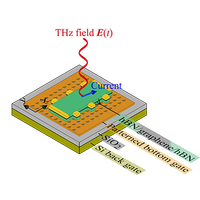
Photocurrents are generated by the ratchet effect – the combined action of a spatially periodic in-plane electrostatic potential and a periodically modulated radiation electric field caused by near-field diffraction. Polarized radiation is converted into a direct current due to the spatial asymmetry of the metamaterial. The ratchet current vector is gate tunable via a global back gate and a patterned gate, which control the lateral asymmetry of the system.

Integer and fractional quantum anomalous Hall effects in pentalayer graphene

Ming Xie and Sankar Das Sarma

Phys. Rev. B 109, L241115 (2024) - Published 21 June, 2024

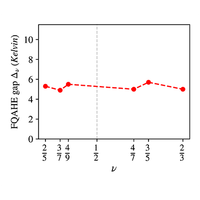
Through a critical analysis of transport data from the recently discovered fractional quantum anomalous Hall effect (FQAHE) in rhombohedral pentalayer graphene on hBN, the authors identify here significant discrepancies between the FQAHE and the conventional fractional quantum Hall effect in Landau levels. Most notably, the excitation gap remains nearly constant for all observed fractions, starkly contrasting with the “v”-shaped linear dependence on |ν-1/2| predicted by the composite fermion model. This uncovers an intriguing puzzle regarding the nature of the FQAHE states.

Many-body quantum heat engines based on free fermion systems

Vincenzo Roberto Arezzo, Davide Rossini, and Giulia Piccitto

Phys. Rev. B 109, 224309 (2024) - Published 20 June, 2024

Devising and constructing quantum many-body heat engines is a key challenge of quantum thermodynamics. Most of the research in this field assumes the strokes to be ideal transformations. Here, the authors study the performance of realistic Otto engines with finite-time duration, whose working substance is made of free-fermion systems. They provide analytic expressions for the work and the power delivered through imperfect adiabatic and isochoric strokes. These findings are applied to the case study of an Ising-like quantum Otto cycle.

Synthesis and superconductivity in (La,Ca)H10 under high pressure

Su Chen, Jianning Guo, Yulong Wang, Xinyue Wu, Wuhao Chen, Xiaoli Huang, and Tian Cui

Phys. Rev. B 109, 224510 (2024) - Published 20 June, 2024

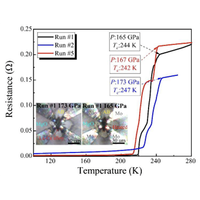
The discovery of binary lanthanum hydrides provides a platform for exploring ternary hydrides with excellent properties. Here, the authors synthesize two lanthanum-calcium hydrides with superconducting critical temperature (Tc) of 247 and 230 K, respectively. The results show that Ca doping has a negligible effect on the Tc of LaH10, but affects the stability of the structure, suggesting that Ca may not be an ideal dopant. This study will help the future search for room-temperature superconductors in more diverse hydride materials.

Optical probing of the carrier-mediated coupling of the spin of two Co atoms in a quantum dot

L. Besombes, J. Kobak, and W. Pacuski

Phys. Rev. B 109, 235302 (2024) - Published 20 June, 2024

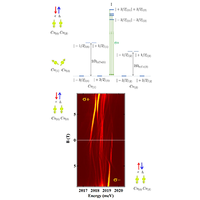
A direct band gap semiconductor quantum dot enables a spin-photon interface with embedded carriers or magnetic impurities, a key element in the establishment of quantum information networks. Spins of magnetic atoms carrying an orbital moment can also be interfaced with phonons and could be used to couple sound, spin, and light at the quantum level. The authors show here that injecting carriers into a quantum dot can induce correlation between two spins of distant magnetic atoms. Resonant optical access to the spin state of the two correlated atoms is conditioned by their position in the dot and by the local configuration of the strain.

Hyperdeterminants and composite fermion states in fractional Chern insulators

Xiaodong Hu, Di Xiao, and Ying Ran

Phys. Rev. B 109, 245125 (2024) - Published 20 June, 2024

Writing down wavefunctions for fractional quantum Hall states was a milestone of condensed matter physics. Here, the authors achieve this goal for the newly discovered fractional quantum anomalous Hall effect (FQAHE), by developing a projective construction for composite fermion (CF) states, and revealing hyperdeterminants as a general structure for electronic wavefunctions. This construction is able to capture the microscopics, and is used to compute many observables in FCI states that are hard to do via traditional methods, including CF dispersion and the magnetoroton spectrum.

Magnetic structure and magnetoelectric effect in the centrosymmetric antiferromagnet Cu2(MoO4)(SeO3)

Pharit Piyawongwatthana, Kazuhiro Nawa, Stuart Calder, Daisuke Okuyama, Hung-Cheng Wu, and Taku J. Sato

Phys. Rev. B 109, 224420 (2024) - Published 17 June, 2024

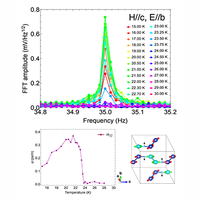
To understand the diverse physics of a quantum magnet, a detailed comprehension of its magnetic properties, particularly the ordered magnetic structure, is essential. This paper demonstrates how sensitive magnetoelectric measurements, realized by detecting SQUID readout phase-locked to the ac electric field excitation, help determine magnetic symmetry. The authors combine neutron diffraction techniques and sensitive magnetoelectric measurements, specifically by measuring the magnetoelectric tensor components, to confirm the crystal’s magnetic symmetry. This approach provides valuable insights into magnetic symmetry and multiferroic phenomena.

Single-photon emitters in WSe2: Critical role of phonons on excitation schemes and indistinguishability

Luca Vannucci, José Ferreira Neto, Claudia Piccinini, Athanasios Paralikis, Niels Gregersen, and Battulga Munkhbat

Phys. Rev. B 109, 245304 (2024) - Published 17 June, 2024

Quantum emitters in few-layer WSe2 hold promise for scalable quantum computation. However, a significant challenge is to prepare the emitter in a specific excited state “on-demand”. Here, the authors demonstrate that the emitter-phonon coupling has a crucial influence on the state preparation fidelity, because such a coupling is orders of magnitude stronger in WSe2 compared to other platforms. While excitation with resonant laser pulses is found to be significantly damped by phonons, alternative strategies based on detuned pulses allow for fast and reliable state preparation.

Longitudinal (curvature) couplings of an N-level qudit to a superconducting resonator at the adiabatic limit and beyond

Rusko Ruskov and Charles Tahan

Phys. Rev. B 109, 245303 (2024) - Published 14 June, 2024

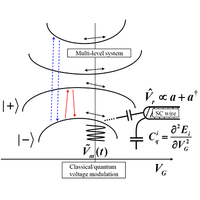
Understanding the coupling of superconducting (SC) wires to solid state qubits is vital to the design of quantum computers. To date, there has not been a complete theory applicable to all parameter regimes, from the traditional dispersive regime of circuit QED to the resonance regime to the far-off resonance situation in the adiabatic regime. This work presents that theory in the context of modulated longitudinal coupling, which promises to enhance the readout and coupling speed and fidelity through a resonator of solid-state qubit operations.

Gravitational wave analogs in spin nematics and cold atoms

Leilee Chojnacki, Rico Pohle, Han Yan, Yutaka Akagi, and Nic Shannon

Phys. Rev. B 109, L220407 (2024) - Published 14 June, 2024

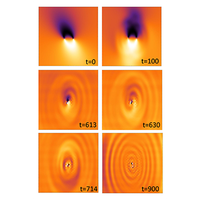
Gravitational waves, detectable in experiments such as LIGO, are challenging to reproduce. For this reason, it is important to identify analogs in other systems that can be studied on the “lab bench”. Here, the authors show how the Goldstone modes of spin nematic phases, found in magnets and cold atoms, are massless, spin-2 bosons in one-to-one correspondence with the gravitational waves in flat spacetime. Using simulations, the authors further illustrate a procedure for the generation and observation of such waves in a 23Na spinor condensate.

High-field/high-frequency electron spin resonances of Fe-doped β−Ga2O3 by terahertz generalized ellipsometry: Monoclinic symmetry effects

Steffen Richter, Sean Knight, Oscar Bulancea-Lindvall, Sai Mu, Philipp Kühne, Megan Stokey, Alexander Ruder, Viktor Rindert, Viktor Ivády, Igor A. Abrikosov, Chris G. Van de Walle, Mathias Schubert, and Vanya Darakchieva

Phys. Rev. B 109, 214106 (2024) - Published 13 June, 2024

High-spin systems with reduced crystal symmetry reveal strongly anisotropic magnetic resonance. Identification of defect-related species requires us to disentangle effects such as anisotropic Zeeman or zero-field splitting, which can be very challenging using traditional magnetic resonance. Here, the authors propose and demonstrate a new cavity-free method for measuring electron paramagnetic resonance at high magnetic fields using frequency-tunable terahertz ellipsometry. Spin Hamiltonian parameters are obtained for the iron defect in monoclinic Ga2O3, and compared with results from advanced theory calculations.

Polaronic mechanism of Nagaoka ferromagnetism in Hubbard models

Rhine Samajdar and R. N. Bhatt

Phys. Rev. B 109, 235128 (2024) - Published 13 June, 2024

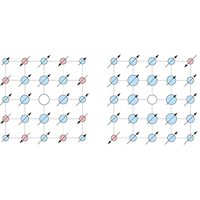
The Hubbard model, a key descriptor of strongly interacting electronic systems, typically features antiferromagnetic spin alignment. However, in certain idealized limits, the celebrated Nagaoka theorem predicts a ferromagnetic ground state. Here, the authors demonstrate how itinerant ferromagnetism arises in a host of real experimental systems without the infeasible constraints required by the Nagaoka theorem. In this universal mechanism, an individual dopant surrounds itself with a ferromagnetically aligned spin bubble, with the local polarons from multiple such dopants combining to create global ferromagnetic order.

High conductivity from cross-band electron pairing in flat-band systems

Maxim Trushin, Liangtao Peng, Gargee Sharma, Giovanni Vignale, and Shaffique Adam

Phys. Rev. B 109, 245118 (2024) - Published 13 June, 2024
A Fermi liquid of electrons is known to be unstable towards a superconducting state even with weak electron pairing. Here, the authors demonstrate theoretically that the Fermi liquid is also unstable to a frozen-like state that is enabled by electron pairing across the band touching point in a flat-band system. Like the surface of water covered by ice, this frozen Fermi liquid is hard to disturb making the electron flow immune to impurity scattering.

Sign In to Your Journals Account

Filter

Section

Filter

Article Lookup

Enter a citation