Highlights

Spin fluctuations in the ultranodal superconducting state of Fe(Se,S)

Yifu Cao, Chandan Setty, Andreas Kreisel, Laura Fanfarillo, and P. J. Hirschfeld

Phys. Rev. B 110, L020503 (2024) - Published 11 July, 2024

An ultranodal superconducting state exhibits very unusual physical properties since it has a strongly enhanced low-energy density of states compared to a nodal state. The iron-based superconductor FeSe1−xSx has been proposed as a realization of such an exotic state. The authors of this work examine here the consequences in this superconductor with Bogoliubov Fermi surfaces and find that the spin-relaxation rate shows an upturn towards low temperature as result of an interplay of correlation effects, multiband nature and the Bogoliubov Fermi surface.

Transport and magnetic properties of Hund's metal CaRuO3 under strain modulation

Zhen Wang, Arjyama Bordoloi, Zhaoqing Ding, Enling Wang, Xiaofeng Wu, Zeguo Lin, Mingyu Yang, Chenxu Liu, Jinglin Zhou, Meng Meng, Fang Yang, Qinghua Zhang, Xiaoran Liu, Sobhit Singh, Huan-hua Wang, and Jiandong Guo

Phys. Rev. B 110, L041403 (2024) - Published 11 July, 2024

The authors investigate here the electronic and magnetic properties of the Hund’s metal CaRuO3 under heteroepitaxial strain using magnetotransport measurements and first-principles density functional theory calculations. The results indicate that moderate strain introduces the Kondo effect, significantly modulating the non-Fermi liquid behavior. At a certain strain threshold, the system transitions from a metal to semiconductor and from a nonmagnetic to possible G-type antiferromagnetic state. The observed phenomena in CaRuO3 are attributed to strain-induced disruption of the balance between itinerant and local Ru 4d electrons.

Theory of quasiparticle-induced errors in driven-dissipative Schrödinger cat qubits

Kirill S. Dubovitskii, Denis M. Basko, Julia S. Meyer, and Manuel Houzet

Phys. Rev. B 110, 024505 (2024) - Published 10 July, 2024

The authors discuss effects of residual Bogolyubov quasiparticles in Schrödinger cat qubits. Such qubits are operated under nonequilibriumconditions including a microwave drive, so that previous studies of quasiparticles in superconducting qubits need to be revised. From a microscopic derivation, the authors express the effect of the quasiparticles as dissipative terms in the master equation for the cat qubit. Finally, conditions under which the quasiparticles give a substantial contribution to the qubit errors are discussed.

Genuine and faux single G centers in carbon-implanted silicon

Alrik Durand, Yoann Baron, Félix Cache, Tobias Herzig, Mario Khoury, Sébastien Pezzagna, Jan Meijer, Jean-Michel Hartmann, Shay Reboh, Marco Abbarchi, Isabelle Robert-Philip, Jean-Michel Gérard, Vincent Jacques, Guillaume Cassabois, and Anaïs Dréau

Phys. Rev. B 110, L020102 (2024) - Published 10 July, 2024

Single color centers recently isolated in carbon-implanted silicon with an emission line at 1.28 μm have so far been identified as a well-known defect called the G center. Here, the authors show that these single defects are split in two distinct families with specific single-photon properties. On one side, are the genuine G centers, and on the opposite, the faux G centers belonging to another defect, labeled the G⋆ center.

Probing magnetism in moiré heterostructures with quantum twisting microscopes

Fabian Pichler, Wilhelm Kadow, Clemens Kuhlenkamp, and Michael Knap

Phys. Rev. B 110, 045116 (2024) - Published 9 July, 2024

Quantum magnetism in two-dimensional semiconductor heterostructures is poorly understood, largely due to a lack of experimental techniques. Recently, the quantum twisting microscope has been introduced to measure the single-particle and collective response of such materials. Here, the authors show the capabilities of the quantum twisting microscope in characterizing magnetism in these materials. This includes both traditional ferromagnetic or antiferromagnetic order and exotic quantum spin liquids, highlighting the potential of quantum twisting microscopes as a powerful tool for improving our understanding of quantum materials.

Chiral spin liquid versus Mott antiferromagnetism in the triangular-lattice Hubbard model

Zheng Zhu

Phys. Rev. B 110, L041113 (2024) - Published 9 July, 2024

Quantum spin liquids emerging near the metal-insulator transition have been a longstanding issue in physics. Here, the author identifies a chiral spin liquid in the half-filled triangular-lattice Hubbard model using state-of-the-art non-Abelian density matrix renormalization. By computing the spin chirality order parameter with unprecedented system sizes and high accuracy, the findings extrapolate toward the two-dimensional limit, impacting theoretical research and experimental realizations in ultracold-atom optical lattices and transition-metal dichalcogenide moiré materials.

Quantum simulation of the spin-12 XYZ model using solid-state spin centers

Troy Losey, Denis R. Candido, Jin Zhang, Y. Meurice, Michael E. Flatté, and S.-W. Tsai

Phys. Rev. B 110, 014413 (2024) - Published 8 July, 2024

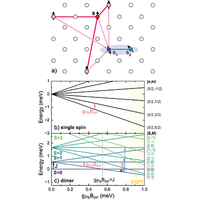
Solid-state systems offer immense untapped potential for simulating exotic quantum phenomena. Here, the authors introduce a solid-state platform for analog quantum simulators utilizing S=1 spin centers implanted in diamond, interacting through magnetic dipole-dipole interactions. This system exhibits a range of quantum phases and critical behaviors that can be controlled by adjusting the magnetic field and the orientation of the spin centers. Notably, it features critical floating phases that terminate at Berezinskii–Kosterlitz–Thouless and Pokrovsky-Talapov transition points.

Altermagnetic superconducting diode effect

Sayan Banerjee and Mathias S. Scheurer

Phys. Rev. B 110, 024503 (2024) - Published 8 July, 2024

Recently, altermagnets and superconducting diodes have been garnering a lot of interest, most notably due to their potential for spintronics applications and fundamental physics questions. Here, the authors combine these active fields and demonstrate that altermagnetism can induce superconducting diode behavior in a conventional superconductor, demonstrating that no net magnetic moment is required for this effect. Possible candidates for experimental realization and key characteristics of the effect are also discussed.

Excitonic response in transition metal dichalcogenide heterostructures from first principles: Impact of stacking, twisting, and interlayer distance

R. Reho, A. R. Botello-Méndez, D. Sangalli, M. J. Verstraete, and Zeila Zanolli

Phys. Rev. B 110, 035118 (2024) - Published 8 July, 2024

The authors use many-body perturbation theory to predict how stacking, twisting, and interlayer distance affect intralayer and interlayer excitons in the transition metal dichalcogenide van der Waals heterostructures MoS₂/WS₂ and MoSe₂/WSe₂. They find “gray” excitons, visible only for in-plane detection. Their analysis into the excitonic lifetimes supports the idea of exciton transport for innovative applications in quantum information systems, next-generation electronic devices, photodetectors light-emitting devices, and lasers. Additionally, the authors observe that the misaligned heterostructure shows a unique state with two intralayer excitons degenerate in energy.

Signatures of electronic ordering in transport in graphene flat bands

Archisman Panigrahi and Leonid Levitov

Phys. Rev. B 110, 035122 (2024) - Published 8 July, 2024

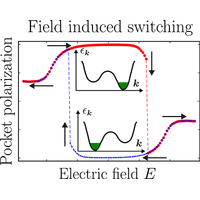
Bilayer graphene’s flat bands host momentum-polarized nematic phases stabilized by exchange interactions, where the carriers spontaneously populate one of several Fermi pockets induced by trigonal warping. Carriers sample k-dependent band mass in the polarized momentum-distribution, making transport coefficients sensitive to pocket polarization, and resulting in the ohmic resistivity decreasing with temperature. Under strong electric field, the momentum-polarized states feature switching between different pockets. This behavior, along with negative dR/dT, may serve as a diagnostic of pocket-polarized order.

Multilocational Majorana zero modes

Yutaro Nagae, Andreas P. Schnyder, Yukio Tanaka, Yasuhiro Asano, and Satoshi Ikegaya

Phys. Rev. B 110, L041110 (2024) - Published 8 July, 2024

A Majorana zero mode is usually localized at one end of one topological superconductor. Here, the authors demonstrate that in a three-terminal Josephson junction, consisting of three one-dimensional topological superconductors, an unconventional Majorana zero mode appears, where the wave function is split into multiple parts located at different ends of different superconductors. Such multilocational Majorana zero modes lead to surprising nonlocal transport phenomena, which manifest the coexistence of the Majorana and the nonlocal nature of the zero mode.

Coexistence of ferromagnetism and antiferromagnetic dimers in topological insulators

Farhan Islam, Deborah Schlagel, Yongbin Lee, Santanu Pakhira, Daniel M. Pajerowski, David C. Johnston, Liqin Ke, David Vaknin, and Robert J. McQueeney

Phys. Rev. B 110, 014408 (2024) - Published 3 July, 2024

The authors investigate here the coexistence of ferromagnetic order and antiferromagnetic dimers in Mn-substituted SnTe, a dilute magnetic topological insulator. Using inelastic neutron scattering and density functional theory, they reveal that the strong antiferromagnetic interaction via Mn-Te-Mn superexchange competes with the long-range ferromagnetic order. These findings provide new insights into the limitations of achieving robust ferromagnetism and quantum anomalous Hall effects in such systems.

Message-passing neural quantum states for the homogeneous electron gas

Gabriel Pescia, Jannes Nys, Jane Kim, Alessandro Lovato, and Giuseppe Carleo

Phys. Rev. B 110, 035108 (2024) - Published 2 July, 2024

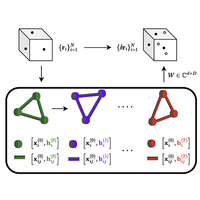
The immense parameter complexity of current neural-network quantum states (NQS) in continuous space renders their application to realistic physical systems impossible. Here, the authors rigorously motivate a many-body coordinate transformation as basis for a variational neural-network Ansatz, implement it via message-passing neural networks, and show a resulting reduction of two orders of magnitude in parameter complexity and convergence speed. With this, the authors open the door for future NQS studies of extended systems in the thermodynamic limit.

Tensor network influence functionals in the continuous-time limit: Connections to quantum embedding, bath discretization, and higher-order time propagation

Gunhee Park (박건희), Nathan Ng, David R. Reichman, and Garnet Kin-Lic Chan

Phys. Rev. B 110, 045104 (2024) - Published 2 July, 2024

The authors describe here two developments of tensor network influence functionals for quantum impurity dynamics within the fermionic setting of the Anderson impurity model. The first provides the correct extension of the method to continuous time by introducing a related mathematical object. The second connects the dynamics described by a compressed tensor network influence functionals to that of a quantum embedding method with a time-dependent effective bath undergoing nonunitary dynamics. Using these concepts, the authors implement higher-order time propagators for the quench dynamics of the Anderson impurity model.

Large quantum nonreciprocity in plasmons dragged by drifting electrons

Debasis Dutta and Amit Agarwal

Phys. Rev. B 110, 045403 (2024) - Published 2 July, 2024

Collective plasmon modes, in the presence of unidirectional drift flow, acquire a nonreciprocal dispersion through the plasmonic Doppler effect. Here, the authors identify an additional quantum correction to the plasmonic Doppler shift arising from the quantum metric of the Bloch wavefunction. The authors show that the quantum plasmonic Doppler shift dominates in moiré systems, such as twisted bilayer graphene, leading to nonreciprocity up to 20%. These findings highlight the potential of moiré systems for innovative nonreciprocal photonic devices with applied direct current.

Dzyaloshinskii-Moriya interaction in Ni/Cu(001)

R. Allenspach, A. Bischof, B. Boehm, U. Drechsler, O. Reich, M. Sousa, S. Tacchi, and G. Carlotti

Phys. Rev. B 110, 014402 (2024) - Published 1 July, 2024

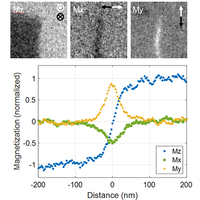
The authors experimentally identify here that domain walls in perpendicularly magnetized Ni films on Cu(001) are chiral – a clear sign of the Dzyaloshinskii-Moriya interaction (DMI) – up to thicknesses of 9 nm, much larger than anticipated for an interfacial effect. A detailed structural investigation shows that strain in the films is inhomogeneous and changes with thickness. The authors conclude that this misfit strain is providing the symmetry breaking interaction, suggesting a further “flavor” of DMI.

Raman signatures of the strong intramolecular and intermolecular charge oscillations in bis(ethylenedithio)-tetrathiafulvalene (BEDT-TTF) κ-phase salts

A. Girlando

Phys. Rev. B 110, 035101 (2024) - Published 1 July, 2024

DFT calculations of Raman intensities for (BEDT-TTF)2+ dimer induces reconsideration of C=C stretching phonons assignment in κ-phase BEDT-TTF salts. A model for interdimer electron-molecular vibration coupling explains crossed-polarized Raman spectra, yielding an estimate of effective dimer Hubbard parameters. Calculations for a charge-ordered (CO) dimer show that Raman in the neglected ~1200 cm−1 spectral region probes the CO pattern in systems undergoing a CO phase transition or fluctuating regime. In ferroelectric κ-(BEDT-TTF)2Hg(SCN)2Cl Raman suggests a (BEDT-TTF)2+0.6(BEDT-TTF)2+0.4 pattern, which is opposite to the currently accepted intradimer CO.

Ring structure in the complex plane: A fingerprint of a non-Hermitian mobility edge

Shan-Zhong Li and Zhi Li

Phys. Rev. B 110, L041102 (2024) - Published 1 July, 2024

The mobility edge, as the critical energy separating the extended and localized states, is an important concept in Anderson localization theory. However, how the mobility edge works in non-Hermitian systems has not yet been revealed. Here, through Avila’s global theory, the authors prove that the non-Hermitian mobility edge will develop into a ring structure in the complex plane. Combined with numerical calculations, it is convincing that the concept of mobility rings is universal in non-Hermitian quasiperiodic systems.

Intertwined magnetism and superconductivity in isolated correlated flat bands

Xuepeng Wang, J. F. Mendez-Valderrama, Johannes S. Hofmann, and Debanjan Chowdhury

Phys. Rev. B 110, L041105 (2024) - Published 1 July, 2024

Here, inspired by the phenomenology of moiré materials, the authors study theoretically the effect of frustrated magnetic interactions in a set of topological bands carrying a finite Chern number, using numerically exact methods. The authors find intertwined insulating magnetism and superconductivity near integer fillings, and a set of continuous quantum phase transitions between them, driven by various microscopic parameters. This study paves the way for studying more realistic models of moiré materials.

Quantum degeneracy in mesoscopic matter: Casimir effect and Bose-Einstein condensation

I. Todoshchenko, M. Kamada, J.-P. Kaikkonen, Y. Liao, A. Savin, E. Kauppinen, E. Sergeicheva, and P. J. Hakonen

Phys. Rev. B 109, 224519 (2024) - Published 28 June, 2024

The pressure of ground-state phonons is an acoustic analog to the famous Casimir pressure of zero-point photons. In the experiments here, the authors demonstrate acoustic Casimir pressure in solid monolayer 3He adsorbed on a nanotube. They also demonstrate pushing out thermal phonons with decreasing temperature or length. Another manifestation of quantum degeneracy is Bose-Einstein condensation of vacancies in dimer solid 3He and supersolidity, i.e., nondissipative mass current. The condensation is detected by an increase of dissipation and decoupling of mass.

Sign In to Your Journals Account

Filter

Section

Filter

Article Lookup

Enter a citation