Highlights

Ultrafast dynamics of photoexcited carriers in tellurium in the vicinity of Weyl nodes

Xiao Zhuo, Qinsheng Wang, Bin Cheng, Delang Liang, Haimen Mu, Lin Li, Zhengfei Wang, Anlian Pan, Changgan Zeng, and Dong Sun

Phys. Rev. B 110, 014311 (2024) - Published 24 July, 2024

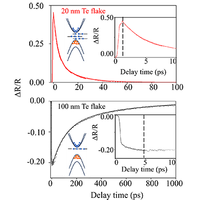
The authors study here the ultrafast dynamics of photoexcited carriers in the Weyl semiconductor Te in the vicinity of Weyl nodes using mid-infrared transient reflection spectroscopy. The relaxation process in a 20-nm Te flake is found to be 10 times faster than a 100-nm flake due to surface defect assisted recombination. The reflection modulation depth of the 20-nm sample is up to 60%, promising great potential for fast optical switch and optical modulator applications in the mid-infrared region.

Detailed dynamics of a moving magnetic skyrmion lattice in MnSi observed using small-angle neutron scattering under an alternating electric current flow

D. Okuyama, M. Bleuel, Q. Ye, J. Krzywon, N. Nagaosa, A. Kikkawa, Y. Taguchi, Y. Tokura, J. D. Reim, Y. Nambu, and T. J. Sato

Phys. Rev. B 110, 014431 (2024) - Published 23 July, 2024

Moving states of magnetic skyrmions under an alternating current (ac) in MnSi are studied here by small-angle neutron scattering (SANS). A drastic difference is found in the SANS patterns measured with the ac frequency below and above the threshold value, indicating that the viscous motion of skyrmion-lattice domains at low frequencies changes to oscillations of individual skyrmions. These oscillations decrease dislocations of the skyrmion lattice by a random organization effect and, with that, the dislocation density of the skyrmion lattice can be controlled by the ac frequency.

Antiferromagnetic superlattices: Anisotropic band and spin-valley valve in buckled two-dimensional materials

Wei-Tao Lu, Tie-Feng Fang, and Qing-Feng Sun

Phys. Rev. B 110, 035426 (2024) - Published 23 July, 2024

Due to it’s chiral nature, graphene with periodic potentials shows transport anisotropy and renormalized velocity perpendicular to the periodic direction. Here, the authors demonstrate that, in antiferromagnetic superlattices, the spin-orbit coupling gives rise to an anomalous anisotropic behavior with velocity renormalization parallel to the periodic direction. The strength and direction of anisotropy can be regulated by adjusting both gate voltage and spin-orbit coupling. These findings have significant implications for engineering anisotropic materials and spin-valley valve.

Effects of nonlocal pseudopotentials on the electrical and thermal transport properties of aluminum: A density functional theory study

Qianrui Liu (刘千锐) and Mohan Chen (陈默涵)

Phys. Rev. B 110, 014207 (2024) - Published 22 July, 2024

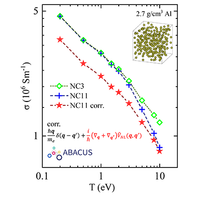
Accurate prediction of electron transport coefficients is crucial for understanding warm dense matter. The authors adopt here the Kubo-Greenwood formula and density functional theory, which are implemented within the ABACUS package, to study the electrical and thermal transport properties of aluminum. They highlight the importance of considering the nonlocal potential correction and validating the frozen core approximation for accurately calculating the electrical and thermal transport properties of electrons in liquid and warm dense aluminum (0.2–10 eV).

Possible Weyl-Luttinger phase transition in pyrochlore iridates revealed by Raman scattering

Predrag Nikolić, Yuanyuan Xu, Takumi Ohtsuki, David C. Elbert, Satoru Nakatsuji, and Natalia Drichko

Phys. Rev. B 110, 035148 (2024) - Published 19 July, 2024

This study is an experimental observation and characterization of the long-anticipated topological phase transition between different types of nodal electronic spectra in pyrochlore iridates. A unique combination of theory and measurements reveal that an incoherent part of the Raman scattering spectrum can unambiguously distinguish between Weyl and quadratic band-touching quasiparticles in correlated topological materials, while extracting Fermi energy relative to the node, Coulomb interaction effects and the amount of disorder. The results provide a critical verification of some prominent expectations that have been driving the research on pyrochlore iridates in recent years.

Extensive long-range entanglement at finite temperatures from a nonequilibrium bias

Shachar Fraenkel and Moshe Goldstein

Phys. Rev. B 110, 035149 (2024) - Published 19 July, 2024

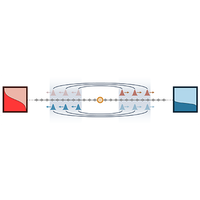
In a quantum many-body system, any two contiguous subsystems are typically either weakly entangled, or this entanglement decays with their separation. Could one observe strong long-range entanglement in a natural setup? Through exact calculations, the authors show here that such a remarkable behavior emerges in a simple 1D wire containing free fermions with a single scatterer, subject to temperature or voltage bias. The phenomenon arises from the coherent nature of the scattering, and may bear implications to more complex nonequilibrium systems.

Theory of intrinsic acoustic plasmons in twisted bilayer graphene

Lorenzo Cavicchi, Iacopo Torre, Pablo Jarillo-Herrero, Frank H. L. Koppens, and Marco Polini

Phys. Rev. B 110, 045431 (2024) - Published 19 July, 2024

The authors theoretically investigate here the intrinsic plasmonic properties of twisted bilayer graphene as a function of twist angle θ, temperature, and filling factor. Using the random phase approximation, the authors consider the layer-pseudospin degree of freedom, spatial nonlocality of the density-density response function, crystalline local field effects, and Hartree self-consistency. Their findings reveal a smooth transition in the plasmonic spectrum of TBG from a strongly coupled regime (θ ≲ 2°) with a weakly dispersive intraband plasmon, to a weakly coupled regime (θ ≳ 2°), where an acoustic plasmon clearly emerges.

Real-space topological invariant for time-quasiperiodic Majorana modes

Zihao Qi, Ilyoun Na, Gil Refael, and Yang Peng

Phys. Rev. B 110, 014309 (2024) - Published 18 July, 2024

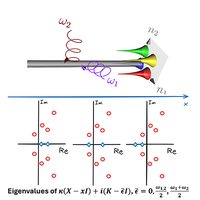
Defining topological invariants in systems with dense energy spectrum is inherently challenging due to the absence of gaps. Here, the authors define a topological invariant for time quasiperiodically driven superconducting systems using spectral localizers, a recently developed tool for probing real-space topology. The invariant is shown to identify the number and quasienergy of quasiperiodic Majorana modes hosted by the system. Drawing insights from non-Hermitian physics, the authors also establish a criterion and provide a physical interpretation for spectral localizers, thereby widening their applicability.

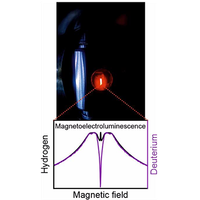
Low-temperature magnetoelectroluminescence of organic light-emitting diodes: Separating excitonic effects from carrier-pair singlet-triplet mixing

F. Braun, T. Scharff, S. Bange, W. Jiang, T. A. Darwish, P. L. Burn, V. V. Mkhitaryan, and J. M. Lupton

Phys. Rev. B 110, 014204 (2024) - Published 17 July, 2024

OLED-based displays are now ubiquitous, and yet the very way positive and negative charges interact with each other to generate excitons and the overall fate of these species in the process of light emission still holds several mysteries. By investigating the operation of OLEDs containing protonated or deuterated organic semiconductors at low temperatures and moderate magnetic fields, the authors reveal here a nonmonotonic dependence of OLED light intensity on magnetic field, which is magnetoelectroluminescence. This enables distinction of interactions between carriers and molecular excitations.

Large-deviation analysis of rare resonances for the many-body localization transition

Giulio Biroli, Alexander K. Hartmann, and Marco Tarzia

Phys. Rev. B 110, 014205 (2024) - Published 17 July, 2024

The authors explore here the many-body localization (MBL) transition through a novel approach based on an analogy with directed polymers in random media. This study reveals how rare long-range resonances, typically absent in small samples, destabilize the MBL phase in the thermodynamic limit in a broad region of the phase diagram, and shift the transition to much higher disorder levels, offering new insights into quantum avalanches and anomalous transport and relaxation near the transition.

Spin wave dynamics excited by a focused laser pulse in antiferromagnet CrSBr

Huicong Liu and Ka Shen

Phys. Rev. B 110, 024424 (2024) - Published 17 July, 2024

The authors theoretically study here laser-induced magnetization dynamics in van der Waals antiferromagnetic CrSBr films by analyzing the spatiotemporal evolution of the magnetization from thermal and nonthermal mechanisms. For the thermal mechanism, the presence and the symmetry of spatial patterns strongly rely on the nonuniformity of shear stress and the strength of the magnetic field. For the nonthermal one, an isotropic spin-wave propagation appears at zero field and becomes anisotropic at finite magnetic field.

Local geometry and quantum geometric tensor of mixed states

Xu-Yang Hou, Zheng Zhou, Xin Wang, Hao Guo, and Chih-Chun Chien

Phys. Rev. B 110, 035144 (2024) - Published 17 July, 2024

The quantum geometric tensor (QGT) encodes information of the local geometry and topology of quantum states. While the QGT of pure quantum states is well known, its generalization to mixed quantum states requires a full characterization of the underlying geometric structure. Here, the authors derive the gauge-invariant QGT of mixed states based on the mathematically rigorous Uhlmann fiber bundle and highlight the similarities and differences of the local geometries of pure and mixed states.

Electron–K-phonon interaction in twisted bilayer graphene

Chao-Xing Liu, Yulin Chen, Ali Yazdani, and B. Andrei Bernevig

Phys. Rev. B 110, 045133 (2024) - Published 17 July, 2024

The authors develop here an analytical theory to describe the interaction between moiré electrons and K-phonons, which is responsible for the replica flat bands of twisted bilayer graphene observed in experiments. They perform an exhaustive numerical, analytical, and symmetry-based description of phonon-mediated attractive interaction and superconducting pairing channels from the K-phonon, and find the competing singlet gapped inter-Chern-band channel and nematic gapless intra-Chern-band channel. The latter shows a gapless spectrum with nodes, a feature observed in recent experiments.

Photonic cross-noise spectroscopy of Majorana bound states

L. Bittermann, F. Dominguez, and P. Recher

Phys. Rev. B 110, 045429 (2024) - Published 16 July, 2024

Distinguishing Majorana bound states (MBSs) from trivial states remains challenging. Here, the authors propose a new route to probe two fundamental properties of MBSs using optically active quantum dots coupled to MBSs embedded in a pnp setup. The presence of a nonlocal superconducting order parameter enables the emission of two correlated photons, whose polarization-resolved cross-noise provides direct information on the pairing spin texture and the number of MBSs, thus differentiating a trivial scenario from a topological one.

Onsager's regression hypothesis adjusted to quantum systems

Peter Reimann and Christian Eidecker-Dunkel

Phys. Rev. B 110, 014306 (2024) - Published 15 July, 2024

Some 93 years ago, Onsager postulated his so-called regression hypothesis, which relates the time-dependent relaxation of a close-to-equilibrium system to its temporal correlations at thermal equilibrium. As far as quantum systems are concerned, it is long-known that this hypothesis cannot be quantitatively correct. Here, the authors analytically derive a suitably adjusted version of Onsager’s original formula, provide a wide variety of numerical illustrations, and compare it with some pertinent previous works.

Framework for polarized magnetic neutron scattering from nanoparticle assemblies with vortex-type spin textures

Michael P. Adams, Evelyn P. Sinaga, Štefan Liščák, and Andreas Michels

Phys. Rev. B 110, 014420 (2024) - Published 12 July, 2024

The authors derive here analytical expressions for the polarized magnetic neutron scattering cross section and the related pair-distance distribution function arising from dilute nanoparticle assemblies with antisymmetric vortex-type spin structures. Connections between the magnetic correlation coefficients and the field-dependent vortex-axes distribution function are established. The results, which are validated through a comparative analysis with micromagnetic simulations, replace the conventional formulation for the macrospin model and provide a framework for the analysis of experimental neutron data.

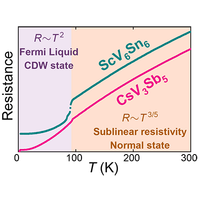
Universal sublinear resistivity in vanadium kagome materials hosting charge density waves

Shirin Mozaffari, William R. Meier, Richa P. Madhogaria, Nikolai Peshcherenko, Seoung-Hun Kang, John W. Villanova, Hasitha W. Suriya Arachchige, Guoxin Zheng, Yuan Zhu, Kuan-Wen Chen, Kaila Jenkins, Dechen Zhang, Aaron Chan, Lu Li, Mina Yoon, Yang Zhang, and David G. Mandrus

Phys. Rev. B 110, 035135 (2024) - Published 12 July, 2024

Kagome metals are exciting platforms to explore electronic instabilities such as charge density waves. The authors study here magnetotransport properties of various kagome compounds, with a focus on the charge density wave metal ScV6Sn6 and explain characteristic features among them. For example, ScV6Sn6 and CsV3Sb5 both have charge density waves, and both exhibit sublinear resistivity above the charge ordering temperature and anomalous Hall-like behavior below this temperature. This contrasts with LuV6Sn6, which lacks charge ordering and lacks these intriguing transport hallmarks.

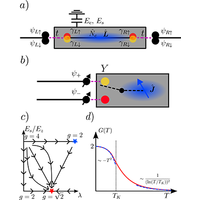
Topological Kondo effect with spinful Majorana fermions

Steffen Bollmann, Jukka I. Väyrynen, and Elio J. König

Phys. Rev. B 110, 035136 (2024) - Published 12 July, 2024

Mesoscopic quantum devices, such as quantum dots in a Coulomb blockade regime, are suitable platforms for emulating strongly correlated many-body effects. Considering a quantum dot with Kramers degenerate doublets of Majorana zero modes in time-reversal invariant triplet superconductors with strong charging energy effects and order parameter fluctuations, the authors suggest here a setup realizing a novel Kondo fixed point. Using Abelian bosonization, they show that the system displays Fermi-liquid and non-Fermi-liquid ground state characteristics alike.

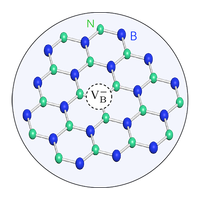
Spin-dependent photodynamics of boron-vacancy centers in hexagonal boron nitride

T. Clua-Provost, Z. Mu, A. Durand, C. Schrader, J. Happacher, J. Bocquel, P. Maletinsky, J. Fraunié, X. Marie, C. Robert, G. Seine, E. Janzen, J. H. Edgar, B. Gil, G. Cassabois, and V. Jacques

Phys. Rev. B 110, 014104 (2024) - Published 11 July, 2024

Here, the authors provide a complete picture of the spin-dependent optical response of the boron vacancy center in hexagonal boron nitride (hBN), which is currently garnering considerable attention for the design of two-dimensional quantum sensing units integrable in van der Waals heterostructures.

Adiabatic approximation and Aharonov-Casher bands in twisted homobilayer transition metal dichalcogenides

Jingtian Shi, Nicolás Morales-Durán, Eslam Khalaf, and A. H. MacDonald

Phys. Rev. B 110, 035130 (2024) - Published 11 July, 2024

In the context of fractional quantum anomalous Hall physics in twisted homobilayer transitional metal dichalcogenides, an emergent magnetic field picture, termed the adiabatic approximation, can be used to explain the emergence of ideal flat bands from the continuum model description. The authors justify here the adiabatic approximation in experimentally relevant parameter regimes and show that the adiabatic approximation is equivalent to an Aharonov-Casher type flat ideal band subject to a periodic potential. Although the potential can significantly modify some properties of the Aharonov-Casher band, its flatness and ideal quantum geometry will be maintained under certain conditions.

Sign In to Your Journals Account

Filter

Section

Filter

Article Lookup

Enter a citation