Highlights

Low-density amorphous ice contains crystalline ice grains

Michael Benedict Davies, Alexander Rosu-Finsen, Christoph G. Salzmann, and Angelos Michaelides

Phys. Rev. B 112, 024203 (2025) - Published 7 July, 2025

The most common form of ice in the Universe is not what it appears to be. In this study, the authors find the low-density amorphous ice (LDA) is not actually truly “amorphous” as its name suggests. They present a unified computational and experimental view that LDA is actually a partially crystalline material, with many small crystallites embedded within an amorphous matrix. LDA plays a cornerstone role in theories on the fundamental nature of liquid water, giving this result considerable interest.

Altermagnetism and beyond in the t−t′−δ Fermi-Hubbard model

Saisai He, Jize Zhao, Hong-Gang Luo, and Shijie Hu

Phys. Rev. B 112, 035108 (2025) - Published 7 July, 2025

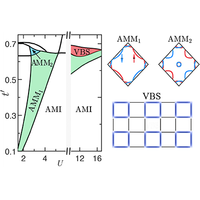
Here, the authors explore altermagnetism in the t-t′-δ Fermi-Hubbard model using mean-field analysis and density-matrix renormalization group (DMRG) simulations, presenting a detailed ground-state phase diagram at half filling that highlights a diverse array of competing magnetic orders. Key findings include two altermagnetic metallic phases, each with distinctive Fermi surface splitting for the two spin species. Plus, a valence-bond solid phase is identified within a narrow intermediate-t′ region, and its stability is rigorously confirmed by DMRG calculations on cylindrical geometries.

Coadjoint-orbit bosonization of a Fermi surface in a weak magnetic field

Mengxing Ye and Yuxuan Wang

Phys. Rev. B 112, 035113 (2025) - Published 7 July, 2025

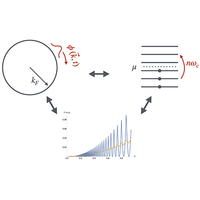
The authors develop here a bosonized theory for thermal and magnetic responses of two-dimensional Fermi surfaces, which has not been adequately addressed in bosonization. The theory describes chiral bosons propagating along the Fermi surface and identifies a topological θ-term crucial for capturing the de Haas–van Alphen effect. In addition, the existence of the magnetic field resolves the issue of UV/IR mixing that plagued earlier efforts to calculate the specific heat. This theory offers a powerful new approach to studying the magnetic response of correlated fermions.

The Aharonov-Casher phase is geometrical and not topological

Igor Kuzmenko, Y. B. Band, and Yshai Avishai

Phys. Rev. B 112, L020501 (2025) - Published 7 July, 2025

In the Aharonov-Casher effect (ACE), a particle with a magnetic moment moves along a closed path and is subject to an electric field. The spin-orbit term in the Hamiltonian affects the wave function phase. Consequently, the ACE is a purely quantum effect. The authors address here the question of whether this geometric phase depends on the details of the closed path (or not, as in the Aharonov-Bohm effect, wherein the phase is topological). By presenting a simple counterexample, it is shown that the phase depends on the details of the path. Therefore, it is not topological.

Noise-induced stabilization of dynamical states with broken time-reversal symmetry

T. F. Q. Larson, L. Zhao, E. G. Arnault, M. T. Wei, A. Seredinski, H. Li, K. Watanabe, T. Taniguchi, F. Amet, and G. Finkelstein

Phys. Rev. B 112, 014502 (2025) - Published 2 July, 2025

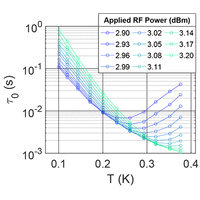
In the inverse Josephson effect, a junction exposed to microwaves develops quantized voltage steps (“Shapiro steps”). Coexisting steps at ±hf/2e lead to spontaneous time-reversal symmetry breaking as the phase ratchets in one direction. The authors study here switching between these states, which varies dramatically with small parameter changes. Unexpectedly, switching slows at high temperatures, showing noise-induced stabilization. This rare experimental observation, involving dynamic states and broken symmetry, highlights opportunities in stochastic physics and quantum thermodynamics using driven-dissipative systems.

Emergent multifractality in power-law decaying eigenstates

Adway Kumar Das, Anandamohan Ghosh, and Ivan M. Khaymovich

Phys. Rev. B 112, 024201 (2025) - Published 1 July, 2025

Eigenstate multifractality is important in many-body localization, superconductivity enhancement, quantum algorithm speed-up, and black hole physics. Unfortunately, multifractality is rare in random matrix models and fragile to uncorrelated disorder. The authors show here that for a wavefunction with a power-law decay R−a where R is the Euclidean distance over a d-dimensional lattice, genuine multifractality is possible for d>2a. The authors demonstrate this proposed principle in a tight-binding model with nearest-neighbor hopping. Based on the energy-coordinate duality with the quantum harmonic oscillator, the authors analytically obtain the spectrum of fractal dimensions and show that the bulk energy eigenstates are multifractal.

Scrutinizing the Mori memory function for diffusion in periodic quantum systems

Scott D. Linz, Jiaozi Wang, Robin Steinigeweg, and Jochen Gemmer

Phys. Rev. B 112, 024301 (2025) - Published 1 July, 2025

Diffusion is an ubiquitous phenomenological transport behavior in condensed matter physics. Attempts at a complete derivation of the diffusion equation from quantum mechanical first principles remain incomplete. It has been conjectured that a finite area under the correlation function of an observable implies ordinary diffusive transport of that observable. This cannot be generally true since, as is shown in this paper, counterexamples can be constructed. Thus, a additional necessary criterion for diffusion is established, ruling out the given counterexample.

Nonrelativistic linear Edelstein effect in helical EuIn2As2

Nayra A. Álvarez Pari, Rodrigo Jaeschke-Ubiergo, Atasi Chakraborty, Libor Šmejkal, and Jairo Sinova

Phys. Rev. B 112, 024404 (2025) - Published 1 July, 2025

A combination of spin symmetry analysis and first-principles calculations of two helical phases reported in EuIn2As2 reveal that magnetic exchange alone induces an odd-parity-wave and g-wave magnetic order in momentum space. These unconventional spin orderings remain mostly unchanged under SOC effects. To further confirm the odd-parity nature of the magnetic order, the authors compute the Edelstein effect, revealing a distinct out-of-plane spin density that dominates over SOC effects. Notably, the magnitude of this anisotropic response differs significantly between the two helical phases.

Orbital-spin locking and its optical signatures in altermagnets

Marc Vila, Veronika Sunko, and Joel E. Moore

Phys. Rev. B 112, L020401 (2025) - Published 1 July, 2025

The authors develop here a microscopic tight-binding model for altermagnets, considering the explicit effects of crystal field, and reveal an inherent interplay between the orbital, sublattice, and spin degrees of freedom. The crystal field couples the orbitals with the sublattices, and these then couple to the spins through the exchange interaction. The model is applied to d-wave altermagnets and the authors predict unique magneto-optical fingerprints resulting from such orbital-spin locking.

Equivalent eigenvalue approach to nonlinear plane waves revealing nonlinearity-induced bandgap opening and closing phenomena

Weijian Jiao

Phys. Rev. B 111, 214308 (2025) - Published 30 June, 2025

To overcome the limitations of regular perturbation methods that fail to correctly capture some unusual nonlinear dispersion behaviors, the author proposes here an equivalent eigenvalue approach that converts the nonlinear wave equation to an equivalent linear eigenvalue problem. This directly gives the nonlinear dispersion relation and modal vectors. The theoretical approach is employed to 1D and 2D phononic crystals with alternating softening and hardening nonlinearities, revealing nonlinearity-induced band-gap opening and closing phenomena and achieving tunable frequency splitting and focusing effects.

Experimental study of Su-Schrieffer-Heeger edge modes for water waves in linear and nonlinear regimes

Adam Anglart, Paweł Obrępalski, Agnès Maurel, Philippe Petitjeans, and Vincent Pagneux

Phys. Rev. B 111, 224311 (2025) - Published 30 June, 2025

The authors experimentally investigate here the Su-Schrieffer-Heeger model in a periodic water wave channel, observing robust topological edge modes consistent with theoretical predictions and 2D simulations. Remarkably, these sloshing modes localized at the boundaries persist under nonlinear excitation, where bifurcations and secondary resonances emerge. This work connects topological physics and fluid mechanics, providing an accessible platform for exploring wave localization, symmetry protection, and nonlinear dynamics in classical wave systems.

Relaxation dynamics of a quantum spin coupled to a topological edge state

Qiyu Liu, Christoph Karrasch, Dante Marvin Kennes, and Roman Rausch

Phys. Rev. B 111, 235153 (2025) - Published 30 June, 2025

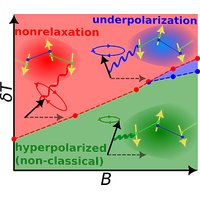
The authors uncover here intriguing differences between quantum and classical impurity spins in one-dimensional topological materials. In the topologically nontrivial case, a quantum spin can be hyperpolarized beyond ground-state values due to Kondo screening effects, which are absent in classical systems. The authors introduce a method to extend the simulation time by a factor of 2.5 beyond the limit of tensor networks. This method learns and predicts the time series using the Sparse Identification of Nonlinear Dynamics (SINDy).

Deconfined quantum criticality in a frustrated Haldane chain with single-ion anisotropy

Niels T. Pronk, Bowy M. La Rivière, and Natalia Chepiga

Phys. Rev. B 111, L220412 (2025) - Published 30 June, 2025

Quantum phase transitions between two phases of matter with incompatible orders that cannot be described by conventional theories is a phenomena known as deconfined quantum criticality. The authors show here that the 1+1D version of this exotic quantum phase transition appears in the frustrated Haldane chain with a single-ion anisotropy, where it separates the Ising antiferromagnet and dimerized phases and belongs to the eight-vertex universality class. At zero anisotropy, this transition is fused with an Ising one into the Wess-Zumino-Witten SU(2)2 critical point.

Charge-order-driven altermagnetism in a bipartite lattice

Dayasindhu Dey, Shivam Choudhary, S. Ramasesha, and Rajamani Raghunathan

Phys. Rev. B 111, 214439 (2025) - Published 27 June, 2025

The authors present here results from mean-field theory calculations of an extended Hubbard model applied to a bipartite square lattice. They show that altermagnetism can be induced by introducing charge-order symmetry, even when the underlying lattice cannot support an altermagnetic phase. This coupling between charge and spin order offers a distinct and tunable route to realize new altermagnets.

X-ray diffraction study of the magnetization plateau above 40 T in the frustrated helimagnet CuGaCr4S8

M. Gen, K. Noda, K. Shimbori, T. Tanaka, D. Bhoi, K. Seki, H. Kobayashi, K. Gautam, M. Akaki, Y. Ishii, Y. H. Matsuda, Y. Kubota, Y. Inubushi, M. Yabashi, Y. Kohama, T. Arima, and A. Ikeda

Phys. Rev. B 111, 214441 (2025) - Published 27 June, 2025

The authors have developed a single-shot powder x-ray diffractometry technique by combining a portable single-turn coil system with an x-ray free-electron laser. Using this method here, they reveal an orthorhombic-to-cubic (or pseudocubic) structural transition associated with the emergence of the 1/2-magnetization plateau phase above 40 T in the breathing pyrochlore helimagnet CuGaCr4S8. This transition indicates the formation of a commensurate 3-up–1-down magnetic structure, likely stabilized by strong spin-lattice coupling.

Geometric effects in the Dyakonov-Shur theory of terahertz photodetection

Riccardo Riolo, Marco Polini, Riccardo Mannella, and Andrea Tomadin

Phys. Rev. B 111, 235150 (2025) - Published 27 June, 2025

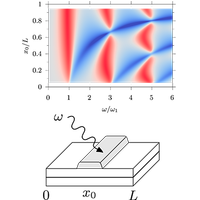
The authors revisit here the Dyakonov–Shur mechanism of terahertz photodetection in field effect transistors. While the classic theory assumes that the gate is as long as the channel, real devices often use shorter or multiple gates. The authors develop a theory accommodating arbitrary gate geometries and positions, revealing that a bad gate placement would degrade the photovoltage, while a good one can significantly enhance detection efficiency. This work bridges theory and device design, offering practical guidance to optimize THz photodetectors for realistic device architectures.

Turning qubit noise into an advantage: Automatic state preparation and long-time dynamics for impurity models on quantum computers

Corentin Bertrand, Pauline Besserve, Michel Ferrero, and Thomas Ayral

Phys. Rev. B 111, 245159 (2025) - Published 27 June, 2025

Strongly correlated materials models are notoriously hard to solve. Even on quantum computers, qubit noise typically limits computation to small systems. The authors propose here a quantum algorithm to instead make noise useful for computing materials properties, by making it behave equivalently to the dissipative environment of electrons in solids. With qubit noise, the authors can obtain long time response functions that would require far more noiseless qubits.

Kibble-Zurek dynamics and statistics of topological defects in chiral superfluid He3 films

Noble Gluscevich and J. A. Sauls

Phys. Rev. B 111, 214526 (2025) - Published 26 June, 2025

Below a critical temperature, 3He films are chiral superfluids in one of two degenerate ground states with angular momentum ±ħ per pair. However, for cool down through the transition at a finite rate, Cooper pair fluctuations evolve into an inhomogeneous ordered phase that hosts domain walls between time-reversed chiral phases as well as quantized vortices. The authors present here numerical simulations based on time-dependent Ginzburg-Landau theory that reveal the nature of the inhomogeneous ordered phase, and the statistics of the vortex populations. The vortex density agrees well with the scaling relation predicted by Kibble and Zurek.

Transparent graphene-superconductor interfaces: Quantum Hall and zero field regimes

Alexey Bondarev, Gu Zhang, and Harold U. Baranger

Phys. Rev. B 111, 235444 (2025) - Published 25 June, 2025

The authors investigate here edge-contacted graphene-superconductor interfaces, revealing that Andreev reflection is significantly stronger than in conventional semiconductor systems due to graphene’s Dirac points. For a transparent interface, the models show maximal electron-hole hybridization, leading in the quantum Hall regime to chiral electron-hole edge modes. The authors demonstrate that these modes form naturally for a broad range of superconductors independent of graphene filling. This work characterizes the spectrum and wavefunction of these unique chiral hybridized states at the superconducting boundary.

Photoassisted shot noise probes multiple charge carriers in quantum Hall edges

Kishore Iyer, F. Ronetti, B. Grémaud, T. Martin, T. Jonckheere, and J. Rech

Phys. Rev. B 111, 245433 (2025) - Published 25 June, 2025
Abelian fractional quantum Hall (FQH) states host anyons with different charges that can tunnel simultaneously across constrictions. Conventional methods often detect only one charge, possibly due to low tunneling amplitudes of others. The authors propose here photoassisted shot noise (PASN), DC shot noise combined with incident photons, as a compelling probe. When the photon frequency matches the anyon’s Josephson frequency, a resonance occurs in PASN, even for weakly tunneling anyons. By sweeping the frequency, all anyon types can distinctly be identified. These resonances remain robust under realistic experimental conditions, offering direct access to the rich topological order of Abelian FQH states.

Sign In to Your Journals Account

Filter

Section

Filter

Article Lookup

Enter a citation