Highlights

First-order preemptive Ising-nematic transition in K5Fe4Ag6Te10

N. Giles-Donovan, Y. Chen, H. Fukui, T. Manjo, D. Ishikawa, A. Q. R. Baron, S. Chi, H. Zhong, S. Cao, Y. Tang, Y. Wang, X. Lu, Y. Song, and R. J. Birgeneau

Phys. Rev. B 111, 224103 (2025) - Published 9 June, 2025

Interplay between multiple degrees of freedom has been shown to be central to the physics of the transition metal pnictides and chalcogenides. Through x-ray and neutron scattering measurements, the authors observe here, for the first time, a strongly first-order Ising-nematic transition followed, upon cooling, by a second-order-like magnetic transition in the magnetic semiconductor K5Fe4Ag6Te10. They attribute this to a quasi-two-dimensional scenario marked by strong out-of-plane spatial anisotropy, where the nematic tricritical point uniquely precedes the magnetic one with decreasing nematic coupling.

Origin of the insulating state in the honeycomb iridate Cu2IrO3

Ying Li, Roger D. Johnson, Yogesh Singh, Radu Coldea, and Roser Valentí

Phys. Rev. B 111, 245122 (2025) - Published 9 June, 2025

It is an unresolved challenge to reconcile the expected metallic state with the experimentally observed insulating behavior in the honeycomb Kitaev candidate Cu2IrO3. The authors unveil here a possible microscopic origin: an instability towards charge ordering of the Ir ions with alternating magnetic Ir4+ and nonmagnetic Ir3+ ions arranged on the honeycomb lattice. The interpenetrating Ir4+ and Cu2+ triangular lattices present a novel type of honeycomb Kitaev lattice, composed of two types of magnetic ion.

Theory for tunnel magnetoresistance oscillation

Keisuke Masuda, Thomas Scheike, Hiroaki Sukegawa, Yusuke Kozuka, Seiji Mitani, and Yoshio Miura

Phys. Rev. B 111, L220406 (2025) - Published 9 June, 2025

The authors propose here a theory for the oscillation of the tunnel magnetoresistance (TMR) ratio as a function of the insulating barrier thickness, called the “TMR oscillation”, which is a long-standing puzzle in spintronics. The essence of this theory is to consider the superposition of wave functions with opposite spins and different Fermi momenta, induced by the exchange interaction at the interface. This theory reproduces all the existing experimental observations on the TMR oscillation.

Electronic structure of AV3Sb5 kagome metals

Keyu Zeng, Zhan Wang, Kun Jiang, and Ziqiang Wang

Phys. Rev. B 111, 235114 (2025) - Published 6 June, 2025

The kagome metals AV3Sb5 (A=K, Rb, Cs) exhibit many intriguing correlated and topological electronic states. Understanding their multiorbital electronic band structure remains a challenge. The authors point out here the unusual and puzzling properties of the density functional theory electronic structure, including the double pure-sublattice-type van Hove singularities, their orbital content, and the geometric shape of the Fermi surface. A generalized multiorbital Slater-Koster approach is developed, which successfully solves these fundamental puzzles and produces a faithful multiorbital tight-binding model description of the electronic structure for kagome metals.

Topological tenfold classification and the entanglement of two qubits

Nadav Orion and Eric Akkermans

Phys. Rev. B 111, 245408 (2025) - Published 6 June, 2025

The authors reveal here a key link between quantum entanglement and the topology of Hilbert spaces in condensed matter physics. Antiunitary symmetries and the Cartan tenfold classification connect the entanglement of evolution operators with the topology of the Hamiltonian. The study is validated with two-qubit systems and establishes groundwork for expanding to complex systems. Direct mapping to quantum graphs enables computation of topological integers.

Magnetism of kagome metals (Fe1−xCox)Sn studied by μSR

Yipeng Cai, Sungwon Yoon, Qi Sheng, Guoqiang Zhao, Eric Francis Seewald, Sanat Ghosh, Julian Ingham, Abhay Narayan Pasupathy, Raquel Queiroz, Hechang Lei, Yaofeng Xie, Pengcheng Dai, Takashi Ito, Ruyi Ke, Robert J. Cava, Sudarshan Sharma, Mathew Pula, Graeme M. Luke, Kenji M. Kojima, and Yasutomo J. Uemura

Phys. Rev. B 111, 214412 (2025) - Published 5 June, 2025

The authors investigate here the magnetic properties of the kagome metals (Fe,Co)Sn. In FeSn, they identify a previously unreported anomaly near 50 K, possibly related to a new phase, in the dynamic relaxation rate 1/T1 from muon spin relaxation and corresponding signatures in ac and dc susceptibility. Upon Co substitution, Fe0.2Co0.8Sn exhibits clear spin-glass behavior with frozen spin dynamics at low temperatures, similar to dilute-alloy spin glasses, in contrast to the persistent spin dynamics often seen in other geometrically frustrated spin systems.

Fabrication of low-loss Josephson parametric devices

K. E. Honasoge, M. Handschuh, W. K. Yam, S. Gandorfer, D. Bazulin, N. Bruckmoser, L. Koch, A. Marx, R. Gross, and K. G. Fedorov

Phys. Rev. B 111, 214508 (2025) - Published 5 June, 2025

The authors demonstrate here superconducting Josephson parametric devices with record-high internal quality factors exceeding 10⁵ at the single-photon level. By combining advanced fabrication steps, including rigorous surface treatment and argon ion milling, these devices achieve exceptionally low intrinsic losses. The latter are verified through microwave scattering and squeezed state microwave measurements. The low-loss superconducting devices are crucial for the quantum-limited amplification, frequency conversion, and generation of high-purity squeezed microwave states.

Quantum dynamics in a spin-12 square lattice J1−J2−δ altermagnet

Yang Liu, Shiqi Shao, Saisai He, Z. Y. Xie, Jia-Wei Mei, Hong-Gang Luo, and Jize Zhao

Phys. Rev. B 111, 245117 (2025) - Published 5 June, 2025

The authors investigate here the spin-½ J-J′-δ Heisenberg model on the square lattice, which is a prototypical model hosting altermagnetism. In addition to the chirality splitting of the magnon modes, the longitudinal modes may also split in the presence of a finite δ. In particular, when δ≳0.5, the lowest longitudinal excitation mode may be lower than the upper magnon branch, demonstrating rich dynamical behaviors in altermagnets.

Singlet/triplet Josephson junction on a substrate

Kaito Yamaki and Yasuhiro Asano

Phys. Rev. B 111, 214505 (2025) - Published 4 June, 2025

The observation of a π-phase shift in a superconducting quantum interference device (SQUID), consisting of a spin-singlet s-wave superconductor and a spin-triplet superconductor, is solid evidence of spin-triplet superconductivity. Here, the authors explain theoretically how spin mismatch is relaxed between a spin-singlet superconductor and a spin-triplet one in a realistic SQUID fabricated on a substrate. The authors also suggest the conditions necessary for such a SQUID to function as a symmetry testing device.

Electromechanical coupled modulation of dislocation nucleation and annihilation in ferroelectric oxide films

Gangchang Li, Haohua Wen, Yi Zhang, He Jiang, Jijie Huang, Wenpeng Zhu, and Yue Zheng

Phys. Rev. B 111, 224101 (2025) - Published 4 June, 2025

To enhance mechanical deformability and avoid performance degradation in ferroelectric oxide films, the authors control here the nucleation and annihilation of dislocations via electromechanical coupled stress. The domain wall positioning, controlled by electric field,is used to seed the dislocations by concentration of electrostatic energy. The incompatible stress induced by the mismatch between fast polarization switching and slow mechanical relaxation, with intrinsic asymmetries of hysteresis loop and polarization constraints, during electric field cycling enables ratcheting motion and eventual escape of dislocations.

Spin chain with non-Hermitian PT-symmetric boundary couplings: Exact solution, dissipative Kondo effect, and phase transitions on the edge

Pradip Kattel, Parameshwar R. Pasnoori, J. H. Pixley, and Natan Andrei

Phys. Rev. B 111, 224407 (2025) - Published 4 June, 2025

The authors construct here an exactly solvable 𝒫𝒯-symmetric non-Hermitian Heisenberg spin chain with complex-conjugate boundary Kondo couplings. They show that the model exhibits three distinct boundary phases: dissipative Kondo screening with unbroken 𝒫𝒯 symmetry, bound-mode phases featuring spontaneously broken 𝒫𝒯 symmetry and complex-conjugate eigenvalues, and an unscreened local-moment phase with a purely real spectrum. Benchmarking with non-Hermitian DMRG demonstrates quantitative agreement with Bethe ansatz, validating tensor-network methods for open quantum systems.

Gapped magnetic ground state in the spin-liquid candidate κ−(BEDT−TTF)2Ag2(CN)3 suggested by magnetic spectroscopy

Sudip Pal, Björn Miksch, Hans-Albrecht Krug von Nidda, Anastasia Bauernfeind, Marc Scheffler, Yukihoro Yoshida, Gunzi Saito, Atsushi Kawamoto, Cécile Mézière, Narcis Avarvari, John A. Schlueter, Andrej Pustogow, and Martin Dressel

Phys. Rev. B 111, L220404 (2025) - Published 4 June, 2025

The putative quantum spin liquid compound κ-(BEDT-TTF)2Ag2(CN)3 is investigated here by multifrequency electron spin resonance spectroscopy. At high temperatures, the spin susceptibility exhibits a weak temperature dependence, which can be described by the Heisenberg model with an antiferromagnetic exchange interaction. At low temperatures, however, the rapid drop of the static spin susceptibility, together with monotonic decrease of the ESR linewidth indicates that strong singlet correlations develop below a pairing energy scale accompanied by a spin gap.

Emergence of aligned nontopological and crossed topological spin helices with unconventional spin-orbit manipulation

Hao Yang, Xue Li, Wei Wang, Ning Hao, Ping Zhang, and Jiyong Fu

Phys. Rev. B 111, L241403 (2025) - Published 4 June, 2025

Multisubband spin-orbit (SO) quantum systems with additional orbital degrees of freedom offer a new avenue for pursuing advanced functionalities in spintronics. The authors unlock here the usual one-way bottleneck in multisubband SO control, uncover the emergence of aligned nontopological and crossed topological (TP) spin helices, and achieve the interconversion between two the distinct phases via in situ electrical means. This opens up new possibilities for exploiting robust, electrically switchable spin phases—whether TP or non-TP—for next-generation spintronic applications.

Majorana sweet spots in three-site Kitaev chains

Rodrigo A. Dourado, Martin Leijnse, and Rubén Seoane Souto

Phys. Rev. B 111, 235409 (2025) - Published 3 June, 2025

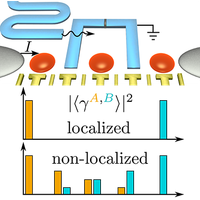
Nonoverlapping Majorana states form the foundation of quantum devices based on topological superconductors. Artificial Kitaev chains have recently emerged as a promising platform for realizing well-localized Majoranas. In their minimal form, these chains host Majoranas at isolated sweet spots in parameter space, with experimental signatures already observed in short chains. Here, the authors investigate three-site Kitaev chains, identifying and classifying distinct sweet spots based on Majorana localization, and outline practical methods to distinguish them—an essential step toward future Majorana-based quantum devices.

Fractionalization as an alternate to charge ordering in electronic insulators

Seth Musser, Meng Cheng, and T. Senthil

Phys. Rev. B 111, 235108 (2025) - Published 2 June, 2025

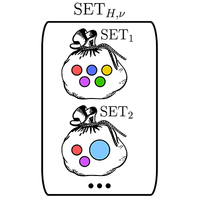
Who ordered anyons? Though exotic, anyons can be required by a system’s fractional symmetry response. For example, in gapped systems with U(1) and unbroken translation symmetry, fractional lattice filling leads to anyons via the LSM constraint. The authors analyze here this setting and, for a given filling, determine the minimal number of required anyons. They prove this minimal topological order is unique and dub it a “quantum charge liquid” (QCL). The authors conclude by discussing the phenomenology of QCLs.

Light-induced anomalous Hall conductivity in the massive three-dimensional Dirac semimetal Co3Sn2S2

Naotaka Yoshikawa, Shun Okumura, Yoshua Hirai, Kazuma Ogawa, Kohei Fujiwara, Junya Ikeda, Akihiro Ozawa, Takashi Koretsune, Ryotaro Arita, Aditi Mitra, Atsushi Tsukazaki, Takashi Oka, and Ryo Shimano

Phys. Rev. B 111, 245104 (2025) - Published 2 June, 2025

The authors investigate here light-induced Dirac-to-Weyl conversion in the massive 3D Dirac semimetal Co3Sn2S2 via ultrafast mid-infrared pump–terahertz probe Faraday rotation spectroscopy. The observed anomalous Hall conductivity under circularly polarized light shows electric field and driving frequency dependence consistent with Floquet-induced Berry curvature from Dirac band splitting. The estimated splitting reaches ~60% of the mass gap, and a theoretical calculation based on Floquet theory quantitatively reproduces the experimental observation, highlighting a promising approach for realizing Floquet-Weyl states in gapped 3D Dirac systems.

Phase-controlled minimal Kitaev chain in multiterminal Josephson junctions

Samuel D. Escribano, Anders Enevold Dahl, Karsten Flensberg, and Yuval Oreg

Phys. Rev. B 111, 195433 (2025) - Published 30 May, 2025

The authors propose here a nanodevice based on a double three-terminal Josephson junction (3TJJ) for the creation and detection of poor man’s Majorana (PMM) modes. Together with identifying the necessary conditions for the emergence of PMM modes, the authors propose a feasible protocol based on conductance measurements to reliably detect these modes. Unlike traditional approaches, the design eliminates the need for magnetic fields, potentially increasing the energy-level resolution and significantly expanding the range of compatible semiconductor materials, such as Ge-based heterostructures.

Shock compression of liquid neon: Experiments, theory, and models

Chad A. McCoy, Seth Root, Kyle R. Cochrane, John H. Carpenter, Jacob T. Banasek, David E. Bliss, and Raymond W. Lemke

Phys. Rev. B 111, 184111 (2025) - Published 29 May, 2025

Comparison between experiment and theory is valuable for furthering understanding of materials at extreme conditions and providing benchmarking to support calculations of novel materials. Using a novel design that maximizes data return for laser-driven shock experiments and previously demonstrated techniques for magnetically accelerated flyer plates, the authors present here the first neon equation of state data above 120 GPa. These results enable improved modeling of other large band-gap materials.

Haldane phase, field-induced magnetic ordering, and Tomonaga-Luttinger liquid behavior in the spin-one chain compound NiC2O4·2NH3

Shuo Li, Zhanlong Wu, Yanhong Wang, Jun Luo, Kefan Du, Xiaoyu Xu, Ze Hu, Ying Chen, Jie Yang, Zhengxin Liu, Rong Yu, Yi Cui, Rui Zhou, Hongcheng Lu, and Weiqiang Yu

Phys. Rev. B 111, 195164 (2025) - Published 29 May, 2025

The Haldane phase is a celebrated example of a magnetic topological phase but rarely reported in materials. The authors show here an NMR study on the spin-1 chain magnet NiC2O4·2NH3, which determines its ground state to be a Haldane phase at zero field. An applied magnetic field induces a magnetic ordering at low temperatures and a Tomonaga-Luttinger liquid phase above the ordering temperature with attractive fermionic interactions.

Screening in Hubbard models with long-range interactions

Florian Gebhard, Kevin Bauerbach, and Örs Legeza

Phys. Rev. B 111, 205146 (2025) - Published 29 May, 2025

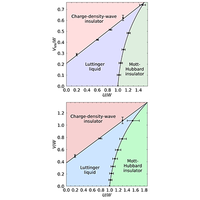
Can the 1/r long-range Coulomb interaction be replaced by a nearest-neighbor interaction? The authors argue here that the screening problem is indeed insignificant: the quantum phase diagrams of a generic Hubbard model with nearest-neighbor interactions (top) and with 1/r long-range interactions (bottom) agree qualitatively. Using constant renormalization factors, the agreement of the phase transition lines can even be made quantitative. Thus, at low energies, Hubbard-type models are seen to provide a significant and viable approach to the interacting electron problem.

Sign In to Your Journals Account

Filter

Section

Filter

Article Lookup

Enter a citation