Highlights

Subballistic operator growth in spin chains with heavy-tailed random fields

Christopher L. Baldwin

Phys. Rev. B 111, 184204 (2025) - Published 28 May, 2025

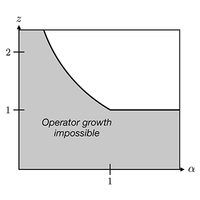
An active area of research in quantum many-body physics is the extent to which quenched disorder impedes “natural” behaviors, such as transport and thermalization. This is an inherently challenging problem to study, and thus it is particularly valuable to have rigorous results that unambiguously prove the absence of transport in certain situations. This work provides such a result: the author uses here the machinery of Lieb-Robinson bounds to prove that ballistic and even diffusive motion is indeed impossible when the distribution of on-site disorder is sufficiently heavy tailed, regardless of most other details of the Hamiltonian.

Impact of phonon lifetimes on the single-photon indistinguishability in quantum emitters based on two-dimensional materials

Alexander Steinhoff, Steffen Wilksen, Ivan Solovev, Christian Schneider, and Christopher Gies

Phys. Rev. B 111, 195431 (2025) - Published 28 May, 2025

Many advanced quantum technologies rely on quantum interference of indistinguishable photons. Quantum emitters made from 2D semiconductors promise cost-efficient single-photon sources. Here, the authors report a fundamental reduction of the achievable photon indistinguishability compared to 3D systems due to increased exciton-phonon coupling efficiency. In particular, coherence is affected by the finite phonon lifetime in the 2D material. Although embedding the quantum emitters in a cavity partly remedies decoherence effects through Purcell enhancement, a maximum achievable indistinguishability of below 50% is predicted.

First-principles studies on superconductivity in quintuple-layer M2X3 (M=Nb, Ta; X=S, Se)

Su-Tao Sun, Jia-Zhen Chen, Y. B. Chen, and Jian Zhou

Phys. Rev. B 111, 174529 (2025) - Published 27 May, 2025

The authors investigate here electron-phonon coupling and superconductivity in newly synthesized two-dimensional quintuple-layer M2X3 (M=Nb, Ta; X= S, Se) using first-principles calculations. These materials are thermally and dynamically stable and exhibit semimetallic properties. The calculated superconducting transition temperatures are approximately 4.4, 2.0, 2.4, and 0.1 K for Nb2S3, Nb2Se3, Ta2S3, and Ta2Se3, respectively, showing an inverse trend with their atomic mass. This study provides a foundation for further theoretical and experimental research on these promising superconductors.

Decomposing electronic structures in twisted multilayers: Bridging spectra and incommensurate wave functions

Citian Wang and Huaqing Huang

Phys. Rev. B 111, 195161 (2025) - Published 27 May, 2025

The authors present here a unified theoretical framework for describing the electronic structure of twisted multilayer systems, including both commensurate and incommensurate cases. Their method decomposes physical observables into layer- and momentum-resolved contributions and introduces a low-rank Hamiltonian approximation for efficient computation. The framework is validated through calculations of spectral function and optical conductivity on moiré and quasicrystalline twisted bilayer graphene.

Ultrafast dynamics of a fermion chain in a terahertz field-driven optical cavity

Mohsen Yarmohammadi, John Sous, Marin Bukov, and Michael H. Kolodrubetz

Phys. Rev. B 111, L201116 (2025) - Published 27 May, 2025

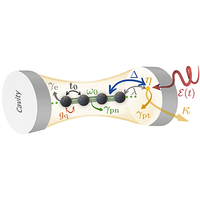
The authors study here ultrafast dynamics in a fermion chain within a terahertz laser-driven optical cavity, coupled to infrared-active phonons. Realistic photon loss in low-quality cavities blocks first-order phase transitions and polariton formation. In high-quality cavities, strong laser drives sustain transitions in the lower phonon-polariton branch. Weak laser fields restore polariton symmetry but fail to trigger transitions. These findings highlight experimentally feasible approaches to manipulate quantum phases and achieve ultrafast switching through cavity-dressed electron-phonon interactions for controlling laser-driven quantum materials.

Understanding and controlling dipolar Moiré pattern in ferroelectric perovskite oxide nanolayers

Sergey Prosandeev, Charles Paillard, and L. Bellaiche

Phys. Rev. B 111, L180103 (2025) - Published 22 May, 2025

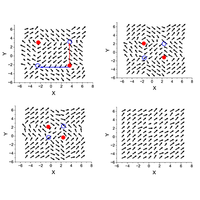
Twisted atomic bilayers of ferroelectrics show unprecedented moiré patterns hosting interpenetrating arrays of dipolar vortices and antivortices. Monte Carlo simulations confirm the critical role of the flexoelectric coupling in mediating the emergence of these polar nanotextures in response to the shear strain gradient created by the twisting angle. The authors reveal here that these polar nano-objects, of high relevance to ultra-dense memory and computing applications, can be manipulated by electric fields, in a manner reminiscent of the Berezinskii-Kosterlitz-Thouless phase transition.

Local signatures of altermagnetism

Jannik Gondolf, Andreas Kreisel, Mercè Roig, Yue Yu, Daniel F. Agterberg, and Brian M. Andersen

Phys. Rev. B 111, 174436 (2025) - Published 21 May, 2025

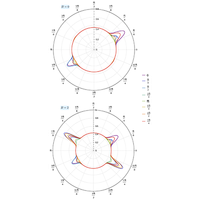
Studying altermagnets experimentally is challenging, especially when their macroscopic properties, such as spin-split bands and spin currents, average out due to domain structures. The authors demonstrate here how nonmagnetic impurities can serve as local probes to reveal the altermagnetic order. Impurities imprint a distinct signature on the local density of states that reflects the underlying momentum structure of the altermagnet, such as d-wave or g-wave. In proximity to a superconductor, these effects can be enhanced at bound states inside the superconducting gap.

Fermionic entanglement in altermagnets

M. Kulig, T. Masłowski, K. A. Kouzakov, V. K. Dugaev, P. Kurashvili, S. Wolski, M. Inglot, C. Jasiukiewicz, and L. Chotorlishvili

Phys. Rev. B 111, 184427 (2025) - Published 21 May, 2025

The momentum-dependent magnetic order is the benchmark of altermagnetic materials. The authors show here that due to a unique feature, altermagnets are suitable for quantum computation and constructing quantum gates controlled via the spin-orbit interaction and external magnetic fields. The authors discuss the scattering process of the itinerant electron on the localized electron that mimics the Hadamard-CNOT gate transformation, converting the initial disentangled state into the entangled state.

Exciton dispersion and effective mass in 2H−WSe2

Zahra Ahmadi Heidari and Martin Knupfer

Phys. Rev. B 111, 205205 (2025) - Published 21 May, 2025

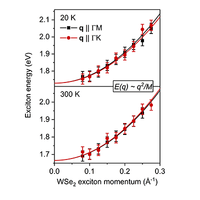
The exciton dispersion and effective mass in bulk WSe2 are determined using electron energy-loss spectroscopy. The effective mass of the direct exciton around the K point of the Brillouin zone is temperature independent and isotropic within the WSe2 layers. The indirect band gap exciton is characterized by a significantly larger effective mass.

Symmetry-induced enhancement of transmission through a disordered system

A. O. Flegontov and D. B. Rogozkin

Phys. Rev. B 111, 174205 (2025) - Published 20 May, 2025

The authors show here that the transmission of a slab-barrier-slab system with mirror-symmetric disorder is controlled by the barrier transparency renormalized due to the interference of waves propagating along symmetrical paths. A transport equation is derived for the correlation function of these waves, which is a tool for taking into account the disorder symmetry breaking and describing the crossover between exact and broken symmetry. The developed formalism enables explaining all aspects of the enhanced transmission effect has found previously in full wave numerical simulations.

Phonon and magnon dynamics across the antiferromagnetic transition in the two-dimensional layered van der Waals material CrSBr

E. Uykur, A. A. Tsirlin, F. Long, M. Wenzel, M. Dressel, K. Mosina, Z. Sofer, M. Helm, and S. Zhou

Phys. Rev. B 111, 174434 (2025) - Published 20 May, 2025

The authors conduct here an infrared spectroscopy study on CrSBr, an air-stable two-dimensional van der Waals magnet. The findings indicate that CrSBr behaves as a polar dielectric crystal, with its reststrahlen bands lying in the THz gap region. The temperature-dependent phonon and magnon dynamics of CrSBr reveal a gradual hardening of the phonon modes and interplay of the b-axis transverse mode with magnetic degrees of freedom. In addition, an optical magnon mode is identified, which provides information on the temperature-dependent magnon population.

Coherently coupled carrier and phonon dynamics in elemental tellurium probed by extreme ultraviolet transient absorption

Jonah R. Adelman, Hugo Laurell, Lauren B. Drescher, Han K. D. Le, Peidong Yang, and Stephen R. Leone

Phys. Rev. B 111, 184315 (2025) - Published 20 May, 2025

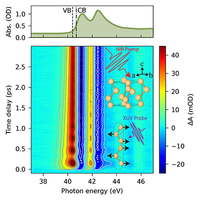
The authors utilize here a broadband extreme ultraviolet probe and a near-infrared pump to study coherent phonon and carrier dynamics in the elemental semiconductor tellurium. By measuring transitions from the tellurium 4d semicore levels to the conduction band, they find that coherent phonon motion couples coherently with the hot holes and electrons. This results in an anticorrelation between the phonon-induced displacement and the electronic temperature. These findings provide insight into the coupling between the lattice and electronic structure in tellurium.

Nature of electronic phase transitions in substituted α−(BEDT−TTF)2I3 studied by generalized ellipsometry

Achyut Tiwari, Bruno Gompf, Savita Priya, Dieter Schweitzer, Reizo Kato, Koichi Hiraki, and Martin Dressel

Phys. Rev. B 111, 195142 (2025) - Published 20 May, 2025

The nature of phase transitions in strongly correlated systems remains a longstanding puzzle. Using advanced Mueller matrix ellipsometry and effective medium approximation, this study uncovers the microscopic behavior of phase transitions in α-(BEDT-TTF)2I3 and its substituted salts. The results confirm the first-order nature of the transition, quantify phase coexistence, and reveal fundamental differences in transition mechanisms. This work offers a powerful approach to exploring the complex nature of phase transitions in correlated electron systems.

Odd-parity ground state in dilute Yu-Shiba-Rusinov dimers and chains

Lisa M. Rütten, Harald Schmid, Werner M. J. van Weerdenburg, Eva Liebhaber, Kai Rossnagel, and Katharina J. Franke

Phys. Rev. B 111, 205424 (2025) - Published 20 May, 2025

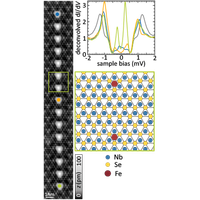
Yu‐Shiba‐Rusinov (YSR) states are key to engineering low‐dimensional correlated systems and topological superconductivity. Competing magnetic interactions and superconductivity yield a rich phase diagram. The authors construct here a YSR dimer with a partially screened YSR channel, where the hybridized states span the Fermi level. By adding atoms sequentially, they track YSR‐band formation, observing the lowest‐energy band crossing the Fermi level. Spatial variations in the spectra along the chain suggest ferromagnetic coupling and highlight the impact of quantum spin effects.

Edge modes and boundary impurities in the anisotropic Heisenberg spin chain

Pradip Kattel, Parameshwar R. Pasnoori, J. H. Pixley, and Natan Andrei

Phys. Rev. B 111, 174430 (2025) - Published 19 May, 2025

The authors study here boundary phenomena in a gapped anisotropic Heisenberg spin chain, revealing a rich phase diagram from the interplay of fractionalized spin-¼ edge modes and a spin-½ impurity. The study uncovers distinct Kondo and bound mode phases, and a novel phase with midgap excitations for nonintegrable antiferromagnetic coupling, providing new insights into impurity screening and Kondo effects. Surprisingly, impurity screening can occur with nonintegrable ferromagnetic coupling, while the impurity remains unscreened for integrable ferromagnetic coupling.

Incommensurate and commensurate antiferromagnetic orders in the kagome compound UV6Sn6

Midori Amano Patino, Stephane Raymond, Georg Knebel, Pierre Le Berre, Stanislav Savvin, Elise Pachoud, Eric Ressouche, James C. Fettinger, Olivier Leynaud, Jacques Pecaut, Peter Klavins, Klaus Hasselbach, Jean-Pascal Brison, Gerard Lapertot, and Valentin Taufour

Phys. Rev. B 111, 174432 (2025) - Published 19 May, 2025

The RT6X6 structural family, featuring kagome networks, provides an exciting platform to investigate the interplay of topology, electron correlations, and magnetism. Incorporating uranium can lead to intricate magnetic and electronic behavior, driven by strong spin-orbit coupling and the dual (localized/delocalized) character of the uranium 5f electrons. The authors discover and investigate here the recent member UV6Sn6, revealing an incommensurate to commensurate antiferromagnetic ordering as well as a superstructure. This compound behaves as a weakly correlated metal, based on resistivity and heat capacity measurements.

Interlayer coupling induced quantum phase transition in quantum anomalous Hall multilayers

Ling-Jie Zhou, Deyi Zhuo, Ruobing Mei, Yi-Fan Zhao, Kaijie Yang, Ruoxi Zhang, Zijie Yan, Han Tay, Moses H. W. Chan, Chao-Xing Liu, and Cui-Zu Chang

Phys. Rev. B 111, L201304 (2025) - Published 19 May, 2025

The ability to control topological quantum phases is central to advancing next-generation electronic technologies. The authors demonstrate here a quantum phase transition between quantum anomalous Hall states, with Chern numbers C=1 and 2, in magnetically doped topological insulator (TI) pentalayers. By systematically varying the thickness of the middle magnetically doped TI spacer layer, the authors identify interlayer coupling as the key driver of the transition. The finding opens new opportunities for chiral edge transport in device applications.

Proof of absence of local conserved quantities in two- and higher-dimensional quantum Ising models

Yuuya Chiba

Phys. Rev. B 111, 195130 (2025) - Published 16 May, 2025

Local conserved quantities are key to understanding macroscopic phenomena, and their absence indicates quantum nonintegrability. Here, the author rigorously proves that quantum Ising models on two- and higher-dimensional lattices possess no local conserved quantities. The proof holds for arbitrary parameter values, thereby theoretically confirming that there are no integrable systems other than the trivial case. Their result establishes this widely studied model as a definitive example of a nonintegrable quantum many-body system.

Superconductivity and electron correlations in the kagome metal LuOs3B2

Yusen Xiao, Qingchen Duan, Tao jia, Yajing Cui, Shaohua Liu, Zhiwei Wen, Liangwen Ji, Ruidan Zhong, Yongliang Chen, and Yong Zhao

Phys. Rev. B 111, 195132 (2025) - Published 16 May, 2025

The authors report superconductivity at Tc~4.63 K in the ideal kagome lattice LuOs3B2. Combined resistivity, magnetization, and specific heat measurements confirm a moderately coupled superconducting state, while enhanced Wilson ratios suggest electron correlations. First-principles calculations reveal the nontrivial topological features, with spin-orbit coupling opening gaps at Dirac points. This work paves the way for exploring superconductivity, electronic correlations, and topological states in this compound.

Thermal cycling: Evidence for a generalized tunneling model and a tool to distinguish noise sources in quantum circuits

Yigal Reiss and Moshe Schechter

Phys. Rev. B 111, L201403 (2025) - Published 16 May, 2025

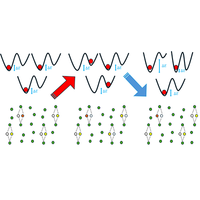
The authors show here that the evolution of the excitation spectrum of tunneling structural two-level systems (TLSs) under thermal cycling reveals the generic existence of two types of TLSs, distinguished by a bimodal coupling to strain. These findings advance the understanding of low-temperature universality in amorphous solids, identify thermal cycling as a unique protocol for isolating TLS noise from other noise sources in quantum devices, and pave the way towards improved stability and scalability of quantum circuits.

Sign In to Your Journals Account

Filter

Section

Filter

Article Lookup

Enter a citation