Highlights

Stability of Majorana modes in Coulomb-disordered topological insulator nanowires

Leonard Kaufhold and Achim Rosch

Phys. Rev. B 112, 045310 (2025) - Published 21 July, 2025

Majorana zero modes are a promising building block for fault-tolerant qubits. Hybrid nanowires made from a topological insulator in contact with a superconductor are a strong candidate to host them. Here, the authors address a key challenge of this platform: charged impurities. Using extensive numerical simulations, they show that due to an efficient screening of Coulomb disorder by the superconductor and the dielectric environment, robust Majorana modes can be obtained for realistic levels of disorder.

Experimental evidence of non-Abelian conservation rule for multiple interacting exceptional points

Qicheng Zhang, Yufei Leng, Cui-Xian Guo, Liangjun Qi, Shuaishuai Tong, Haiping Hu, and Chunyin Qiu

Phys. Rev. B 112, L020101 (2025) - Published 21 July, 2025

The authors experimentally uncover here a surprising twist in non-Hermitian physics: exceptional points—previously thought to annihilate in pairs—can instead coalesce into new, higher-order ones. Using sound waves in a specially designed resonator array, the authors track how multiple exceptional points split, interact and collide. The results validate a non-Abelian conservation rule that governs their collective behavior, including topological charge transmutations. This counterintuitive discovery challenges conventional wisdom and opens exciting new possibilities for controlling sound waves in engineered systems.

Orbital origin of fourfold anisotropic magnetoresistance in Dirac materials

Daifeng Tu, Can Wang, and Jianhui Zhou

Phys. Rev. B 112, L041405 (2025) - Published 21 July, 2025

The underlying mechanisms of ubiquitous fourfold anisotropic magnetoresistance (AMR) in quantum materials remain poorly understood. Here, the authors find the unusual fourfold AMR due to the intrinsic orbital magnetic moment of electrons and quantitatively explain fourfold AMR and its anomalous evolution of AMR with the magnetic fields in both bismuth and MnBi2Te4. This work highlights the significance of the orbital magnetic moment in magneto-transport, inspiring more investigations of intriguing quantum phenomena associated with the orbital magnetism.

Indirect excitons and many-body interactions in InGaAs double quantum wells

Christopher L. Smallwood, Rachel Owen, Matthew W. Day, Takeshi Suzuki, Rohan Singh, Travis M. Autry, Smriti Bhalerao, Fauzia Jabeen, and Steven T. Cundiff

Phys. Rev. B 112, 035305 (2025) - Published 18 July, 2025

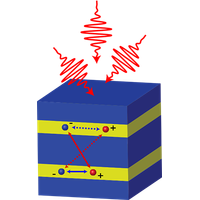
Spatially indirect excitons in semiconductors consist of electrons and holes residing in physically different locations. The particles in turn are characterized by enhanced moiré pattern sensitivity, extended lifetimes, and significant tunability. Here, the authors investigate indirect excitons in InGaAs double quantum wells using optical multidimensional coherent spectroscopy and discovering signatures of many-body effects that have relevance to exciton dephasing mechanisms and the role of free-electron continuum states. The findings will have impact on the design of coherent optical emitters, such as lasers.

Tunable altermagnetism via interchain engineering in parallel-assembled atomic chains

Deping Guo, Canbo Zong, Weihan Zhang, Cong Wang, Junwei Liu, and Wei Ji

Phys. Rev. B 112, L041404 (2025) - Published 18 July, 2025

The authors demonstrate here the existence of altermagnetism in quasi-one-dimensional (Q1D) systems by assembling single-atomic magnetic chains into monolayers. Through systematic symmetry analysis and high-throughput calculations, they identify four altermagnetic prototypes and predict eight dynamically stable Q1D monolayers, including three intrinsic and five extrinsic candidates. The interchain spacing and external electric fields enable tunable spin splitting. These findings establish a highly versatile family of Q1D altermagnets with anisotropic interactions, offering new avenues for designing low-dimensional spintronic devices.

Observation of chiral domain walls in an octupole-ordered antiferromagnet

Moeta Tsukamoto, Zhewen Xu, Tomoya Higo, Kouta Kondou, Kento Sasaki, Mihiro Asakura, Shoya Sakamoto, Pietro Gambardella, Shinji Miwa, YoshiChika Otani, Satoru Nakatsuji, Christian L. Degen, and Kensuke Kobayashi

Phys. Rev. B 112, L020404 (2025) - Published 17 July, 2025

The noncollinear antiferromagnet Mn3Sn is a model material for antiferromagnetic spintronics due to its topological transport phenomena. However, direct observation of its magnetic texture has been challenging due to the extremely small moment from its magnetic octupole order. The authors use here a diamond-based quantum scanning microscope to sensitively map stray magnetic fields at the nanoscale, visualizing the intrinsic magnetic domains and chiral domain walls in a single-crystalline Mn3Sn thin film. The results provide quantitative evidence of octupole ordering and open new directions for exploring chiral antiferromagnetism in spintronic applications.

Superconducting phase in KxFe2−ySe2: Critical role of intact FeSe layers

Shaoshuai Hou, Ang Qian, Xingyang Zhang, Shuo Jiang, Mingshu Tan, Xueying Ma, Wei Ren, Shiyu Wang, Ning Zhang, Junwei Zhang, Xianggang Qiu, Anmin Zhang, and Qingming Zhang

Phys. Rev. B 112, 014512 (2025) - Published 16 July, 2025

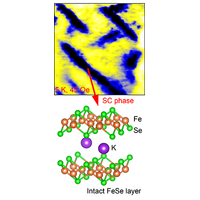
Here, the authors identify and characterize the superconducting phase in KxFe2−ySe2. The Fe:Se ratio in the superconducting phase, along with the number, symmetry, and frequencies of the phonon modes, is consistent with the FeSe layers, indicating that the superconducting phase in the striped regions retains an approximately intact FeSe layer. The findings underscore the critical role of the intact FeSe layer in FeSe-based superconductors and provide new insights into the mechanism of high-temperature superconductivity.

Magnetic-field-tuned randomness in inhomogeneous altermagnets

Anzumaan R. Chakraborty, Jörg Schmalian, and Rafael M. Fernandes

Phys. Rev. B 112, 035146 (2025) - Published 16 July, 2025

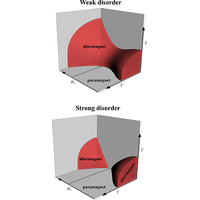
The authors show here that, although altermagnets do not have a finite magnetization, an external magnetic field can be used to tune their phase diagram due to an effect called piezomagnetism, by which applying strain generates a magnetic field and vice versa. They show that two sources of inhomogeneous strain—elastic fluctuations and crystalline disorder—have opposing effects when a magnetic field is applied: the former favors order and the latter favors disorder. This leads to a rich phase diagram and experimental signatures in the shear modulus and in the elastocaloric effect.

Advancing excited-state properties of two-dimensional materials using a dielectric-dependent hybrid functional

Arghya Ghosh, Subrata Jana, Manoar Hossain, Dimple Rani, Szymon Śmiga, and Prasanjit Samal

Phys. Rev. B 112, 045128 (2025) - Published 16 July, 2025

The authors present here a first-principles framework based on dielectric-dependent hybrid functionals to accurately predict band gaps and optical properties of two-dimensional van der Waals materials and their heterostructures. This efficient approach rivals the accuracy of many- body perturbation methods at significantly reduced computational cost. The work lays a robust foundation for advancing theoretical and experimental exploration of excited-state phenomena in novel materials, paving the way for next-generation optoelectronic applications.

Magnetism in the spin-orbit entangled Jeff=12 triangular-lattice quantum magnet Rb3Yb(VO4)2

Lei Wang, Zhengrong Li, Yingjian Chen, Jiaojiao Cao, Zhengcai Xia, Zhenxing Wang, Hiroyuki Nojiri, and Zhongwen Ouyang

Phys. Rev. B 112, 014429 (2025) - Published 15 July, 2025

The authors report here easy-plane magnetic anisotropy and a large crystal field gap in Rb3Yb(VO4)2, a triangular-lattice quantum magnet. High frequency, high field, and wide temperature ESR (HFHFWT-ESR) spectroscopy reveals anisotropic g factors consistent with the crystal symmetry and a well-isolated Jeff = ½ ground state. Combined with magnetic and crystal electric field (CEF) analyses, the results highlight the role of spin-orbit entanglement and magnetic anisotropy in rare-earth systems, establishing this compound as a promising platform for exploring frustrated magnetism and quantum spin liquid (QSL) behavior.

Incipient quantum spin Hall insulator under strong correlations

Peizhi Mai, Jinchao Zhao, and Philip W. Phillips

Phys. Rev. B 112, L041116 (2025) - Published 15 July, 2025

Using determinantal quantum Monte Carlo, the authors show here that magnetic fluctuations overturn mean-field predictions of a Chern insulator in the interacting Kane–Mele model with a sublattice potential. XY antiferromagnetic correlations prevail at low temperature, stabilizing a quantum spin Hall phase across a wide parameter range, consistent with robust quantum spin Hall effects observed in moiré transition metal dichalcogenides at even-integer fillings.

Nonperturbative treatment of a quenched Langevin field theory

Friederike Ihssen, Valerio Pagni, Jamir Marino, Sebastian Diehl, and Nicolò Defenu

Phys. Rev. B 112, 024306 (2025) - Published 11 July, 2025

Developing nonperturbative tools to tackle real-time dynamics in many-body systems remains a central challenge in theoretical physics. This work extends the functional renormalization group to dynamical settings by expanding around time-evolving states, rather than static vacua. Applied to aging dynamics in φ⁴ field theory, the method outperforms the two-loop ε-expansion and meets analytic benchmarks. The approach is readily extendable to quantum critical systems out of equilibrium, offering a powerful new tool for characterizing quantum dynamical scaling.

Textured exciton insulators

Yves H. Kwan, Ziwei Wang, Glenn Wagner, Steven H. Simon, S. A. Parameswaran, and Nick Bultinck

Phys. Rev. B 112, 035129 (2025) - Published 11 July, 2025

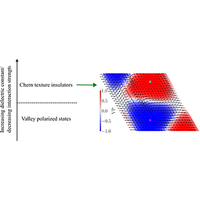
In electronic systems with a spin or valley flavor index, interactions can drive the condensation of flavor excitons, resulting in an excitonic insulator. The authors introduce here textured exciton insulators (TEIs), where the underlying electronic topology forces a momentum-space texture into the excitonic order parameter. This leads to consequences such as a delicate obstruction to atomic localization, and a lower bound on the quantum geometry. The authors demonstrate that one class of TEIs has already been experimentally realized in magic-angle moiré graphene.

Chern-textured exciton insulators with valley spiral order in moiré materials

Ziwei Wang, Yves H. Kwan, Glenn Wagner, Steven H. Simon, Nick Bultinck, and S. A. Parameswaran

Phys. Rev. B 112, 035130 (2025) - Published 11 July, 2025

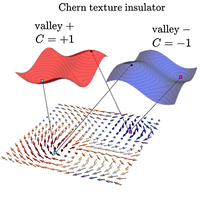
The authors explore here the phase diagrams of moiré materials in search of a new class of insulating states: the Chern texture insulators. These states spontaneously break the symmetry of independent charge conservation in each “valley” (low-energy regions in momentum space). The valley order parameter has a nontrivial texture in momentum space enforced by the underlying electronic band topology. Using detailed Hartree-Fock studies, the authors establish that such states emerge as competitive ground states in several moiré systems.

Anomalies in G and 2D Raman modes of twisted bilayer graphene near the magic angle

Darshit Solanki, Kenji Watanabe, Takashi Taniguchi, A. K. Sood, and Anindya Das

Phys. Rev. B 112, 045412 (2025) - Published 11 July, 2025

This study shows that twist angle controls phonon behaviour in bilayer graphene near the magic angle. Using micro‑Raman spectroscopy on samples with twist angles from 0.3° to 3°, the authors find here that the G mode splits into two bands near 1° due to moiré potential-induced phonon hybridization. The linewidths of the G⁻ and 2D modes broaden at the magic angle, driven by flat band-enhanced electron-phonon coupling. Temperature‑dependent Raman measurements of the ~1° sample reveal a tenfold increase in anharmonicity compared to Bernal bilayer graphene.

Phonon-limited valley lifetimes in single-particle bilayer graphene quantum dots

L. Banszerus, K. Hecker, L. Wang, S. Möller, K. Watanabe, T. Taniguchi, G. Burkard, C. Volk, and C. Stampfer

Phys. Rev. B 112, 035409 (2025) - Published 10 July, 2025

The authors report here on single-particle valley lifetimes of up to several microseconds in a bilayer graphene quantum dot via a pulse-gating technique. An out-of-plane magnetic field dependence reveals electron-phonon coupling as the dominant relaxation mechanism. These findings highlight bilayer graphene as a promising platform for valley-based quantum technology.

Efficient periodic density functional theory calculations of charged molecules and surfaces using Coulomb kernel truncation

Sudarshan Vijay, Martin Schlipf, Henrique Miranda, Ferenc Karsai, Merzuk Kaltak, Martijn Marsman, and Georg Kresse

Phys. Rev. B 112, 045409 (2025) - Published 10 July, 2025

Density functional theory (DFT) calculations of charged molecules and surfaces are critical to applications in electrocatalysis, energy materials, and related fields of materials science. DFT implementations such as the Vienna ab initio Simulation Package (VASP) compute the electrostatic potential under 3D periodic boundary conditions, necessitating charge neutrality. Here, the authors implement 0D and 2D periodic boundary conditions using the Coulomb kernel truncation method to facilitate DFT calculations of charged molecules and surfaces respectively. By combining the Coulomb kernel truncation method with a computationally efficient padding approach, the authors remove nonphysical potentials from vacuum in 0D and 2D systems.

Spin relaxation and transport behavior in d-wave altermagnetic systems

Y. J. Sun, F. Yang, and L. Q. Chen

Phys. Rev. B 112, 024412 (2025) - Published 8 July, 2025

D’yakonov-Perel’ (DP) spin relaxation is often associated with spin-orbit coupling or inhomogeneous magnetization. Here, the authors demonstrate that in altermagnetic systems—lacking both ingredients—a DP-type spin relaxation mechanism persists across both weak and strong scattering regimes. This relaxation is governed by a distinct correlation time originating from spin dephasing, dominated by high-order angular scattering rather than conventional backscattering. These results highlight opportunities for designing spintronic devices where spin transport is tunable via symmetry, disorder, and temperature.

A quantum cellular automaton for every symmetry protected topological phase

Lukasz Fidkowski, Jeongwan Haah, and Matthew B. Hastings

Phys. Rev. B 112, 035123 (2025) - Published 8 July, 2025

Quantum cellular automata (QCA) are unitary operations within a many-body Hilbert space that preserve the notion of locality by mapping local observables to nearby local observables. Every local quantum circuit is a QCA, but the reverse is not true, and it is an interesting open problem to classify the “nontrivial” QCA that do not have local circuit representatives. Here, the authors construct a large class of such QCA from disentanglers of ground states of lattice Hamiltonians, representing interacting bosonic analogs of topological superconductors. The topological properties encoded in their ground states translate into the nontrivial nature of the corresponding QCA. This work proposes a general conjecture that relates the quantum information theoretic problem of classifying QCA to the cobordism classification of invertible many-body quantum phases.

Instability in domain wall dynamics in almost-compensated ferrimagnets

R. V. Ovcharov, B. A. Ivanov, E. G. Galkina, J. Åkerman, and R. S. Khymyn

Phys. Rev. B 112, 014408 (2025) - Published 7 July, 2025

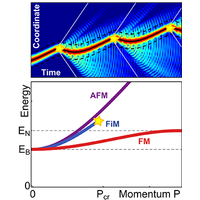
The authors show here that ferrimagnets near the angular-momentum compensation point exhibit a unique “explosive” instability in domain wall dynamics, absent in both ferromagnets and antiferromagnets. Using collective coordinate theory and micromagnetic simulations, they reveal how a driven domain wall, upon reaching the end of its dispersion, enters a highly nonequilibrium state and releases excess energy through a burst of spin waves before stabilizing.

Sign In to Your Journals Account

Filter

Section

Filter

Article Lookup

Enter a citation