Recent Articles

Terahertz optical activity near crystal field transitions of Tm3+ ions in magnetoelectric alumoborates

A. M. Kuzmenko, V. Yu. Ivanov, S. V. Garnov, A. Shuvaev, A. Pimenov, K. N. Boldyrev, I. A. Gudim, and A. A. Mukhin

Phys. Rev. B 113, 024418 (2026) - Published 16 January, 2026

Origin of magnetic anisotropy in monolayer CrI3: Identifying the J−K1−Γ′1−K2−Ak magnetic interaction model

Zhengyu Jiang, Can Huang, Lingzi Jiang, Bingjie Liu, Yanfei Pan, Jiyu Fan, Chunlan Ma, and Yan Zhu

Phys. Rev. B 113, 024419 (2026) - Published 16 January, 2026

Energy density driven ultrafast electronic excitations in a cuprate superconductor

Alessandra Milloch, Francesco Proietto, Naman Agarwal, Laura Foglia, Riccardo Mincigrucci, Genda Gu, Claudio Giannetti, Federico Cilento, Filippo Bencivenga, and Fulvio Parmigiani

Phys. Rev. B 113, 024507 (2026) - Published 16 January, 2026

Strengthened correlations near [110] edges of d-wave superconductors in the t−J model with the Gutzwiller approximation

A. Joki, M. Fogelström, and T. Löfwander

Phys. Rev. B 113, 024508 (2026) - Published 16 January, 2026

Second ac screening step as a probe for the first-order melting transition in layered vortex matter at intermediate temperatures

Gonzalo Rumi, Pablo Pedrazzini, Hernán Pastoriza, Marcin Konczykowski, and Yanina Fasano

Phys. Rev. B 113, 024509 (2026) - Published 16 January, 2026

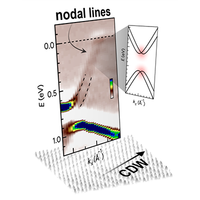
Kramers nodal line in the charge density wave state of YTe3 and the influence of twin domains

Shuvam Sarkar, Joydipto Bhattacharya, Pramod Bhakuni, Divya Jangra, Pampa Sadhukhan, Rajib Batabyal, Christos D. Malliakas, Marco Bianchi, Davide Curcio, Shubhankar Roy, Arnab Pariari, Sajal Barman, Mohammad Balal, Giovanni Di Santo, Luca Petaccia, Duck Young Chung, Yihao Wang, Vasant G. Sathe, Prabhat Mandal, Mercouri G. Kanatzidis, Philip Hofmann, Aparna Chakrabarti, and Sudipta Roy Barman

Phys. Rev. B 113, 035129 (2026) - Published 16 January, 2026

The authors demonstrate here that incommensurate charge density wave (CDW) driven inversion symmetry breaking in YTe3 produces a Kramers nodal line across the Brillouin zone. ARPES agrees well with ab initio band structure calculations when the CDW twin domains are considered. Consequently, symmetry-protected CDW shadow-band crossings with bilayer-split main bands that reach the Fermi level are identified. The noncentrosymmetric crystal structure has been established by x-ray crystallography and Raman spectroscopy. These findings establish YTe3 as a CDW-driven topological nodal-line metal.

Impurity-induced nonunitary criticality

Heng-Hsi Li, Kuang-Hung Chou, Xueda Wen, and Po-Yao Chang

Phys. Rev. B 113, 035130 (2026) - Published 16 January, 2026

Local electronic structure and magnetic properties of double-perovskite LaCo0.5Ni0.5O3 and PrCo0.5Ni0.5O3

Meng-Jie Huang, Peter Nagel, Andreas Eich, Michael Merz, and Stefan Schuppler

Phys. Rev. B 113, 035131 (2026) - Published 16 January, 2026

Correlated phases in rhombohedral multilayer graphene

Arsen Herasymchuk, Sergei G. Sharapov, Oleg V. Yazyev, and Yaroslav Zhumagulov

Phys. Rev. B 113, 035132 (2026) - Published 16 January, 2026

Anomalous thermal conductivity enhancement in twisted graphene/h-BN bilayers revealed by neuroevolution potential driven atomistic simulations

Ningxi Yang, Jincheng Yue, Xinkai Sun, Yinong Liu, Meng An, and Shiqian Hu

Phys. Rev. B 113, 035426 (2026) - Published 16 January, 2026

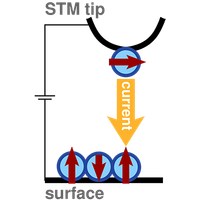
Inelastic electron tunneling through adatoms and molecular nanomagnets

Daria Kývala and Jindřich Kolorenč

Phys. Rev. B 113, 035427 (2026) - Published 16 January, 2026

The authors discuss here a theory of the inelastic electron tunneling spectra of a magnetic nanosystem (an atom or a molecule) adsorbed on a solid surface measured in a scanning tunneling microscope. They study scenarios when the tunneling electrons sequentially interact with several magnetic centers or when the magnetic centers are made out of heavy atoms with a strong spin-orbit coupling. They discuss how the exchange interaction between the nanosystem and the tunneling electrons changes when orbital moments enter the picture.

Hierarchy of timescales in a disordered spin-12 XX ladder

Kadir Çeven, Lukas Peinemann, and Fabian Heidrich-Meisner

Phys. Rev. B 113, 045126 (2026) - Published 16 January, 2026

Electronic structure of the kagome compound CaTi3Bi4 using high-field torque magnetometry and density functional theory

Kyryl Shtefiienko, Cole Phillips, Brenden R. Ortiz, David E. Graf, and Keshav Shrestha

Phys. Rev. B 113, 045128 (2026) - Published 16 January, 2026

Strong-coupling theory of bilayer plasmon excitations

Hiroyuki Yamase, Luciano Zinni, Matías Bejas, and Andrés Greco

Phys. Rev. B 113, 045129 (2026) - Published 16 January, 2026

Topological order and fractons from gauging exponential symmetries

Guilherme Delfino, Claudio Chamon, and Yizhi You

Phys. Rev. B 113, 045130 (2026) - Published 16 January, 2026

Proximate spin-liquid behavior in the double trillium lattice antiferromagnet K2Co2(SO4)3

A. Magar, K. Somesh, M. P. Saravanan, J. Sichelschmidt, Y. Skourski, M. T. F. Telling, V. A. Ginga, A. A. Tsirlin, and R. Nath

Phys. Rev. B 113, L020409 (2026) - Published 16 January, 2026

Spin-ferroelasticity coupling in nonrelativistic spin-split antiferromagnetic-ferroelastic systems

Fenfen Huang, Shenda He, Ke-Qiu Chen, and Li-Ming Tang

Phys. Rev. B 113, L020411 (2026) - Published 16 January, 2026

Traditional classifications of ferroelastic species cannot distinguish a special ferroelastic species in which the [C2||A] symmetry-related orientation states show a spin-flipping feature in the energy bands. By extending the ferroelastic classification scheme to nonrelativistic magnetic systems, this work introduces a spin point group based classification framework that captures ferroelastic species with spin-ferroelastic coupling. In this framework, clear symmetry criteria and all such kinds of ferroelastic species are provided. These results establish a theoretical framework that will guide our understanding and identification of systems with spin-ferroelastic coupling.

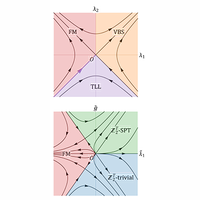
Emergent symmetry and phase transitions on the domain wall of Z2 topological orders

Hong-Hao Song, Chen Peng, Rui-Zhen Huang, and Long Zhang

Phys. Rev. B 113, L041114 (2026) - Published 16 January, 2026

Domain walls of topological phases can host exotic gapless states. In the one-dimensional domain wall between Z2 topological orders, the authors uncover here a hidden nonsymmorphic symmetry that enforces an emergent SU(2)1 conformal field theory. The domain wall is either gapless or symmetry breaking, reflecting its symmetry anomaly inherited from the bulk topological order. The gapless domain wall corresponds to a topological quantum critical point, fulfilling a holographic construction of topological phase transitions.

Sliding-induced polarization stability in two-dimensional materials: Tolerance to local symmetry breaking resulting from point defects and ambient molecules

Yue Wang, Yinghe Zhao, Fengyu Li, Xiuyun Zhang, Yan Xing, and Xianghong Niu

Phys. Rev. B 113, 014108 (2026) - Published 15 January, 2026

Structural reassessment and emergent altermagnetism of MnS under high pressure

Jing Zhao, Shuaiqi Ma, Bingqing Cao, Wenfeng Wu, Guo Chen, Pei Wang, and Xianlong Wang

Phys. Rev. B 113, 014109 (2026) - Published 15 January, 2026

Sign In to Your Journals Account

Filter

Recent Issues

Vol. 114, Iss. 24
15 October 2026
Vol. 114, Iss. 23
15 October 2026
Vol. 114, Iss. 22
15 October 2026
Vol. 114, Iss. 21
1 October 2026
Category
Article Type
Section

Filter

Article Lookup

Enter a citation