Recent Articles

Emergent impedance due to antiferromagnetic domain wall dynamics

Yuta Yamane, Jotaro J. Nakane, Yasufumi Araki, and Jun'ichi Ieda

Phys. Rev. B 113, 014421 (2026) - Published 15 January, 2026

Influence of donor and acceptor doping on conductivity in potassium niobate

Lorenzo Villa, Till Frömling, and Karsten Albe

Phys. Rev. B 113, 024110 (2026) - Published 15 January, 2026

Floquet operator dynamics and orthogonal polynomials on the unit circle

Hsiu-Chung Yeh and Aditi Mitra

Phys. Rev. B 113, 024308 (2026) - Published 15 January, 2026

Magnetic measurements of Ni and Gd in the vicinity of the transition temperature

Harish Chandr Chauhan, Umesh C. Roy, Shovan Dan, A. Thamizhavel, and Pintu Das

Phys. Rev. B 113, 024414 (2026) - Published 15 January, 2026

Origin of the anisotropic multiglass state in highly disordered Fe2TiO5

Hao-Hang Xu, Jian Liu, L. L. Tao, Xian-Jie Wang, and Yu Sui

Phys. Rev. B 113, 024415 (2026) - Published 15 January, 2026

Effective field theory for the superfluid vortex lattice from coset construction

Aleksander Głódkowski, Sergej Moroz, Francisco Peña-Benítez, and Piotr Surówka

Phys. Rev. B 113, 024506 (2026) - Published 15 January, 2026

Proximity-induced spin-orbit torque in graphene on a trigonal CrSBr monolayer

Maedeh Rassekh and Martin Gmitra

Phys. Rev. B 113, 035126 (2026) - Published 15 January, 2026

SU(4) Kondo lattice in semiconductor moiré materials

Sunghoon Kim

Phys. Rev. B 113, 035127 (2026) - Published 15 January, 2026

Low-energy gap associated with the anomalous symmetry-breaking states in CsV3Sb5

Jiahao Hao, Xiaoxiang Zhou, Yongkai Li, Zhe Liu, Bingke Ji, Yaomin Dai, Zhiwei Wang, and Hai-Hu Wen

Phys. Rev. B 113, 035128 (2026) - Published 15 January, 2026

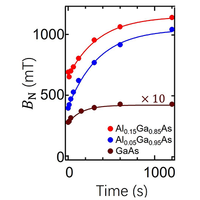
Slowly generated large nuclear field in bulk n-AlGaAs

A. Shen, J. Chen, R. Kaji, S. Yamamoto, H. Sasakura, T. Uemura, and S. Adachi

Phys. Rev. B 113, 035202 (2026) - Published 15 January, 2026

Here, the authors observe a large nuclear magnetic field, BN, exceeding 1 T in bulk n-AlGaAs via time-resolved Kerr rotation measurements, exhibiting a two-stage formation process comprising a rapid initial rise followed by gradual saturation. Based on experimental results, the authors modify the nuclear spin polarization formation model and conclude that a large BN forms due to the combined effects of increased electron localization sites from aluminum incorporation and the suppression of quadrupole-induced relaxation by a strong magnetic field.

Zero-energy resonances in ultracold hydrogen sticking to liquid helium films of finite thickness

R. Karakhanyan, V. Nesvizhevsky, A. Semakin, S. Vasiliev, and A. Voronin

Phys. Rev. B 113, 035421 (2026) - Published 15 January, 2026

Decoherence of Majorana zero modes mediated by gapless fermions

Sauri Bhattacharyya, Marco Grilli, and Bernard van Heck

Phys. Rev. B 113, 035422 (2026) - Published 15 January, 2026

Enhanced excitonic absorption and emergence of interlayer bright excitons via sliding ferroelectricity in Janus bilayer MoSeTe

Huiwen Luo, Gencai Guo, Jiansheng Tang, Siwei Luo, Chaoyu He, Zongyu Huang, Limin Liu, and Jianxin Zhong

Phys. Rev. B 113, 035423 (2026) - Published 15 January, 2026

Photophysics of cavity-coupled quantum emitters in hexagonal boron nitride

Sancia M. Tauro, Jennifer Brumley, Antonio Cobarrubia, C. Abinash Bhuyan, Diego V. Lundquist, Eli Janzen, Boris Kiefer, James H. Edgar, and Sanjay K. Behura

Phys. Rev. B 113, 035424 (2026) - Published 15 January, 2026

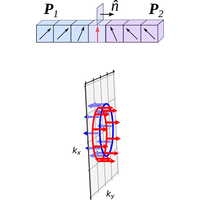
Spin-orbit coupling and the Edelstein effect at conducting ferroelectric domain walls

Maryam A. Nasir and W. A. Atkinson

Phys. Rev. B 113, 035425 (2026) - Published 15 January, 2026

Charged domain walls in ferroelectrics form conducting two-dimensional channels that can be manipulated by electric fields. They exhibit memristive behaviour that makes them, for example, candidate synapses in neuromorphic computers. Here, the authors show that for common domain-wall geometries, electrons are subject to nontrivial spin-orbit coupling. This result suggests that reconfigurable electronics with spin-orbitronic functionality may be possible.

Low-energy photoexcitations inside the Mott gap in doped Hubbard and t−J ladders

Sumal Chandra, Kazuya Shinjo, Shigetoshi Sota, Seiji Yunoki, and Takami Tohyama

Phys. Rev. B 113, 045127 (2026) - Published 15 January, 2026

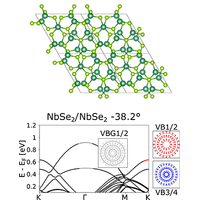
Radial Rashba spin-orbit fields in commensurate twisted transition metal dichalcogenide bilayers

Thomas Naimer, Paulo E. Faria Junior, Klaus Zollner, and Jaroslav Fabian

Phys. Rev. B 113, 045417 (2026) - Published 15 January, 2026

The authors investigate here predominantly radial in-plane spin-orbit fields in twisted transition metal dichalcogenide homobilayers (NbSe2, WSe2, and WTe2) using density functional theory. Their results highlight the crucial role of the 180o in-plane rotational symmetry as well as the dependence on the size of the commensurate supercell. By fitting the first-principles results to an effective model Hamiltonian, the authors extract the twist-angle-dependent and supercell-size-dependent parameters governing the spin-orbit fields, relevant for designing spintronic devices.

Coherent suppression and dephasing-induced reentrance of high harmonics in gapped Dirac materials

Wolfgang Hogger, Alexander Riedel, Debadrito Roy, Angelika Knothe, Cosimo Gorini, Juan-Diego Urbina, and Klaus Richter

Phys. Rev. B 113, 045418 (2026) - Published 15 January, 2026

Delocalization induced by enhanced hyperuniformity in one-dimensional disordered systems

Junmo Jeon, Harukuni Ikeda, and Shiro Sakai

Phys. Rev. B 113, L020201 (2026) - Published 15 January, 2026

Here, the authors show that the conventional belief that any disorder localizes all states in one dimension breaks down when long-wavelength fluctuations in the potential are suppressed, a property known as hyperuniformity. In tight-binding chains, strongly hyperuniform disorder interpolates between random and periodic potentials, inducing a sharp delocalization transition and the emergence of mobility edges. This shows that reducing large-scale irregularities alone is sufficient to control localization and transport in low-dimensional systems.

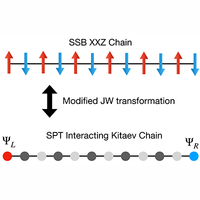
On the topological dual of the XXZ spin chain

Yicheng Tang, Pradip Kattel, and Natan Andrei

Phys. Rev. B 113, L041113 (2026) - Published 15 January, 2026

The spin-½ XXZ chain is a well-known model of spontaneous symmetry breaking. But what is its symmetry-protected topological dual model? Here, the authors construct a fermionic dual model via a modified Jordan–Wigner transformation. They demonstrate its topological nature through exact string order parameters, entanglement spectrum degeneracies, and Majorana zero modes, and identify the duals of the ferromagnetic and antiferromagnetic phases as two distinct topological phases separated by an extended Luttinger liquid regime.

Sign In to Your Journals Account

Filter

Recent Issues

Vol. 114, Iss. 24
15 October 2026
Vol. 114, Iss. 23
15 October 2026
Vol. 114, Iss. 22
15 October 2026
Vol. 114, Iss. 21
1 October 2026
Category
Article Type
Section

Filter

Article Lookup

Enter a citation