Recent Articles

First-principles study of bulk stacking, Jeff picture, magnetic Hamiltonian, g factors, and structural distortions of α−RuCl3

Seung-Ju Hong, Tae Yun Kim, and Cheol-Hwan Park

Phys. Rev. B 113, 014427 (2026) - Published 20 January, 2026

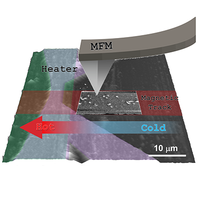
Temperature gradient driven motion of magnetic domains in a magnetic metal multilayer by entropic forces

Lin Huang, Joseph Barker, Lekshmi Kailas, Soumyarup Hait, Simon D. Connell, Gavin Burnell, and Christopher H. Marrows

Phys. Rev. B 113, 014428 (2026) - Published 20 January, 2026

Magnetic domains are known to move along temperature gradients, a phenomenon for which various mechanisms have been theoretically proposed. Here, the authors use magnetic force microscopy to quantify this effect for domains in a perpendicularly magnetized Pt/CoB/Ir multilayer. The domains always moved towards the hottest region. Quantitative evaluation of the different effects that could drive the domain motion shows that entropic forces, related to the spatial gradient in domain wall energy, dominate over spin-transfer torques arising from currents of magnons or electron spins.

Enhancement of antiferromagnetic spin fluctuations in UTe2 under pressure revealed by Te125 NMR

Devi Vijayan Ambika, Qing-Ping Ding, Corey E. Frank, Sheng Ran, Nicholas P. Butch, and Yuji Furukawa

Phys. Rev. B 113, 014510 (2026) - Published 20 January, 2026

The authors investigate here the evolution of magnetic fluctuations under pressure in the spin-triplet superconductor candidate UTe2, which exhibits multiple superconducting phases. These are SC1, in which the critical temperature (Tc) decreases with increasing pressure, and SC2, where Tc increases. Using 125Te NMR measurements, the authors reveal the coexistence of antiferromagnetic and ferromagnetic fluctuations, where the antiferromagnetic fluctuations are enhanced as pressure increases. This suggests a significant role for antiferromagnetic fluctuations in stabilizing the SC2 phase, while rendering the SC1 phase less favorable.

Orbital-selective superconductivity via interlayer electron transfer in the two-dimensional borides MB3 (M=Mg, Al, Ca, Sc, Y, and In)

Shengnan Bi, Fei Li, and Guochun Yang

Phys. Rev. B 113, 014511 (2026) - Published 20 January, 2026

Lithium impurity induced electron doping and in-gap states in high-Tc monolayer Fe(Te,Se)/SrTiO3

Yuxuan Lei, Zhuoran Xu, Guanyang He, Yu Li, Yi Liu, Yanzhao Liu, and Jian Wang

Phys. Rev. B 113, 014512 (2026) - Published 20 January, 2026

Disorder-driven exceptional points and concurrent topological phase transitions in non-Hermitian systems

Xiaoyu Cheng, Tiantao Qu, Yaqing Yang, Jun Chen, and Lei Zhang

Phys. Rev. B 113, 024203 (2026) - Published 20 January, 2026

Strong anharmonicity guided weaker temperature-dependent phonon transport in CaSnS3: A chalcogen perovskite showing wavelike phonon tunneling

Surbhi Ramawat, Sumit Kukreti, and Ambesh Dixit

Phys. Rev. B 113, 024310 (2026) - Published 20 January, 2026

Altermagnetism and its induced higher-order topology on the Lieb lattice

Xingmin Huo, Xingchuan Zhu, Chang-An Li, Shiping Feng, Song-Bo Zhang, Shengyuan A. Yang, and Huaiming Guo

Phys. Rev. B 113, 024420 (2026) - Published 20 January, 2026

6H-perovskite dimer lattice with antiferromagnetic interactions: Ba3Zn1−xCaxRu2O9

Daniel M. Pajerowski, David A. Dahlbom, Alexander I. Kolesnikov, Daniel Phelan, and Yu Li

Phys. Rev. B 113, 024421 (2026) - Published 20 January, 2026

Impact of absorption due to zero-field splitting on loss in dielectrics: A case study in sapphire

Mark E. Turiansky and Chris G. Van de Walle

Phys. Rev. B 113, 024422 (2026) - Published 20 January, 2026

Insulating ground state and 2−k magnetic structure of candidate Weyl hydrogen-atom K2Mn3(AsO4)3

Keith M. Taddei, Kulugammana G. S. Ranmohotti, Duminda S. Liurukara, Alex Martinson, Stuart Calder, German Samolyuk, Nabaraj Pokhrel, Daniel Phelan, and David Parker

Phys. Rev. B 113, 024423 (2026) - Published 20 January, 2026

Doping the S=1 antiferromagnet in one dimension

J. Prokopczyk and J. Herbrych

Phys. Rev. B 113, 024424 (2026) - Published 20 January, 2026

Phase fluctuation dominated superconducting transition in ultrathin Pb films: Berezinskii-Kosterlitz-Thouless transition and incoherent Cooper pairs

Jinyue Wang, Ningning Liu, Xutao Wang, Yanfu Wu, Wenxuan Zhang, Zhan Wang, Dandan Guan, Shiyong Wang, Hao Zheng, Yaoyi Li, Hao Yang, Xiaoxue Liu, Liang Liu, Canhua Liu, and Jinfeng Jia

Phys. Rev. B 113, 024510 (2026) - Published 20 January, 2026

Single crystal growth, structural and physical properties, and absence of a charge density wave in Ti0.85Fe6Ge6

Dechao Cheng, Nour Maraytta, Xiuhua Chen, Xizhi Li, Xueliang Wu, Xiangxiang Jing, Yong Hu, Youpin Gong, Mingquan He, Yisheng Chai, Xiaoyuan Zhou, Pengfei Jiang, Yilin Wang, Michael Merz, and Aifeng Wang

Phys. Rev. B 113, 035133 (2026) - Published 20 January, 2026

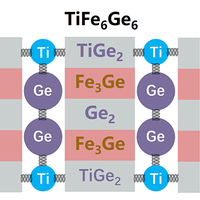
The rattling chain model predicts CDWs in AM6X6 kagome compounds with small filler atoms A embedded in a large M6X6 host. Here, despite Ti being a small filler atom, the authors observe no CDW in Ti0.85Fe6Ge6. Through in-depth electronic structure and bonding analyses, they demonstrate that, in addition to ionic radius, the bonding characteristics of the filler atom are crucial for CDW formation. This finding significantly extends the rattling chain model, offering new insights into the factors driving CDW transitions in kagome materials.

Filling-dependent phase competition in the interacting kagome flat band system

Kevin J. U. Vidarte, R. Cardias, and A. Latgé

Phys. Rev. B 113, 035134 (2026) - Published 20 January, 2026

Engineering Hubbard models with gated two-dimensional moiré systems

Yiqi Yang (杨怡奇), Yubo Yang (杨煜波), Miguel A. Morales, and Shiwei Zhang

Phys. Rev. B 113, 035135 (2026) - Published 20 January, 2026

Anisotropic fine structure of ion tracks in single crystals

Jessica Wierbik, Hendrik Heimes, Christian Notthoff, Shankar Dutt, Taleb Alwadi, Alexander Kiy, Pablo Mota-Santiago, Nigel Kirby, and Patrick Kluth

Phys. Rev. B 113, 035306 (2026) - Published 20 January, 2026

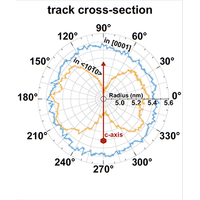
Swift heavy ion irradiation of single crystals leaves permanent damage trails, ion tracks, that are commonly assumed to be cylindrical with circular cross-sections, a view shaped by the limited resolution of conventional characterization techniques. Using an advanced small-angle x-ray scattering method here, long-standing resolution limits are overcome and ion track cross-sections are probed with Angstrom-level precision. It is found that tracks in single crystals are not circular, but instead exhibit strong, orientation-dependent anisotropy, challenging the conventional assumption and revealing how crystal structure governs track formation.

Valley splitting in Si/SiGe heterostructures from first principles

Lukas Cvitkovich, Tancredi Salamone, Christoph Wilhelmer, Biel Martinez, Tibor Grasser, and Yann-Michel Niquet

Phys. Rev. B 113, 035307 (2026) - Published 20 January, 2026

Impact of ambient molecular contamination on scanning tunneling microscopy and spectroscopy of layered materials

György Kálvin, Péter Vancsó, Márton Szendrő, Konrád Kandrai, András Pálinkás, Levente Tapasztó, and Péter Nemes-Incze

Phys. Rev. B 113, 035428 (2026) - Published 20 January, 2026

Phases and criticality of the triangular lattice SU(N) Hofstadter-Hubbard model

Lu Zhang, Rongning Liu, and Xue-Yang Song

Phys. Rev. B 113, 045131 (2026) - Published 20 January, 2026

Sign In to Your Journals Account

Filter

Recent Issues

Vol. 114, Iss. 24
15 October 2026
Vol. 114, Iss. 23
15 October 2026
Vol. 114, Iss. 22
15 October 2026
Vol. 114, Iss. 21
1 October 2026
Category
Article Type
Section

Filter

Article Lookup

Enter a citation