Browse Issues:

HIGHLIGHTED ARTICLES

Isotropic superconductivity in the room-temperature superconductor LaSc2H24

Zefang Wang, Wenbo Zhao, Yuan Ma, Hanyu Liu, and Yanming Ma

Phys. Rev. B 114, 154501 (2026) - Published 1 September, 2026

Why does LaSc2H24 exhibit superior superconductivity compared with LaH10? Here, the authors indicate that scandium not only distorts the hydrogen cage structure but also creates MgB2-like Sc-H states at the Fermi level. This synergy enhances electron-phonon coupling, unifies strongly coupled H-H states with widely distributed Sc-H states on the Fermi surface, and leads to isotropic single-gap superconductivity with a higher superconductivity.

Dynamically robust counterdiabatic topological pumping

Joshua Chiel, Christopher Jarzynski, and Jay Sau

Phys. Rev. B 114, 154308 (2026) - Published 28 September, 2026

Adiabatic Thouless pumps, which undergird the modern theory of polarization, have potential applications ranging from metrology to adiabatic quantum computing. Here, the authors use counterdiabatic driving to develop a non-adiabatic Thouless pump. Their analytic model, which has only nearest neighbor interactions, exhibits exactly quantized charge pumping that is topologically robust to disorder, and dynamically robust to disorder and noise for sufficiently rapid driving – which the authors demonstrate is a universal feature of counterdiabatic driving. The fast, robust and locally tuned pump cycle also models qubit flips, which may have quantum hardware applications.

Optical spin precession

Abanoub Mikhail, Maxim Mazanov, Ilya Deiry, Mingzhao Song, Ivan Iorsh, and Andrey Bogdanov

Phys. Rev. B 114, 154403 (2026) - Published 2 September, 2026

Here, optical spin angular momentum is extended to nonmonochromatic electromagnetic fields, revealing that specific polychromatic configurations exhibit photonic spin precession governed by a Landau–Lifshitz-like equation. A precessing magnetic dipole realizes source-driven spin dynamics in the near field, while bichromatic two-wave interference additionally produces nutation. A generalized spin-continuity equation shows how sources act on optical spin through torque, establishing a direct link between photonic spin and magnetization dynamics.

Hidden ferromagnetism of centrosymmetric antiferromagnets

I. V. Solovyev

Phys. Rev. B 114, 154413 (2026) - Published 15 September, 2026

Here, the author develops a symmetry-based framework that explains why certain centrosymmetric antiferromagnets exhibit a finite anomalous Hall effect (AHE). In antipolarly distorted lattices, the inversional invariance of the spin-orbit interaction allows the antiferromagnetic state to be represented as an effective ferromagnet in a suitable local frame. This mapping naturally accounts for the emergence of conventionally ferromagnetic responses, including the AHE and a net orbital magnetization, even though the spin magnetization vanishes globally.

Topological spin multipolization and linear magnetoelectric coupling in two-dimensional antiferromagnets

Jörn W. F. Venderbos, Paola Gentile, and Carmine Ortix

Phys. Rev. B 114, 154414 (2026) - Published 15 September, 2026

Three-dimensional topological insulators exhibit a quantized magnetoelectric effect described by a topological response theory. This hallmark result raises the question whether magnetoelectric effects rooted in topology also exist in lower dimensions. Here, the authors demonstrate a (quasi)topological magnetoelectric response in a class of two-dimensional antiferromagnets, which is similarly described by a topological response theory, yet in two dimensions and derived from topological semimetals. As such, the effect ultimately originates from a crystalline topological index in one dimension.

Magnetic diffuse scattering study of the dipolar-octupolar pyrochlore Ce2Sn2O7

B. Yuan, M. Powell, X. Liu, J. Ni, E. M. Smith, R. Schäfer, R. Moessner, F. Ye, J. Dudemaine, A. D. Bianchi, J. W. Kolis, and B. D. Gaulin

Phys. Rev. B 114, 154419 (2026) - Published 21 September, 2026

The Ce pyrochlores Ce2X2O7 (X = Sn, Hf, Zr) have attracted considerable attention as quantum spin ice candidates. So far, much of their physics has been interpreted by considering only nearest-neighbor interactions. Here, diffuse neutron scattering reveals that these interactions fail to explain the dominant spin correlations in Ce2Sn2O7 even qualitatively. Instead, the observed correlations strikingly resemble those of classical dipolar spin ice, demonstrating a nonperturbative role of further-neighbor interactions in controlling its low-energy physics.

Spin-orbit-entangled Jeff=12 magnetism and unconventional spin freezing in the bond-disordered pyrochlore antiferromagnet NaCdCo2F7

A. Kancko, H. Sakai, J. Herrero-Martín, A. Berlie, M. Uhlarz, T. Haidamak, M. Klicpera, Y. Tokunaga, and R. H. Colman

Phys. Rev. B 114, 154431 (2026) - Published 30 September, 2026

Here, the authors establish NaCdCo2F7 as a spin-orbit-entangled Jeff=½ pyrochlore antiferromagnet, in which strong geometric frustration and bond disorder drive unconventional spin freezing. Despite the onset of a frozen state, persistent spin dynamics survive to the lowest temperatures, revealing an unusual coexistence of static and dynamic magnetism in a highly frustrated, disordered system.

Tunable superconductivity and spin density waves in La3Ni2O7/LaAlO3 thin films

Yu-Han Cao, Kai-Yue Jiang, Hong-Yan Lu, Da Wang, and Qiang-Hua Wang

Phys. Rev. B 114, 154511 (2026) - Published 21 September, 2026

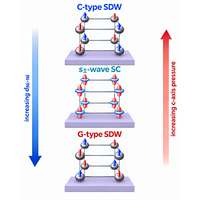
The authors combine first-principles calculations and singular-mode functional renormalization group to show that the interlayer Ni–Ni distance controls competing orders in La3Ni2O7/LaAlO3 thin films. With increasing distance, the ground state evolves from a C-type spin density wave through s±-wave superconductivity, with pairing dominated by Ni 3d3z2−r2 orbitals, to a G-type spin density wave. The predicted pressure suppression of Tc provides a test of itinerant versus local-moment descriptions.

Josephson scanning tunneling spectroscopy in superconducting phases coexisting with pair-, charge-, and spin-density waves

Alyson Laskowski, Jasmin Bedow, and Dirk K. Morr

Phys. Rev. B 114, 154513 (2026) - Published 24 September, 2026

Here, the authors demonstrate that the recent observations in scanning tunneling spectroscopy (STS) experiments of spatial oscillations in the energy position of the superconducting coherence peaks in the cuprate, transition metal dichalcogenide, iron-based, and heavy-fermion superconductors can arise from the possible presence of pair-, charge- or spin-density-wave phases. In all of these phases, the spatial oscillations of the superconducting order parameter can be imaged via the critical Josephson current, measured in Josephson STS experiments.

ARTICLES

Structure, structural phase transitions, mechanical properties, defects

Structure of niobium to 365 GPa using ultrafast x-ray diffraction and shock compression

C. M. Lonsdale et al.

Phys. Rev. B 114, 154101 (2026) - Published 1 September, 2026

Computational prediction of strontium carbide phases under compression

Nikita Rybin, Evgeny Moerman, Pranab Gain, Artem R. Oganov, and Alexander Shapeev

Phys. Rev. B 114, 154102 (2026) - Published 4 September, 2026

Pulse-driven reconfiguration of fractional polar topology in Zr-substituted barium titanate

Florian Mayer

Phys. Rev. B 114, 154103 (2026) - Published 8 September, 2026

Shear piezoelectricity and polarization rotation in two-dimensional ferroelectric bismuthene

Xin Jiang, Churen Gui, Qingde Sun, Zhenqing Li, Chaoyu He, Weibing Zhang, and Jianxin Zhong

Phys. Rev. B 114, 154104 (2026) - Published 9 September, 2026

Finite-temperature bulk moduli from an equation-of-state-based Grüneisen function

Çetin Kılıç

Phys. Rev. B 114, 154105 (2026) - Published 8 September, 2026

Hidden ferroelectric chiral ground state of silver niobate

Safari Amisi, Fernando Gómez-Ortiz, Eric Bousquet, and Philippe Ghosez

Phys. Rev. B 114, 154106 (2026) - Published 10 September, 2026

Topological braiding states of elastic waves in transformable mechanical metamaterials

Zi-Jiang Yang and Yi-Ze Wang

Phys. Rev. B 114, 154107 (2026) - Published 15 September, 2026

Pressure-tuned successive structural distortions and magnetic phase transitions in EuAg4As2

Jin Jiang, Xuliang Chen, Shuyang Wang, Chao An, Yongji Shi, Yong Nie, Xiangde Zhu, Wei Ning, Lili Zhang, Yonghui Zhou, and Zhaorong Yang

Phys. Rev. B 114, 154108 (2026) - Published 18 September, 2026

Tunable microwave surface lattice resonances in plasma cylinder arrays

Nie Chen, Ying Wang, Chengxun Yuan, and Zhongxiang Zhou

Phys. Rev. B 114, 154109 (2026) - Published 28 September, 2026

Inhomogeneous, disordered, and partially ordered systems

Hidden unbounded potential and reentrant multifractalization in a generalized Su-Schrieffer-Heeger model

Yun-Yan Chen, Jia-Ming Zhang, and Zhi Li

Phys. Rev. B 114, 154201 (2026) - Published 2 September, 2026

Ab initio and embedded-atom-model simulation analysis of collective dynamics in liquid Fe at experimental high pressures

Taras Demchuk, Anatoly B. Belonoshko, and Taras Bryk

Phys. Rev. B 114, 154202 (2026) - Published 3 September, 2026

Semiclassical thermoelectric transport in the disordered Dirac electron system Ag2Te

Kentaro Kuga, Keisuke Hirata, Daiki Goto, Ryogo Ishihara, Masaharu Matsunami, and Tsunehiro Takeuchi

Phys. Rev. B 114, 154203 (2026) - Published 4 September, 2026

Thermal conductivity in amorphous strontium titanate

Siu Ting Tai and Yue Chen

Phys. Rev. B 114, 154204 (2026) - Published 21 September, 2026

Lévy Sachdev-Ye-Kitaev model

Budhaditya Bhattacharjee, William E. Salazar, Dario Rosa, and Alexei Andreanov

Phys. Rev. B 114, 154205 (2026) - Published 22 September, 2026

Quantum information scrambling in strongly disordered Rydberg spin systems

Maximilian Müllenbach, Sebastian Geier, Adrian Braemer, Eduard J. Braun, Titus Franz, Gerhard Zürn, Matthias Weidemüller, and Martin Gärttner

Phys. Rev. B 114, 154206 (2026) - Published 23 September, 2026

Analytical quantification of strongly disordered discrete time crystals

Yang-Ren Liu and Biao Huang

Phys. Rev. B 114, 154207 (2026) - Published 24 September, 2026

Dynamics, dynamical systems, lattice effects

Phonon drag as a mechanism of delayed terahertz response of metals

Ivan Oladyshkin

Phys. Rev. B 114, 154301 (2026) - Published 2 September, 2026

Large lattice thermal conductivity and significant role of electron-phonon interaction in MAX phase Ti2SC

Anish Das, Guijian Pang, Yuwen Zhang, Xiao-Ping Yao, and Wu Li

Phys. Rev. B 114, 154302 (2026) - Published 3 September, 2026

Finite-temperature Green's function theory of terahertz-induced phonon angular momentum in polar crystals

Hong Sun, Xiaozhe Li, and Lifa Zhang

Phys. Rev. B 114, 154303 (2026) - Published 3 September, 2026

Interface-localized states mediate ultrafast cooling of hot electrons in epitaxial graphene

R. Stefanuik, A. Kuklin, T. Leitner, J. A. Terschlüsen, U. B. Cappel, H. Siegbahn, S. Plogmaker, A. Sandell, O. Karis, J. Söderström, N. Mårtensson, S. Svensson, H. Ågren, M. Venkata Kamalakar, R. Ovsyannikov, H. Rensmo, and R. Knut

Phys. Rev. B 114, 154304 (2026) - Published 9 September, 2026

Fractional topology and multiperiod requantization in open quantum systems

Xi Wu, Xiang Zhang, and Fuxiang Li

Phys. Rev. B 114, 154305 (2026) - Published 8 September, 2026

Unusually high phonon thermal conductivity in the Weyl semimetal TaP: A comparative study with TaAs

Xianyong Ding, Xin Jin, Dengfeng Li, Jing Fan, Peng Yu, Xiaoyuan Zhou, Xiaolong Yang, and Rui Wang

Phys. Rev. B 114, 154306 (2026) - Published 8 September, 2026

Compression-induced anomalous thermal transport in the giant negative thermal expansion material NaB(CN)4

Yijing Zuo, Wei Cao, Yuxuan Zeng, Zhaofu Zhang, Fang Lyu, Yue Hou, Ling Miao, and Ziyu Wang

Phys. Rev. B 114, 154307 (2026) - Published 16 September, 2026

Dynamically robust counterdiabatic topological pumping

Joshua Chiel, Christopher Jarzynski, and Jay Sau

Phys. Rev. B 114, 154308 (2026) - Published 28 September, 2026

Adiabatic Thouless pumps, which undergird the modern theory of polarization, have potential applications ranging from metrology to adiabatic quantum computing. Here, the authors use counterdiabatic driving to develop a non-adiabatic Thouless pump. Their analytic model, which has only nearest neighbor interactions, exhibits exactly quantized charge pumping that is topologically robust to disorder, and dynamically robust to disorder and noise for sufficiently rapid driving – which the authors demonstrate is a universal feature of counterdiabatic driving. The fast, robust and locally tuned pump cycle also models qubit flips, which may have quantum hardware applications.

Semiclassical theory of resonant localization in graded phononic superlattices

Seiji Mizuno

Phys. Rev. B 114, 154309 (2026) - Published 28 September, 2026

Dynamic scaling beyond the Kibble-Zurek mechanism in measurement-induced phase transitions

Wantao Wang, Shuo Liu, Jiaqiang Li, Shi-Xin Zhang, and Shuai Yin

Phys. Rev. B 114, 154310 (2026) - Published 29 September, 2026

Electronic structure, lattice dynamics, and energy levels of Dy3+- and Eu3+-doped CaAl4O7 phosphors: First-principles computations and crystal-field parameters modeling

Dinabandhu Halder, Nandalal Das, Yatramohan Jana, Riti Ghosh, Sonali Khatun, R. Arun Kumar, Yau Yuen Yeung, Muhammed Acikgoz, Marcin Runowski, and Czesław Rudowicz

Phys. Rev. B 114, 154311 (2026) - Published 29 September, 2026

Magnetism

Interplay of lattice geometry, crystal electric field, and complex magnetism on the triangular-net TbAl2Ge2

Atreyee Das, Ishan Kollipara, Tyler Barton, Qiai Lan, Jordan T. Miller, and Ryan E. Baumbach

Phys. Rev. B 114, 154401 (2026) - Published 2 September, 2026

Intrinsic intralayer antiferromagnetism in the near-stoichiometric two-dimensional van der Waals magnet Fe3GeTe2

Neesha Yadav, Shivani Kumawat, Sandeep Soni, Brajesh Kumar Mani, and Pintu Das

Phys. Rev. B 114, 154402 (2026) - Published 2 September, 2026

Optical spin precession

Abanoub Mikhail, Maxim Mazanov, Ilya Deiry, Mingzhao Song, Ivan Iorsh, and Andrey Bogdanov

Phys. Rev. B 114, 154403 (2026) - Published 2 September, 2026

Here, optical spin angular momentum is extended to nonmonochromatic electromagnetic fields, revealing that specific polychromatic configurations exhibit photonic spin precession governed by a Landau–Lifshitz-like equation. A precessing magnetic dipole realizes source-driven spin dynamics in the near field, while bichromatic two-wave interference additionally produces nutation. A generalized spin-continuity equation shows how sources act on optical spin through torque, establishing a direct link between photonic spin and magnetization dynamics.

Dynamic interplay between magnons and phonons in photoexcited antiferromagnetic Co3O4

Huifeng Zhang, Kang Wang, Kelvin HL Zhang, and Ye Yang

Phys. Rev. B 114, 154404 (2026) - Published 4 September, 2026

Competing Ru magnetic orders in the spin-1 XY pyrochlore Nd2Ru2O7

Poonam Yadav, Jae Hyuck Lee, Heung-Sik Kim, Dongjoon Song, A. Dominic Fortes, Changyoung Kim, and Sungkyun Choi

Phys. Rev. B 114, 154405 (2026) - Published 4 September, 2026

Ultrafast spin dynamics and low Gilbert damping in ferrimagnetic Mn4N films

Zhuang Ji, Qinwen Lu, Zhen Wang, Minghui Gu, Dongxiao Yang, Zhigao Sheng, Jiandong Guo, and Meng Meng

Phys. Rev. B 114, 154406 (2026) - Published 4 September, 2026

All-in-all-out pyrochlore iridates as noncollinear spin-orbit coupled counterparts of altermagnets

Yang Yang, Turan Birol, Rafael M. Fernandes, and Natalia B. Perkins

Phys. Rev. B 114, 154407 (2026) - Published 8 September, 2026

Effect of competing orders on the half-magnetization plateaus in spin-1 and spin-3/2 pyrochlore magnets

Imre Hagymási

Phys. Rev. B 114, 154408 (2026) - Published 9 September, 2026

Coexistence of spin-orbital decoupling and RKKY exchange with Weyl-type itinerant electronic states in PrGaSi

Azizur Rahman, Xiaoyang Lin, Muhammad Ismail Khan, Zia Ur Rahman, Zheng Chen, Lei Zhang, Weisheng Zhao, Bin Hong, Zahir Muhammad, and Majeed Ur Rehman

Phys. Rev. B 114, 154409 (2026) - Published 8 September, 2026

Partially polarized order in the orthogonal Ising Shastry-Sutherland magnet BaNd2PdS5

Ying Fu, Qiye Liu, Han Ge, Nan Zhao, Tiantian Li, Fangli Li, Huanpeng Bu, Jiayue Yuan, Junyu Li, Jun-Feng Dai, Jieming Sheng, and Liusuo Wu

Phys. Rev. B 114, 154410 (2026) - Published 10 September, 2026

Sub-spin-flop switching of a fully compensated antiferromagnet by magnetic field

Honglin Zhou, Muyu Wang, Yinina Ma, Xiaoyan Ma, Gang Li, Zihao Tao, Xiquan Zheng, Liqin Yan, Yingying Peng, Ding-Fu Shao, Bo Liu, and Shiliang Li

Phys. Rev. B 114, 154411 (2026) - Published 11 September, 2026

Anisotropic magnetotransport and optical response of the multiband low-carrier antiferromagnet DyPtSb

Snehashish Chatterjee, Abhinav Agarwal, Raphael Borkenhagen, Christine A. Kuntscher, Maciej J. Winiarski, Orest Pavlosiuk, Piotr Wiśniewski, and Dariusz Kaczorowski

Phys. Rev. B 114, 154412 (2026) - Published 14 September, 2026

Hidden ferromagnetism of centrosymmetric antiferromagnets

I. V. Solovyev

Phys. Rev. B 114, 154413 (2026) - Published 15 September, 2026

Here, the author develops a symmetry-based framework that explains why certain centrosymmetric antiferromagnets exhibit a finite anomalous Hall effect (AHE). In antipolarly distorted lattices, the inversional invariance of the spin-orbit interaction allows the antiferromagnetic state to be represented as an effective ferromagnet in a suitable local frame. This mapping naturally accounts for the emergence of conventionally ferromagnetic responses, including the AHE and a net orbital magnetization, even though the spin magnetization vanishes globally.

Topological spin multipolization and linear magnetoelectric coupling in two-dimensional antiferromagnets

Jörn W. F. Venderbos, Paola Gentile, and Carmine Ortix

Phys. Rev. B 114, 154414 (2026) - Published 15 September, 2026

Three-dimensional topological insulators exhibit a quantized magnetoelectric effect described by a topological response theory. This hallmark result raises the question whether magnetoelectric effects rooted in topology also exist in lower dimensions. Here, the authors demonstrate a (quasi)topological magnetoelectric response in a class of two-dimensional antiferromagnets, which is similarly described by a topological response theory, yet in two dimensions and derived from topological semimetals. As such, the effect ultimately originates from a crystalline topological index in one dimension.

Magnetic field effects on spin-split band and magnon transport in altermagnets and emergent compensated ferrimagnets

Kazushi Aoyama and Hikaru Kawamura

Phys. Rev. B 114, 154415 (2026) - Published 15 September, 2026

Anisotropy of spin waves in the field-polarized phase of Fe-doped MnSi

I. N. Khoroshiy, A. Podlesnyak, D. Menzel, M. C. Rahn, D. S. Inosov, A. S. Sukhanov, and S. E. Nikitin

Phys. Rev. B 114, 154416 (2026) - Published 17 September, 2026

Complex dynamics of dual vortex nano-oscillators mutually coupled via spin torques

Loukas Kokkinos and Joo-Von Kim

Phys. Rev. B 114, 154417 (2026) - Published 18 September, 2026

Magnetic symmetry and hyperfine fields of V4 tetrahedral clusters in the multiferroic lacunar spinel GeV4S8

Th. Gimpel, N. Büttgen, L. Prodan, V. Tsurkan, A. A. Tsirlin, H. Nakamura, and I. Kézsmárki

Phys. Rev. B 114, 154418 (2026) - Published 18 September, 2026

Magnetic diffuse scattering study of the dipolar-octupolar pyrochlore Ce2Sn2O7

B. Yuan, M. Powell, X. Liu, J. Ni, E. M. Smith, R. Schäfer, R. Moessner, F. Ye, J. Dudemaine, A. D. Bianchi, J. W. Kolis, and B. D. Gaulin

Phys. Rev. B 114, 154419 (2026) - Published 21 September, 2026

The Ce pyrochlores Ce2X2O7 (X = Sn, Hf, Zr) have attracted considerable attention as quantum spin ice candidates. So far, much of their physics has been interpreted by considering only nearest-neighbor interactions. Here, diffuse neutron scattering reveals that these interactions fail to explain the dominant spin correlations in Ce2Sn2O7 even qualitatively. Instead, the observed correlations strikingly resemble those of classical dipolar spin ice, demonstrating a nonperturbative role of further-neighbor interactions in controlling its low-energy physics.

Bulk photovoltaic effects in fully compensated ferrimagnets

Yani Ren, Sandong Guo, Jiaqiu Wang, and Chunmei Zhang

Phys. Rev. B 114, 154420 (2026) - Published 21 September, 2026

Reversible steady domain-wall motion driven by a direct current

K. Y. Jing, X. R. Wang, and H. Y. Yuan

Phys. Rev. B 114, 154421 (2026) - Published 21 September, 2026

Exact eigenvalues and thermodynamic signatures of Heisenberg-Kitaev interactions in spin-12 quantum clusters

E. M. Wilson, Jian-Xin Zhu, and J. T. Haraldsen

Phys. Rev. B 114, 154422 (2026) - Published 21 September, 2026

Spin-torque-modified foldover of nonlinear ferromagnetic resonance in Y3Fe5O12/Pt

Zhenlin Jia, Yifei Wang, Tong Li, Zhirui Wang, Dangwei Guo, Xiaolong Fan, Li Xi, Chenglong Jia, and Desheng Xue

Phys. Rev. B 114, 154423 (2026) - Published 22 September, 2026

First-principles linear response theory for open quantum systems and its application to Orbach relaxation and direct magnetic relaxation in Ln-based coordination polymers

Mikolaj Zychowicz, Jakub J. Zakrzewski, Szymon Chorazy, and Alessandro Lunghi

Phys. Rev. B 114, 154424 (2026) - Published 23 September, 2026

Multipiezo effect in a two-dimensional Janus altermagnetic Fe2MoS2Se2 monolayer

Rui Yang, Bo Zhao, Huan Yang, Xue Jiang, Jijun Zhao, and Yujun Zheng

Phys. Rev. B 114, 154425 (2026) - Published 24 September, 2026

Short-range magnetic dynamics drive spin-phonon coupling above the Néel temperature in CrSBr

Zhe Zhang, Mustafa Mahmoud Aboulsaad, Ji Qi, Keda Jin, Felix Lüpke, Andreas Rydh, Roland Mathieu, Tomas Edvinsson, Zhaojun Li, and Peter Svedlindh

Phys. Rev. B 114, 154426 (2026) - Published 25 September, 2026

Relativistic reconstruction of the altermagnetic spin texture in bilayer V2WS4

Yihang Bai, Chaoran Niu, Yaxin Pan, Bing Wang, and Jun-Hyung Cho

Phys. Rev. B 114, 154427 (2026) - Published 25 September, 2026

Length–velocity gauge equivalence of quantum geometric nonlinear conductivity in the adiabatic DC limit

Shakeel Ahmad and Fei Xue

Phys. Rev. B 114, 154428 (2026) - Published 25 September, 2026

Engineering Dzyaloshinskii-Moriya interaction and magnetic skyrmions in Janus MoSSe via strain and MnmRhn (m+n=3) cluster adsorption

Jiaxing Ma, Liangshi Wang, Xinyu Sheng, Qingqing Yang, Xinwei Shi, Hongxia Yan, Long Zhou, Hanwen Cheng, Guixian Ge, and Renchao Che

Phys. Rev. B 114, 154429 (2026) - Published 28 September, 2026

Anomalous inverse Faraday effect for graphene quantum dots in optical vortices

Zi-Yang Xu, Wei E. I. Sha, Zhong-Jiang Tang, and Hang Xie

Phys. Rev. B 114, 154430 (2026) - Published 29 September, 2026

Spin-orbit-entangled Jeff=12 magnetism and unconventional spin freezing in the bond-disordered pyrochlore antiferromagnet NaCdCo2F7

A. Kancko, H. Sakai, J. Herrero-Martín, A. Berlie, M. Uhlarz, T. Haidamak, M. Klicpera, Y. Tokunaga, and R. H. Colman

Phys. Rev. B 114, 154431 (2026) - Published 30 September, 2026

Here, the authors establish NaCdCo2F7 as a spin-orbit-entangled Jeff=½ pyrochlore antiferromagnet, in which strong geometric frustration and bond disorder drive unconventional spin freezing. Despite the onset of a frozen state, persistent spin dynamics survive to the lowest temperatures, revealing an unusual coexistence of static and dynamic magnetism in a highly frustrated, disordered system.

Superfluidity and superconductivity

Isotropic superconductivity in the room-temperature superconductor LaSc2H24

Zefang Wang, Wenbo Zhao, Yuan Ma, Hanyu Liu, and Yanming Ma

Phys. Rev. B 114, 154501 (2026) - Published 1 September, 2026

Why does LaSc2H24 exhibit superior superconductivity compared with LaH10? Here, the authors indicate that scandium not only distorts the hydrogen cage structure but also creates MgB2-like Sc-H states at the Fermi level. This synergy enhances electron-phonon coupling, unifies strongly coupled H-H states with widely distributed Sc-H states on the Fermi surface, and leads to isotropic single-gap superconductivity with a higher superconductivity.

Diode effect in a skyrmion-coupled high-temperature Josephson junction

Digvijay Singh, Pankaj Sharma, and Narayan Mohanta

Phys. Rev. B 114, 154502 (2026) - Published 2 September, 2026

Magnetochiral anisotropy in strained superconducting transition metal dichalcogenides

Joaquim Telles de Miranda, Maxim Khodas, and Alex Levchenko

Phys. Rev. B 114, 154503 (2026) - Published 8 September, 2026

Chiral superconductors from parent states with nonuniform Berry curvature: Momentum-space vortices, Bogoliubov–de Gennes topology, and thermal Hall conductivity

L. David Le Nir, Asimpunya Mitra, and Yong Baek Kim

Phys. Rev. B 114, 154504 (2026) - Published 9 September, 2026

Inequivalent interstitial electron states and pressure-enhanced superconductivity in the Li6Mg2P electride via heterometallic competitive polarization

Shuai Han, Xiaohua Zhang, and Guochun Yang

Phys. Rev. B 114, 154505 (2026) - Published 11 September, 2026

Evidence for interior-gap pair density wave state in Kondo-Heisenberg chains

Yuto Hirose, Shunsuke C. Furuya, and Yasuhiro Tada

Phys. Rev. B 114, 154506 (2026) - Published 11 September, 2026

Toward ambient-pressure superconductivity from boron icosahedral superatoms

Simone Di Cataldo, Antonio Sanna, and Lilia Boeri

Phys. Rev. B 114, 154507 (2026) - Published 11 September, 2026

Beam-induced instabilities of Josephson plasma waves in a cylindrical beam-waveguide system with a layered superconducting shell

Yu. O. Averkov, O. Yu. Averkov, Yu. V. Prokopenko, N. Williams, and V. A. Yampol'skii

Phys. Rev. B 114, 154508 (2026) - Published 14 September, 2026

Theory of frozen flux in a narrow uniform superconducting strip after cooling in a small magnetic field

Alexei E. Koshelev

Phys. Rev. B 114, 154509 (2026) - Published 17 September, 2026

Supercurrents in Josephson junctions with chiral molecular potentials

Oleg Kuliashov, Alberto Cappellaro, Oded Millo, Yossi Paltiel, Mikhail Lemeshko, and Ragheed Alhyder

Phys. Rev. B 114, 154510 (2026) - Published 17 September, 2026

Tunable superconductivity and spin density waves in La3Ni2O7/LaAlO3 thin films

Yu-Han Cao, Kai-Yue Jiang, Hong-Yan Lu, Da Wang, and Qiang-Hua Wang

Phys. Rev. B 114, 154511 (2026) - Published 21 September, 2026

The authors combine first-principles calculations and singular-mode functional renormalization group to show that the interlayer Ni–Ni distance controls competing orders in La3Ni2O7/LaAlO3 thin films. With increasing distance, the ground state evolves from a C-type spin density wave through s±-wave superconductivity, with pairing dominated by Ni 3d3z2−r2 orbitals, to a G-type spin density wave. The predicted pressure suppression of Tc provides a test of itinerant versus local-moment descriptions.

Real-space understanding of electron-phonon coupling in superconducting hydrides

Trinidad Novoa, Francesco Belli, Raffaello Bianco, Julia Contreras-García, and Ion Errea

Phys. Rev. B 114, 154512 (2026) - Published 22 September, 2026

Josephson scanning tunneling spectroscopy in superconducting phases coexisting with pair-, charge-, and spin-density waves

Alyson Laskowski, Jasmin Bedow, and Dirk K. Morr

Phys. Rev. B 114, 154513 (2026) - Published 24 September, 2026

Here, the authors demonstrate that the recent observations in scanning tunneling spectroscopy (STS) experiments of spatial oscillations in the energy position of the superconducting coherence peaks in the cuprate, transition metal dichalcogenide, iron-based, and heavy-fermion superconductors can arise from the possible presence of pair-, charge- or spin-density-wave phases. In all of these phases, the spatial oscillations of the superconducting order parameter can be imaged via the critical Josephson current, measured in Josephson STS experiments.

Nonreciprocal impurity scattering as a probe for pairing symmetries in kagome superconductors

Hong-Min Jiang, Hao Du, and Shun-Li Yu

Phys. Rev. B 114, 154514 (2026) - Published 25 September, 2026

Intrinsic spin Nernst effect in spin-triplet superconductors

Taiki Matsushita, Youichi Yanase, Takeshi Mizushima, Satoshi Fujimoto, and Ilya Vekhter

Phys. Rev. B 114, 154515 (2026) - Published 29 September, 2026

Sign In to Your Journals Account

Filter

Filter

Article Lookup

Enter a citation