Highlights

High-accuracy variational Monte Carlo for frustrated magnets with deep neural networks

Christopher Roth, Attila Szabó, and Allan H. MacDonald

Phys. Rev. B 108, 054410 (2023) - Published 8 August, 2023

Establishing quantum spin liquid physics in microscopic models is a daunting task due to a variety of competing low-energy states, requiring sophisticated computational approaches to find the true ground state. Here, the authors present such a technique, based on neural networks with space-group symmetry, to obtain significantly improved ground-state wave functions of frustrated Heisenberg models. The authors also use this approach to find excited states and provide a blueprint for testing analytical predictions from spin-liquid theories.

Phase transitions and bunching of correlated particles in a non-Hermitian quasicrystal

Stefano Longhi

Phys. Rev. B 108, 075121 (2023) - Published 8 August, 2023

Strongly correlated systems in non-Hermitian models are an emergent area of research. Here, the author considers the correlated hopping dynamics of two fermions in a quasicrystal with a complex phase, unraveling non-Hermitian-induced mobility edges and the tendency of the fermions to stick together, forming a doublon state in the long time limit of evolution, a phenomenon that can be dubbed non-Hermitian particle bunching.

Ferroelectric tuning of superconductivity and band topology in a two-dimensional heterobilayer

Jianyong Chen, Wei Qin, Ping Cui, and Zhenyu Zhang

Phys. Rev. B 108, L060501 (2023) - Published 4 August, 2023

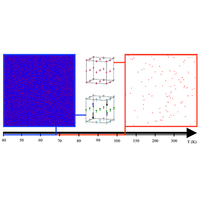
Ferroelectricity, superconductivity, and topology are three cornerstone concepts of condensed matter physics, and integration of any two may further fertilize exotic emergent phenomena. To date, harmonic coexistence of all three remains to be materialized. Here, the authors predict simultaneous tuning of superconducting transition temperature and band topology by ferroelectricity, with a heterobilayer of superconducting IrTe2 and ferroelectric In2Se3 as a physically realistic example. Such reversible and nonvolatile tunabilities may find important applications in novel superconducting devices and topological quantum computation.

Magnetic inhomogeneities in the quadruple perovskite manganite [Y2−xMnx]Mn6O12

A. M. Vibhakar, D. D. Khalyavin, P. Manuel, N. J. Steinke, L. Zhang, K. Yamaura, A. A. Belik, and R. D. Johnson

Phys. Rev. B 108, 054403 (2023) - Published 3 August, 2023

The authors show here that the introduction of substitutional disorder in the presence of competing exchange interactions causes the [Y2−xMnx]Mn6O12 quadruple perovskite manganites to develop short-range antiferromagnetic clusters contained in a paramagnetic matrix, before transitioning to a phase characterized by well correlated long-range ferrimagnetic order that coexists with the short-range antiferromagnetic clusters. It is spin doping through the substitution of magnetic Mn ions for nonmagnetic Y ions that gives rise to a spin texture that is inhomogeneous on the nanoscale.

Quantum oscillations in a doped Mott insulator beyond Onsager's relation

Valentin Leeb and Johannes Knolle

Phys. Rev. B 108, 085106 (2023) - Published 3 August, 2023

The Fermi surface — the manifold of gapless excitations forming due to Pauli’s famous exclusion principle— determines all electronic properties of metals. In 1952 Lars Onsager discovered how to measure a Fermi surface by studying the response of a metallic material as a function of an applied magnetic field. In fact, observables like electrical resistivity or the magnetization oscillate as a function of inverse field. Onsager’s relation forms the basis for our understanding of electronic properties of metals and is used in many experimental labs around the world. Here, the authors find that, in the presence of strong interactions between electrons, Onsager’s relation can be violated and they provide the first rigorous calculations of this effect. In general, solving for the emergent Landau levels of a strongly interacting material in a magnetic field is a hard problem. The methodological progress made here is enabled by concentrating on an exactly soluble model with infinite-range interactions. This research establishes the importance of inter Landau level interactions for understanding correlated materials in magnetic fields.

Braiding fractional quantum Hall quasiholes on a superconducting quantum processor

Ammar Kirmani, Derek S. Wang, Pouyan Ghaemi, and Armin Rahmani

Phys. Rev. B 108, 064303 (2023) - Published 2 August, 2023

Using a noisy quantum computer, the authors emulate direct braiding in a fractional quantum Hall system via a simplified model for a thin cylinder. The quantum algorithm prepares a ground state with two quasiholes, performs a unitary operation controlled by an ancilla to move one quasihole around the other, and measures the ancilla with error mitigation to extract the wave function’s acquired phase. This approach offers a method for studying braiding statistics in fractional Hall states in digitized devices.

Competing role of the p and d orbitals in the orbital angular momentum induced spin splitting of surface states on Au(110)

H. Ishida

Phys. Rev. B 108, 085401 (2023) - Published 2 August, 2023

There is currently large interest in the orbital Rashba effect at crystal surfaces. Here, the author investigates the orbital angular momentum induced spin splitting of surface states on Au(110) by first-principles calculations. It is revealed that although the p component of the orbital angular momentum is much smaller than the d component, the former gives rise to a large anisotropy in the orientation dependence of spin-splitting energies. This is because the spin-orbit coupling parameter for the p orbital of Au is several times larger than that for the d orbital.

Tuning heat transport in graphene by tension

H. Liu, M. Lee, M. Šiškins, H. S. J. van der Zant, P. G. Steeneken, and G. J. Verbiest

Phys. Rev. B 108, L081401 (2023) - Published 2 August, 2023

The speed of sound and flexural phonons in two-dimensional materials depends strongly on the tension in these ultraflexible membranes. Here, the authors experimentally demonstrate that freestanding graphene membranes cool down 33% faster when increasing tension by electrostatic gating. They attribute this effect mainly to improved acoustic impedance match of flexural phonons at the boundaries of the membrane and thus provide a route towards electronic devices and circuits for high-speed control of nanoscale heat transport.

Surprises in the deep Hilbert space of all-to-all systems: From superexponential scrambling to slow entanglement growth

Zihao Qi, Thomas Scaffidi, and Xiangyu Cao

Phys. Rev. B 108, 054301 (2023) - Published 1 August, 2023

Quantum dynamics of spin systems with uniform infinite-range interaction are often considered “simple” because they become semiclassical in the thermodynamic limit. However, the standard semiclassical theory only applies to a shallow surface of the vast many-body Hilbert space. What happens away from this? Here, the authors dive into the “deep Hilbert space” and unveil a number of exotic phenomena in this rarely charted territory.

Energy transfer in random-matrix ensembles of Floquet Hamiltonians

Christina Psaroudaki and Gil Refael

Phys. Rev. B 108, 064301 (2023) - Published 1 August, 2023

Quantum machines have been a fascination for years. This paper examines a specific quantum machine - a spin driven by two harmonically related light beams. When the spin adopts a specific Floquet state, it receives energy from one beam and transfers it to the other, acting as an energy frequency converter. The authors study the power distribution of this 2-beam and spin system, uncovering an intriguing transition in distribution width, tuned by the drive amplitude.

Structure, stability, and superconductivity of N-doped lutetium hydrides at kbar pressures

Katerina P. Hilleke, Xiaoyu Wang, Dongbao Luo, Nisha Geng, Busheng Wang, Francesco Belli, and Eva Zurek

Phys. Rev. B 108, 014511 (2023) - Published 31 July, 2023

The recent results describing a room-temperature superconductor in the lutetium nitrogen hydrogen system have prompted an avalanche of work. In this computational study, a range of techniques from crystal structure prediction to prototype modification, produce an array of low-pressure dynamically stable Lu-N-H phases. None were thermodynamically stable. The best fit to the experimental EOS came from fluorite-type LuH2, while the highest estimated Tc (a meager 17 K) arose from an extremely thermodynamically unstable phase based on 50% N substitution (LuNH)

Suppression of spin-wave nonreciprocity due to interfacial Dzyaloshinskii-Moriya interaction by lateral confinement in magnetic nanostructures

S. Tacchi, R. Silvani, M. Kuepferling, A. Fernández Scarioni, S. Sievers, H. W. Schumacher, E. Darwin, M.-A. Syskaki, G. Jakob, M. Kläui, and G. Carlotti

Phys. Rev. B 108, 024430 (2023) - Published 31 July, 2023

Brillouin light scattering (BLS) experiments assisted by micromagnetic simulations show that the difference in frequency between counterpropagating spin waves in extended films and multilayers, induced by interfacial Dzyaloshinskii–Moriya interaction (i-DMI), is strongly reduced when lateral confinement is introduced. This poses a limit to the exploitation of BLS to quantify the i-DMI strength in the case of magnetic elements, such as dots and wires, with lateral dimensions below about 400 nm.

Revealing temperature evolution of the Dirac band in ZrTe5 via magnetoinfrared spectroscopy

Yuxuan Jiang, Tianhao Zhao, Luojia Zhang, Qiang Chen, Haidong Zhou, Mykhaylo Ozerov, Dmitry Smirnov, and Zhigang Jiang

Phys. Rev. B 108, L041202 (2023) - Published 26 July, 2023

The topological phases and their dependence on the lattice constant in zirconium pentatelluride ZrTe5 have been under heated debate. Here, the authors study the temperature evolution of the Dirac band in ZrTe5 and find no indication of band-gap closure as temperature changes. They show that a weak topological insulator phase across the temperature range may not be the only explanation. A topological phase transition is still possible if the band mixing and inversion are considered.

Anharmonicity of the antiferrodistortive soft mode in barium zirconate BaZrO3

Petter Rosander, Erik Fransson, Cosme Milesi-Brault, Constance Toulouse, Frédéric Bourdarot, Andrea Piovano, Alexei Bossak, Mael Guennou, and Göran Wahnström

Phys. Rev. B 108, 014309 (2023) - Published 25 July, 2023

BaZrO3 is one of the very few perovskites that is claimed to remain cubic down to 0 K, but its tendency towards an antiferrodistortive (AFD) instability has fueled a lot of debates. Here, the AFD phonon mode is studied using inelastic neutron scattering (INS) and inelastic x-ray scattering (IXS), combined with a computational approach including anharmonicity. Both classical molecular dynamics (MD) and a self-consistent phonon approach are used, the latter including quantum fluctuations of the atomic motion. This robust description of the AFD mode clarifies that BaZrO3 stays cubic down to 0 K.

Drag resistance mediated by quantum spin liquids

Raffaele Mazzilli, Alex Levchenko, and Elio J. König

Phys. Rev. B 108, 014425 (2023) - Published 24 July, 2023

Probing quantum spin liquid behavior in atomically thin materials is a challenging task. The authors propose here an experimental setup consisting of two metallic layers separated by a thin quantum spin liquid. The voltage induced in one of the metals by injecting a current in the other metal probes the nontrivial dynamics of gapless excitations in the quantum spin liquid. This analysis captures U(1) and ℤ2 quantum spin liquids and may find realizations in materials such as α-RuCl3, 1T-TaSe2, and 1T-TaS2.

Exciton superfluidity in two-dimensional heterostructures from first principles: Importance of material-specific screening

Rune Højlund, Emil Grovn, Sahar Pakdel, Kristian S. Thygesen, and Fredrik Nilsson

Phys. Rev. B 108, 014506 (2023) - Published 20 July, 2023

van der Waal heterostructures can host long-lived excitons that can condense and exhibit superfluidity at low temperatures. In this paper, Højlund, Grovn and coworkers derive a first-principles framework, based on existing open-source codes, that can be used to model these systems. This framework is then used to evaluate the exciton binding energies and superfluid properties of hundreds of different heterostructures. Based on these calculations, the authors propose optimized materials with superior properties compared to the standard platforms.

Dynamics of orbital degrees of freedom probed via isotope Sb121,123 nuclear quadrupole moments in Sb-substituted iron pnictide superconductors

T. Kouchi, K. Yoshinaga, T. Asano, S. Nishioka, M. Yashima, H. Mukuda, A. Iyo, T. Kawashima, and S. Miyasaka

Phys. Rev. B 108, 014507 (2023) - Published 20 July, 2023

Since the discovery of the iron-based high-temperature superconductors, the superconductivity mechanism related to spin fluctuations and nematic (orbital) fluctuations has been much discussed, but it is remains unclear. Here, the authors reveal that the isotope 121,123Sb nuclei with large quadrupole moments are a sensitive local probe to observe the dynamics of orbital degrees of freedom. This provides us with a new approach to investigate systematically the correlation between the superconductivity and both the nematic and spin fluctuations, even in polycrystalline samples.

Optical magnetoelectric effects resonantly enhanced via electromagnons in cycloidal helimagnets Eu1−xYxMnO3

M. Ogino, Y. Kaneko, Y. Tokura, and Y. Takahashi

Phys. Rev. B 108, 024418 (2023) - Published 20 July, 2023

Dynamical magnetoelectric coupling gives rise to nonreciprocal phenomena for light such as the optical diode effect and the nonreciprocity of light polarization. Here, the authors comprehensively study these nonreciprocal optical effects resonantly enhanced by electromagnons for multiferroic spin spiral states of perovskite manganites. The giant nonreciprocity observed near the phase boundary demonstrates an important role of anharmonicity of spin excitations for these nonreciprocal effects. Furthermore, they find one of the largest values for the dynamical magnetoelectric coupling on the resonance of electromagnons.

Obstructions to gapped phases from noninvertible symmetries

Anuj Apte, Clay Córdova, and Ho Tat Lam

Phys. Rev. B 108, 045134 (2023) - Published 20 July, 2023

Our understanding of quantum symmetry of systems has considerably broadened over the last decade. The idea of symmetry has become intrinsically linked with topology described and algebraically characterized by higher categories. Studying three-dimensional systems with noninvertible symmetries, the authors show here that these symmetries are in general incompatible with a unique gapped ground state. Their results extend the ideas behind the Lieb-Shultz-Mattis theorem to the arena of higher-dimensional field theories invariant under a novel class of symmetries.

Strain control of exciton and trion spin-valley dynamics in monolayer transition metal dichalcogenides

Z. An, P. Soubelet, Y. Zhumagulov, M. Zopf, A. Delhomme, C. Qian, P. E. Faria Junior, J. Fabian, X. Cao, J. Yang, A. V. Stier, F. Ding, and J. J. Finley

Phys. Rev. B 108, L041404 (2023) - Published 20 July, 2023

The spin-valley physics of monolayer transition metal dichalcogenides (TMDs) remains one of the main interests in the class of van der Waals materials. At low temperature, it is mainly driven by the electron-hole exchange interaction (EHEI) that describes the annihilation of an exciton in one valley and the creation of an exciton in the time-reversal equivalent valley. Here, the authors show that the EHEI in monolayer TMDs is biaxial strain dependent and, surprisingly, it is an order of magnitude more strain dependent than expected from these first principles calculations. This points to a valley scattering channel that has not been considered in the literature so far.

Sign In to Your Journals Account

Filter

Section

Filter

Article Lookup

Enter a citation