Highlights

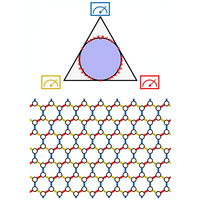
Variational Monte Carlo study of symmetric mass generation in a bilayer honeycomb lattice model

Wanda Hou and Yi-Zhuang You

Phys. Rev. B 108, 125130 (2023) - Published 20 September, 2023

This paper investigates the symmetric mass generation transition in a bilayer honeycomb lattice model using variational Monte Carlo simulations. By measuring the fermion scaling dimension at the critical point, the authors provide evidence for fermion fractionalization into deconfined emergent particles, supporting the hypothesis that the transition is a fermionic deconfined quantum critical point. The numerical results, including the critical exponent and fermion dimension, agree with theoretical predictions.

ac Josephson effect in a gate-tunable Cd3As2 nanowire superconducting weak link

R. Haller, M. Osterwalder, G. Fülöp, J. Ridderbos, M. Jung, and C. Schönenberger

Phys. Rev. B 108, 094514 (2023) - Published 19 September, 2023

Experimental signatures of topological superconductivity have been notoriously difficult to verify, even though they are actively being researched. Here, the authors use nanowires of Cd3As2 – a Dirac semimetal – to hunt for these signatures by simultaneously looking at Josephson radiation and Shapiro patterns at different doping levels. By cross-checking the experimental results with an extensive (RCSJ) model that includes thermal noise, it is concluded that trivial supercurrent dominates and that topological supercurrent, if existent, falls below the detection limit of the setup.

Experimental demonstration of splitting rules for exceptional points and their topological characterization

Yi-Xin Xiao, Jing Hu, Zhao-Qing Zhang, and C. T. Chan

Phys. Rev. B 108, 115427 (2023) - Published 19 September, 2023

This work establishes clear relationships between how exceptional points of varying orders split and which parts of the system are perturbed. Additionally, two topological invariants are identified to fully characterize the various splitting behavior. These findings provide a comprehensive understanding of how exceptional points split in various non-Hermitian systems, and can help optimize the performance of sensors that rely on exceptional points.

Topology, criticality, and dynamically generated qubits in a stochastic measurement-only Kitaev model

Adithya Sriram, Tibor Rakovszky, Vedika Khemani, and Matteo Ippoliti

Phys. Rev. B 108, 094304 (2023) - Published 15 September, 2023

Even in the absence of unitary evolution, measurements alone can induce a rich variety of dynamical phases and phenomena in many-body quantum systems. Inspired by the Kitaev honeycomb Hamiltonian, a paradigmatic model of topological physics, the authors construct here a stochastic measurement-only dynamics on a honeycomb lattice and show that it hosts distinct entanglement phases, including phases that protect topological qubits for an exponential amount of time and a critical phase with exotic dynamical scaling.

Monitored quantum dynamics and the Kitaev spin liquid

Ali Lavasani, Zhu-Xi Luo, and Sagar Vijay

Phys. Rev. B 108, 115135 (2023) - Published 15 September, 2023

The authors study the quantum dynamics of a (2+1)D monitored random circuit involving local projective measurements, inspired by the physics of the Kitaev quantum spin liquid. A Majorana parton description of the dynamics reveals a close connection between the entanglement dynamics of quantum trajectories and the 3D classical fully packed loop model. The authors uncover a critical phase where quantum trajectories exhibit long-range entanglement with a logarithmic (L log L) violation of the area law, and a topologically ordered phase reminiscent of the toric code phase.

Magnetohydrodynamic boundary conditions for the two-dimensional fermion gas

O. E. Raichev

Phys. Rev. B 108, 125305 (2023) - Published 15 September, 2023

In the hydrodynamic regime of electron transport, the distribution of electrical currents and potentials inside a conductor are determined by the Navier-Stokes equation with boundary conditions. The derivation of the boundary conditions from kinetic theory includes both an approximate approach, expressing them through the electronic viscosity, and a more accurate approach, implying numerical solution of the Boltzmann equation. With magnetic field, the results of the two approaches are considerably different when the mean free path length determined by electron-electron collisions is comparable to the cyclotron radius.

Electronic excitations in 5d4J=0Os4+ halides studied by resonant inelastic x-ray scattering and optical spectroscopy

P. Warzanowski, M. Magnaterra, P. Stein, G. Schlicht, Q. Faure, Ch. J. Sahle, T. Lorenz, P. Becker, L. Bohatý, M. Moretti Sala, G. Monaco, P. H. M. van Loosdrecht, and M. Grüninger

Phys. Rev. B 108, 125120 (2023) - Published 14 September, 2023

The cubic halides K2OsCl6, K2OsBr6, and Rb2OsBr6 are found to be excellent realizations of spin-orbit-entangled nonmagnetic J=0 compounds in the intermediate coupling regime. The two complementary techniques of resonant inelastic x-ray scattering and optical spectroscopy allow the authors to draw a comprehensive picture of the electronic excitations and to assess the electronic structure. The accurate set of electronic parameters such as spin-orbit coupling, Hund’s coupling, crystal-field splitting, Mott gap, and charge-transfer energy will serve as a solid reference for future studies on Os compounds.

Phonon-mediated dark to bright plasmon conversion

Benjamin Rousseaux, Yanko Todorov, Angela Vasanelli, and Carlo Sirtori

Phys. Rev. B 108, 125417 (2023) - Published 14 September, 2023

Unlocking the full potential of nanophotonic devices involves the engineering of their intrinsic optical properties. Here, the authors investigate a quantum theory that treats the interaction between quantum-confined plasmons and optical phonons in semiconductors. This theory allows computation of the optical response beyond the conventional Drude-Lorentz model. In particular, it predicts new effects, such as an oscillator-strength transfer mechanism between phonons and dark plasmon modes.

Strongly anisotropic spin and orbital Rashba effect at a tellurium – noble metal interface

B. Geldiyev, M. Ünzelmann, P. Eck, T. Kißlinger, J. Schusser, T. Figgemeier, P. Kagerer, N. Tezak, M. Krivenkov, A. Varykhalov, A. Fedorov, L. Nicolaï, J. Minár, K. Miyamoto, T. Okuda, K. Shimada, D. Di Sante, G. Sangiovanni, L. Hammer, M. A. Schneider, H. Bentmann, and F. Reinert

Phys. Rev. B 108, L121107 (2023) - Published 14 September, 2023

The orbital Rashba effect describes the formation of chiral orbital angular momentum textures upon inversion symmetry breaking at surfaces or interfaces. Here, the authors unveil a pronounced anisotropic spin-orbit splitting with a Rashba-type spin polarization in the electronic interface states in the model system Te/Au(100). Exploring the momentum-dependent response of inversion symmetry breaking, they particularly demonstrate that the orbital texture leads to a strongly anisotropic spin and orbital Rashba effect. These findings will provide a valuable contribution to the discovery and understanding of future “orbitronic” phenomena.

Maximally localized exciton Wannier functions for solids

Jonah B. Haber, Diana Y. Qiu, Felipe H. da Jornada, and Jeffrey B. Neaton

Phys. Rev. B 108, 125118 (2023) - Published 13 September, 2023

Over 25 years ago, Marzari and Vanderbilt introduced maximally localized Wannier functions (MLWFs), the most compact real-space representation of electronic wavefunctions in solids. Here, the authors put forward a generalization of this scheme for excitons, correlated electron-hole pairs that dictate the optical properties of materials. Much as MLWFs have transformed our understanding of electrons in solids, from chemical bonding to polarization to topology, these maximally localized exciton Wannier functions should deepen our understanding of photophysical and excited-state phenomena of materials.

Renormalization group for measurement and entanglement phase transitions

Adam Nahum and Kay Jörg Wiese

Phys. Rev. B 108, 104203 (2023) - Published 12 September, 2023

Field theoretic renormalization group is applied to measurement and entanglement phase transitions. The renormalization group flows for both random tensor networks and monitored systems show that, in high dimensions, there exist distinct weak- and strong-coupling universality classes for these phase transitions. In addition, one of the field theories exhibits a supersymmetry that leads to dimensional reduction by four.

Inhomogeneity-induced time-reversal symmetry breaking in cuprate twist junctions

Andrew C. Yuan, Yaar Vituri, Erez Berg, Boris Spivak, and Steven A. Kivelson

Phys. Rev. B 108, L100505 (2023) - Published 12 September, 2023

The lowest-order Josephson coupling between d-wave superconductors vanishes by symmetry when the twist angle is close to 45 degrees. The authors propose here an “order by disorder” mechanism, whereby spatial fluctuations in the local Josephson coupling generate an effective higher-order coupling, leading to a time reversal symmetry breaking superconducting phase at the twisted interface. This mechanism may offer an explanation for recent experiments in twist junctions between high-Tc cuprate superconductors. These findings have broader implications for high-Tc cuprate physics, requiring a local admixture of an s-wave component in the d-wave order parameter.

Deep learning extraction of band structure parameters from density of states: A case study on trilayer graphene

Paul Henderson, Areg Ghazaryan, Alexander A. Zibrov, Andrea F. Young, and Maksym Serbyn

Phys. Rev. B 108, 125411 (2023) - Published 11 September, 2023

Harnessing the power of deep learning, researchers have developed a novel method to fit the band structure parameters of complex 2D materials, such as trilayer graphene. By training neural networks on simulated data for the density of states, and then minimizing the effective distance between network-generated images and experimental data, the authors obtain here accurate predictions of tight-binding parameters, validating their results against literature values. This method can be easily extended to other complex two-dimensional materials, as well as to other experimental techniques.

Two-way photoeffectlike occupancy dynamics in a single (InGa)As quantum dot

Pavel Sterin, Kai Hühn, Mikhail M. Glazov, Jens Hübner, and Michael Oestreich

Phys. Rev. B 108, 125301 (2023) - Published 8 September, 2023

Spin noise spectroscopy on single quantum dots (QDs) has matured to a highly efficient method to study the spin and charge dynamics of semiconductor quantum dots, including the subtle impact of their surroundings. Here, the authors extend the theory and the experimental technique of optical spin noise spectroscopy to high magnetic fields and study the fundamental mechanisms of decharging and recharging of (InGa)As QDs at quasiresonant and nonresonant optical excitation. The resulting photoinduced two-way charge dynamics in single QDs is not only interesting from the fundamental point of view but plays an important role in many quantum dot based photonic devices, such as optically addressable qubits or reliable single-photon emitters.

Continuity equation for the many-electron spectral function

F. Aryasetiawan

Phys. Rev. B 108, 115110 (2023) - Published 6 September, 2023

A continuity equation determining the total spectral function of a many-electron system is derived within the recently proposed exchange-correlation field framework. A practical scheme is constructed in which only the diagonal part of the exchange-correlation field is needed as input, leading to an explicit formula for the spectral function. This will greatly simplify calculations of spectral functions provided a reliable approximation for the exchange-correlation field is available. The local-density approximation could be a suitable starting point for an accurate approximation.

Crossover from exciton polarons to trions in doped two-dimensional semiconductors at finite temperature

Antonio Tiene, Brendan C. Mulkerin, Jesper Levinsen, Meera M. Parish, and Francesca Maria Marchetti

Phys. Rev. B 108, 125406 (2023) - Published 6 September, 2023

Should the optical response of doped two-dimensional semiconductors be described within a Fermi polaron or a trion model? Using a finite-temperature Fermi polaron theory, the authors demonstrate here a crossover from a quantum degenerate regime with a well-defined polaron quasiparticle to an incoherent regime at high temperature or low doping, where the lowest-energy attractive polaron becomes subsumed into a broad trion-hole continuum. The crossover is accompanied by a characteristic evolution of the emission profile, from a symmetric Lorentzian to an asymmetric peak.

Exactly solvable lattice models for interacting electronic insulators in two dimensions

Qing-Rui Wang, Yang Qi, Chen Fang, Meng Cheng, and Zheng-Cheng Gu

Phys. Rev. B 108, L121104 (2023) - Published 6 September, 2023

Topological insulators in two-dimensional systems are well-understood within the context of free-fermion systems. Nevertheless, comprehending their strongly interacting counterparts presents a significant challenge. Here, the authors developed an innovative lattice model based on U(1)f fermionic charge decorations. The model furnishes a rigorous mathematical framework for delving into fermionic symmetry-protected topological phases that conserve U(1)f charge, among other types of symmetries. Notably, this research expands the existing theoretical landscape by presenting an exactly solvable Hamiltonian with a finite local Hilbert space and a sophisticated classification scheme for continuous symmetries.

High-precision measurement of the Ferrell-Glover-Tinkham sum rule in a cuprate high-temperature superconductor

R. D. Dawson, X. Shi, K. S. Rabinovich, D. Putzky, Y.-L. Mathis, G. Christiani, G. Logvenov, B. Keimer, and A. V. Boris

Phys. Rev. B 108, 104501 (2023) - Published 5 September, 2023

The authors have combined several complementary spectroscopic methods to achieve high-precision control over the superconductivity-induced spectral weight transfer in a DyBa2Cu3O7 film with a superconducting Tc of 90 K, spanning an energy range over three orders of magnitude from ~1 meV to 1 eV. They find that the Ferrell-Glover-Tinkham sum rule is satisfied within an unprecedented accuracy of 2% by integrating the optical conductivity up to 0.6 eV, consistent with the spectral range of antiferromagnetic spin fluctuations.

Functional renormalization group without functional integrals: Implementing Hilbert space projections for strongly correlated electrons via Hubbard X-operators

Andreas Rückriegel, Jonas Arnold, Rüdiger Krämer, and Peter Kopietz

Phys. Rev. B 108, 115104 (2023) - Published 5 September, 2023

The authors show here that exact functional renormalization group flow (FRG) equations for quantum systems can be derived directly within an operator formalism without using functional integrals. This simple insight opens new possibilities for applying FRG methods to models for strongly correlated electrons with projected Hilbert spaces, such as quantum spin models, the t-J model, or the Hubbard model at infinite on-site repulsion. By representing these models in terms of Hubbard X-operators, various applications of this approach are explored.

Photocurrents induced by structured light

A. A. Gunyaga, M. V. Durnev, and S. A. Tarasenko

Phys. Rev. B 108, 115402 (2023) - Published 5 September, 2023

Structured light, ranging from intensity or polarization gratings to beams with fully controlled spatiotemporal structure, has great potential for use in optics and optoelectronics. This paper explores the photoresponse of a two-dimensional electron system to structured terahertz radiation and uncovers photocurrents related to the gradients of radiation intensity, polarization, and phase. The theory is applied to study the radial and azimuthal currents induced by twisted light beams carrying orbital angular momentum.

Sign In to Your Journals Account

Filter

Section

Filter

Article Lookup

Enter a citation