Highlights

Exciton-phonon scattering: Competition between the bosonic and fermionic nature of bound electron-hole pairs

Manuel Katzer, Malte Selig, Lukas Sigl, Mirco Troue, Johannes Figueiredo, Jonas Kiemle, Florian Sigger, Ursula Wurstbauer, Alexander W. Holleitner, and Andreas Knorr

Phys. Rev. B 108, L121102 (2023) - Published 5 September, 2023

Semiconductor excitons are composite particles consisting of fermionic carriers. Nevertheless they are considered as paradigmatic candidates for bosonic condensation and the formation of macroscopic coherence in solids. To address both effects, the kinetics of exciton thermalization is studied, including their composite fermionic character. This way, exciton condensation based on the primary assumption of a bosonic thermalization is questioned. In this light, also discussed is whether a recently observed decrease of linewidths at increasing exciton density can be related to a signature for emerging excitonic coherence.

Spin wave Hamiltonian and anomalous scattering in NiPS3

A. Scheie, Pyeongjae Park, J. W. Villanova, G. E. Granroth, C. L. Sarkis, Hao Zhang, M. B. Stone, Je-Geun Park, S. Okamoto, T. Berlijn, and D. A. Tennant

Phys. Rev. B 108, 104402 (2023) - Published 1 September, 2023

Magnetic van der Waals materials have many proposed technological uses, but predicting their behavior requires understanding their magnetic interactions. Here, the authors present a comprehensive study of the spin exchange Hamiltonian of semiconducting magnet NiPS3. Using inelastic neutron scattering and first-principles density functional theory calculations, the authors derive a spin-exchange Hamiltonian able to explain spin excitations observed with other probes. Comparing semiclassical simulations against the experimental neutron spectrum reveals an anomalous suppression of low-energy magnetism in NiPS3, signaling nontrivial physics lurking in its ground state.

Real Hopf insulator

Hyeongmuk Lim, Sunje Kim, and Bohm-Jung Yang

Phys. Rev. B 108, 125101 (2023) - Published 1 September, 2023

While stable and fragile topological insulators (TIs) are blind to unoccupied states, defining a delicate TI depends critically on the conduction band. Here, the authors report a new delicate TI, dubbed a “real Hopf insulator” (RHI), in a spinless PT-symmetric fermion system in three dimensions. Having two topological invariants characterizing both conduction and valence bands, the RHI features a bulk-boundary correspondence and reverting Thouless pump that must be described by using both bands simultaneously. This sheds light on the generic properties of delicate TIs.

Linear scaling relationship of Néel temperature and dominant magnons in pyrochlore ruthenates

Jae Hyuck Lee, Dirk Wulferding, Junkyoung Kim, Dongjoon Song, Seung Ryong Park, and Changyoung Kim

Phys. Rev. B 108, 054443 (2023) - Published 31 August, 2023

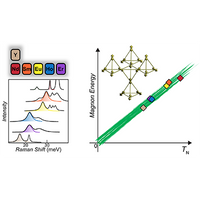
Transition metal pyrochlore oxides are prototypical platforms for exploring and engineering a plethora of magnetic phases based on the intimate interplay of charge, lattice, and spin degrees of freedom. Here, the authors conduct Raman spectroscopic experiments on a series of pyrochlore ruthenates and identify one-magnon modes. They find a remarkably simple proportional relation between the Néel temperature and magnon energy, inferring that the compounds host common spin structures. This work showcases the straightforward tunability of the magnon band structure based on the A-site ion in A2Ru2O7.

Phonon-induced collective modes in spin-orbit coupled polar metals

Abhishek Kumar, Premala Chandra, and Pavel A. Volkov

Phys. Rev. B 108, 075162 (2023) - Published 28 August, 2023

In spin-orbit coupled metals, polar phonons couple to the spin of electrons by inducing a dynamical Rashba-type spin splitting. Here, the authors study the consequences of such coupling in polar metals, where one of the polar phonons has undergone a symmetry-breaking transition. They show that application of magnetic field reveals a spectrum of collective modes that can change their character (electronic vs. lattice) and energy as a function of field strength. Optical spectroscopy experiments are shown to have the capability to probe these modes.

Search for magnetoelectric monopole response in Cr2O3 powder

Syed Q. A. Shah, Ather Mahmood, Arun Parthasarathy, and Christian Binek

Phys. Rev. B 108, 054437 (2023) - Published 25 August, 2023

The discovery of a monopole contribution to the overall magnetoelectric susceptibility of Cr2O3 sparked the search for a material with pure monopole response. Magnetoelectric powder samples are alternatives to magnetic topological insulators which, in practice, are not suitable candidates. Here, the authors experimentally and theoretically investigate the magnetoelectric susceptibility of Cr2O3 powder. Although electric and magnetic field cooling tunes the susceptibility, there is no field-cooling protocol that leads to a pure monopole response. These insights provide alternatives to realize effective magnetoelectric monopole media.

Intercorrelated anomalous Hall and spin Hall effect in kagome-lattice Co3Sn2S2-based shandite films

Yong-Chang Lau, Junya Ikeda, Kohei Fujiwara, Akihiro Ozawa, Jiaxin Zheng, Takeshi Seki, Kentaro Nomura, Liang Du, Quansheng Wu, Atsushi Tsukazaki, and Koki Takanashi

Phys. Rev. B 108, 064429 (2023) - Published 25 August, 2023

This work establishes the pivotal role of topological bands in the magnetic Weyl semimetal prototype Co3Sn2S2 for efficient generation of spin current at room temperature via the spin Hall effect. Electron and hole-doped shandite films are systematically studied to map the evolution of Hall conductivities against Fermi level tuning. The authors demonstrate that the observed anomalous Hall conductivity and spin Hall conductivity maxima at distinct doping levels share the common origin in the band structure, suggesting such a correlation can be exploited for screening materials with large transverse magnetoelectric responses.

Modeling temperature-dependent population dynamics in the excited state of the nitrogen-vacancy center in diamond

S. Ernst, P. J. Scheidegger, S. Diesch, and C. L. Degen

Phys. Rev. B 108, 085203 (2023) - Published 24 August, 2023

The nitrogen vacancy (NV) center in diamond is well known for its outstanding optical and spin properties, enabling various applications in quantum sensing and quantum information at both cryogenic and ambient temperatures. Despite a large body of work, however, the NV center’s dynamics at intermediate temperatures are incompletely understood. This paper describes a basic rate model able to explain the NV population dynamics over the full parameter space of temperature, crystallographic strain, and magnetic field. Numerical simulations of the model are in excellent agreement with experiments discussed in the accompanying PRL.

Exchange-renormalized crystal field excitations in the quantum Ising magnet KTmSe2

Shiyi Zheng, Hongliang Wo, Yiqing Gu, Rui Leonard Luo, Yimeng Gu, Yinghao Zhu, Paul Steffens, Martin Boehm, Qisi Wang, Gang Chen, and Jun Zhao

Phys. Rev. B 108, 054435 (2023) - Published 23 August, 2023

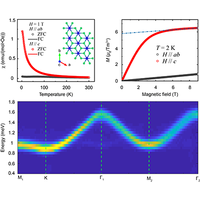
Emerging as a platform for novel quantum effects, triangular-lattice rare-earth delafossite compounds have attracted significant attention. This study investigates KTmSe2 using thermodynamic and neutron scattering methods, revealing highly dispersive crystal electric field excitations. From the transverse field Ising model and a full crystal field scheme, the findings uncover a strong interplay between spin exchange interactions and crystal field effects. These insights will provide a valuable framework for understanding low-temperature magnetism in materials of a similar type.

Sublattice interference promotes pair density wave order in kagome metals

Yi-Ming Wu, Ronny Thomale, and S. Raghu

Phys. Rev. B 108, L081117 (2023) - Published 22 August, 2023

Pair density wave superconductivity arises when the two paired fermions have finite center-of-mass momentum. It is usually not a weak coupling instability and requires stringent conditions, such as the pairing interaction remaining attractive at finite momentum, and the interaction strength has to be strong enough. Here, the authors find that the kagome lattice model, when doped to a particular Van Hove filling with both onsite and nearest neighbor repulsion, can serve as an ideal platform for realizing this novel superconducting state.

Crucial role of thermal fluctuations and vertex corrections for the magnetic pseudogap

Mengxing Ye and Andrey V. Chubukov

Phys. Rev. B 108, L081118 (2023) - Published 22 August, 2023

It is known that thermal magnetic fluctuations can give rise to pseudogap behavior in a paramagnetic metal. However, the role of vertex corrections for the pseudogap formation is not well understood. The authors show here that without vertex corrections there is no pseudogap, but an inclusion of even infinitesimally small vertex corrections gives rise to pseudogap behavior. The authors further generalize this statement to a set of boundary models, in which the pseudogap develops upon inclusion of perturbations. This work provides an understanding of recent numerical studies of the pseudogap.

Role of dimensionality and size in controlling the drag Seebeck coefficient of doped silicon nanostructures: A fundamental understanding

Raja Sen, Nathalie Vast, and Jelena Sjakste

Phys. Rev. B 108, L060301 (2023) - Published 16 August, 2023

It is commonly believed that phonon drag, a phenomenon where electrons are dragged from the hot to the cold side of the sample by out-of-equilibrium phonons, does not play any significant role on the nanoscale. Here, the authors show that, even if the phonon-drag contribution is strongly reduced by nanostructuring, a silicon thin film of 100 nm thickness can still preserve more than 20% of the bulk phonon-drag contribution at 300 K along the in-plane direction of the thin film.

Easy-plane dominant stochastic magnetic tunnel junction with synthetic antiferromagnetic layers

Jonathan Z. Sun, Christopher Safranski, Philip Trouilloud, Christopher D'Emic, Pouya Hashemi, and Guohan Hu

Phys. Rev. B 108, 064418 (2023) - Published 15 August, 2023

Superparamagnetic fluctuation of a nanomagnet, when confined by a strong easy-plane anisotropy, can yield a GHz-speed random signal. A magnetic tunnel junction converts such moment movement into conductance fluctuation and is useful as an entropy source for modern computing circuits. Here, the authors experimentally explore a magnetic tunnel junction with a synthetic antiferromagnetically coupled free layer and reference layer, in their superparamagnetic limit, to demonstrate hardware-based generation of a Gb/sec random bit stream, and to learn of factors in device materials and the fabrication process that are in need of future optimization.

Fractional quantum anomalous Hall states in twisted bilayer MoTe2 and WSe2

Aidan P. Reddy, Faisal Alsallom, Yang Zhang, Trithep Devakul, and Liang Fu

Phys. Rev. B 108, 085117 (2023) - Published 15 August, 2023

The recent observation of the fractional quantum anomalous Hall effect opens a new frontier in topological phases and quantum materials. Here, the authors demonstrate that the strong interaction in partially filled topological moiré bands of twisted semiconductor bilayers induces a variety of phases, including ferromagnetic metals, charge density waves, and fractional quantum anomalous Hall states. This work reveals a remarkably rich phase diagram as a function of twist angle, awaiting further exploration.

Quantized interband topological index in two-dimensional systems

Tharindu Fernando and Ting Cao

Phys. Rev. B 108, L081111 (2023) - Published 15 August, 2023

Classifying the multiband topology of two-dimensional parameter space submanifolds, exemplified by electron valleys in a Brillouin zone, has historically been a complex endeavor. In response to these limitations, the authors unveil here a gauge-invariant, quantized interband topological index. This refined approach enhances the classification of valleys, and additionally sheds light on the nature of edge states resulting from band inversions in multiband systems. These findings deepen our grasp of valley physics and the intricacies of interband topology.

Covalency, correlations, and interlayer interactions governing the magnetic and electronic structure of Mn3Si2Te6

Chiara Bigi, Lei Qiao, Chao Liu, Paolo Barone, Monica Ciomaga Hatnean, Gesa-R. Siemann, Barat Achinuq, Daniel Alexander Mayoh, Giovanni Vinai, Vincent Polewczyk, Deepak Dagur, Federico Mazzola, Peter Bencok, Thorsten Hesjedal, Gerrit van der Laan, Wei Ren, Geetha Balakrishnan, Silvia Picozzi, and Phil D. C. King

Phys. Rev. B 108, 054419 (2023) - Published 11 August, 2023

This work establishes the spectroscopic fingerprints of ferrimagnetic Mn3Si2Te6, providing a comprehensive understanding of the electronic states underpinning its magnetic interactions. The authors show the pivotal role played by covalency, which weakens the electronic correlations and influences the magnetic frustrations and anisotropic exchange, leading to the onset of the long-range ferrimagnetic order in this compound. The approach of combining spectroscopic experiments with state-of-the-art first-principles theory will have widespread applicability across the families of layered and quasilayered magnetic materials.

Refined spin-wave model and multimagnon bound states in Li2CuO2

Eli Zoghlin, Matthew B. Stone, and Stephen D. Wilson

Phys. Rev. B 108, 064408 (2023) - Published 9 August, 2023

Quasi-one-dimensional materials serve as both testbeds for tractable magnetic models and as a perennial source of intriguing physics. An excellent example is the emergence of multimagnon bound states in ferromagnetic (FM) spin chains, which provide a platform for probing a few-body quantum phenomenon. Despite being studied for many years, the exchange anisotropy-driven bound state of a FM chain has yet to be observed by inelastic neutron scattering (INS). As INS provides a unique window into the nature of magnon-magnon interactions, this represents a substantive gap in the literature. Here, the authors rectify this gap by presenting detailed INS data on the S=½ spin chain Li2CuO2. Their data allows for determination of a refined spin Hamiltonian which fully describes the one-magnon dispersion. With these details in hand, they demonstrate the existence of two-magnon and, potentially, three-magnon bound states in Li2CuO2, with the potential three-magnon bound state showing anomalous behavior.

Hybrid higher-order skin-topological effect in hyperbolic lattices

Junsong Sun, Chang-An Li, Shiping Feng, and Huaiming Guo

Phys. Rev. B 108, 075122 (2023) - Published 9 August, 2023

The hyperbolic lattice, existing in a space of constant negative curvature, displays unique physical properties compared to its Euclidean counterpart, and has garnered significant attention recently. Here, the authors have proposed the existence of a higher-order skin-topological effect in hyperbolic lattices. This result first introduces a non-Hermitian effect into hyperbolic lattices, which extends the regime of topological phases with hyperbolic geometry.

Low-dissipation data bus via coherent quantum dynamics

Dylan Lewis, João P. Moutinho, Antonio T. Costa, Yasser Omar, and Sougato Bose

Phys. Rev. B 108, 075405 (2023) - Published 9 August, 2023

The transport of information is an essential component of both classical and quantum computers. Coherent quantum dynamics offers the potential for the transfer of information through a linear array of quantum dots almost without dissipation. Here, the authors describe a protocol and calculate the energetic cost of transferring quantum states as a quantum or classical data bus, showing its advantage over the shuttling of electrons and classical data buses.

Electronic nematic order in the normal state of strontium ruthenate

Ryan S. Russell, Hari P. Nair, Kyle M. Shen, Darrell G. Schlom, and John W. Harter

Phys. Rev. B 108, L081105 (2023) - Published 9 August, 2023

The nature of unconventional superconductivity in Sr2RuO4 remains stubbornly unresolved, and it is clear that a fundamental piece of the puzzle is still missing. Here, the authors use static and ultrafast optical dichroism measurements to uncover signatures of electronic nematic order in high quality epitaxially strained thin films of Sr2RuO4. Through the development of a simple Ising model of the nematic order, the authors show that optical pumping induces a coherent oscillation of its amplitude mode. Whether and how this nematic order ultimately influences the superconductivity in Sr2RuO4 remains a key open question.

Sign In to Your Journals Account

Filter

Section

Filter

Article Lookup

Enter a citation