Highlights

Neural network ansatz for periodic wave functions and the homogeneous electron gas

Max Wilson, Saverio Moroni, Markus Holzmann, Nicholas Gao, Filip Wudarski, Tejs Vegge, and Arghya Bhowmik

Phys. Rev. B 107, 235139 (2023) - Published 21 June, 2023

The authors introduce here WAPNET, a periodic neural network (NN) variational ansatz for solving the ground state of a homogeneous electron gas with high accuracy over a broad range of the density coupling constant rs. Going beyond recent work for molecules, this contribution establishes NN models as flexible and powerful ansatz for electronic structure calculations in extended systems. In all density regimes, WAPNET-based variational Monte Carlo results are comparable to or better than state-of-the-art benchmarks obtained by diffusion Monte Carlo with iterative backflow.

InAs-Al hybrid devices passing the topological gap protocol

Morteza Aghaee et al. (Microsoft Quantum)

Phys. Rev. B 107, 245423 (2023) - Published 21 June, 2023

Topological phases of matter can enable highly stable qubits with small footprints, fast gate times, and digital control. These hardware-protected qubits must be fabricated with a material combination in which a topological phase can reliably be induced. The challenge: disorder can destroy the topological phase and obscure its detection. This paper reports on devices with low enough disorder to pass the topological gap protocol, thereby demonstrating gapped topological superconductivity and paving the way for a new stable qubit.

Magnetic ground state and perturbations of the distorted kagome Ising metal TmAgGe

C. B. Larsen, D. G. Mazzone, N. Gauthier, H. D. Rosales, F. A. Gómez Albarracín, J. Lass, X. Boraley, S. L. Bud'ko, P. C. Canfield, and O. Zaharko

Phys. Rev. B 107, 224419 (2023) - Published 20 June, 2023

Magnetic order and excitations of the distorted kagome intermetallic magnet TmAgGe are explored using a variety of methods, including single-crystal neutron diffraction, inelastic neutron scattering, Monte Carlo simulations, and the random phase approximation. The magnetic properties are governed by strong, local single-ion anisotropy and geometrically frustrated magnetic exchanges. The authors establish multi-k structures at several different magnetic field configurations and model effective exchange parameters using field-dependencies of the magnetic neutron diffraction reflections and the weakly dispersive crystal electric field mode.

Symmetry-conserving maximally projected Wannier functions

K. Koepernik, O. Janson, Yan Sun, and J. van den Brink

Phys. Rev. B 107, 235135 (2023) - Published 20 June, 2023

Wannier functions are a powerful tool for the determination of topological properties of solids based on band structure calculations. Here, the authors present a simple and efficient scheme to obtain symmetry-conserving Wannier functions especially suitable for local orbital codes. They analyze which approximation of the basis contribution to the Berry connection and curvature matrices preserves symmetry and argue which Bloch function gauge is best suited for model systems, where the basis is not explicitly known.

Topological Andreev rectification

Pok Man Tam, Christophe De Beule, and Charles L. Kane

Phys. Rev. B 107, 245422 (2023) - Published 20 June, 2023

Quantized transport is a powerful probe of topological phases, and metals are topologically classified by the Euler characteristic of the Fermi sea. Here, the authors demonstrate analytically and numerically that a 2D metal proximitized by a Josephson π junction exhibits rectification for current along the junction. They introduce the rectified nonlocal conductance and show it is quantized by the Fermi sea topology. InAs-based heterostructures, as well as monolayer and bilayer graphene, are identified as promising platforms for demonstrating this effect.

Role of alkaline metal in the rare-earth triangular antiferromagnet KYbO2

Franziska Grußler, Mamoun Hemmida, Sebastian Bachus, Yurii Skourski, Hans-Albrecht Krug von Nidda, Philipp Gegenwart, and Alexander A. Tsirlin

Phys. Rev. B 107, 224416 (2023) - Published 15 June, 2023

Spin-liquid materials can be tailored by chemical substitutions. Here, the authors use thermodynamic measurements and electron spin resonance to show that replacing Na by K in triangular magnets of the AYbO2 family weakens the magnetic couplings and renders the Yb3+ ion more isotropic. They map out the temperature-field phase diagram and demonstrate that the field-induced plateau phase corresponds to 1/2 of the saturated magnetization.

Magnetism and quantum melting in moiré-material Wigner crystals

Nicolás Morales-Durán, Pawel Potasz, and Allan H. MacDonald

Phys. Rev. B 107, 235131 (2023) - Published 14 June, 2023

Semiconductor moiré materials host generalized Wigner crystal states at a series of fractional fillings, originating from localization of electrons in a subset of moiré sites in order to minimize long-range Coulomb interactions. Using exact diagonalization calculations, this paper studies the interplay between spin and charge degrees of freedom that gives rise to different magnetic orders within the crystalline states at fillings ν=1/3 and ν=2/3. The authors provide effective spin model descriptions of those phases, also addressing their Mott-Wigner melting transitions.

Significant phonon drag effect in wide band gap GaN and AlN

Yujie Quan, Yubi Chen, and Bolin Liao

Phys. Rev. B 107, 245202 (2023) - Published 14 June, 2023

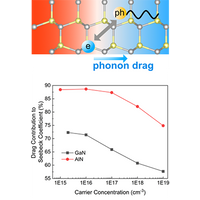
Understanding the electrical and thermal transport properties of group-III nitride semiconductors is crucial for their electronic and thermoelectric applications. This study investigates the impact of the phonon drag effect, which refers to the momentum exchange between nonequilibrium phonons and electrons, on electronic transport in GaN and AlN. Results show that, even at room temperature, phonon drag significantly enhances mobility and the Seebeck coefficient. The study delves into the specific mechanisms for this.

Electrically driven photon statistics engineering in quantum-dot circuit quantum electrodynamics

Lei-Lei Nian, Bo Zheng, and Jing-Tao Lü

Phys. Rev. B 107, L241405 (2023) - Published 14 June, 2023

Quantum-dot circuit quantum electrodynamics (QD-cQED) has enabled the probe and control of light-matter interaction at the elementary level, with the demonstration of nonclassical photon sources driven by inelastic electron tunneling. Due to the absence of the photon blockade mechanism, an general scheme for photon statistics engineering in QD-cQED is lacking. Based on current-driven joint interference effect, the authors propose here an all-electrical scheme to achieve arbitrary photon statistics with classical or quantum correlation by simply controlling bias voltage.

Interacting models for twisted bilayer graphene: A quantum chemistry approach

Fabian M. Faulstich, Kevin D. Stubbs, Qinyi Zhu, Tomohiro Soejima, Rohit Dilip, Huanchen Zhai, Raehyun Kim, Michael P. Zaletel, Garnet Kin-Lic Chan, and Lin Lin

Phys. Rev. B 107, 235123 (2023) - Published 13 June, 2023

Twisted bilayer graphene (TBG) has garnered significant interest in condensed matter physics over the past few years. Here, the authors present numerical investigations of TBG implementing state-of-the-art quantum chemistry methods. Using a gauge-invariant order parameter, they show a C2z𝒯 phase transition at charge neutrality which persists at noninteger fillings near charge neutrality. The work is the first systematic study of TBG for noninteger fillings near charge neutrality.

Independent and coherent transitions between antiferromagnetic states of few-molecule systems

Claire Besson, Philipp Stegmann, Michael Schnee, Zeila Zanolli, Simona Achilli, Nils Wittemeier, Asmus Vierck, Robert Frielinghaus, Paul Kögerler, Janina Maultzsch, Pablo Ordejón, Claus M. Schneider, Alfred Hucht, Jürgen König, and Carola Meyer

Phys. Rev. B 107, 245414 (2023) - Published 13 June, 2023

Molecular spintronics is usually based on paramagnetic or ferromagnetic (S ≠ 0) species. Here, the authors study small ensembles of two molecular antiferromagnets, {Mn4} and {Co4}, bound to carbon nanotube quantum dots. The current through the quantum dots shows a random telegraph signal caused by transitions between nondegenerate Stot = 0 states of individual molecular antiferromagnets. Statistical analysis shows that transitions between those states are independent in the case of {Co4} ensembles, while {Mn4} ensembles display long-lived coherent superposition involving multiple complexes.

Large upper critical fields and dimensionality crossover of superconductivity in the infinite-layer nickelate La0.8Sr0.2NiO2

Wei Wei, Wenjie Sun, Yue Sun, Yongqiang Pan, Gangjian Jin, Feng Yang, Yueying Li, Zengwei Zhu, Yuefeng Nie, and Zhixiang Shi

Phys. Rev. B 107, L220503 (2023) - Published 12 June, 2023

The recent discovery of superconductivity in nickelates, sharing structural and electronic similarities with cuprates, is crucial for understanding the high-Tc superconducting pairing mechanism. Here, the authors study the Hc2 of a high-quality La0.8Sr0.2NiO2 thin film. Significantly large Hc2 (∼ 40 T for H || c and ∼ 52 T for H || ab) are obtained. The anisotropy decreases from ∼10 near Tc to ∼1.5 at 2 K, which confirms a crossover from 2D to 3D superconductivity based on the angle dependence of Hc2.

Phase transitions and spin state of iron in FeO under the conditions of Earth's deep interior

E. Greenberg, R. Nazarov, A. Landa, J. Ying, R. Q. Hood, B. Hen, R. Jeanloz, V. B. Prakapenka, V. V. Struzhkin, G. Kh. Rozenberg, and I. V. Leonov

Phys. Rev. B 107, L241103 (2023) - Published 12 June, 2023

Iron oxide (FexO) serves as a model constituent of Earth-like planetary interiors, reflecting the distinctive high-pressure chemistry of their cores and rocky mantles. Under pressure it undergoes crystal structural transitions and metallization, accompanied by a local-moment collapse of Fe ions. Here, the experiments and theoretical calculations characterize the complex interplay between electron states and structural phases, resulting in a rich phase diagram and revealing the existence of a metallic high-spin state of iron at the conditions near those of Earth’s core-mantle boundary.

Ab initio Green-Kubo simulations of heat transport in solids: Method and implementation

Florian Knoop, Matthias Scheffler, and Christian Carbogno

Phys. Rev. B 107, 224304 (2023) - Published 7 June, 2023

Ab initio Green-Kubo simulations provide an accurate description of lattice thermal conductivities from first principles. This approach reliably describes the full range from harmonic to strongly anharmonic materials. The latter are not handled well by often employed, perturbed phonon models. Using challenging benchmark materials as examples, this paper discusses various physical and computational strategies that speed up the calculations. These advancements pave the way for efficiently exploring materials space in the search for thermal insulators, as demonstrated in the accompanying PRL (DOI: https://doi.org/10.1103/PhysRevLett.130.236301).

Inhomogeneous disordering at a photoinduced charge density wave transition

Antonio Picano, Francesco Grandi, and Martin Eckstein

Phys. Rev. B 107, 245112 (2023) - Published 7 June, 2023

Symmetry-breaking phase transitions are ubiquitous in nature. The study of their dynamics in solids has often been performed using homogeneous order parameter theories. By microscopically modeling the photoinduced melting and recovery of a charge density wave, the authors instead show here that the transient dynamics can lead to disordered state, where the average order parameter is not representative of the atomic-scale configuration. This provides a possible minimal model description of the experimentally proposed inhomogeneous disordering pathway in photoinduced phase transitions.

Measurement of the conduction band spin-orbit splitting in WSe2 and WS2 monolayers

Lei Ren, Cedric Robert, Hanan Dery, Minhao He, Pengke Li, Dinh Van Tuan, Pierre Renucci, Delphine Lagarde, Takashi Taniguchi, Kenji Watanabe, Xiaodong Xu, and Xavier Marie

Phys. Rev. B 107, 245407 (2023) - Published 6 June, 2023

The conduction band spin-orbit splitting ∆c has a strong impact on optical, transport, and spin-valley properties of 2D materials based on transition metal dichalcogenide monolayers. Here, the authors study charge tunable devices based on WSe2 and WS2 monolayers. In addition to the well-known radiative recombination of neutral and charged excitons, photoluminescence measurements highlight a weaker intensity optical transition. This line is interpreted as an impurity-assisted recombination of the negatively charged exciton (triplet trion), whose radiative recombination energy differs by ∆c from that of the trion’s direct optically active recombination.

Paramagnetic electronic structure of CrSBr: Comparison between ab initio GW theory and angle-resolved photoemission spectroscopy

Marco Bianchi, Swagata Acharya, Florian Dirnberger, Julian Klein, Dimitar Pashov, Kseniia Mosina, Zdenek Sofer, Alexander N. Rudenko, Mikhail I. Katsnelson, Mark van Schilfgaarde, Malte Rösner, and Philip Hofmann

Phys. Rev. B 107, 235107 (2023) - Published 2 June, 2023

Understanding the electronic structure of the layered magnetic semiconductor CrSBr is a formidable challenge for both experiment and theory. The material is highly insulating at low temperatures, preventing angle-resolved photoemission spectroscopy investigations in the magnetically ordered phase. Theoretically, not only the non-local Coulomb interaction in the low-dimensional compound needs to be addressed properly, but a comparison to the experimental data also requires an approximate handling of the paramagnetic phase. Including these effects gives an excellent understanding of the experimentally observed band structure.

Topological invariants for symmetry-protected topological phase entanglers

Carolyn Zhang

Phys. Rev. B 107, 235104 (2023) - Published 1 June, 2023

Broad classes of symmetry protected topological (SPT) phases can be prepared from a product state by locality preserving unitary operators that respect the symmetry as a whole, but cannot be written as symmetric finite depth quantum circuits. This work provides a framework for obtaining explicit topological invariants of such unitary operators, based on a special easily computable flux insertion operator. For unitary operators that are SPT entanglers, these invariants are related to the cocycle that labels the SPT phase.

Evidence for three-dimensional Dirac conical bands in TlBiSSe by optical and magneto-optical spectroscopy

F. Le Mardelé, J. Wyzula, I. Mohelsky, S. Nasrallah, M. Loh, S. Ben David, O. Toledano, D. Tolj, M. Novak, G. Eguchi, S. Paschen, N. Barišić, J. Chen, A. Kimura, M. Orlita, Z. Rukelj, Ana Akrap, and D. Santos-Cottin

Phys. Rev. B 107, L241101 (2023) - Published 1 June, 2023

TlBiSSe is a 3D Dirac semimetal that exists at the interface between a topological insulator, TlBiS2, and a trivial insulator, TlBiSe2. It is one of the few systems with an ideal band structure, exhibiting only conical dispersive bands over almost half an electronvolt. Here, the authors find a rare unequivocal signature of a 3D Dirac cone in its optical and magneto-optical properties, achieved by carefully controlled synthesis that places the Fermi level very close to the Dirac point.

Electronic density of states of a U(1) quantum spin liquid with spinon Fermi surface. I. Orbital magnetic field effects

Wen-Yu He and Patrick A. Lee

Phys. Rev. B 107, 195155 (2023) - Published 31 May, 2023

The authors study the orbital magnetic field induced Landau quantization of a quantum spin liquid with spinon Fermi surface. In the electronic density of states of the quantum spin liquid, the Landau quantization is found to induce a set of band-edge steps, band-edge resonance peaks, or in-gap bound states when the gauge-field fluctuations are negligible, weak, or strong, respectively. The results indicate that the Landau quantization of the spinon Fermi surface can be detected through scanning tunneling microscope measurements.

Sign In to Your Journals Account

Filter

Section

Filter

Article Lookup

Enter a citation