Highlights

Characterization of individual charge fluctuators in Si/SiGe quantum dots

Feiyang Ye, Ammar Ellaboudy, Dylan Albrecht, Rohith Vudatha, N. Tobias Jacobson, and John M. Nichol

Phys. Rev. B 110, 235305 (2024) - Published 11 December, 2024

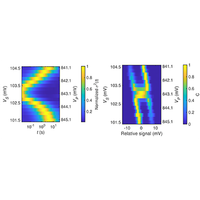
Quantum computers are susceptible to noise. In silicon quantum computers, random electrical fluctuations in the semiconductor can disturb qubits based on individual electrons. However, little is known about the causes of these electrical fluctuations. Here, the authors zoom in and study individual charge fluctuators in silicon quantum dots and observe a variety of new phenomena. The results promise to help understand and mitigate charge noise in silicon quantum computers.

Quantum geometry and nonlinear optical responses in rhombohedral trilayer graphene

Abigail Postlewaite, Arpit Raj, Swati Chaudhary, and Gregory A. Fiete

Phys. Rev. B 110, 245122 (2024) - Published 10 December, 2024

Multilayered graphene systems provide a highly tunable platform to study quantum geometric effects. Here, the authors show that the quantum geometry of electronic bands in rhombohedral trilayer graphene leads to a large shift-current response which can be tuned by applying a displacement field perpendicular to the layers. The authors compare the response with Bernal stacked bilayer graphene and find additional features arising due to the confluence of quantum geometry and the multiband nature of rhombohedral trilayer graphene.

Importance of electron-phonon coupling near the electron-liquid to Wigner-crystal transition in two-dimensional atomically thin materials

Tixuan Tan, Vladimir Calvera, and Steven A. Kivelson

Phys. Rev. B 110, L241104 (2024) - Published 10 December, 2024

Motivated by recent experiments on atomically thin transition metal dichalcogenides (TMDs), the authors explore here the role of electron-phonon coupling in the location of the fluid-to-liquid transition point of electrons. They highlight that phonons (illustrated as the blue background) can gain more energy when electrons form a Wigner crystal compared to when they are in a liquid state. Their findings demonstrate that this effect significantly affects TMDs and other atomically thin materials, while its impact remains negligible in quantum wells. This is consistent with previous experimental results.

Relevance of anisotropy in the Kondo effect: Lessons from the symplectic case

Matan Lotem, Sarath Sankar, Tianhao Ren, Moshe Goldstein, Elio. J. König, Andreas Weichselbaum, Eran Sela, and Alexei M. Tsvelik

Phys. Rev. B 110, 235122 (2024) - Published 9 December, 2024

The authors carry out here a “tour de force” analytical and numerical analysis of the stability of non-Fermi-liquid physics in Kondo models. Focusing on the Sp(2k) Kondo effect, they highlight a common misconception that coupling anisotropy is inherently irrelevant in single-channel Kondo models. They show that, when the group generators do not span the impurity space, relevant perturbations can emerge due to anisotropic coupling. This calls for a more detailed inspection of exotic Kondo effects such as the topological Kondo models.

Symmetry-broken metallic orders in spin-orbit-coupled Bernal bilayer graphene

Jin Ming Koh, Alex Thomson, Jason Alicea, and Étienne Lantagne-Hurtubise

Phys. Rev. B 110, 245118 (2024) - Published 9 December, 2024

Here, the authors investigate the phase diagram of Bernal bilayer graphene in the presence of long-range Coulomb interactions, short-range Hund’s coupling, and proximity-induced Ising spin-orbit coupling using self-consistent Hartree-Fock calculations. Their analysis reveals a rich landscape of symmetry-broken phases resulting from the interplay between these three ingredients, which is tunable via doping and applied displacement field. Particular focus is placed on spin-canted and intervalley coherent states that may hold the key to understanding spin-orbit-enabled superconductivity observed in this platform.

Nuclear spin-spin interactions in CdTe probed by zero- and ultralow-field optically detected NMR

V. M. Litvyak, P. S. Bazhin, R. André, M. Vladimirova, and K. V. Kavokin

Phys. Rev. B 110, 245303 (2024) - Published 9 December, 2024

Nuclear spins occupying adjacent lattice sites in crystalline solids are often coupled by indirect interactions mediated by valence electrons. If the abundance of magnetic isotopes in the crystal is low, these interactions bind nuclear spins into small clusters. Zero or ultralow magnetic field NMR spectra of CdTe, detected via warm-up of the optically cooled nuclear spin system by oscillating magnetic fields, reveal pseudodipole and scalar interactions within clusters composed of up to 4 spins of magnetic isotopes of Cd and Te.

Inverse magnetoconductance design by automatic differentiation

Yuta Hirasaki, Koji Inui, and Eiji Saitoh

Phys. Rev. B 110, 214201 (2024) - Published 6 December, 2024

Magnetoconductance in thin wires often displays complex patterns due to the quantum interference of conduction electrons, which reflects the microscopic structures of the wires. The authors propose here a method to automatically determine the microscopic structure of a thin wire that reproduces a desired magnetoconductance pattern, leveraging automatic differentiation. The authors identify multiple microscopic structures that accurately reproduce a given magnetoconductance pattern, and discuss techniques for selecting experimentally feasible microscopic structures.

Reversal behavior and stability of spin textures with different topologies in ultrathin films

Yao Zhang, Guy Dubuis, Edward Trewick, and Simon Granville

Phys. Rev. B 110, 224413 (2024) - Published 6 December, 2024

Topological spin textures exhibit an exceptional stability for practical devices. Here, the authors successfully generate spin textures with different topologies in an ultrathin films system. The reversal behavior and stability of these spin textures are characterized with magnetic domain imaging and magnetotransport measurements with/without a magnetic field. The authors demonstrate that a sufficiently strong anisotropy is required to stabilize the nontrivial ground states at zero field for practical spintronic applications, though the topological protection exists.

Quasinormal mode theory for multiresonant metasurfaces with superwavelength periodicity involving two-dimensional materials

Thomas Christopoulos, Georgios Nousios, Emmanouil E. Kriezis, and Odysseas Tsilipakos

Phys. Rev. B 110, 245407 (2024) - Published 6 December, 2024

Contemporary photonic resonant systems are non-Hermitian, exhibiting radiation leakage and loss. By specifying the quasinormal modes (QNMs) that they support, one can obtain physical insight into the light-matter interaction processes and construct modal analysis tools that allow for the efficient calculation of their spectral response. The authors develop here a QNM framework for non-Hermitian periodic resonant systems that involves bulk and two-dimensional materials. It is employed to study multiresonant metasurfaces with superwavelength periodicity and is proven highly efficient and accurate.

Effect of impurities and disorder on the braiding dynamics of Majorana zero modes

Cole Peeters, Themba Hodge, Eric Mascot, and Stephan Rachel

Phys. Rev. B 110, 214506 (2024) - Published 5 December, 2024

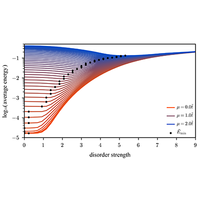
Majorana zero modes, the midgap states in topological superconductors, can be utilized as topological qubits in future quantum computers. By pairwise exchanging them (called braiding), quantum gates can be operated. Impurities and random disorder are usually foes of Majorana zero modes and braiding operations. The authors investigate here both the case of single impurities and random disorder on a T-junction geometry with four Majorana zero modes, and analyze the induced qubit errors. Surprisingly, there is a parameter regime in which disorder can even enhance the topological phase (black dots in the figure) and improve the braiding performance.

Pressure-induced quantum melting of chiral spin order and subsequent transition to a degenerate semiconductor state in FeGe

Y. Fujishiro, C. Terakura, A. Miyake, N. Kanazawa, K. Nakazawa, N. Ogawa, H. Kadobayashi, S. Kawaguchi, T. Kagayama, M. Tokunaga, Y. Kato, Y. Motome, K. Shimizu, and Y. Tokura

Phys. Rev. B 110, L220401 (2024) - Published 5 December, 2024

The authors reveal here anomalous charge transport upon melting of chiral spin orders, such as helical and skyrmion spin textures, in the itinerant chiral magnet FeGe. Under high pressure, significant modifications in the electronic structure induce a metal-to-semiconductor transition. Remarkably, a spontaneous anomalous Hall effect is observed in the short-range-ordered chiral spin ground state (P= 20–30 GPa) beyond the quantum phase transition. This macroscopic time-reversal symmetry breaking in the absence of long-range magnetic order represents a highly unconventional phenomenon.

Nonlinear finite-difference time-domain method for exciton-polaritons: Application to saltatory conduction in polariton neurons

K. Dini, H. Sigurðsson, N. W. E. Seet, P. M. Walker, and T. C. H. Liew

Phys. Rev. B 110, 214303 (2024) - Published 4 December, 2024

Polariton neurons allow exciton-polaritons to transport information using a successive local switching in analogy to action potentials in biological neurons. The authors show here an analogue of saltatory conduction for enhancing signal speeds: by connecting bistable nodes with waveguides, polariton signal speeds can be increased tenfold. The modeling of this system requires a new theoretical tool: nonlinear finite-difference time-domain simulation, which accounts for the propagation of light in the full three-dimensional nanostructure together with nonlinear exciton-exciton scattering using Maxwell-Bloch equations.

Complex orders and chirality in the classical Kitaev-Γ model

P. Peter Stavropoulos, Yang Yang, Ioannis Rousochatzakis, and Natalia B. Perkins

Phys. Rev. B 110, 214406 (2024) - Published 4 December, 2024

This study explores the complex interplay of interactions in the classical Kitaev-Γ model, revealing a rich phase diagram characterized by a diverse range of magnetic ground states. It uncovers incommensurate spiral orders and chiral phases arising from the competition between Kitaev and Γ interactions, emphasizing the significant role of magnetic anisotropy. These findings provide valuable insights into the formation of unconventional magnetic order in systems with bond-anisotropic interactions, contributing to the understanding of experimental findings in 4d and 5d transition metal compounds with strong spin-orbit coupling.

Competing magnetic states on the surface of multilayer ABC-stacked graphene

Lauro B. Braz, Tanay Nag, and Annica M. Black-Schaffer

Phys. Rev. B 110, L241401 (2024) - Published 3 December, 2024

The discovery of novel magnetic phases on the surface of rhombohedral graphene multilayers presents exciting potential for novel physics. Here, the authors demonstrate that the topological surface states of ABC-stacked graphite host competing magnetic states arising from intravalley and intervalley electron scattering. Electron-electron interactions generate incommensurate magnetic states with notably long spin-spin relaxation times at charge neutrality. These findings suggest that rhombohedral graphite likely hosts a plethora of different magnetic states.

Quantum tensor network algorithms for evaluation of spectral functions on quantum computers

Michael L. Wall, Aidan Reilly, John S. Van Dyke, Collin Broholm, and Paraj Titum

Phys. Rev. B 110, 214402 (2024) - Published 2 December, 2024

Quantum tensor networks enable efficient representation of low-energy quantum states on quantum computers by minimizing qubit resources through qubit reuse. Existing algorithms are limited to extracting simple, static properties like total magnetization. The authors present here two new efficient quantum algorithms for computing more complex dynamic correlation functions critical to modeling neutron scattering experiments and apply them to simulate properties of magnetic molecules.

Hubbard and Heisenberg models on hyperbolic lattices: Metal-insulator transitions, global antiferromagnetism, and enhanced boundary fluctuations

Anika Götz, Gabriel Rein, João Carvalho Inácio, and Fakher F. Assaad

Phys. Rev. B 110, 235105 (2024) - Published 2 December, 2024

This paper addresses the question of whether standard models of correlated electron systems, Hubbard and Heisenberg, show novel physics when defined on hyperbolic geometries with open boundaries. It turns out that the boundary, being extensive, plays a dominant role. At the boundary, spin fluctuations are enhanced. The metal-insulator transition observed on some geometries is a consequence of the boundary. The magnetically ordered phase at weak coupling shows macroscopic moments that cancel to form a spin-singlet ground state.

Going beyond Landauer scattering theory to describe spatially resolved nonlocal heating and cooling in quantum thermoelectrics

Nico G. Leumer, Denis M. Basko, Rodolfo A. Jalabert, Dietmar Weinmann, and Robert S. Whitney

Phys. Rev. B 110, 245402 (2024) - Published 2 December, 2024

Nanoscale thermometry is starting to reveal answers to the 40 year old question of where dissipation (Joule heating) occurs when an electric current flows through a nanostructure. Since the 1980s, Landauer scattering theory has only said that it happens “somewhere” in the leads connected to that nanostructure. This theoretical work goes beyond this by modeling spatially resolved Joule heating and thermoelectric cooling. It predicts an unexpected nonlocality in heat transfer between electrons and phonons, with heating and cooling spots at a finite distance from the voltage drop that causes them.

(H,Li)6Ru2O6: A possible zero-field Ru3+-based Kitaev quantum spin liquid

Sanjay Bachhar, M. Baenitz, Hubertus Luetkens, John Wilkinson, Sumiran Pujari, and A. V. Mahajan

Phys. Rev. B 110, L241102 (2024) - Published 2 December, 2024

This is a comprehensive study of the Ru3+-based Kitaev honeycomb compound (H,Li)6Ru2O6 (HLRO), combining magnetization (M), magnetic specific heat (Cm), and local probes (muon spin relaxation and magnetic resonance). There is clear evidence of a Kitaev quantum spin liquid (KQSL) state. M, Cm, and magnetic fluctuations (1/T1) exhibit scaling behavior. The Cm scaling is in good agreement with theory [PRX 11, 011034 (2021)]. A two-step entropy release is taken as a signature of Majorana fermions. HLRO is a realization of a KQSL without magnetic order in zero field, unlike 𝛼-RuCl3.

Field-angle evolution of the superconducting and magnetic phases of UTe2 around the b axis

Sylvia K. Lewin, Josephine J. Yu, Corey E. Frank, David Graf, Patrick Chen, Sheng Ran, Yun Suk Eo, Johnpierre Paglione, S. Raghu, and Nicholas P. Butch

Phys. Rev. B 110, 184520 (2024) - Published 27 November, 2024

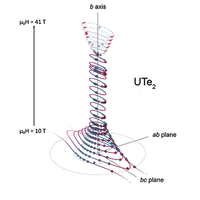
Uranium ditelluride (UTe2) is a prospective spin-triplet heavy fermion superconductor with intriguing behavior in high magnetic fields. Here, the authors measure the angular phase boundaries of two superconducting states in UTe2, one of which only exists for large fields along the b axis, by tilting magnetic fields away from the b axis with fields up to 41 T. Their findings indicate that both phases are spin-triplet and that the field-stabilized phase likely experiences paramagnetic limiting with fields away from b.

Terahertz-induced second harmonic generation dynamics in antiferromagnetic Cr2O3

Vladislav Bilyk, Elena Mishina, Theo Rasing, and Alexey Kimel

Phys. Rev. B 110, 174449 (2024) - Published 26 November, 2024

Developing efficient means to control and detect stable spin states in antiferromagnets, which often do not have any net magnetization, has been a challenge since the very discovery of antiferromagnetism. Here, the authors report on experimental study of ultrafast Second Harmonic Generation (SHG) from antiferromagnetic Cr2O3 excited by an intense nearly single cycle terahertz (THz) pulse. The authors show that although SHG is an efficient mean to detect stable spin states in this compound and THz pulse is an efficient mean to control them, THz-induced SHG transients appear to have no relation to spin dynamics and can be explained in terms of THz electric field induced SHG.

Sign In to Your Journals Account

Filter

Section

Filter

Article Lookup

Enter a citation