Highlights

Magnetic, thermodynamic, and dynamical properties of the three-dimensional fermionic Hubbard model: A comprehensive Monte Carlo study

Yu-Feng Song, Youjin Deng, and Yuan-Yao He

Phys. Rev. B 111, 035123 (2025) - Published 10 January, 2025

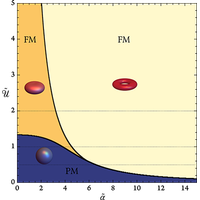
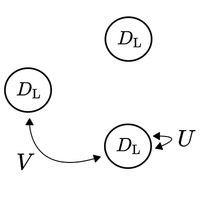
The authors present here a comprehensive and numerically unbiased study for finite-temperature properties of the 3D fermionic Hubbard model. At half-filling, a complete temperature-interaction strength phase diagram of the model is established, including the highly accurate results of the Néel transition temperature and a multimessenger characterization of the metal-insulator crossover in the paramagnetic phase. The temperature dependence of various thermodynamic quantities and their underlying physics are thoroughly explored. The persistence of Néel AFM ordered phase to finite doping is further revealed.

Topological triviality of flat Hamiltonians

Pratik Sathe and Rahul Roy

Phys. Rev. B 111, L041105 (2025) - Published 9 January, 2025

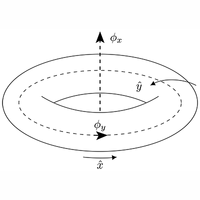
Landau levels have played a pivotal role in advancing our understanding of topological phases of matter. Motivated by Landau levels, which are flat and topological, the authors answer here the following question: can a tight-binding Hamiltonian that exclusively has flat bands be topologically nontrivial? The authors show that, under broad conditions, energy levels in such flat-band Hamiltonians have vanishing Chern numbers. They also identify the exotic condition that is necessary for topologically nontrivial flat-band Hamiltonians. Importantly, all the proofs extend even to Hamiltonians that lack translational invariance.

Measurement-induced transitions for interacting fermions

Igor Poboiko, Paul Pöpperl, Igor V. Gornyi, and Alexander D. Mirlin

Phys. Rev. B 111, 024204 (2025) - Published 8 January, 2025

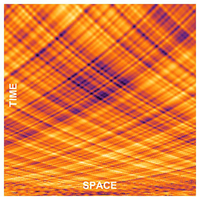
The authors develop here a unifying field-theoretical framework to study effects of quantum measurements on interacting fermionic systems. The interaction reduces the problem’s symmetry, dramatically affecting the phase diagram and scaling of observables. It leads to information-charge separation and stabilization of the volume-law phase for entanglement. In one-dimensional systems, it establishes measurement-induced transitions for entanglement and charge fluctuations. Analytical results are supported by numerical simulations utilizing matrix product states. This work paves the way to exploring measurement-induced phenomena in generic settings.

Edge-driven transition between extended quantum anomalous Hall crystal and fractional Chern insulator in rhombohedral graphene multilayers

Zezhu Wei, Ang-Kun Wu, Miguel Gonçalves, and Shi-Zeng Lin

Phys. Rev. B 111, 035116 (2025) - Published 8 January, 2025

Puzzling transitions between an extended quantum anomalous Hall (EQAH) crystal and fractional Chern insulators (FCI) were recently observed in pentalayer graphene. This work proposes a scenario to understand these transitions based on the topologically protected gapless edge modes that are present in both the FCI and EQAH phases. The edge velocity in FCI is smaller than that in EQAHE and can be reduced by current, both contributing to a higher entropy. Therefore, the edge entropy can drive the transition from EQAH to FCI either by temperature or current.

Dirac anyons in magnetophotoluminescence spectra of Wigner quantum dots: Molecular versus puddle states

A. M. Mintairov, V. Yu. Axenov, D. V. Lebedev, A. S. Vlasov, A. S. Frolov, E. V. Ponamarev, and V. S. Stolyarov

Phys. Rev. B 111, 045410 (2025) - Published 8 January, 2025

The existence of an elementary electric charge implies the existence of an elementary magnetic pole, as demonstrated by Dirac in 1931. The authors here identify such poles as magnetic flux quanta vortices spontaneously generated in the Wigner quantum dots using magnetophotoluminescence spectroscopy. The resulting quantum states are fractionally charged magnetoelectronic complexes – the Dirac anyons. The observation of Dirac anyons clarifies unresolved issues in the description of quantum Hall effect states, providing new perspectives in topological quantum computing.

Emergent cross-product-type spin-orbit coupling under ferroaxial ordering

Akane Inda and Satoru Hayami

Phys. Rev. B 111, L041104 (2025) - Published 7 January, 2025

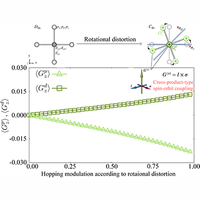
Ferroaxial ordering, which is characterized as a ferroic alignment of a time-reversal-even axial vector, is often caused by vertical mirror symmetry breaking according to a rotational distortion of the lattice structure. The authors theoretically clarify here the emergent cross-product-type spin-orbit coupling under ferroaxial ordering based on a d-p tetragonal cluster model. Such unconventional spin-orbit entanglement originates from the interplay between the atomic spin-orbit coupling and the d-p hybridization according to vertical mirror symmetry breaking.

Observation of non-Hermitian pseudo-mobility-edge in a coupled electric circuit ladder

Xuewei Zhang, Chaohua Wu, Mou Yan, and Gang Chen

Phys. Rev. B 111, 014304 (2025) - Published 6 January, 2025

The authors report here the experimental observation of the non-Hermitian pseudo-mobility-edge in a hybridized non-Hermitian circuit ladder. Through measuring the admittance spectrum and eigenstates, they show the transition from pseudo-mobility-edge phase to the skin-localized phase for open boundary condition and to the extended phase for mixed boundary condition. The results are in good agreement with theoretical predictions.

Electron-phonon coupling in the topological heavy fermion model of twisted bilayer graphene

Yi-Jie Wang, Geng-Dong Zhou, Biao Lian, and Zhi-Da Song

Phys. Rev. B 111, 035110 (2025) - Published 6 January, 2025

Plentiful strongly correlated electronic phases have been identified in magic-angle twisted bilayer graphene, yet the microscopic ingredients that stabilize them have remained elusive. This study demonstrates that the electron-phonon coupling (EPC), by introducing a significant multiplet splitting to the moiré-scale local orbitals, plays a vital role in determining these phases. The splitting not only selects the competing symmetry-breaking insulators, but also triggers the unconventional superconducting phase, and provides an alternative explanation to the semimetallic behavior at the charge neutrality point.

s±-wave superconductivity in the bilayer two-orbital Hubbard model

Yao-Yuan Zheng and Wéi Wú

Phys. Rev. B 111, 035108 (2025) - Published 3 January, 2025

This study explores superconductivity in a bilayer, two-orbital Hubbard model inspired by the nickelate superconductor La3Ni2O7. Using cluster dynamical mean-field theory, the authors examine how the s±-wave superconducting Tc depends on the hopping t⊥ between interlayer dz2 orbitals and the hybridization V between intralayer dz2 and dx2−y2 orbitals.The findings support a theory of “two-component” superconductivity, highlighting distinct roles played by the two eg orbitals in the pairing mechanism.

Altermagnetism from interaction-driven itinerant magnetism

Samuele Giuli, Carlos Mejuto-Zaera, and Massimo Capone

Phys. Rev. B 111, L020401 (2025) - Published 3 January, 2025

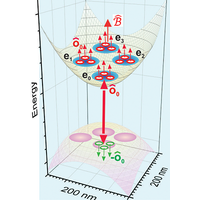
Altermagnetism is a new collinear magnetic phase with zero net magnetization and bands with nonrelativistic spin splitting. The search for intrinsic altermagnets has been focused so far on the role of anisotropy in the crystallographic symmetries. The authors present here a mechanism based on electronic correlations that leverages the itinerant magnetism driven by Hubbard repulsion and van Hove singularities, and orbital anisotropies. They discuss the fingerprints of correlations in spectral properties and transport, and demonstrate the tunability of spin currents via doping.

Electron interactions in Rashba materials

Yasha Gindikin and Alex Kamenev

Phys. Rev. B 111, 035104 (2025) - Published 2 January, 2025

Berry curvature in materials with a strong spin-orbit coupling results in spin- and momentum-dependent electron-electron interactions. Such interactions may lead to a host of novel collective phenomena. Examples are provided by p-wave superconducting states, mirroring superfluid phases of 3He in 3D, and by time-reversal-invariant topological superconductivity in 2D. They also drive ferromagnetism associated with the Lifshitz transition from spherical to toroidal Fermi surfaces. Such ferromagnetism may coexist with the p-wave superconductivity, opening new avenues for superconducting spintronics, unattainable with conventional superconductors.

Scaling of contraction costs for entanglement renormalization algorithms including tensor Trotterization and variational Monte Carlo

Thomas Barthel and Qiang Miao

Phys. Rev. B 111, 045104 (2025) - Published 2 January, 2025

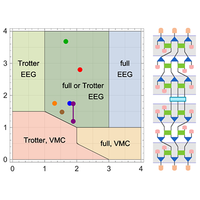
Strongly correlated quantum matter, such as the insufficiently understood high- temperature superconductors, are difficult to simulate numerically. The multiscale entanglement renormalization ansatz (MERA) is a hierarchical class of tensor networks that efficiently captures the typical ground-state entanglement structures. Motivated by recent advances to employ MERA in quantum-classical algorithms, the authors take a fresh look here, analyzing new variations of the approach including tensor Trotterization and importance sampling. Optimal contraction sequences and algorithmic phase diagrams show that these quantum-inspired methods can substantially reduce computational costs.

Light-controlled terahertz plasmonic time-varying media: Momentum gaps, entangled plasmon pairs, and pulse-induced time reversal

Egor I. Kiselev, Yiming Pan, and Netanel H. Lindner

Phys. Rev. B 110, L241411 (2024) - Published 30 December, 2024

The authors suggest here a new method to excite terahertz plasmons in two-dimensional Dirac materials with amplitude modulated high frequency light. This method does not make use of THz sources, but, in fact, could be used to generate THz radiation. Additionally, they show that their method can be used to create entangled plasmon pairs, to amplify plasmons, and to actively control them, e.g. to time-mirror plasmonic waves.

Nanoscale structural correlations in a model cuprate superconductor

Zachary W. Anderson, Marin Spaić, Nikolaos Biniskos, Liam Thompson, Biqiong Yu, Jack Zwettler, Yaohua Liu, Feng Ye, Garrett E. Granroth, Matthew Krogstad, Raymond Osborn, Damjan Pelc, and Martin Greven

Phys. Rev. B 110, 214519 (2024) - Published 27 December, 2024

Nanoscale structural and electronic inhomogeneity is known to be common in the cuprate superconductors, and there is reason to believe that it is fundamental to much of the rich electronic phenomenology of these complex oxides. The authors use here advanced neutron and x-ray diffuse scattering to measure local structural correlations in HgBa2CuO4+δ, a high-symmetry cuprate with exemplary electronic properties. Combined diffuse scattering, spectral analysis, and structural modeling reveal locally correlated atomic displacements perpendicular to the CuO2 planes.

Electrically defined quantum dots for bosonic excitons

Deepankur Thureja, F. Emre Yazıcı, Tomasz Smoleński, Martin Kroner, David J. Norris, and Atac İmamoǧlu

Phys. Rev. B 110, 245425 (2024) - Published 27 December, 2024

Solid-state single-photon sources based on quantum dots have found numerous applications in fields ranging from quantum information processing to commercial displays. A major current limitation is the large inhomogeneity in, and lack of tunability of, the photon energy. Here, the authors demonstrate electrically defined quantum dots for excitons in monolayer semiconductors, where the exciton, and consequently the photon emission, energy can be controlled using applied gate voltages. Resonance fluorescence measurements show strong spectral jumps and blinking of exciton emission, verifying their zero-dimensional nature.

Quantum noise in time-dependent media and cosmic expansion

Ziv Landau and Ulf Leonhardt

Phys. Rev. B 110, 224202 (2024) - Published 26 December, 2024

In astrophysics, cracks have appeared in the cosmological standard model. Now, this new paper in condensed matter physics suggests a surprisingly simple fix. The authors develop here a theory for calculating the energy of quantum fluctuations in spatially homogeneous but time-depending media. The expanding universe acts as such a medium. The authors show that in this “medium of space” each ingredient of the cosmic mix get a little lighter as if it were partially buoyant in the sea of the vacuum.

Identifying the topological order of quantized half-filled Landau levels through their daughter states

Evgenii Zheltonozhskii, Ady Stern, and Netanel H. Lindner

Phys. Rev. B 110, 245140 (2024) - Published 26 December, 2024

Identifying the topological order of potentially non-Abelian half-filled quantum Hall states is notoriously difficult. While “daughter states” have been proposed as a signature, existing calculations were incomplete. This work provides a comprehensive framework based on hierarchical construction and flux attachment, predicting daughter states for all candidate parent states. Observing daughter states on both sides of half-filling enables the identification of the parent’s topological order. Applied to experiments, this reveals a Pfaffian state in wide-well GaAs and a Pfaffian/anti-Pfaffian sequence in graphene, a contrast to PH-Pfaffian in narrow-well GaAs.

Continuous Wigner-Mott transitions at ν=1/5

Thomas G. Kiely and Debanjan Chowdhury

Phys. Rev. B 110, L241112 (2024) - Published 26 December, 2024

Interactions and fluctuations can drastically change the nature of phases and phase transitions in electronic materials. Here, the authors provide numerical evidence for a continuous quantum phase transition between a normal metal and a crystalline insulator, which challenges physicists’ standard theories for quantum phase transitions and demands novel explanations. Inspired by experiments in moiré quantum simulators and using sophisticated numerics, the authors study the transition from a crystal of spatially separated electron pairs to a metal as the interaction strength is reduced at a fixed low filling.

Superconductivity from repulsive interactions in Bernal-stacked bilayer graphene

Glenn Wagner, Yves H. Kwan, Nick Bultinck, Steven H. Simon, and S. A. Parameswaran

Phys. Rev. B 110, 214517 (2024) - Published 24 December, 2024

The authors propose here a simple three-pocket model for Kohn-Luttinger type interaction-driven superconductivity in untwisted “Bernal-stacked” bilayer graphene. The Cooper pairing results from overscreening of the purely repulsive Coulomb interaction, leading to p-wave superconductivity. The three-pocket model is substantiated by both random phase approximation and functional renormalization group calculations. These show that the proposed mechanism can account for the unusual behaviour seen in experiments, where superconductivity only emerges under application of an in-plane magnetic field or proximity-induced spin-orbit coupling.

Origin of metal-insulator transitions in the parent compounds of ruthenium-pnictide superconductors

Niraj Aryal, Corey Melnick, Emil S. Bozin, Robert M. Konik, and Weiguo Yin

Phys. Rev. B 110, 235153 (2024) - Published 24 December, 2024
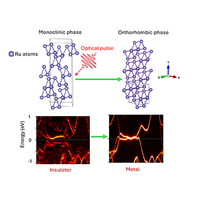
The authors explore here the origin of metal-to-insulator transition (MIT) in the parent compounds of recently discovered ruthenium pnictide superconductors. Using various first-principles calculations, such as density functional and dynamical mean-field theories, they rule out electronic correlation and Fermi surface nesting as the drivers for MIT. Instead, they suggest electron-phonon coupling as the most likely mechanism to induce the transition from an insulating monoclinic to a metallic orthorhombic phase. They propose ultrafast light-induced novel two-step MIT in these systems,which calls for further investigation.

Sign In to Your Journals Account

Filter

Section

Filter

Article Lookup

Enter a citation