Highlights

Coexistence of Kondo coherence and localized magnetic moments in the normal state of molten salt-flux grown UTe2

N. Azari, M. Yakovlev, S. R. Dunsiger, O. P. Uzoh, E. Mun, B. M. Huddart, S. J. Blundell, M. M. Bordelon, S. M. Thomas, J. D. Thompson, P. F. S. Rosa, and J. E. Sonier

Phys. Rev. B 111, 014513 (2025) - Published 17 January, 2025

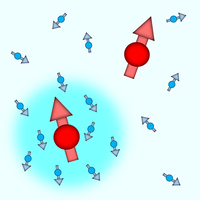
The normal state properties often provide vital insights into elucidating the pairing mechanism in a superconductor. Here, the authors report an experimental study of the normal state of the purported spin-triplet superconductor UTe2, in which the superconducting condensate develops from a heavy-electron fluid. The key finding is that localized magnetic moments condense out of a large fraction of the heavy-electron fluid prior to the onset of superconductivity. This suggests that Kondo hybridization of the conduction and localized electrons in UTe2 is probably orbital selective.

Unidirectional superconductivity and superconducting diode effect induced by dissipation

Akito Daido and Youichi Yanase

Phys. Rev. B 111, L020508 (2025) - Published 17 January, 2025

Electric current is generally prohibited in equilibrium. This prevents a zero-resistance state realized solely under a finite electric current, namely, unidirectional superconductivity. Here, the authors propose a setup to realize unidirectional superconductivity as a nonequilibrium steady state, focusing on the in-plane transport of thin-film superconductors which lack in-plane inversion symmetry. Introducing dissipation with the out-of-plane electric field and current, the system realizes unidirectional superconductivity as well as the superconducting diode effect, enabled by the effective time-reversal symmetry breaking by dissipation.

Interatomic spin-orbit coupling in atomic orbital based tight-binding models

Masaki Kato and Masao Ogata

Phys. Rev. B 111, 035137 (2025) - Published 16 January, 2025

Spin-dependent interatomic hopping gives rise to exotic phenomena such as topological insulators and cross-correlated effects. The authors systematically investigate interatomic spin-orbit coupling (SOC) and derive an explicit expression for the SOC hopping integrals. Using a multipole technique, they discuss how spin and orbital degrees of freedom couple in several specific tight-binding models on several distinct lattices. In particular, they reveal that the spin splitting, unique to chiral systems, is induced by the electric toroidal quadrupole.

Cloaking obstacles using synchronization

Tiemo Pedergnana, Julia Kölliker, Leonardo Perniola, and Nicolas Noiray

Phys. Rev. B 111, 035427 (2025) - Published 16 January, 2025

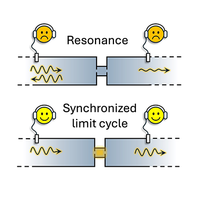
Physical objects create reflections and shadows under incident waves, making them detectable and motivating research on cloaking devices. Here, the authors use the synchronization of a self-oscillating cavity mode with the incident waves to cancel backscattering and compensate transmission losses from a cavity. This cloak of invisibility concept only requires the addition of a saturable gain to the resonant scatterer. An acoustic experiment demonstrates this quasipassive concept in a one-dimensional waveguide, cloaking an obstacle by simply tuning the saturable gain.

High-order van Hove singularities and nematic instability in the kagome superconductor CsTi3Bi5

Bikash Patra, Amrita Mukherjee, and Bahadur Singh

Phys. Rev. B 111, 045135 (2025) - Published 16 January, 2025

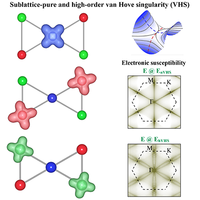
Kagome materials are well-known for supporting many-body instabilities, yet discerning their origins remains a challenge. In the superconducting kagome metal CsTi3Bi5, the presence of sublattice-pure high-order van Hove singularities, a multiorbital Fermi surface, and the absence of phonon-driven charge density wave instabilities suggest that the nematic order is primarily driven by electronic interactions, rather than by translation symmetry breaking.

Genesis and atomic structure of the charge density wave phase of 1T−VSe2

V. Petkov, A. Zafar, M. Jakhar, and AM Milinda Abeykoon

Phys. Rev. B 111, 014105 (2025) - Published 15 January, 2025

Charge density waves may be viewed as ordered quantum fluid of electrons that form a standing wave pattern, causing the electron charge density to become spatially modulated. Concurrently, the crystal lattice distorts, and the participating atoms arrange in a superstructure. Using variable-temperature total x-ray scattering, the authors determine here the unknown superstructure in the archetypal transition-metal dichalcogenides 1T-VSe2. Notably, V atoms are found to form an ordered pattern of triclusters that are uncommon to systems exhibiting charge density wave phenomena.

Element-selective observation of the orbital angular momentum of Fe and Co in the noncentrosymmetric magnets Fe1−xCoxSi (x=0.25 and 0.50)

M. Mito, M. Ohkuma, T. Tajiri, Y. Kousaka, J. Akimitsu, K. Inoue, and K. Amemiya

Phys. Rev. B 111, 024412 (2025) - Published 15 January, 2025

Here, the authors demonstrate by using soft x-ray magnetic circular dichroism spectroscopy that the Dzyaloshinskii-Moriya (DM) interaction in the noncentrosymmetric magnet Fe1−xCoxSi originates from the orbital angular momentum of Fe. The spectroscopy results for x = 0.25 and 0.50 indicate that the ratios of orbital and spin magnetic moments for Fe and Co are almost independent of x. The adjacent arrangement of Fe and Co stabilizes the ferromagnetic state, yet the DM interaction intrinsically originates from the spin-orbit coupling of Fe.

Quasiparticle interference in altermagnets

Hao-Ran Hu, Xiangang Wan, and Wei Chen

Phys. Rev. B 111, 035132 (2025) - Published 15 January, 2025

Here, the authors investigate quasiparticle interference (QPI) effects in metallic altermagnets, induced by both nonmagnetic and magnetic impurities and incorporating the influence of Zeeman splitting and spin-orbit coupling. It is shown that the QPI patterns for various spin polarizations of magnetic impurities and different spin-probe channels can faithfully reveal both the geometric and spin configurations of altermagnetic Fermi surfaces, which can be probed through spin-resolved scanning tunneling spectroscopy.

Effect of dynamical electron correlations on the tunnelling magnetoresistance of Fe/MgO/Fe(001) junctions

Declan Nell, Stefano Sanvito, Ivan Rungger, and Andrea Droghetti

Phys. Rev. B 111, 035133 (2025) - Published 15 January, 2025

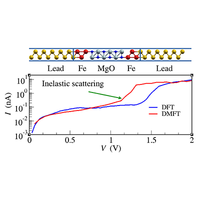
Understanding electron-correlation effects on the current-voltage characteristics of spintronic devices remains largely limited to simplified models. To advance beyond this, the authors present a computational framework combining density functional theory, nonequilibrium Green’s functions, and dynamical mean-field theory for quantum transport, introducing efficient approximations for finite-bias calculations. Applied to an Fe/MgO/Fe magnetic tunnel junction, the results reveal that bias-driven inelastic electron-electron scattering can sharply increase electrical current and impact tunnel magnetoresistance, providing guidance relevant for experiments.

Non-Hermitian skin effect along hyperbolic geodesics

Ruizhe Shen, Wei Jie Chan, and Ching Hua Lee

Phys. Rev. B 111, 045420 (2025) - Published 15 January, 2025

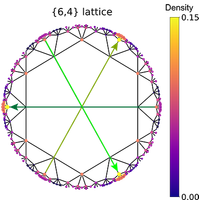
Understanding the localization of the non-Hermitian skin effect (NHSE) becomes particularly difficult when the underlying lattice deviates from the traditional translation and periodicity, found in Euclidean lattices. Here, the authors found a way to locally circumvent this by studying the NHSE along the geodesics in hyperbolic space instead. Specifically, they develop a framework based on geodesic-periodic boundary conditions, revealing the distinctive spectral sensitivity induced by hyperbolic curvature. Furthermore, the scaling properties of hyperbolic lattices give rise to intriguing phenomena like hybrid skin modes and intrinsic boundary modes. This study provides valuable insights into the riches of non-Hermitian physics in curved spaces.

Magnon spectrum of altermagnets beyond linear spin wave theory: Magnon-magnon interactions via time-dependent matrix product states versus atomistic spin dynamics

Federico Garcia-Gaitan, Ali Kefayati, John Q. Xiao, and Branislav K. Nikolić

Phys. Rev. B 111, L020407 (2025) - Published 15 January, 2025

Altermagnets, a newly classified type of collinear magnet, exhibit zero magnetization, akin to antiferromagnets, but have spin-split electronic bands, akin to ferromagnets. Their low-energy excitations are predicted to be magnons, but with linear energy-momentum dispersion, typical of antiferromagnets, and additional chiral splitting analogous to those of electronic bands. However, such predictions are made using linear spin wave theory, which considers infinitely long-lived noninteracting magnons. This study employs nonperturbative quantum many-body calculations, via tensor network algorithms, to find how a chiral magnon will acquire finite lifetime and how the bands will shift due to magnon-magnon interaction. Such corrections to noninteracting magnon bands could be detected by Raman scattering experiments, for which the recipe is provided. Although the same interaction effects are often described in magnetism by nonlinearity of the Landau-Lifshitz-Gilbert equation, direct comparison using altermagnetic magnons as the testbed, shows how such classical methods cannot fully reproduce the results of quantum many-body calculations.

Robustness of flat band superconductivity against disorder in a two-dimensional Lieb lattice model

G. Bouzerar and M. Thumin

Phys. Rev. B 111, L020506 (2025) - Published 15 January, 2025

The possibility of achieving high-temperature superconductivity in flat-band materials causes a great deal of excitement in the condensed matter community. As the synthesis of real materials inevitably leads to the presence of an unavoidable amount of defects, the authors explore the robustness of flat-band superconductivity in the face of disorder. They reveal in this letter that, unlike conventional intraband superconductivity for which disorder has a dramatic impact, flat-band superconductivity is surprisingly resilient to disorder-induced fluctuations and quasiparticle localization.

Atomic-scale Dzyaloshinskii-Moriya-modified Yoshimori spirals in an Fe double layer on Ir(110)

Timo Knispel, Vasily Tseplyaev, Gustav Bihlmayer, Stefan Blügel, Thomas Michely, and Jeison Fischer

Phys. Rev. B 111, L020405 (2025) - Published 14 January, 2025

Ultrathin magnetic films on heavy metal substrates with strong spin-orbit coupling enable exploration of novel spin textures and magnetic interactions. While isotropic Ir substrates have been extensively studied, anisotropic fcc(110) surfaces remain overlooked. The authors stabilize here a pseudomorphic Fe double layer on a metastable unreconstructed Ir(110)-(1×1) surface. Spin-polarized scanning tunneling microscopy reveals a magnetically robust right-handed Néel-type magnetic spiral, identified via density functional theory as Yoshimori-type, with the Dzyaloshinskii-Moriya interaction determining the handedness and type of the spiral.

Direct observation of the vanishing electron energy loss spectroscopy cross section in graphene

Alberto Guandalini, Ryosuke Senga, Yung-Chang Lin, Kazu Suenaga, Paolo Barone, Francesco Mauri, Thomas Pichler, and Christian Kramberger

Phys. Rev. B 111, L041401 (2025) - Published 14 January, 2025

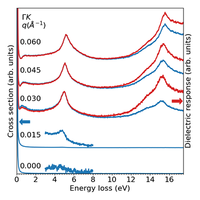
Here, the authors use graphene to confirm for the first time the vanishing of the electron energy-loss function in 2D materials upon approaching the optical limit, combining high energy and momentum resolution in a transmission electron microscope. Modeling kinematic effects is essential for retrieving the intrinsic uniform dielectric response of graphene, highlighting the need for ultrahigh momentum resolution to compare EELS with optics, as the measured loss function can approach but never reach the optical limit.

Current-induced circular dichroism on metallic surfaces: A first-principles study

Farzad Mahfouzi, Mark D. Stiles, and Paul M. Haney

Phys. Rev. B 111, 014415 (2025) - Published 13 January, 2025

Orbital angular momentum is a central quantity in the burgeoning field of orbitronics. Researchers have interpreted optical measurements of current-driven accumulation versus film thickness as determining the depth dependence of orbital angular momentum accumulation. The authors compute here both the current-induced orbital angular momentum spatial profile at the surface of a Pt thin film and the film-thickness dependence of the circular dichroism, and show that the latter is set by the mean free path while the former is considerably shorter.

Precisely tracking critical spin fluctuations using the ac magnetostriction coefficient: A case study on the Kitaev spin liquid candidate Na3Co2SbO6

Xinrun Mi, Xintong Li, Long Zhang, Yuchen Gu, Aifeng Wang, Yuan Li, Yisheng Chai, and Mingquan He

Phys. Rev. B 111, 014417 (2025) - Published 13 January, 2025

Quantum critical points (QCPs) are essential for understanding emergent quantum phases of matter. The authors introduce here a simple yet highly sensitive composite magnetoelectric method to detect critical spin fluctuations near QCPs by measuring the ac magnetostriction coefficient, which directly probes spin-spin correlations. Applied to the Kitaev spin liquid candidate Na3Co2SbO6, this method identifies two tricritical points, one of which is in close proximity to a QCP. This showcases the method’s broad applicability in probing QCPs in quantum magnets.

Quantum criticality and superconductivity in twisted transition metal dichalcogenides

A. V. Chubukov and C. M. Varma

Phys. Rev. B 111, 014507 (2025) - Published 13 January, 2025

The authors analyze here superconductivity in the twisted transition metal chalcogenide WSe2. In this material, spin-orbit scattering locks the z components of spins of low-energy fermions. The authors show that the nominally repulsive 4-fermion interaction gives rise to an attraction in a hexagonal lattice version of p-wave channel. The gap function is inversion-odd and a linear combination of spin singlet and spin triplet. At weak coupling, superconductivity emerges via the Kohn-Luttinger mechanism. At strong coupling, the pairing is mediated by XY magnetic fluctuations.

Influence of hydrogen on the electronic structure in the transition metallic glass V80Zr20

Johan Bylin, Rebecka Lindblad, Lennart Spode, Ralph H. Scheicher, and Gunnar K. Pálsson

Phys. Rev. B 111, 035128 (2025) - Published 13 January, 2025

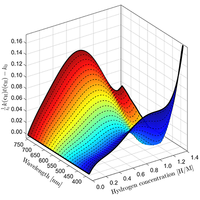
The theoretical framework describing the influence of hydrogen on the electronic structure is well established for crystalline materials. However, for disordered materials such a framework is lacking. The authors contribute to closing this gap in understanding by determining here the evolution of s-d hybridization in V80Zr20 with hydrogen uptake, using hard x-ray photoemission, ab initio calculations, and both optical and electrical measurements. The authors identify optical transmission changes as a tool in determining the thermodynamic properties of hydrogen in thin metallic glasses.

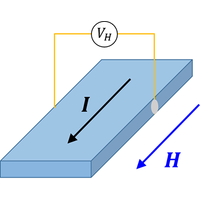
Parallel-field Hall effect in ZrTe5

Yongjian Wang, Thomas Bömerich, A. A. Taskin, Achim Rosch, and Yoichi Ando

Phys. Rev. B 111, L041201 (2025) - Published 13 January, 2025

Our common sense says that Hall voltage disappears when the magnetic field is parallel to the current. This is true for most materials, but when such a “parallel-field Hall effect” is observed, it gives unambiguous evidence for broken symmetry. A new study elucidates that this unusual phenomenon occurs in the topological semimetal ZrTe5, whose crystal symmetry has been controversial. This study demonstrates that the parallel-field Hall effect is a powerful tool to detect tiny symmetry breaking that is otherwise difficult to detect.

Topological chiral superconductivity beyond pairing in a Fermi liquid

Minho Kim, Abigail Timmel, Long Ju, and Xiao-Gang Wen

Phys. Rev. B 111, 014508 (2025) - Published 10 January, 2025

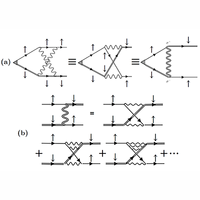
The BCS theory of superconductivity is based on determinant or Pfaffian wave functions, which also describe Fermi liquids. Here, the authors develop a new theory of superconductivity in two dimensions, based on product wave functions. The new superconductivity is shown to be induced by purely repulsive interactions for flat dispersion ε∼k4, and can potentially have high transition temperatures. The resulting chiral superconductors display topological order, fractional statistics, and chiral edge states.

Sign In to Your Journals Account

Filter

Section

Filter

Article Lookup

Enter a citation