Highlights

Role of nonmagnetic spacers in the magnetic interactions of antiferromagnetic topological insulators MnBi4Te7 and MnBi2Te4

Bing Li, D. M. Pajerowski, J.-Q. Yan, and R. J. McQueeney

Phys. Rev. B 111, 064418 (2025) - Published 14 February, 2025

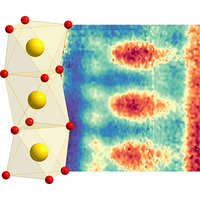
MnBi4Te7 belongs to a family of magnetic topological insulators formed from a natural heterostructure of magnetic and nonmagnetic blocks. In these materials, magnetism evolves systematically as nonmagnetic spacers are inserted between the magnetic blocks. The authors explore the magnetic interactions in two members of this family, MnBi2Te4 and MnBi4Te7, using inelastic neutron scattering. Comparison reveals that the interlayer magnetic coupling weakens as nonmagnetic blocks are introduced, but other key magnetic energy scales within the magnetic block stay the same.

Resilience of the quantum critical line in the Schmid transition

Nicolas Paris, Luca Giacomelli, Romain Daviet, Cristiano Ciuti, Nicolas Dupuis, and Christophe Mora

Phys. Rev. B 111, 064509 (2025) - Published 14 February, 2025

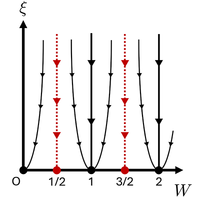
The phase diagram of a resistively shunted Josephson junction has been the subject of recent debate. Using a combination of analytical techniques (perturbative renormalization group and conformal field theory) and exact diagonalization, the authors confirm here the traditional phase diagram, where the transition between insulating and superconducting phases occurs when the shunt resistance R is equal to the resistance quantum RQ=e2/h, regardless of the ratio EJ/EC between Josephson energy and charge energy.

Interlayer hopping between a surface Mott insulator and a bulk band insulator in layered 1T−TaS2

Zijian Lin, Jie Li, Xiaodong Cao, Jingjing Gao, Xuan Luo, Yuping Sun, Yi Lu, Nanlin Wang, Jiandong Guo, and Xuetao Zhu

Phys. Rev. B 111, 075126 (2025) - Published 13 February, 2025

The authors reveal here how competing insulating phases—Mott and band insulators—coexist and interact in layered quantum materials. Combining surface-sensitive electron scattering technique and bulk-sensitive optical probe, they resolve distinct electronic excitations—Mott and band insulator gaps—and track their temperature evolution, uncovering a universal mechanism where interlayer coupling compete with local correlations near phase transitions.

Electrical transport in the Hatsugai-Kohmoto model

Daniele Guerci, Giorgio Sangiovanni, Andrew J. Millis, and Michele Fabrizio

Phys. Rev. B 111, 075124 (2025) - Published 12 February, 2025

The exactly solvable “H-K” family of interacting electron models introduced by Hatsugai and Kohmoto have played an important role in recent studies of the effect of wave function topology on the properties of correlation-driven (“Mott”) insulators. The authors show here that the very features that enable the exact solution lead to pathological transport properties including electrical conduction in the notionally insulating gapped Mott state and to divergent responses to applied magnetic fields. Caution is required in interpreting the results of the exact solutions.

Rabi and Ramsey oscillations of a Majorana qubit in a quantum dot-superconductor array

Haining Pan, Sankar Das Sarma, and Chun-Xiao Liu

Phys. Rev. B 111, 075416 (2025) - Published 12 February, 2025

The authors address here the latest experimental platform for the topological Majorana qubit – the artificial Kitaev chain – and propose a new experimental direction to establish the topological qubit by evaluating its realistic qubit performance in Rabi and Ramsey oscillation experiments, including dephasing time, quality factor, leakage, and other key metrics. This work demonstrates that the qubit performance in the current experimental platform exhibits significantly enhanced coherence compared to conventional semiconductor quantum dot based charge qubits without superconductors, marking a crucial step toward realizing the first topological Majorana qubit in a solid-state system.

Tunable exciton polaritons in biased bilayer graphene

V. G. M. Duarte, P. Ninhos, C. Tserkezis, N. Asger Mortensen, N. M. R. Peres, and A. J. Chaves

Phys. Rev. B 111, 075411 (2025) - Published 10 February, 2025

Exciton polaritons—hybrids of light and matter—unlock fascinating quantum effects, from sensing and efficient lasers to quantum memories. Here, the authors show how placing electrically biased bilayer graphene inside an optical cavity creates a highly tunable playground for strong light-matter interactions. The theoretical analysis highlights how exciton lifetimes and epsilon-near-zero materials play a key role in boosting exciton-photon coupling. This platform’s flexibility allows precise control over both the polariton energy landscape and the strength of light-matter mixing (Rabi splitting), pushing the system into the strong coupling regime.

Quasimolecular electronic structure of the trimer iridate Ba4NbIr3O12

M. Magnaterra, A. Sandberg, H. Schilling, P. Warzanowski, L. Pätzold, E. Bergamasco, Ch. J. Sahle, B. Detlefs, K. Ruotsalainen, M. Moretti Sala, G. Monaco, P. Becker, Q. Faure, G. S. Thakur, M. Songvilay, C. Felser, P. H. M. van Loosdrecht, J. van den Brink, M. Hermanns, and M. Grüninger

Phys. Rev. B 111, 085122 (2025) - Published 10 February, 2025

The trimer compound Ba4NbIr3O12 is found to be a spin-orbit-entangled cluster Mott insulator, with two holes per trimer occupying quasimolecular orbitals. The authors employ here resonant inelastic x-ray scattering (RIXS) and exact diagonalization. The quasimolecular nature yields a characteristic interference pattern in the RIXS intensity, reflecting the character of the wavefunction. Despite a large hopping, strong spin-orbit coupling is decisive for the electronic states. This promises nontrivial magnetic moments in trimers with an odd number of holes.

Field theory of non-Hermitian disordered systems

Ze Chen, Kohei Kawabata, Anish Kulkarni, and Shinsei Ryu

Phys. Rev. B 111, 054203 (2025) - Published 7 February, 2025

The interplay between non-Hermiticity and disorder gives rise to unique universality classes of phase transitions and critical phenomena. Here, the authors develop effective field theory of non-Hermitian disordered systems and classify the universality classes across all the symmetry classes of non-Hermitian systems. The authors demonstrate that the phase transition characteristic of nonreciprocal disordered systems originates from the competition between kinetic and topological terms from the field-theoretical perspective.

In-plane Hall effect in Co3Sn2S2

Lujunyu Wang, Guang Tian, Haiyun Chen, Jiaji Zhao, Hengjie Shi, Haoyu Wang, Zhilin Li, and Xiaosong Wu

Phys. Rev. B 111, 054412 (2025) - Published 7 February, 2025

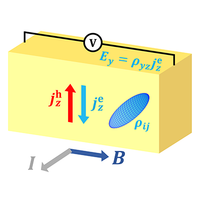
The Hall effect driven by in-plane magnetic field or magnetization has recently attracted widespread interest. Various mechanisms, most of which are related to the Berry curvature, have been proposed to explain this unusual phenomenon. Here, the authors report an in-plane Hall effect dominated by the Lorentz force in the magnetic Weyl semimetal Co3Sn2S2. The study provides insights into the conductivity anisotropy of individual Fermi pockets in multiband systems and broadens the exploration of the in-plane Hall effect to a wider range of materials.

Theory of terahertz-driven magnetic switching in rare-earth orthoferrites: The case of TmFeO3

N. R. Vovk, E. V. Ezerskaya, and R. V. Mikhaylovskiy

Phys. Rev. B 111, 064411 (2025) - Published 7 February, 2025

Antiferromagnetic iron oxides with rare-earth ions provide a promising platform for ultrafast spin switching by light. The magnetic properties in these materials are defined by anisotropic exchange coupling between the rare-earth orbitals and iron spins. Here, the authors present a comprehensive theory, describing the dynamical response of the magnetic rare-earth and iron systems to a strong ultrashort THz pulse. Working out the case of the archetypical orthoferrite TmFeO3, the authors identify different coherent spin switching scenarios in this compound.

Linear-in-temperature conductance in two-dimensional electron fluids

Serhii Kryhin, Qiantan Hong, and Leonid Levitov

Phys. Rev. B 111, L081403 (2025) - Published 7 February, 2025

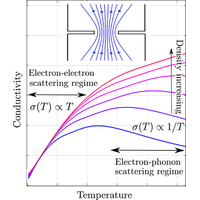
A hallmark of electron hydrodynamics—a transport regime dominated by electron collisions—is that collisions enhance conduction and reduce dissipation, causing resistance to drop and conductance to rise with temperature (T). Here, the authors present a microscopic study of two-dimensional electron fluids, predicting linear-in-T scaling of hydrodynamic conductance. This behavior, contrasting with the T2 scaling in three-dimensional Fermi liquids, arises from a cascade of multiple long-lived viscous modes unique to two-dimensional systems. The number of modes relevant for transport grows as T decreases, resulting in a non-Fermi-liquid linear-in-T behavior.

Hardening of Ni-O bond-stretching phonons in LaNiO2

Yilin Wang

Phys. Rev. B 111, 085117 (2025) - Published 6 February, 2025

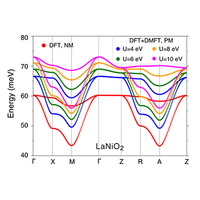
Using DFT+DMFT calculations, the authors demonstrate here that dynamical electron correlations and fluctuating local magnetic moments in the paramagnetic state induce significant hardening of the optical Ni-O bond-stretching phonons of the infinite-layer nickelate superconductor LaNiO2. The electron correlations are found to be sensitive to such phonons, indicating a strong electron coupling to the Ni-O bond-stretching phonons. It emphasizes that local spin fluctuations should be fully considered when describing the lattice dynamics of the infinite-layer nickelates without long-range magnetic order.

Material-oriented modeling of quantum many-body effects in a monolayer transition metal dichalcogenide nanolaser device

J. Buchgeister, A. Steinhoff, D. Erben, M. Lorke, and F. Jahnke

Phys. Rev. B 111, 085301 (2025) - Published 6 February, 2025

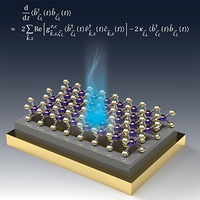
Monolayer transition metal dichalcogenides are a notable option as a gain material in future optoelectronic devices, in particular as source of stimulated emission. Here, the authors report a fully quantum mechanical theory to microscopically investigate the interplay of the efficient light-matter interaction and many-body effects in an MoS2 monolayer nanolaser operating at room temperature. The key finding is that such devices are capable of establishing stable gain phases for electron-hole-plasma-based lasing occurring at excited carrier densities above 5×1013cm−2.

Spin current generation due to differential rotation

Takumi Funato, Shunichiro Kinoshita, Norihiro Tanahashi, Shin Nakamura, and Mamoru Matsuo

Phys. Rev. B 111, L060403 (2025) - Published 6 February, 2025

The authors study here nonequilibrium spin dynamics in differentially rotating systems, deriving an effective Hamiltonian for conduction electrons in the comoving frame. In contrast to conventional spin current generation mechanisms that require vorticity, this theory describes spins and spin currents arising from differentially rotating systems regardless of vorticity. They demonstrate the generation of spin currents in differentially rotating systems, such as liquid metals with Taylor-Couette flow. This alternative mechanism will be important in the development of nanomechanical spin devices.

Transverse voltage in anisotropic hydrodynamic conductors

Kaize Wang, Chunyu Guo, Philip J. W. Moll, and Tobias Holder

Phys. Rev. B 111, L081402 (2025) - Published 6 February, 2025

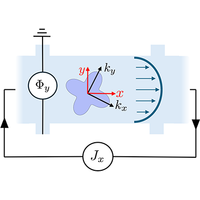
Here, the authors study correlated electron flow in a two-dimensional channel at highly anisotropic Fermi surfaces. If the principal crystal axes are misaligned with respect to the channel geometry, a transverse voltage develops whose sign is determined by the competition of viscous and dissipative forces. This effect presents a sensitive indicator for the onset of hydrodynamic electron transport, showcasing that real materials give rise to novel phenomena which are unattainable with purely isotropic Fermi surfaces.

Charge density waves and pinning by lattice anisotropy in 214 cuprates

Xiao Hu, P. M. Lozano, Feng Ye, Qiang Li, J. Sears, I. A. Zaliznyak, G. D. Gu, and J. M. Tranquada

Phys. Rev. B 111, 064504 (2025) - Published 5 February, 2025

Unlocking the secrets of high-temperature superconductivity, researchers have turned their attention to the La2−x(Ba,Sr)xCuO4 family, where subtle lattice distortions play a pivotal role. By employing neutron diffraction, the authors have successfully identified that the tilt pattern of the CuO6 octahedra, which breaks the fourfold Cu-O bond symmetry, is uniquely responsible for pinning the charge density wave order to the lattice.

Generalized framework for straintronics in two-dimensional quantum materials using group theory

Rami Zemouri, A. R. Champagne, and Saurabh Maiti

Phys. Rev. B 111, 085112 (2025) - Published 5 February, 2025

There is a growing need for strain modeling in the rapidly developing field of straintronics and two-dimensional materials. Here, by means of group theory the authors formulate a general microscopic theory of strain which considers the symmetry of the lattice and the bonds within the unit cell. They identify when and how many scalar and vector potentials can arise from strain in single and multilayer systems. Thus, for example, strained low-energy bilayer graphene is shown to have two vector potentials. This formulation allows for a greater range of materials to be studied in quantum transport experiments.

Full minimal coupling Maxwell-TDDFT: An ab initio framework for light-matter interaction beyond the dipole approximation

Franco P. Bonafé, Esra Ilke Albar, Sebastian T. Ohlmann, Valeriia P. Kosheleva, Carlos M. Bustamante, Francesco Troisi, Angel Rubio, and Heiko Appel

Phys. Rev. B 111, 085114 (2025) - Published 5 February, 2025

The authors present here the first ab initio nonrelativistic QED method that self-consistently couples light and matter beyond the electric dipole approximation, avoiding multipolar truncations. Implemented in the open-source code Octopus for massively parallel simulations, this framework unveils phenomena like renormalized Cherenkov radiation, magneto-optical effects in molecules, and frequency shifts in plasmonic modes. Crucially, it captures effects beyond the dipole approximation, missed by traditional approaches. Thus, the method opens new frontiers in the exploration of quantum matter driven by structured light, orbital angular momentum, and strong-field physics.

Graph-theoretical proof of nonintegrability in quantum many-body systems: Application to the PXP model

HaRu K. Park and SungBin Lee

Phys. Rev. B 111, L081101 (2025) - Published 4 February, 2025

The Yang-Baxter method is a powerful tool for studying integrable systems, but proving whether a system possesses local conserved quantities remains challenging. Shiraishi’s proof of the XYZ model’s nonintegrability with a magnetic field inspired the authors’ demonstration of the PXP model’s nonintegrability, previously only conjectured via level statistics. As the PXP model is a key example of quantum many-body scars exhibiting exotic long-time behavior, the present work highlights that such behavior is unrelated to local conserved quantities and introduces a graph-theoretical approach, suggesting universality in nonintegrability proofs.

Optical manifestations and bounds of topological Euler class

Wojciech J. Jankowski, Arthur S. Morris, Adrien Bouhon, F. Nur Ünal, and Robert-Jan Slager

Phys. Rev. B 111, L081103 (2025) - Published 4 February, 2025

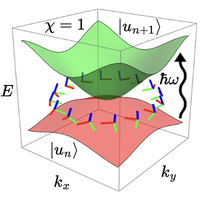
The authors demonstrate here that multigap topological phases hosting an Euler invariant relate to quantum-geometric bounds. These bounds constrain optical weights and sizes of adjacent gaps. The results are validated upon recasting them as optical absorption rates and open up a route to determine experimentally the topological Euler class through momentum- and frequency-resolved measurements. Moreover, it is shown that a singular quantum geometry of topological Euler band nodes induces observable features, such as quantized optical conductivities.

Sign In to Your Journals Account

Filter

Section

Filter

Article Lookup

Enter a citation