Highlights

Statistical analysis of spurious dot formation in silicon metal-oxide-semiconductor single electron transistors

Kuan-Chu Chen, Clement Godfrin, George Simion, Imri Fattal, Julien Jussot, Stefan Kubicek, Sofie Beyne, Bart Raes, Arne Loenders, Kuo-Hsing Kao, Danny Wan, and Kristiaan De Greve

Phys. Rev. B 111, 125301 (2025) - Published 5 March, 2025

The presence of spurious quantum dots in silicon-based spin qubit devices is a challenge for quantum system scalability. The authors use here electrostatic triangulation to statistically analyse their spatial distribution in silicon metal-oxide-semiconductor (SiMOS) single-electron transistors (SETs), fabricated on an industrial 300-mm process. By combining experimental mapping with simulations, they reveal that spurious dots primarily arise from strain and gate bias effects. This insight informs device design strategies to mitigate spurious dots while preserving tunability, advancing scalable silicon-based quantum technologies.

Layer Nernst and thermal Hall effects in two-dimensional antiferromagnets

Xiangju Wang, Ling Bai, Wanxiang Feng, and Yugui Yao

Phys. Rev. B 111, 104405 (2025) - Published 4 March, 2025

In two-dimensional layered antiferromagnets, an out-of-plane electric field (ℰ) breaks the band spin degeneracy, inducing opposite spin polarizations in different layers due to spin-layer coupling. When an in-plane longitudinal temperature gradient (∇T) is applied, charge and heat currents in the top (Jt and JtQ) and bottom (Jb and JbQ) layers flow transversely in opposite directions with different magnitudes. This gives rise to net transverse charge and heat currents, referred to as the layer Nernst and layer thermal Hall effects, respectively.

Stripe magnetic order in semimetallic triangular-lattice CeLi3Bi2

M. M. Bordelon, R. Yamamoto, M. O. Ajeesh, C. Girod, J. Wampler, P. Sherpa, A. P. Dioguardi, J. D. Thompson, S. Calder, V. Zapf, F. Ronning, S. M. Thomas, E. D. Bauer, M. Hirata, and P. F. S. Rosa

Phys. Rev. B 111, 094401 (2025) - Published 3 March, 2025

Insulating triangular lattice materials have attracted much attention due to their potential quantum spin liquid ground state. Though metallic counterparts are predicted to host a breadth of exotic quantum states, experimentally recognizing pristine platforms that could be chemically and electronically tuned to generate unconventional states remains an outstanding challenge. This work presents a comprehensive experimental and theoretical investigation of triangular lattice CeLi3Bi2. The finding of stripe antiferromagnetic order in a semimetal places this compound as a promising platform for tuning the interplay between short-range geometric frustration and long-range magnetic interactions.

Nonmonotonic temperature dependence of electron viscosity and crossover to high-temperature universal viscous fluid in monolayer and bilayer graphene

Indra Yudhistira, Ramal Afrose, and Shaffique Adam

Phys. Rev. B 111, 085433 (2025) - Published 28 February, 2025

This paper studies the temperature dependence of viscosity and entropy density in the strong interaction regime for the electron fluid in monolayer and bilayer graphene. It demonstrates the nontrivial temperature dependence of the viscosity in the hydrodynamic regime, and calculates, via a combination of microscopic calculation of electron lifetime and the macroscopic Navier-Stokes equation, a high-temperature limit for the viscosity and entropy density. It represents a significant advancement in our understanding of the hydrodynamic electronic transport in monolayer and bilayer graphene.

Field-orientation-dependent magnetic phases in GdRu2Si2 probed with muon-spin spectroscopy

B. M. Huddart, A. Hernández-Melián, G. D. A. Wood, D. A. Mayoh, M. Gomilšek, Z. Guguchia, C. Wang, T. J. Hicken, S. J. Blundell, G. Balakrishnan, and T. Lancaster

Phys. Rev. B 111, 054440 (2025) - Published 27 February, 2025

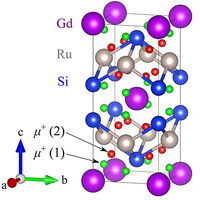
Centrosymmetric GdRu2Si2 exhibits a variety of multi-Q magnetic states as a function of temperature and applied magnetic field, including a square skyrmion lattice phase, with different phase diagrams resulting for fields applied parallel or perpendicular to the crystallographic c axis. These are revealed using muon spin relaxation (μ+SR) measurements on single crystals of this compound, aided by calculations of the dipolar field at the muon sites determined by density functional theory.

Harmonic Hall characterization of voltage-controlled magnetic anisotropy at ferromagnet/oxide interfaces

M. Fettizio and C. O. Avci

Phys. Rev. B 111, 054438 (2025) - Published 26 February, 2025

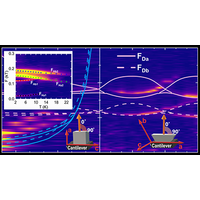
Voltage control of magnetic anisotropy (VCMA) has emerged as an effective solution to reduce power consumption in magnetic memories. This work presents an alternative method to detect and quantify VCMA at a ferromagnet/oxide interface using harmonic Hall voltage detection. An AC voltage is applied simultaneously across the Hall bar and oxide gate using the same source while measuring first and second harmonic Hall voltage responses. This approach also enables measurement of voltage-induced changes in anomalous Hall resistance, interpreted using a spin-dependent screening model.

Induced ferroelectricity and enhanced superconductivity through B-site doped SrTi1−xZrxO3

Stephen Zhang, Xianghan Xu, and R. J. Cava

Phys. Rev. B 111, 054522 (2025) - Published 26 February, 2025

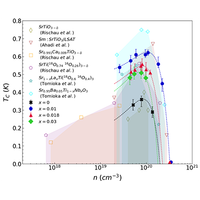
Quantum criticality has long been linked to enhanced superconductivity in SrTiO3, with fluctuations near a quantum phase transition potentially aiding Cooper pairing. In this study, the authors explore this connection by introducing ferroelectricity into SrTiO3 via slight Zr substitution. A small amount of Zr induces a ferroelectric transition, and electron doping reveals enhanced superconducting Tc. Interestingly, excessive ferroelectric substitution weakens pairing, forming a superconducting dome. These findings suggest a possible role of quantum fluctuations in superconductivity within quantum paraelectrics.

Surface states and the robustness of charge density wave order in LaTe2

Alex Louat, Cephise Cacho, and Matthew D. Watson

Phys. Rev. B 111, 075160 (2025) - Published 25 February, 2025

Many layered lanthanide telluride compounds, particularly those in the RTe3 and RTe2 families, exhibit charge density wave (CDW) order. This phenomenon is driven by their nearly square, quasi-two-dimensional tellurium nets, with the CDW commonly attributed to Fermi surface nesting. Here, the authors use micro-angle-resolved photoemission spectroscopy on polar surfaces of cleaved LaTe2 single crystals to investigate the Te square sheet under three different chemical potentials, focusing on the band-filling effect on CDW order.

Magneto-optical conductivity and circular dichroism in d-wave altermagnets

Wang Chen, Xiaoying Zhou, Wen-Kai Lou, and Kai Chang

Phys. Rev. B 111, 064428 (2025) - Published 24 February, 2025

Altermagnetism is a magnetic phase characterized by spin-split band structures without spin-orbit coupling (SOC) and rotation symmetry-compensated net magnetization. Here, the authors uncover the magneto-optical properties of a d-wave altermagnet. They demonstrate that the spin-polarized bands manifest in the anisotropic spin-resolved optical conductivity, enabling circular dichroism. In the absence (presence) of SOC, only intraband (both intraband and interband) transitions occur which satisfy the selection rule ∆n=±1 (∆n=±1,±3). This research provides valuable insights into the unique optical properties of altermagnetic materials.

Non-BCS behavior of the pairing susceptibility near the onset of superconductivity in a quantum-critical metal

Artem Abanov, Shang-Shun Zhang, and Andrey V. Chubukov

Phys. Rev. B 111, 075157 (2025) - Published 21 February, 2025

In a quantum critical metal, superconductivity out of non-Fermi liquid normal state develops only when the pairing interaction exceeds a certain threshold. The authors show here that the dynamic pairing susceptibility exhibits an unexpected behavior: it diverges at the onset of pairing only for a certain subclass of bare/test pairing amplitudes and remains nonsingular for other amplitudes, and below the instability becomes a nonunique function. The authors argue that this behavior reflects a highly non-BCS nature of the pairing at quantum criticality.

Landé g factors and spin dynamics of charge carriers in CuCl nanocrystals in a glass matrix

Dennis Kudlacik, Evgeny A. Zhukov, Dmitri R. Yakovlev, Gang Qiang, Marina A. Semina, Aleksandr A. Golovatenko, Anna V. Rodina, Alexander L. Efros, Alexey I. Ekimov, and Manfred Bayer

Phys. Rev. B 111, 085423 (2025) - Published 21 February, 2025

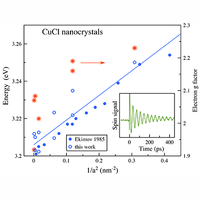
The size-dependent blue shift of exciton lines due to confinement in CuCl nanocrystals (NCs), observed by Ekimov and Onuschenko in 1981, was likely the first demonstration of the quantum confinement effect. Parabolic conduction and valence band edges in CuCl resemble those of a large class of perovskite semiconductors. Few magneto-optical studies, however, exist on CuCl NCs, unlike perovskite NCs. Here, the electron g-factor, measured using different methods, shows puzzlingly increases as CuCl NC sizes decrease, a phenomenon that is not described within existing theoretical models.

Solid-state platform for cooperative quantum dynamics driven by correlated emission

Xin Li, Jamir Marino, Darrick E. Chang, and Benedetta Flebus

Phys. Rev. B 111, 064424 (2025) - Published 20 February, 2025

The authors develop here a theoretical framework for the quantum many-body dynamics of a qubit array interacting via the electromagnetic noise of a shared solid-state bath. Applied to an NV-center ensemble coupled to a YIG film, this study demonstrates that robust many-body effects, such as superradiance and subradiance, are within experimental reach, opening new opportunities for engineering collective quantum phenomena in solid-state platforms and advancing multi-qubit quantum sensing approaches.

Electronic structure of the honeycomb iridate Cu2IrO3 at high pressure

G. Fabbris, E. H. T. Poldi, S. Sinha, J. Lim, T. Elmslie, J. H. Kim, A. Said, M. Upton, M. Abramchuk, F. Bahrami, C. Kenney-Benson, C. Park, G. Shen, Y. K. Vohra, R. J. Hemley, J. J. Hamlin, F. Tafti, and D. Haskel

Phys. Rev. B 111, 075153 (2025) - Published 20 February, 2025

This work investigates the high-pressure electronic phase diagram of honeycomb iridate Cu2IrO3, a candidate material to host the Kitaev quantum spin liquid state. The authors find a complex set of electronic phases, including an electron transfer from Cu to Ir that only occurs upon cold compression, highlighting the proximity between multiple electronic states. The results also underscore the importance of the thermodynamic pathway in accessing novel states in honeycomb iridates.

Intrinsic mixed-state topological order in a stabilizer system under stochastic decoherence: Strong-to-weak spontaneous symmetry breaking from a percolation point of view

Yoshihito Kuno, Takahiro Orito, and Ikuo Ichinose

Phys. Rev. B 111, 064111 (2025) - Published 19 February, 2025

Decoherence on quantum many-body systems induces nontrivial mixed states with specific properties that have no counterparts in pure states. The authors clarify here the emergence of “intrinsic mixed state topological order” in a toric code state under decoherence, which accompanies exotic anyon proliferation. Furthermore, the authors find that the decoherence-induced phase transition in the stabilizer formalism is described by a percolation picture in two dimensions. The viewpoint of one-form symmetry and its spontaneous symmetry breaking plays an important role in this study.

Mapping the three-dimensional fermiology of the triangular lattice magnet EuAg4Sb2

J. Green, Harry W. T. Morgan, Morgaine Mandigo-Stoba, William T. Laderer, Kuan-Yu Wey, Asari G. Prado, Chris Jozwiak, Aaron Bostwick, Eli Rotenberg, Christopher Gutiérrez, Anastassia N. Alexandrova, and Ni Ni

Phys. Rev. B 111, 085139 (2025) - Published 19 February, 2025

Magnetic materials that allow for the mapping of all Fermi surfaces to fully capture the interplay between magnetism and electronic structure are rare. The authors elucidate here the fermiology of antiferromagnetic EuAg4Sb2 through quantum oscillations, capturing full sets of spin-split Fermi pockets in the polarized ferromagnetic state. These results show good agreement with first-principles calculations and ARPES data. Temperature-dependent changes in the size and shape of the small hourglass pockets, but not the large ones, highlight that variations in exchange splitting, driven by changes in magnetic moment, primarily affect the small pockets without significantly altering the overall electronic structure in this compound.

Higher-rank spin liquids and spin nematics from competing orders in pyrochlore magnets

Niccolò Francini, Lukas Janssen, and Daniel Lozano-Gómez

Phys. Rev. B 111, 085140 (2025) - Published 19 February, 2025

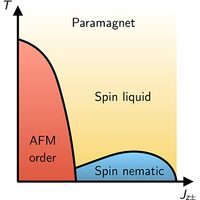
Magnetic insulators with a pyrochlore lattice structure serve as an ideal platform for investigating exotic phases of matter arising from frustration. Here, the authors reveal two previously unidentified phases in pyrochlore magnets: a higher-rank classical spin liquid and a spin-nematic phase stabilized by a thermal order-by-disorder mechanism. These discoveries shed new light on the interplay of competing magnetic orders and highlight the potential for realizing unconventional magnetic phases driven by this competition.

Formation of a high-density skyrmion crystal in the monolayer semiconductor LiCrTe2 with tunable bands

Mingliang Liu, Jia-Tao Sun, and Sheng Meng

Phys. Rev. B 111, 054423 (2025) - Published 18 February, 2025

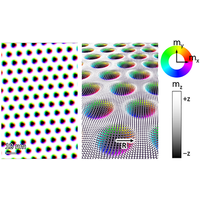
Magnetic skyrmions, as whirling topological spin textures, are promising for next-generation spintronic devices. Here, the authors theoretically study the formation of a skyrmion crystal in the monolayer semiconductor LiCrTe2, achieving a density of up to 0.018 skyrmions/nm2 with a diameter of 2.9 nm. The synergistic effects of temperature and magnetic field on the evolution of spin textures and their density are obtained. First-principles calculations reveal the electronic properties and the tunable interplay between real-space and reciprocal-space spin textures.

Large topological Hall effect induced by a field-driven metamagnetic transition in a centrosymmetric antiferromagnetic EuCuSb single crystal

Jing Wang, Yibo Wang, Xiaoyu Wang, Jianlei Shen, Enke Liu, and Xiaohong Xu

Phys. Rev. B 111, 054428 (2025) - Published 18 February, 2025

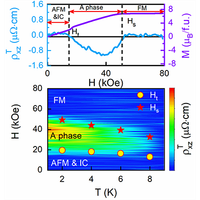
This study reports the observation of a significant topological Hall effect in centrosymmetric antiferromagnetic EuCuSb single crystals, revealing the potential formation of an unknown topological magnetic structure following a first-order-like metamagnetic transition. This discovery not only provides a new platform for investigating the formation mechanisms of topological magnetic structures in centrosymmetric antiferromagnetic systems, but also offers crucial insights into the intricate coupling between topological spin textures and conduction electrons, potentially advancing the field of topological spintronics.

Origin of the density wave instability in trilayer nickelate La4Ni3O10 revealed by optical and ultrafast spectroscopy

Shuxiang Xu, Cui-Qun Chen, Mengwu Huo, Deyuan Hu, Hao Wang, Qiong Wu, Rongsheng Li, Dong Wu, Meng Wang, Dao-Xin Yao, Tao Dong, and Nanlin Wang

Phys. Rev. B 111, 075140 (2025) - Published 18 February, 2025

The authors observe here a distinct formation of a density wave energy gap in La4Ni3O10 using optical conductivity and pump-probe measurements. By comparing the experimentally determined plasma frequency with first-principles calculations, La4Ni3O10 is classified as a moderately electron-correlated material, exhibiting weaker electronic correlation than the bilayer nickelate La3Ni2O7. The enhanced gap feature and weaker electronic correlation in La4Ni3O10 provide insight into its lower superconductivity transition temperature under high pressure.

Zeeman splitting and quantum-limit magnetoresistance anomaly in the topological insulator β-Ag2Se

Yue Zhao, Lei Shi, Kuan Li, Huakun Zuo, Gangjian Jin, Zhifeng Xue, Wei Zhou, Dingyong Zhong, Donghui Guo, Qizhong Zhu, Yunwei Zhang, Huixia Luo, and Huichao Wang

Phys. Rev. B 111, 085135 (2025) - Published 18 February, 2025

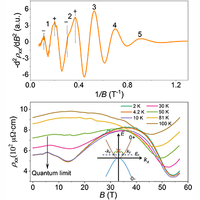
The nontrivial bulk states of topological insulators open avenues for comprehending and harnessing topological phases. Here, the authors demonstrate β-Ag2Se as a topological insulator by uncovering exceptional transport properties linked to the bulk states, supported by theoretical calculations. The observation of notable Shubnikov–de Haas oscillations and Zeeman splitting reveals a Landé g-factor of approximately 10. The longitudinal magnetoresistance exhibits two anomalous dips in the quantum limit, attributed to forbidden backscattering, providing further affirmation of the strong topological insulator characteristics in this compound.

Sign In to Your Journals Account

Filter

Section

Filter

Article Lookup

Enter a citation